childhood, Culture, Sports

For All The Marbles

There was a time when a young boy’s wealth was measured in marbles.   In my hometown, Delhi, Ontario, any 8- to 10-year-old was appointed rank according to how low his pants sagged after a lucky run at the alley pots in our school yard.

IMG_6985

Wealthy beginnings.

We called these beautiful pieces of glass “allies”, and we played on a hard-packed stretch of topsoil just east of the bike racks under a young oak tree.  Alley season started in late April, as soon as the ground dried up from winter, and lasted until school adjourned, end of June.

The alley “pots” peppered a 50-foot square of packed dirt, which looked like a miniature minefield pocked with tiny craters, and not one blade of grass in sight.   The dirt patch was as noisy and busy as any Vegas casino, with players hustling any comer when a pot freed up for a game.   Pint-sized spectators crowded the action like gamblers around a craps table.

The pot was a significant diversion from tradition.   Generally people describe “marbles” as a ring drawn in the dirt or pavement, and a bunch of marbles inside the ring.   Two players would flick marbles at the inner circle, claiming any they knocked out of the ring.  Like dodgeball.

Our game was a more like golf.   The pot was dug into the dirt.   Kids would rotate about ten times on their heel, and form a 4-inch- deep pot that measured about 6 inches across.     Do NOT try this at the golf course.   The pot was the target, and also held the stakes–a heap of 10, 20, 40, maybe a 100 marbles.   Each player would keep one marble out for play.    Stepping about ten feet back from the pot, they dropped their marble, and would alternately inch the marbles towards the pot, usually with their foot.

IMG_6973

Big stakes for the winner of the pot.

The moment of truth occurred when a player felt they could sink one of the marbles into the pot.   Crouching down on one knee, they pushed the marble with a curled forefinger.   Much like golf putting without the fancy shoes.  Or billiards, with no cue.  Or like curling, without the 40-pound rock.

That decisive shot may have been 5 feet away, or perhaps only 12 inches, depending upon the smoothness of the path, the break, and the depth, width and contents of the pot.  If the marble dropped, the player had another turn with the remaining marble.   He might inch that one along, or, take the long shot.   If it sank, he won the pot.   If he missed, then the next turn went back to the other player, who probably would sink it.

With that, fortunes were won and lost every minute with a chorus of cheers and groans around the alley pots.
IMG_7045

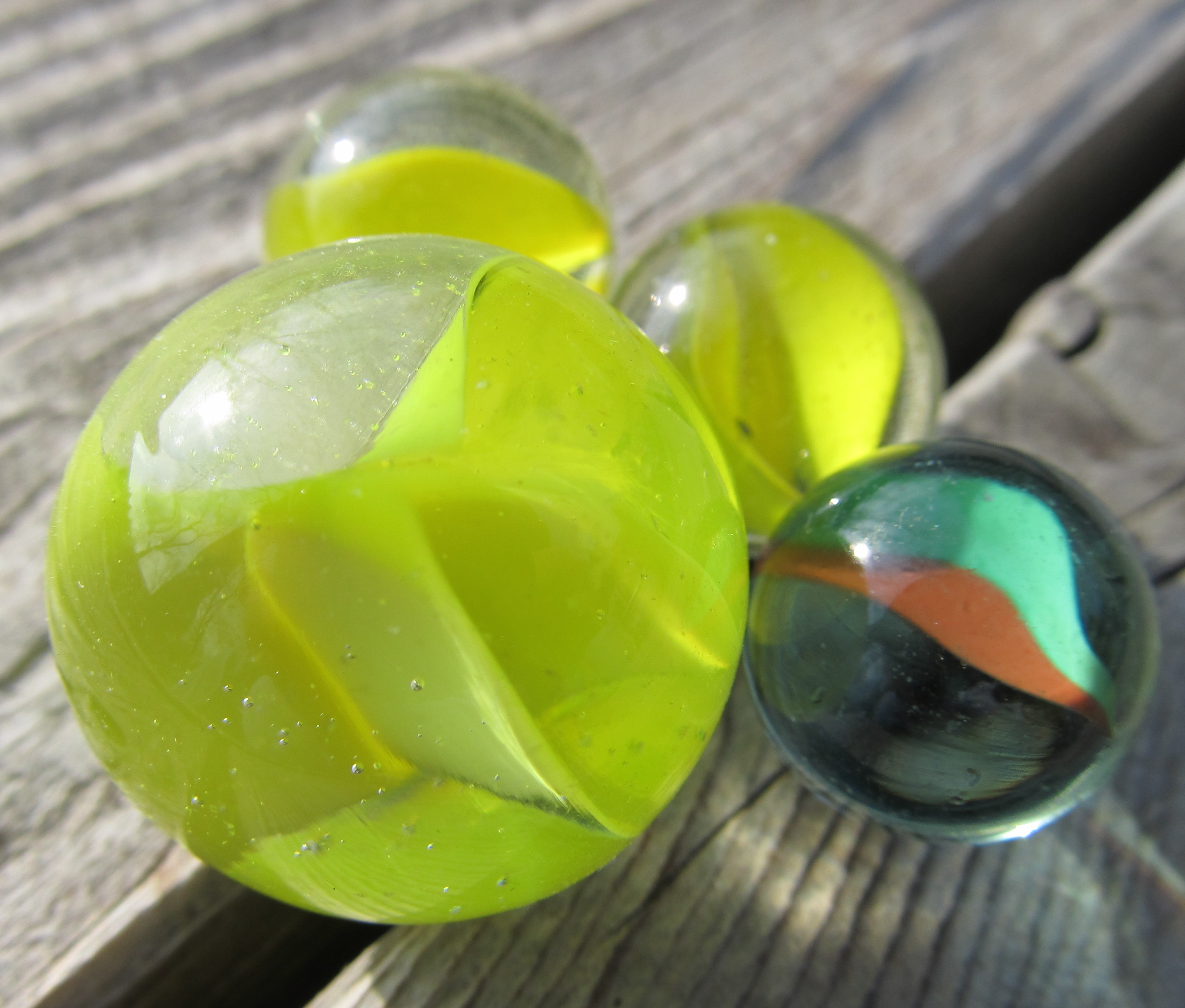
A “starry boulder” with three small friends.

And fortunes they were. The Chainway sold “starries”, 30 for a dime.   The starry was a half inch in diameter, and had a twirly colored pigment frozen into the center of the marble.   If you had the money, you might pick up a bag of starry “boulders”.   These were nearly an inch in diameter and went 6 for a quarter.  Pricey, but in the school yard, they traded around 10:1 against the smaller marble so there was room for arbitrage among the quicker thinking players in the yard.

Possessing a fortune in marbles was risky, too.

According to their job description, grade school teachers are hired to confiscate marbles.  In class, the sound of a vagrant marble clattering among the chair legs on a hardwood floor felt like money falling down a grate.

Aggies were the antiques of marbles.

“Aggies” were the antiques of marbles.

Logging the misdemeanor, the teacher would demand the marble be retrieved and placed in a mason jar on the corner of their desk.   You could buy them back, 3 for a penny, proceeds to the Red Cross.

This was a tension-filled time for big winners, whose loaded pockets would bulge like mumps.   Gingerly sitting down with the grace of a hemmorhoidal sufferer, the trick was to keep the pockets vertical to the fall line, and packed tight.

Kids with zippered cargo pants could plop, heavily laden, into their chair with impunity, but if they didn’t wear belts, they ran the risk of mooning the class which was a major felony.

A super boulder aggie, bigger than a quarter.

A super boulder aggie, bigger than a quarter.

Of all my childhood past times, allies made the deepest imprint.   In 5th and 6th grade, I played with stakes from one to twenty marbles, and had won pots as high as 400.

But I have lost 400 too, which twisted the sharp blade of experience, let me tell you.   So much so, that I cannot pass a marble display in a toy store today without picking up a bag or two.   Now, a marble costs about 10-cents each, a 3,000 % inflationary effect.

Do you know some popular brands of liquor use small marbles in the bottle neck to slow the flow?   I cut them out when the bottle’s empty.  So far, I am not buying liquor just to retrieve the marble.  My wife shakes her head, staring at me– a sorry junkie who can’t kick the habit.
IMG_7043

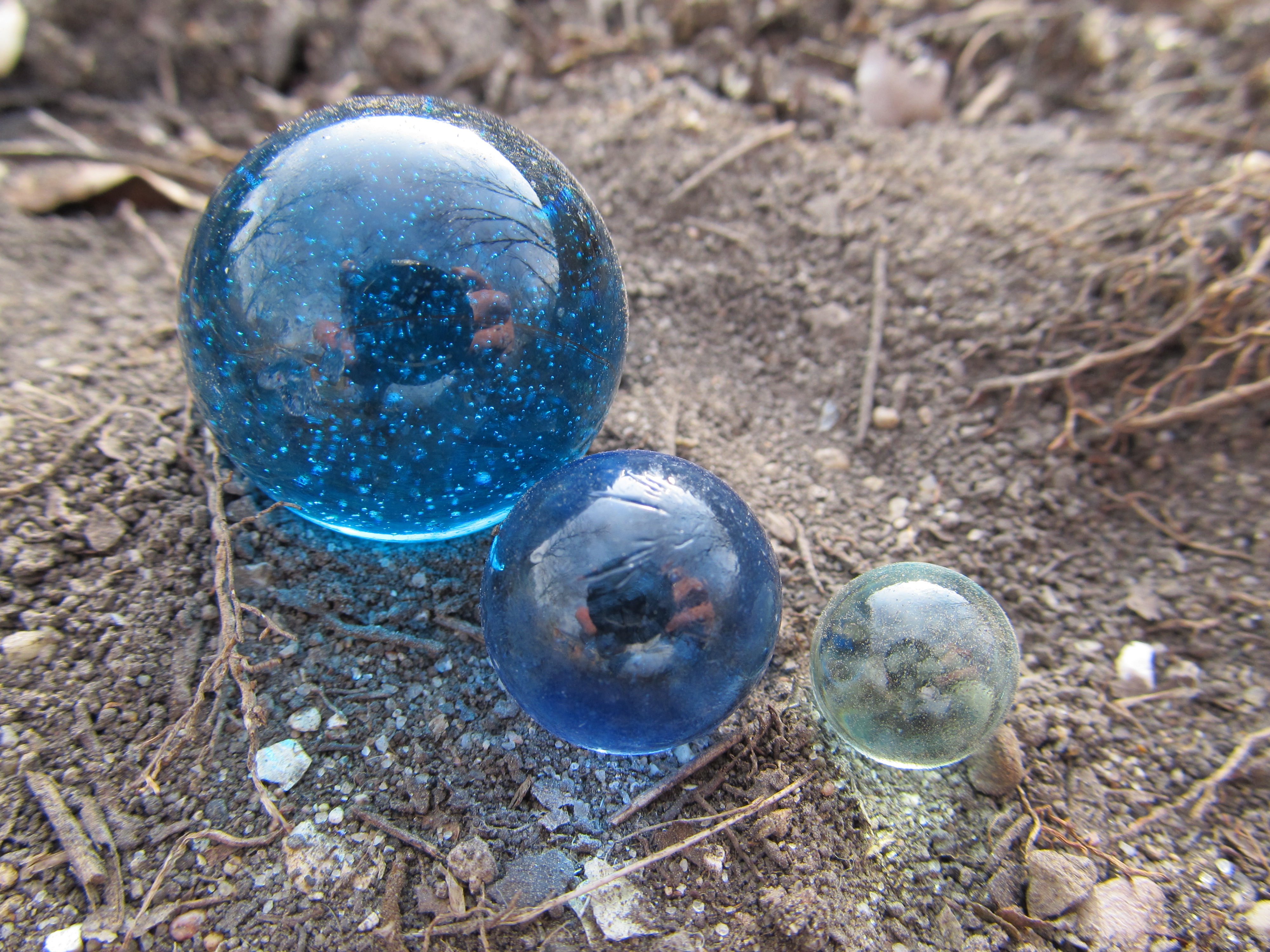
A “purie” boulder and marble. Johnny Walker Double Black provided the tiny one.

I am not sure what to do with my stash: two large Crown Royal bags.   While I want to give them to my grand kids, I have this shameful, miserly greed that won’t let them go.  Remember in “Ghost” when Whoopy Goldberg won’t let go of the $4,000,000 check?  It’s like that.    I am afraid they’ll end up at the bottom of a fish tank.   Or worse, inside a flower pot anchoring a bunch of tulips.  It would be okay if they were displayed in a glass table, maybe.

IMG_6987

The alley bag of choice.

But what I wouldn’t give to take the whole lot of them to a school yard next week and find a buzzing, hard-packed dirt casino, under the shade of an oak, churning with the yell of young risk takers, digging holes for a new game.


Thanks for sticking with me as I try to control this habit of mine.  I just can’t shake it.  If you “like”, say so, and please share or follow!

Marble Count 038

At the end of a long successful day.


Standard
direct mail, Marketing

Mayo Clinic: Right On The Money

Smart, effective direct mail design comes from experience, and some times a lot of guts.    The Mayo Clinic Health Letter subscription kit is a classic example.   This masterpiece came to my mail box last month, and while the design may shake you, the numbers will knock you out.   Here’s why:

A Whopping Big Envelope

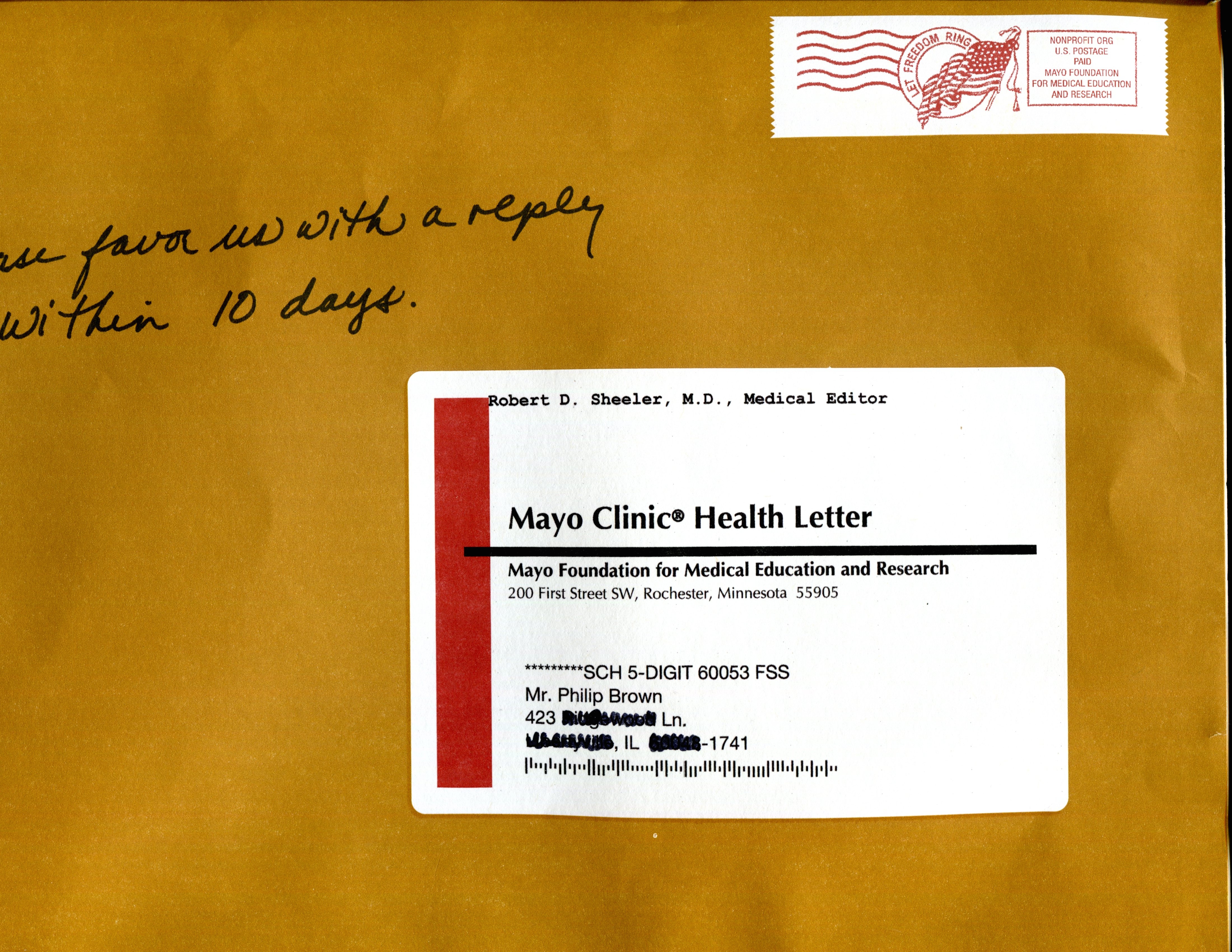
This one measures 10 x 14 inches.  Really??  Yes.   Why send a little #9 package when

Mayo OE

The envelope becomes the carrier for all the other letters delivered that day.

you can bury the mail carrier with a doormat?   To reinforce the mailing’s impact, the paper stock is nearly cardboard–you could chip a tooth on it–and it’s printed to look like kraft paper.

Creating the kraft look is just the beginning though. The address label is not real, but it is varnished to look like it, and as a special touch, this mass-produced kit has a postage meter label, except–that’s printed too.  The overall presentation says to the reader: “you need to open this now”.

My immediate reaction is:

1.   The Mayo accountants are taking blood pressure tests on both arms in the cafeteria, jabbing at their adding machines, looking for answers.

2.   USPS Postmaster Donahoe is toting up his winnings on this over-sized Flat mail piece.

Long On Words

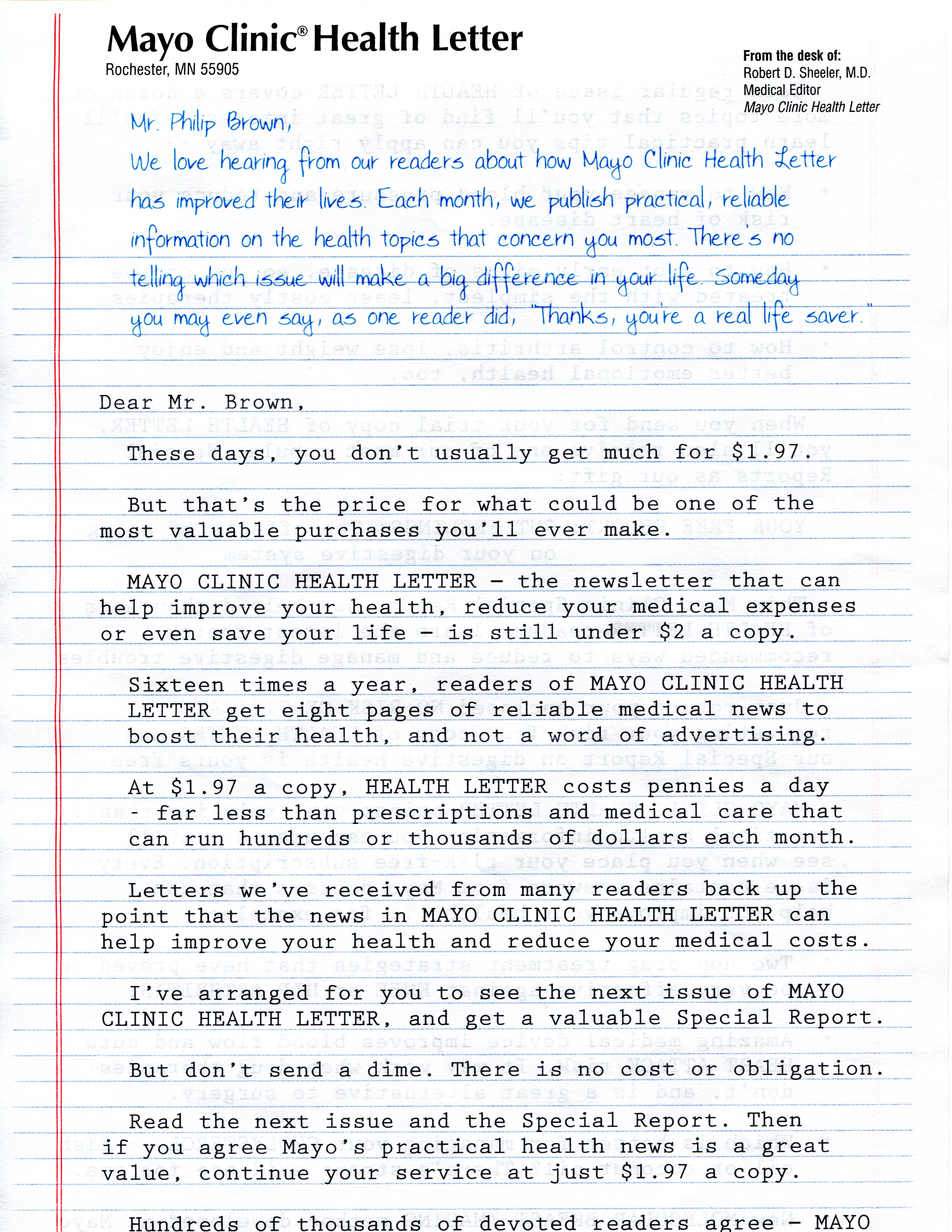
The extravagance continues inside.   I ripped open the zipper on the envelope to pull out the letter. 8 pages!   That’s four, 8-1/2 by 12-inch

The letter: a lifetime of Tweets.

The letter: a lifetime of Tweets.

sheets, printed front and back.  For you attention-deficient followers, that’s about 198 Tweets.   The CFO is banging out numbers to see how much waste was incurred by using 16-point type instead of 10-point.    Not to mention typing the letter on lined pages!

Nobody reads letters.  Well just about nobody.  Right?

Canary Yellow Reply Envelope

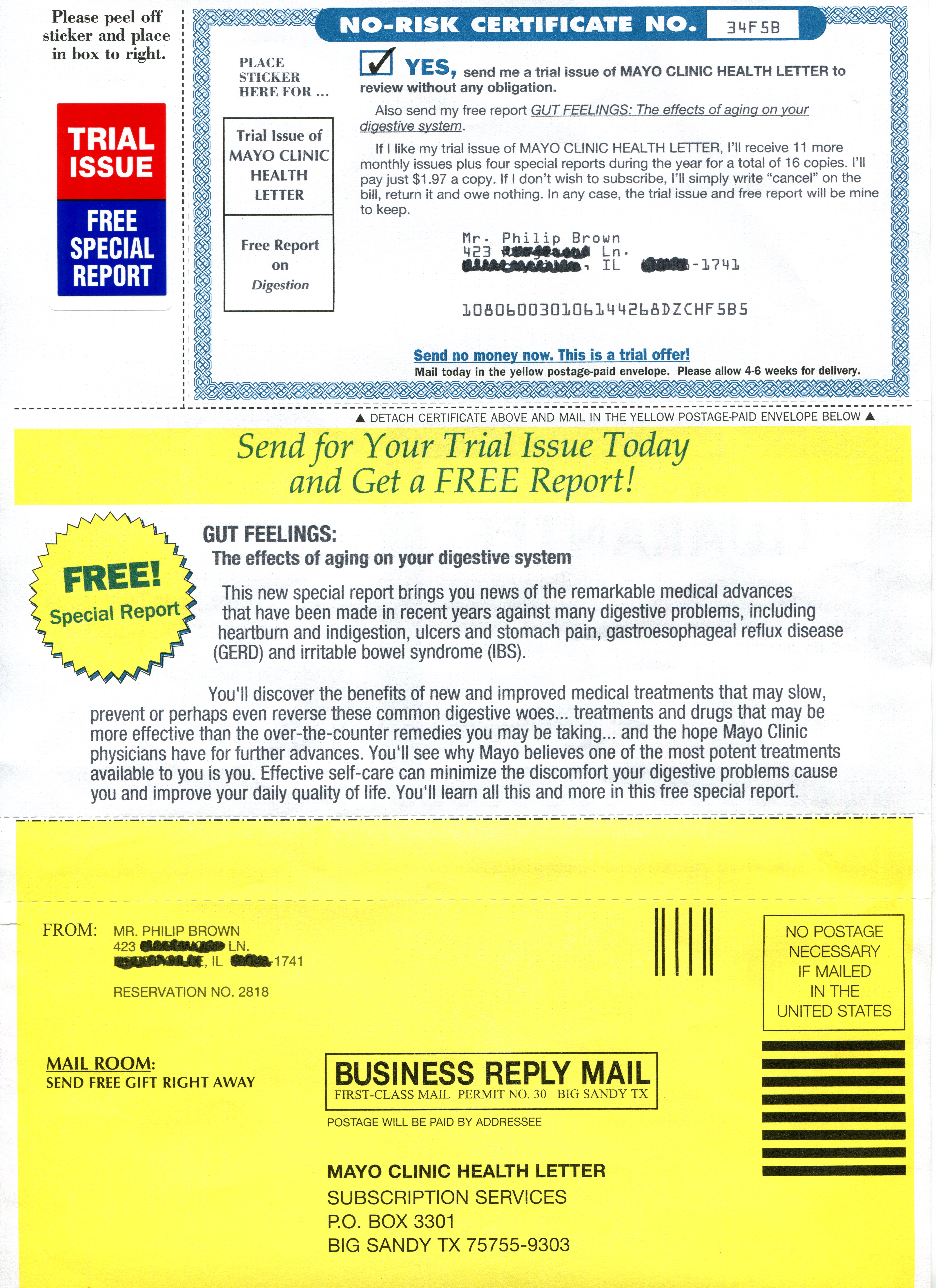
Subtlety doesn’t work in direct mail, even for Mayo.   We can’t just hide stuff in white reply envelopes when we can tell the world we probably have an urgent itch in a better-left-unmentionable place.   So there it is– a large bangtail order form I send back in this shout-it-out yellow BRE.

Yellow BREs never get mislaid.

Yellow BREs never get mislaid. And they get action, too.


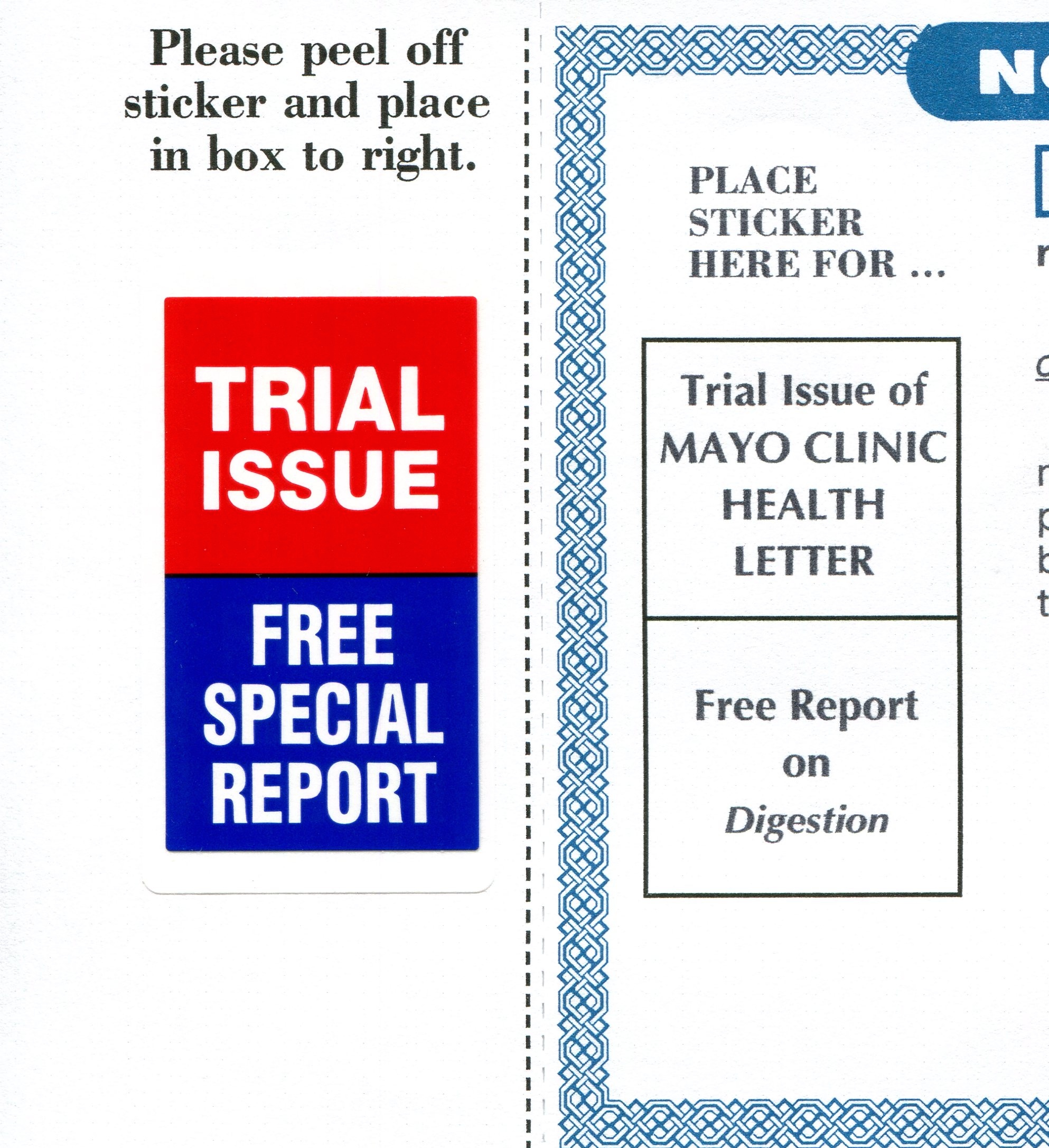
Stickers-just to keep it tactile.

Stickers-just to keep it tactile.

Stickers!

The ad agency downtown would never place a sticky label in a mail piece.   How corny.   Yet Mayo does this prominently and proudly, knowing that we can’t resist the temptation.  Does anyone really need to peel a “trial issue” label and stick it on the order form?   Of course we do.  There’s a sense of decisiveness and approval connected to the action, just like updating your car plate ever year.

It’s All About Me

What is irritatingly attractive is Mayo’s continual pandering to my ego.   They have hijacked my name.  Of course, they have it on the envelope, but it’s also on the letter.   And at the top of the letter is a handwritten note addressed to me.   Wow!

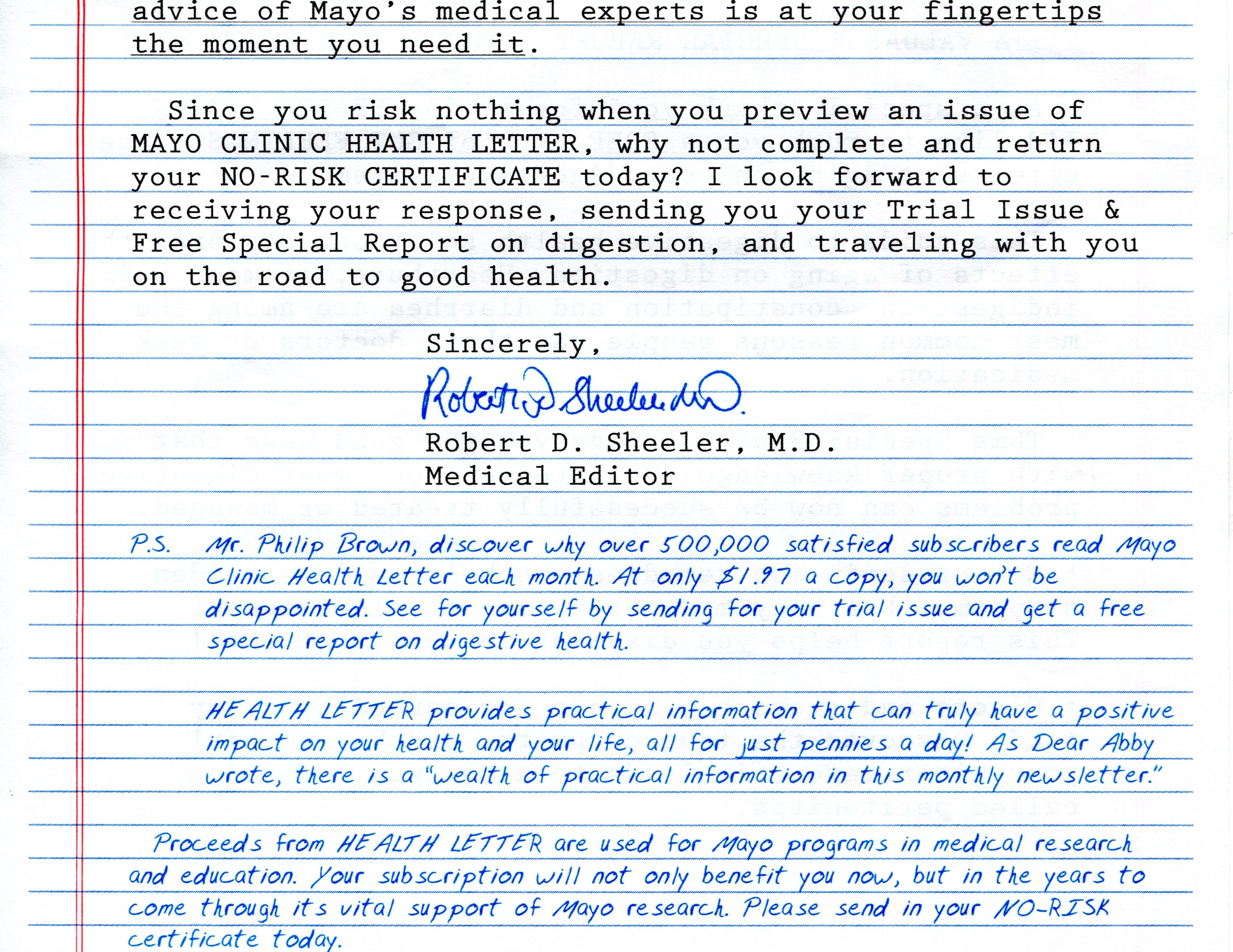
The P.S.--after 8 pages, there's still more to say!

The P.S.–even after 8 pages, there’s still more to say!

Again on page 8, up to which, yes, I read, there’s a P.S.  Also written to me.

As expected, the order form has my name, but they slapped it on the flaming yellow BRE just for good measure.

The Story Continues

To dispel any last doubts about the Mayo brothers, they have also included a brochure on the Mayo Clinic just in case I had been hiding in a duck blind too long.   Plus a Post-It note stuck onto the letter quoting readers who bragged about how the newsletter fixed their swollen joints, their riled digestion and unbending digits.

The family story fills in the cracks.

The family story fills in the cracks.

It’s About Making The Numbers

Any cognoscente in the advertising world would roll their eyes at this piece and grab another canapé off the awards dinner banquet table.   Mayo is not going to win a trophy any time soon.

That is because they are too busy depositing checks at the bank.    This package works because it takes enormous advantage of our curiosity.   If you are in the right demographic, you can’t ignore it.

Here are the numbers as I see them.  I have not confirmed with Mayo, but then again, they didn’t ask me either.

It's going to run into money!

It’s going to run into money!

List and production costs have to be at least $350/m. Postage for this Flat, $200/m.   This could be a 55-cent package, all-in.   By the way, while you thought the accountants might have been turning into jelly at that number, it is more likely they are quietly smiling while they top up the USPS Caps account.

Now, response rates.   1% is pretty much the norm, but this gargantuan kit, which includes a gift, could pull a 2% response, which again, I have not confirmed with Mayo.   At 2%, a 55-cent kit delivers a $27.50 acquisition cost. ($0.55/2% = $27.50).  Large, but actually about half of what any credit card sub would cost.   In any event, they wouldn’t do it if it didn’t work.

The Final Number

Medicine aside, Mayo still needs to return a positive cash flow, a.k.a. profit.   An annual subscription to this newsletter is basically $32.00.  Assuming a contribution of $8.00 per sub, Mayo needs to keep the average reader for 3-1/2 years to pay back the $27.50 acquisition cost.

But maybe not.  Because while these 50-year to 80-year-olds, approximately 500,000 of them, are perusing their newsletter, they are also biting on additional offers for Mayo’s entire library of publications. Enough to fill all the waiting rooms in Fort Myers, Miami and Scottsdale for years.

Even if the Mayo Clinic Health Letter program only breaks even, it is the gateway to a flood of peripheral revenues.

Mastering a standout program like the Mayo Clinic Health Letter didn’t happen over night.   These savvy marketers have tested into the present format.   In fact, it could be a test too.

But the numbers are still rewarding, if formidable.  And that’s where the guts come in.


Thanks for reading along on this.  Please let me know you liked it.  And share, too!


Standard