One of my most fascinating discoveries in researching the Prohibition days of Norfolk County was the building of the ‘Grey Ghost’.
It was literally 100 years ago that small lakeport communities along Lake Erie’s Ontario shore were forced to transition from commercial fishing to other sources of income.
Turtleback Racey, courtesy of the Port Dover Harbour Museum
Not all fishermen, but many, resorted to delivering shipments of whiskey and beer. The primary vessel was their main asset, the Turtleback fishing tug. That is, until the Grey Ghost appeared.
Turtlebacks are gill-netting fish tugs. They got their name for the box-like construction that covered the hull of the boat. The canopy shielded the crews and their fish from the punishing effects of sun, wind and cold. The tugs themselves weighed anywhere from fifteen to thirty tons, stretched thirty to fifty-plus feet, and their cruising speeds, around eight to fifteen knots.
HMCS Vigilant patrolled Lake Erie
These vital statistics put the tug, and its crew, in fairly even competition with the US Coast Guard, and Canada’s own revenue cutters. Those large navy boats were armed and armoured, and could cruise between 10-15 knots.
Rum-running was a risky, but respected sideline opportunity for some fishermen. When not being pursued by the law, both in Canadian and US waters, the midnight mariners also had to beware of hijackers. Those gangs were the nautical arms of organized crime. Not surprisingly, they had contacts in Detroit, Chicago, Hamilton, Montreal and New York. What bubbled up from these associations was a radical concept: the speedboat.
‘Patricia’ built by Gambles Shipyard, Port Dover, Ontario. ~Courtesy Port Dover Harbour Museum
The Grey Ghost was a steel-hulled, low profile, armoured delivery boat powered by one, or two aircraft engines. It was sinister in appearance, and undeniably designed to race across the lake waters undetected. Its Liberty-12 engines were army surplus. Ordered up during World War 1, the engines were originally intended to be installed in army planes that flew over Europe.
The Liberty-12 changed the rum-running business.
The Liberty-12 was a V-twelve-cylinder engine with an aluminum block. It had enormous power for lifting a biplane into the air. Who guessed it should power watercraft as well? While some tugs were still coal-fired steamers, the majority had moved to diesel. Gasoline was powerful, but dangerously flammable.
Along the Atlantic seaboard rum-runners had experimented with installing these engines in the steel speedboats. A fully-laden Grey Ghost could carry as many as fifty cases of liquor. When loaded, it could streak across the waters at speeds approaching fifty knots, over 90 kph. Today’s replica would be the monstrous, multi-coloured cigarette boats that roar along the urban shorelines of the Great Lakes.
Suffolk County Historical Society, Riverhead, NY
The Grey Ghost’s advantage was timeliness and escape. No one saw it coming, and no one could catch it. This enabled smugglers to elude the clutches of the US Coast Guard and Canada’s revenue cutters, and to do it in broad daylight. Multiple deliveries in a day. It ruled the waves until the coast guard itself launched its own speed boats, well into the waning days of Prohibition.
The USCG fleet, including speedboat lower left.
The Grey Ghost was a winning solution for rum-runners, but understandably, it had some drawbacks. First, it traveled over the water, not through it, and if the seas were not calm, it was a bone-jarring ride. Second, it was noisy. Even with submarine mufflers engaged, the ride was so noisy that by the time it arrived, everyone was alerted. Third, and not to be ignored, it was so noisy it could scramble the brains of its drivers.
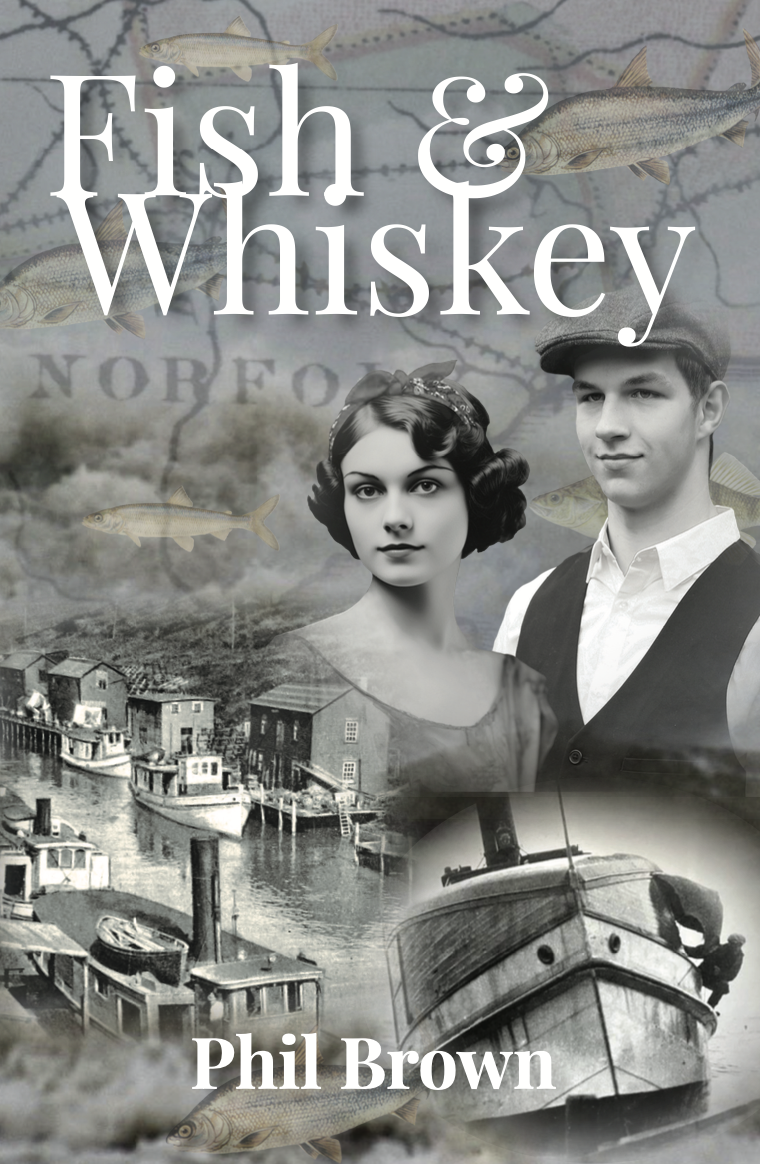
But that was the risk of rum-running. For all the excitement and story, get a copy of Fish & Whiskey, and see how two young lovers, Joey and Belle, survive the time. I include an American and Canadian Amazon link for you!
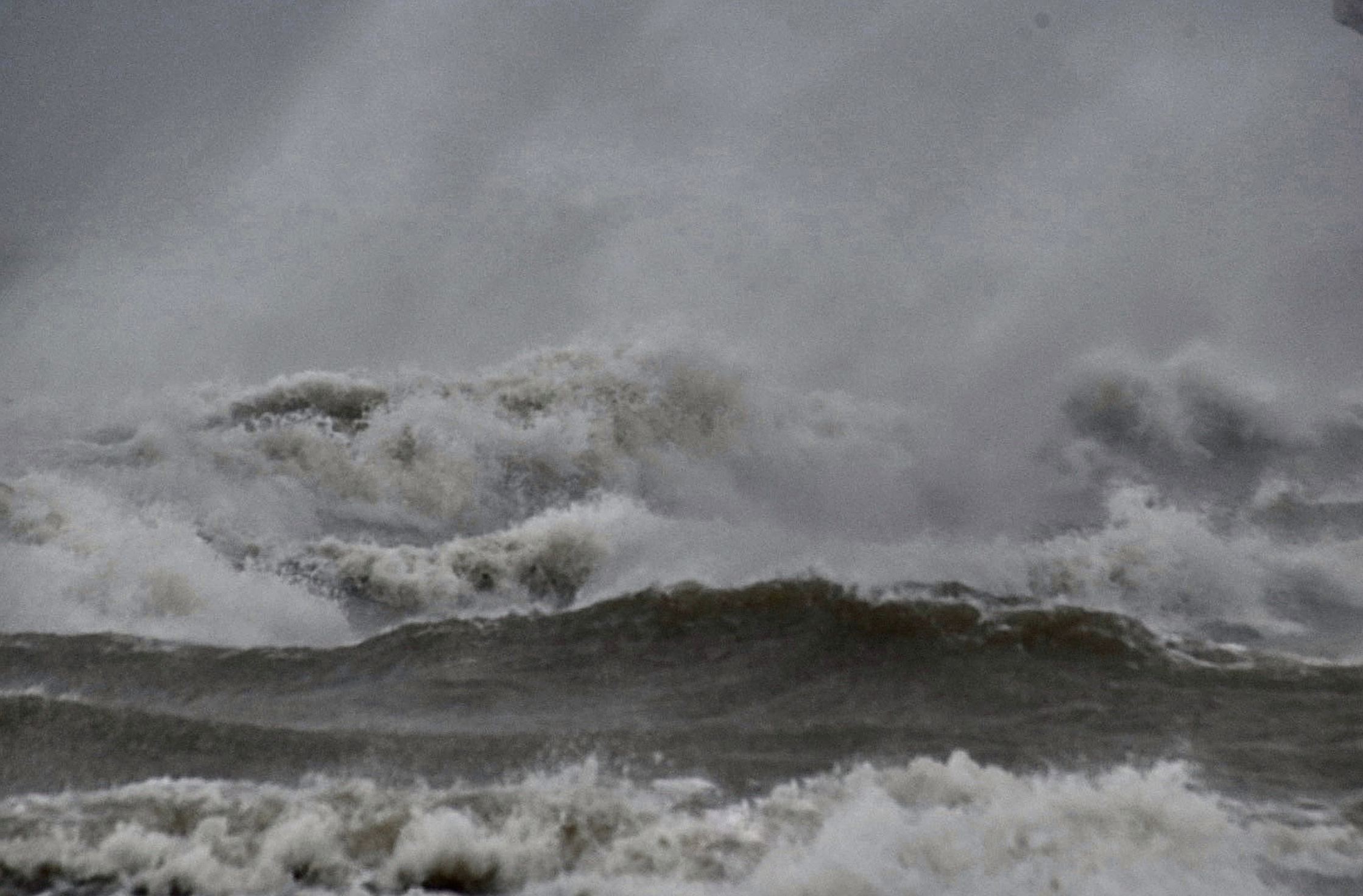
In my research for ‘Fish & Whiskey‘ I learned just what a devilish work place Lake Erie could become. It is beset by capricious and powerful gales which rile the waters. Waves can reach ocean-like heights that would topple any small craft like children’s toy boats in a bath tub.
Lake Erie’s Angry Moments
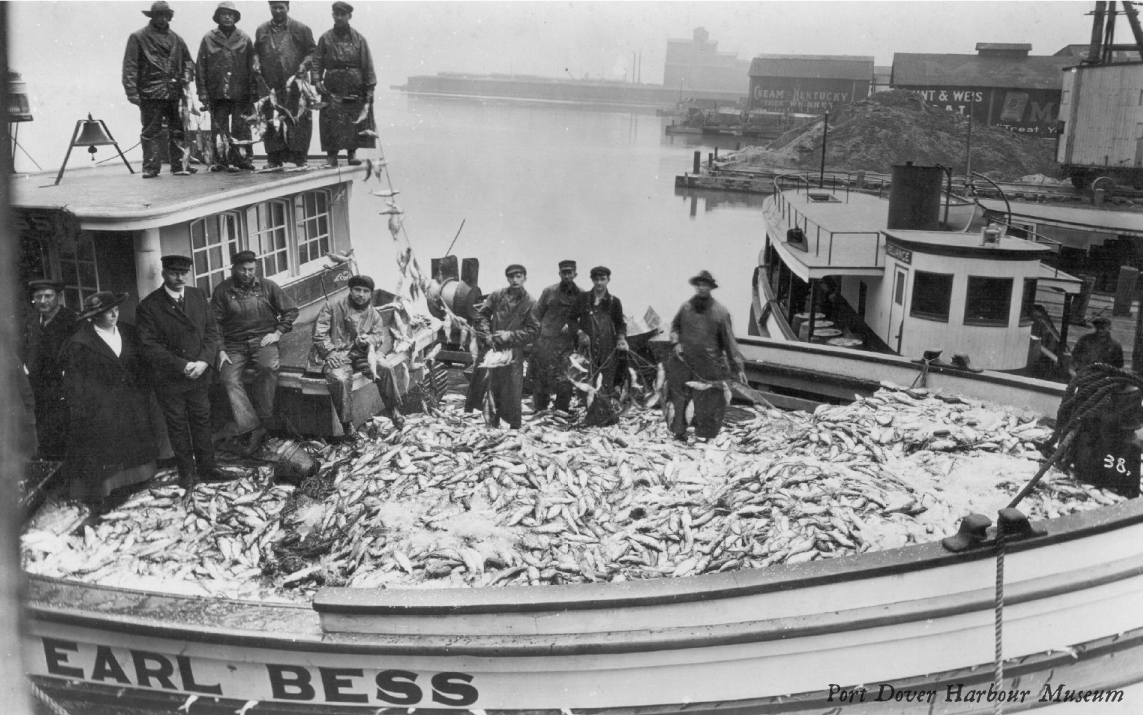
Despite that, fleets of fishing tugs would venture out on to the lake in search of fish, bringing home tons of herring, walleye, whitefish, perch and bass. The men and occasionally women who made those forays into the fog, rains and winds did so to maintain a livelihood that was as stable and familiar as any landlubber’s.
In the 1920s however, two unanticipated events occurred, colliding together to bring the fishing life to a sudden halt. First, the fresh water herring catch disappeared. Not overnight, but within a decade, the catch had plummeted from 40,000,000 pounds in a year to barely a million. Fishing communities all along the shores of Lake Erie reeled under the loss. The capital investment in boats and machinery, nets and equipment was unsustainable. The loss of income deprived family dinner tables of food.
Photo courtesy Port Dover Harbour Museum
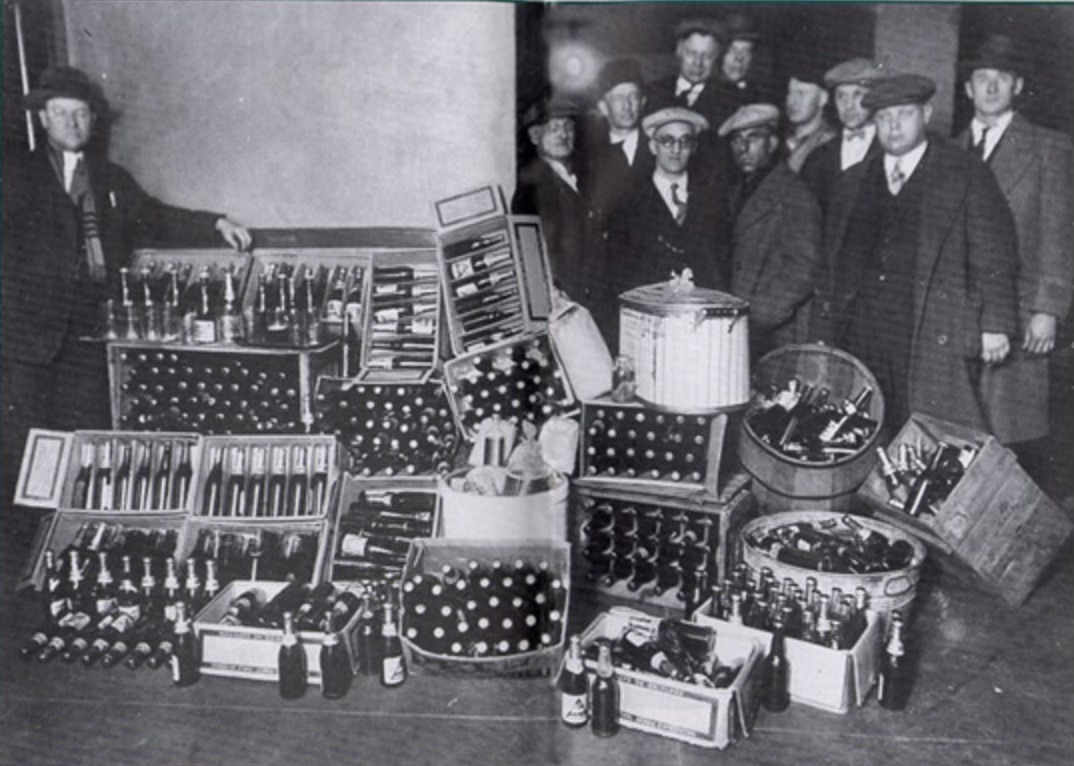
Second, the governments of Canada and the United States stumbled into a confused tangle of laws that prohibited alcohol from the general populace. While temperance and prohibition were on the radar, no one had foreseen the real menace of alcohol restriction: organized crime.
Within a year of the passage of the laws to prohibit alcohol, many fishermen had transitioned from setting and lifting nets to making cross-lake, night-cruises laden with cases of whiskey, gin and beer. An insatiable demand for booze in America drove the price of a 40-ouncer from $3 up to $15. This profit bailed the fishing industry out. But more importantly, it brought the Mob in. Gangs in Detroit, Hamilton, Toronto, and Buffalo organized impenetrable networks and shipping lanes to deliver an estimated hundred million gallons of illegal booze annually, from 1920 all the way to 1933.
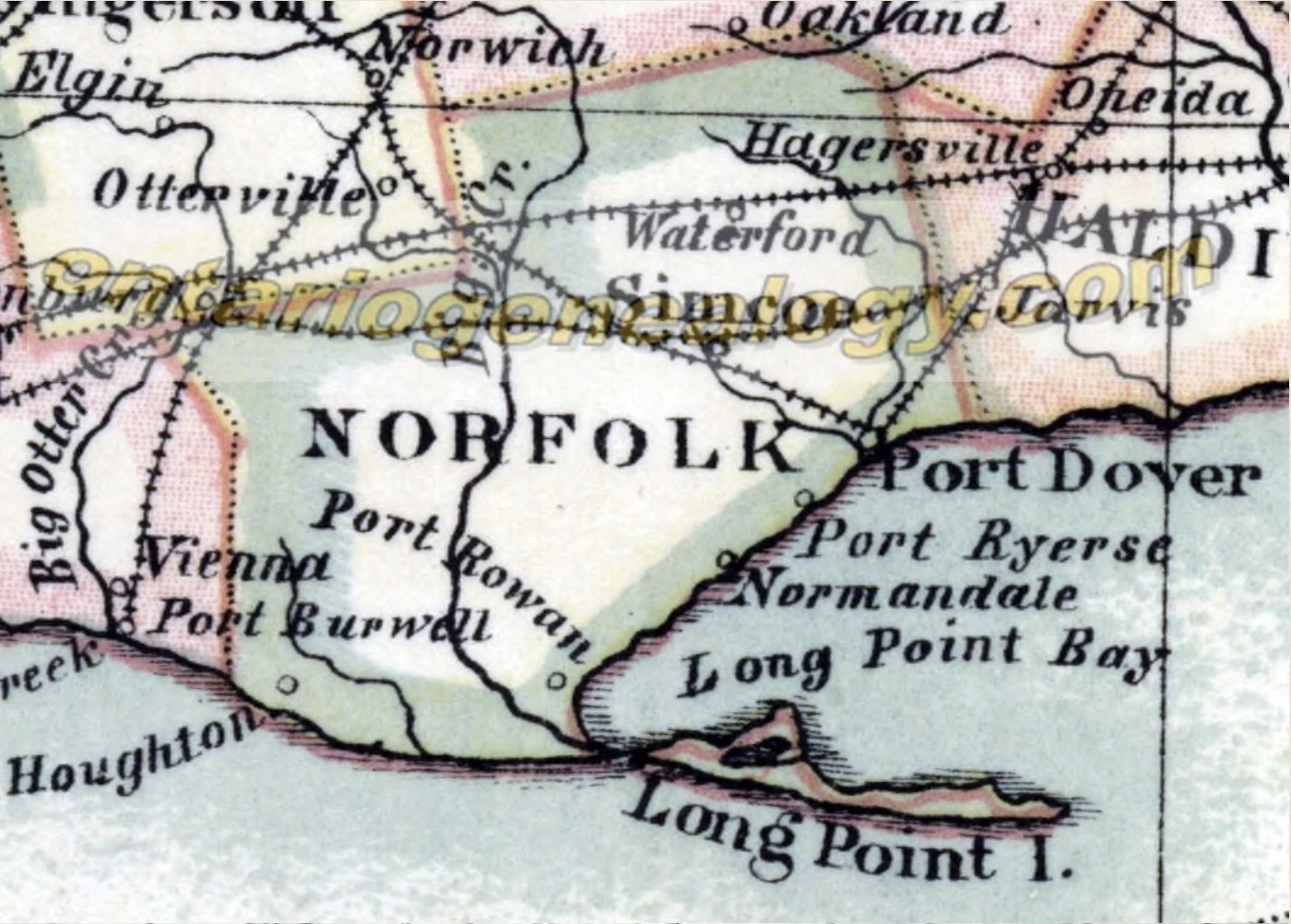
Lake Erie’s Path To Riches, courtesy Ted’s Vintage Art
One of the principal conduits was from Norfolk County’s shores to Erie Pennsylvania, just over 40 miles away. To get there, Lake Erie had to be calm, free of coast guard, hijackers, and daylight. That was not always the case.
What facilitated this industry was the Canadian federal government’s allowance for Canadian distillers and brewers to continue their work. Ironically, while the local populations were not allowed to possess or purchase alcohol, the factories were encouraged to produce it.
At Amazon Now!
‘Fish & Whiskey‘ is the story of a small town in Norfolk County, and its residents who learned to cope under the new drinking laws, the unruly laws of nature, and the ascent of violent crime. In the midst of this, Joey and Belle are a young couple who navigate the new terrain while they learn more about each other, and themselves.
You can get your copy of Fish & Whiskey on Amazon anywhere the company has a presence. I enclose the Canadian link and the American link for your convenience.
Sounds like a weird combination? Sort of a Baltic Sea appetizer? I apologize for my absence; I just finished my fifth book, whose curious title is above.
“Fish & Whiskey” came into being as the result of picking up an old book my parents had given me nearly fifty years ago. Harry B. Barrett wrote “Lore & Legends of Long Point”. It is a charming collection of stories and myths about the historic and scenic Long Point peninsula which juts out into the middle of Lake Erie. Ancient communities lived and hunted on this sandy, marsh-laden, mystical spit of land . Along its shores, the fishermen of Norfolk County had netted for their catch for hundreds of years.
Most intriguing however was Barrett’s tales of bootleggers and rum-runners who shipped millions of gallons of illegal liquor from Norfolk to Erie, Pennsylvania for thirteen wild, risky and profitable years. It led me to investigate further, and before long, I had dug into a story about the Prohibition years, and how the fishermen and communities along the Norfolk County shores participated in a trade revolution of mammoth proportions.
Fish & Whiskey is the fictional story of a small harbor town called Riverport. The year is 1925, Prohibition is in effect, and the town is reeling from the collapse of the fresh water herring catch.
The fish nets are coming in empty. The only recourse is to smuggle illegal booze into the U.S. To complicate issues, organized crime on both sides of the border are muscling in to Riverport with deadly ramifications.
Joey and Belle are two young lovers In the middle of this maelstrom of trouble. They wrestle with the circumstances, as best they can, all the while, exploring their mutual attraction.
The story is revealing of the times, and is told to keep the pages turning. Events occur, decisions are made —with consequences— and the tale concludes with a surprise and ironic ending.
You can find Fish & Whiskey on Amazon. I include two links, one for Canada, and one for the U.S.
Enjoy the read, and let me know what you think! I especially appreciate your review on Amazon!
They say that memory plays tricks on us. I think it teases.
I had often thought it was 1967 that I had joined a sailing trip out to Giants Tomb Island, on Georgian Bay. I was part of a flotilla of two small gaff-rig dinghies and an 18-foot sloop. Our crew comprised a dozen young campers, boys who had all qualified to be in our expedition by passing the requirements necessary for open water sailing. We had embarked from our summer camp, nestled at the mouth of Frying Pan Bay on the northern tip of Beausoleil Island, one of Canada’s beautiful national parks.
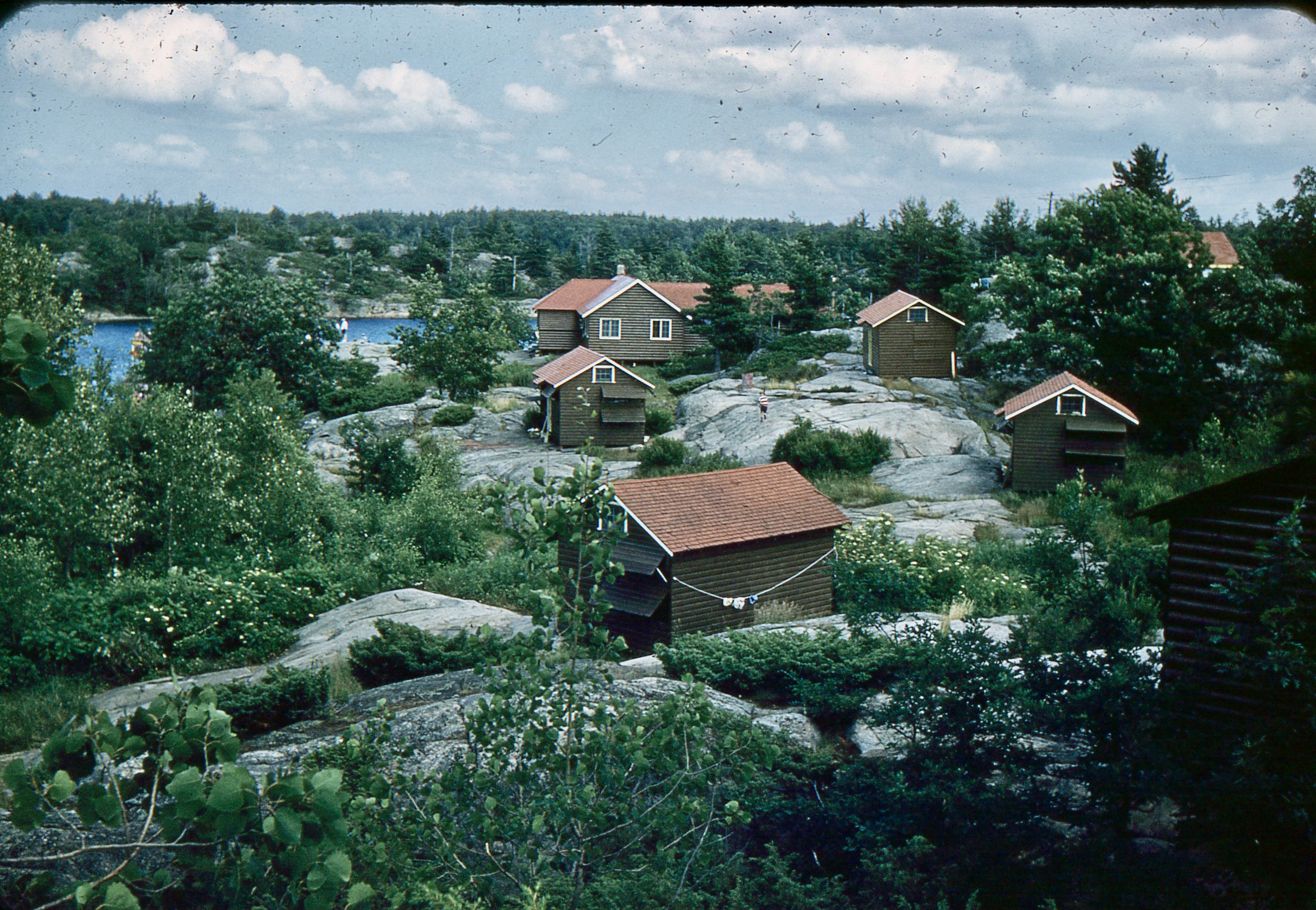
As we entered the main channel that pointed us northwest, we had a clear view of our summer vacation home: twelve red-roofed shanties and a dining hall, perched on a frozen magma flow of pre-cambrian granite.
Our summer camp on Frying Pan Bay, Beausoleil Island
The glacier-smoothed, pink and grey rock was sprinkled with low stands of green juniper bushes which eked out a living on less than three or four inches of hard-earned sediment and gravel. Groves of young red oak trees occupied the site, anchored by tall white pines, quite symbolic of the northern Ontario 30,000 Islands—windswept, stately and rugged, all at once. A population of 160 campers and staff romped over and roamed the site, on their way to skills and sports sessions.
Ahead of us was the opening to Georgian Bay. Tomahawk Island to our right, and Ardilaun to our left. These two guardians let us loose to sail on the powerful, awesome blue waters of the Great Lakes.
If you look at a satellite image of Beausoleil, you will see from the advantage of height the terrible submarine terrain of the shoreline. Over 10,000 years ago the last invading ice age scraped away the surface of the rock with the slow, unrelenting brutality of a gigantic bulldozer. The landscape is indelibly scarred. It gives the impression of a housekeeper’s impatient sweep of a tired broom across a dirty kitchen floor, painful streaks left behind with each effort. The region is blessed with the name of 30,000 Islands, and indeed, there are probably that many if you count all the small desolate islands and hidden shoals that may appear suddenly before the bow of your boat.
Which brings me to the strange beauty of Giants Tomb Island. It resembles a burial mound of a three-mile giant.
Giants Tomb Island, in southern Georgian Bay
Geologically, it is a glacial till, a deposit of residue from the receding glaciers. But historically, and more important, according to legend, the island is the final resting place of Kitchikewana, the powerful, and terrifying son of Manitou. The story goes that Kitchikewana was frustrated in love, and in a storming rage threw a handful of gravel to the ground, forming the 30,000 islands. The people were frightened by him, and when he died, they burnt his corpse where it fell. As the flames grew, and black smoke rose from the funeral pyre, its ashes fell to the ground as swarms of painful, biting flies. The flies are still a curse today for any sailor who visits Giants Tomb.
Our small expedition emerged into the open waters after passing the Whalesback Islands, an archipelago that is the southern guardrail of the Cognashene channel. From here we looked forward to long tacks in rolling six-foot swells as we steered west to the Tomb four miles away.
While our Camp program was historically devoted to canoe tripping, sailing was an exciting diversion that allowed for the wind to do the work. With a crew of four in each boat, our skippers could test us on the techniques and knowledge that brought true understanding of sailing. Every item in the boat was identified, and worked until we were proficient.
The task was to keep our bearing, but also to watch the sail and gaff for any change in wind. The constant hiking on the tilting decks of the dinghies was a thrill as the occasional swell reached up to douse our shorts with warm lake water. The summer sun and pleasant breeze escorted us to the shore of the island by late afternoon. Overall, it was a successful crossing for a group of kids, many from the city who had never been so far away from home, let alone dry land.
Giants Tomb is the remnant of glacial action. Its beaches have virtually no sand, but rather are cobbled in worn, rounded sedimentary stone, dredged up and exported from southern Ontario on the undersides of massive glacial arms in retreat. As a result, we moored our boats out in waste deep water to avoid any possible hull damage.
We spent the evening on the shoreline eating, singing and storytelling, feeding a warm fire with driftwood and looking up at the stars all around our heads. Liberally coated in bug repellent, we fought off the scourge of sand flies which nipped at our ankles incessantly. The ashes of Kitchikewana bent on revenge. After checking the boats, we turned in and slept. The wind was steady out of the west, and as we were on the lee side of the island, the night was calm.
In the morning we were up with the sun. Except there was none. A heavy blanket of fog, low-flying cloud, had smothered out the light, and we ate our campfire breakfast in a clinging cool grey mist that swirled about the boats, but did not dissipate. By eight o’clock we were launched, and headed for home, with a gentle uncertain breeze behind us.
The voyage home was expected to be one long broad reach, sailing before the wind, and as we let out our sheets, the sails filled, suspended under the gaffs. For any spectator, our parade was scenic.
Our dinghies, gaff-rigged, and crewed enthusiastically.
A red sail on a white dinghie, another yellow sail on a brown, led by the blue sloop with its jib and main sail spread wing and wing. From above, three small dots venturing across the froth and foam of Georgian Bay waters. Hopefully, the fog would blow off and allow us to watch the coastlines as we headed back to Beausoleil.
But the fog persisted. In spite of the wind, it hung around us as we tobogganed off the waves and made our way east before wide open sails. The water gurgled along our hull and bubbled up behind our stern while the steel centerboard moaned as it fought the currents below. It was another teachable moment. We sat in the cockpit of our dinghie, working the 1:50,000 chart and Silva compass to keep us in the clear, more or less. Tracing and projecting our path across the vast bay was exciting, guessing our exact location on the green and blue map spread across the floorboards.
How long would this flying blind last? Little did anyone know, but in a lucky moment, someone looked up into the grey, over the gaff.
“Look out!!”
“What?”
“Look! There!”
Suddenly, a huge, white, castle-like structure had appeared, bearing down on us quickly, not thirty yards ahead. It was a gigantic boat dividing the heaving waves in our direction. Staring up at the vessel we could see its upturned bow, a foredeck of windows, with a pilot’s cabin one deck higher.
The City of Dover, with passengers waving to onlookers.
Our skipper yelled at us, “Hang on. We’re jibing!” He pulled the tiller to his side, and the boat heeled to the right as the boom flew across our heads. The stern of the dinghie broached for a moment , and we found our maps and gear in a pool of water. The boat tossed sideways with the change in energy, and when we looked up we saw that the gaff had goose-necked, pinned on the windward side of the boat, twisting the sail and lifting the boom upwards like a broken limb. The boat continued to turn into the wind until we were tossing in a violent luff, and then the gaff swung back to norm and the boom crashed down into place. Thankfully no one was under that piece of lumber as it fell.
The wild ride continued as the boat now spun into a westerly direction, and we were, ironically, chasing the steamer that nearly put us under. Along its starboard bow were the words, City of Dover. Its wake lifted us up and we scalloped across a set of waves as the stern of the steamer disappeared into the grey.
The City of Dover in the main channel heading to Honey Harbour.
Did it ever see us? I don’t know, but typical of young adventurers we roared with excitement, laughing off the near collision, righting our course, and continued our way back to camp without further disruptions.
But the event hung with me for years, always a moment of intensity, and I wondered whatever happened to the City of Dover? I set out to get its story. And when did this really take place?
Casting my line across the internet, I learned that the boat was built in Port Dover on Lake Erie in 1916, and was slated to deliver passengers, freight and fish to the port of Erie, Pennsylvania. The fact that this boat originated in my home County of Norfolk was an intriguing coincidence.
The wooden hull was 75 feet long, 20 wide, and had a draught of 7 feet. It had a gross tonnage of 81 and could carry up to 197 passengers.
In 1921 it left Lake Erie for Midland Ontario as the newest addition to the Honey Harbour Navigation Co. Ltd. Out of the fish business, it was a freighter delivering supplies and laundry to the islands around Honey Harbour. In 1928 the Dover was sold to the Georgian Bay Tourist and Steamships, Ltd. It provided service between Midland and Go Home Bay, north of Cognashene on Georgian Bay. For several years she was owned by a group in Penetanguishene, and ultimately sold again in 1955 to a couple in Sault Ste. Marie. They refitted her in Wiarton, and initiated ferry service between Salt Ste. Marie (the Soo), and Michipicoten Harbour, on Lake Superior. The business shifted however, and the Dover resumed service between Midland and Go Home. At some point, the boat added a pilot’s cabin above the upper deck for better visibility. That hadn’t helped us though.
The City, beached on the stones of Little Lake, Port Severn.
In 1960, the steamer was 44 years old. It was drydocked in lock 45 at Port Severn for the winter. There, sadly, its new owner discovered its keel was broken, and the boat was taken out of service. It was moved to the Lone Pine Lodge on Little Lake near Port Severn. Its latest owners planned to open a restaurant or an amusement park on the injured vessel. But over the years, it was crushed by ice and eventually burnt to the waterline.
The timeline of my story however was suddenly altered. According to all reports, the boat was no longer on the water by 1967, the summer of our last meeting in my faulty memory. In fact, there are images of the once proud steamer lying on its side like a bloated elephant, circa 1965.
How could that be? For a moment, I actually imagined an image where the burning flames of the dying steamer launched a ghost into the fog of Georgian Bay to scare the daylights out of me and my fellow sailors. A crazed, fire-breathing Kitchikewana would be at the helm. What a delicious tale.
But after searching out fellow camp cabin mates, as well as two crew who worked on the Dover and the Keewatin in the 50’s, I came to accept that it was likely 1959 that we met the City of Dover. I was only ten and half years old. And it was in its last year of operation, perhaps its very last trip.
But I remember it like it was yesterday.
Thanks for reading and sharing! I also thank Dean Nichols (1952- 1953 crew Dover) and Jim Sykes (1946-1956 crew Keewatin) who worked on the boats starting in their early teens.
Photos were provided by summer camp mate Skip Lumley; John Todd, Administrator for Facebook group site Huronia Past and Present; and Tom Barber, “Looking Back 60 Years in North Simcoe, January 15th 1961.”