Culture, Sports, Wildlife

Paddles Keen And Bright

We have a fleet of canoes.  It was never planned that way, but nevertheless, fate, good fortune and the wish of one man made us canoe mavens.

Freight Canoe Honda

A typical sight along the summer roads of Ontario.

Just last week our son rescued one from the shaky rafters of a rustic, ancient boathouse on a lake in eastern Ontario.

The craft in question is a Chestnut brand Prospector with v-stern. It is a super-wide 16 feet feet long, and has a transom that could host a 3hp outboard if required.

IMG_0011

The Chestnut Prospector known as “Pickle” by our grandchildren.

Our grandchildren call it the Pickle, because it’s green. The Pickle is the last of three canoes which my late father-in-law bestowed upon his three daughters, fulfilling a wish that spanned over half a century.

Chestnut Canoes were an iconic boat company headquartered in Fredericton, New Brunswick.  It went under in 1979, victim of changing tastes.

1982 Canoe421

1983– Mabel’s Tremblay loaded down with our young family.

The class of canoe is cedar-canvas. That is, a cedar rib and plank hull, over which canvas is stretched and bound into place. You will find modern canoes made out of fiber glass, and the truly exotic craft are made from pure cedar strip.  Last summer we lifted a carbon-fiber canoe with two fingers.   It weighed 14 pounds.

In the heyday of cedar-canvas canoes, it was common that most cottages in eastern Canada had a canoe, or were in sight of one off their front dock.

2015 243

Camp was our training ground, and today it commissions at least one war canoe, seen above in their brochure.

Truly a Canadian legacy, the canoe today is still seen on the tops of vacationers’ cars speeding along the highways all summer long. But more often, you will see kayaks.  Hard fiberglass, ultra light, in hues of red and yellow.

When not on the road, or in the water, canoes are habitually found in the rafters of boathouses and garages, nation-wide. Which is where we have two, right now.

The Big Idea

1996 235

1996–Our boys ponder a launch of our Pal Chestnut off the front point of the cottage.

Tom Hamilton is my wife’s Dad, and from the time of his youth he had been an outdoorsman. Very much into camping and fishing, Tom enjoyed no greater release than to glide among the ripples of a quiet northern lake, trolling a lure in search of a hit from a bass or muskie. If he couldn’t experience that first hand, he was intent on passing the thrill along to his daughters.

So they went to camp.

1950 Hamilton702 copy

1950– Tom took his team to camp to build cabins. Here they are arriving in “Tough”, a war canoe.

The YMCA summer camp of our youth was built by service groups, in one of which Tom was a member. After WWII, he spent springs and summers cobbling together cabins, docks and dining hall for generations to enjoy.

The waterfront was well stocked with Chestnut canoes, donated by wealthy benefactors.

The skills regimen at our camp focused on canoeing and out-tripping. The requisites were quite firm for campers to canoe and out-trip.

1989 237

1989– Tom with his grandson and friend paddling the Grand River in his Pal, “Hochelaga”.
IMG_1099

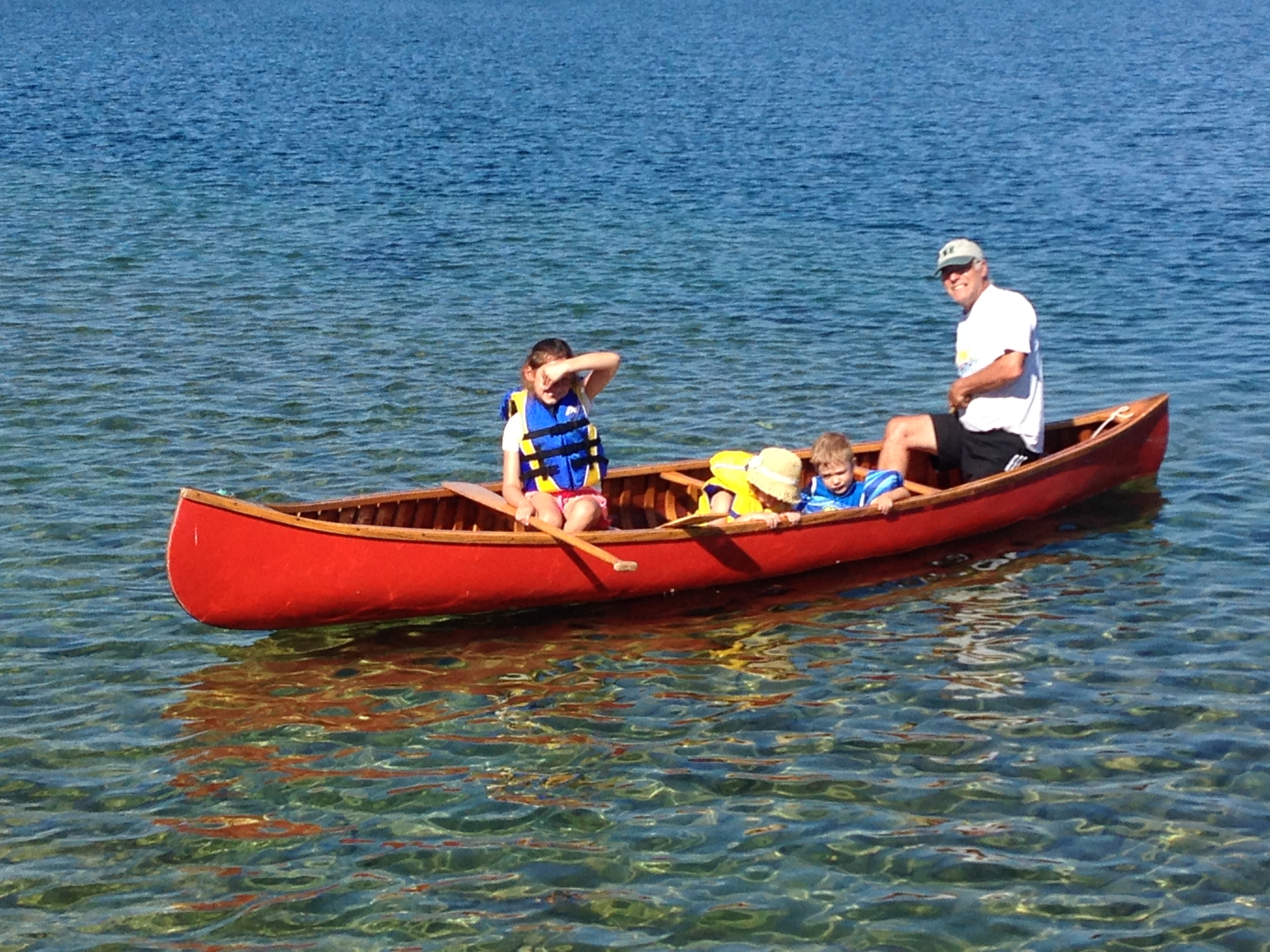
2016– Tom’s Hochelaga now carries three great grandchildren on the Bruce Peninsula.

We graduated from Tenderfoot to Tribesman, Brave, Chieftain, and Chieftain Expert. A fully-fledged canoeist was eligible for out-tripping when they had mastered bow, stern, portage and solo.

The strength test was to hoist a canoe onto one’s shoulders, unassisted, and portage it about a quarter mile. The canoe weighed around 80 pounds, which doesn’t sound like much until you are swinging it over your head in one move.  The ultimate test was to paddle a “Figure 8” without changing sides.

1989 238

The beauty of river canoeing is to enjoy sights unseen from the highway. Grand River, Ontario.

This was the environment Tom treasured, we were raised in, and not surprisingly, it generated tremendous self confidence and pride. The dividend was paddling these sleek, quiet craft on waters through valleys of forest and granite, easily gliding up to wildlife unaware at any bend in the shoreline.

Among Tom’s three daughters, we have 5 cedar-canvas canoes.

2003 245

2001–Mabel’s Tremblay under total rebuild. The red paint bled through an earlier canvas.

When he retired in 1985, Tom searched classified ads, read marina bulletin boards, and probably pestered a few motorists who were transporting a canoe, and eventually acquired three beauties.

They are all in Ontario. Mary’s Chestnut (a Pal model) canoe resides in a bay by her cottage on the Bruce Peninsula.   Bonney’s Langford is beside the Mississippi River in Pakenham, and Jane’s Prospector “Pickle” is just returning from a week on Silent Lake.

Many years before Tom hatched his acquisition plans, I had a well-travelled canoe given to me by a veteran cottager on our lake. Her name was Mabel Stearns. Her canoe was made in eastern Canada, around 1951.   I think it is a Tremblay.
2003 244

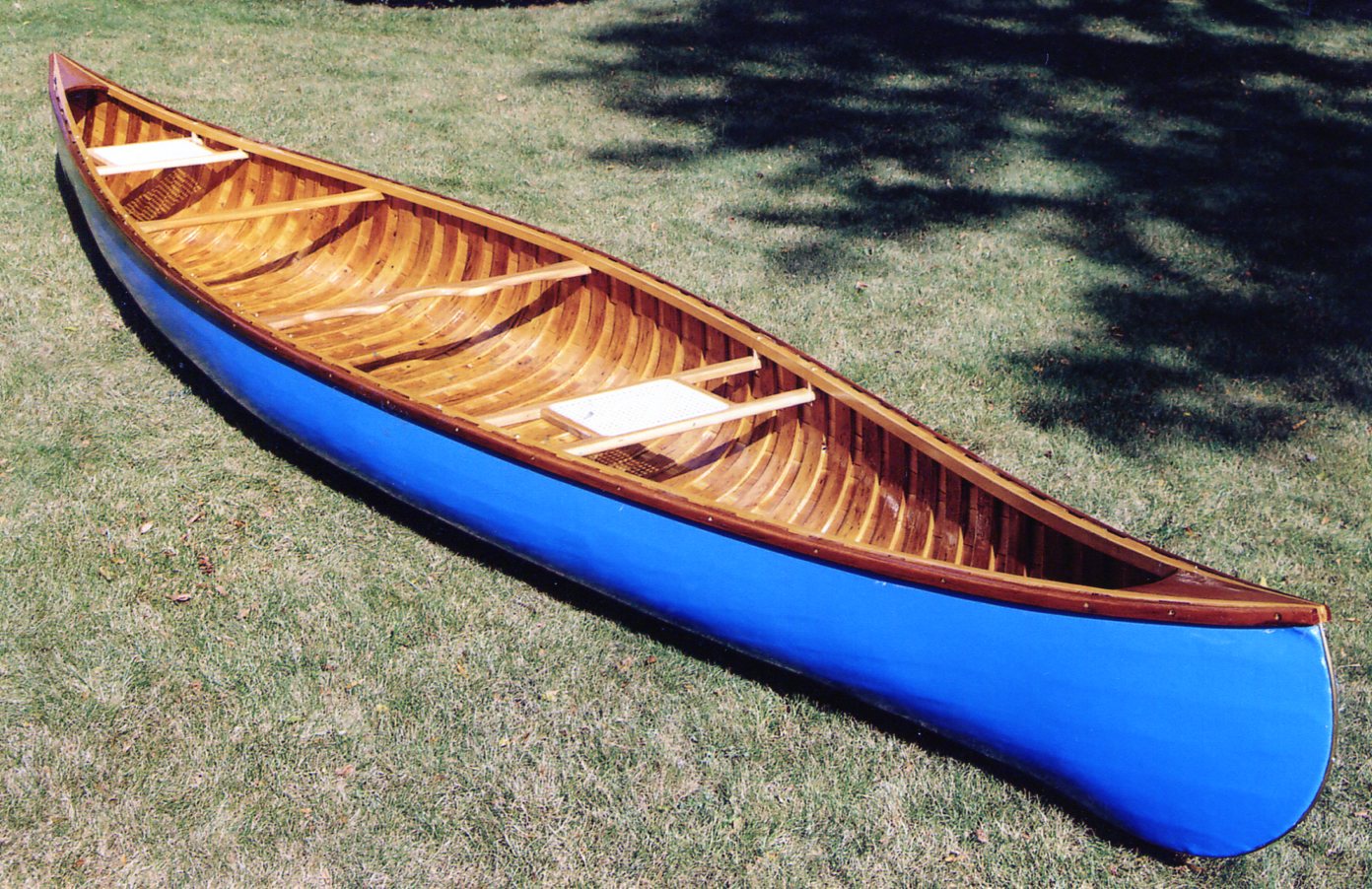
2003– Mabel, all spiffed up, trim and pretty.

It looked pretty rough. Coated in layers of chunky blue and green paint, it had dirty brown, peeling varnish coating its ribs and gunwales, and a hole in its bow, attributed to a fast speeding bullet.

Like most older canoes that live outdoors, its decks were crumbling and rotted from years of storage on the ground.

IMG_8482

Bonney’s Langford among the rushes in Pakenham, Ontario.

We were nevertheless thrilled to have the canoe, and that fall we put on a new canvas, reinforced the bow and stern stems, and painted it red. Not a professional job, but sufficient for the time being.

A couple years after that, in 1981, Tom found a red Chestnut Pal looking for a new owner, and convinced me to buy it from a childhood friend of his for $100.  For me, that was considerable, but at the time, a Pal retailed for $800 or more. This canoe was also broken, and I forthwith re-canvassed it, and painted it yellow.

The reconditioned canoes went to our cottage and traded places a couple of times when a more serious attempt was made to give them a worthy overhaul.
IMG_3657

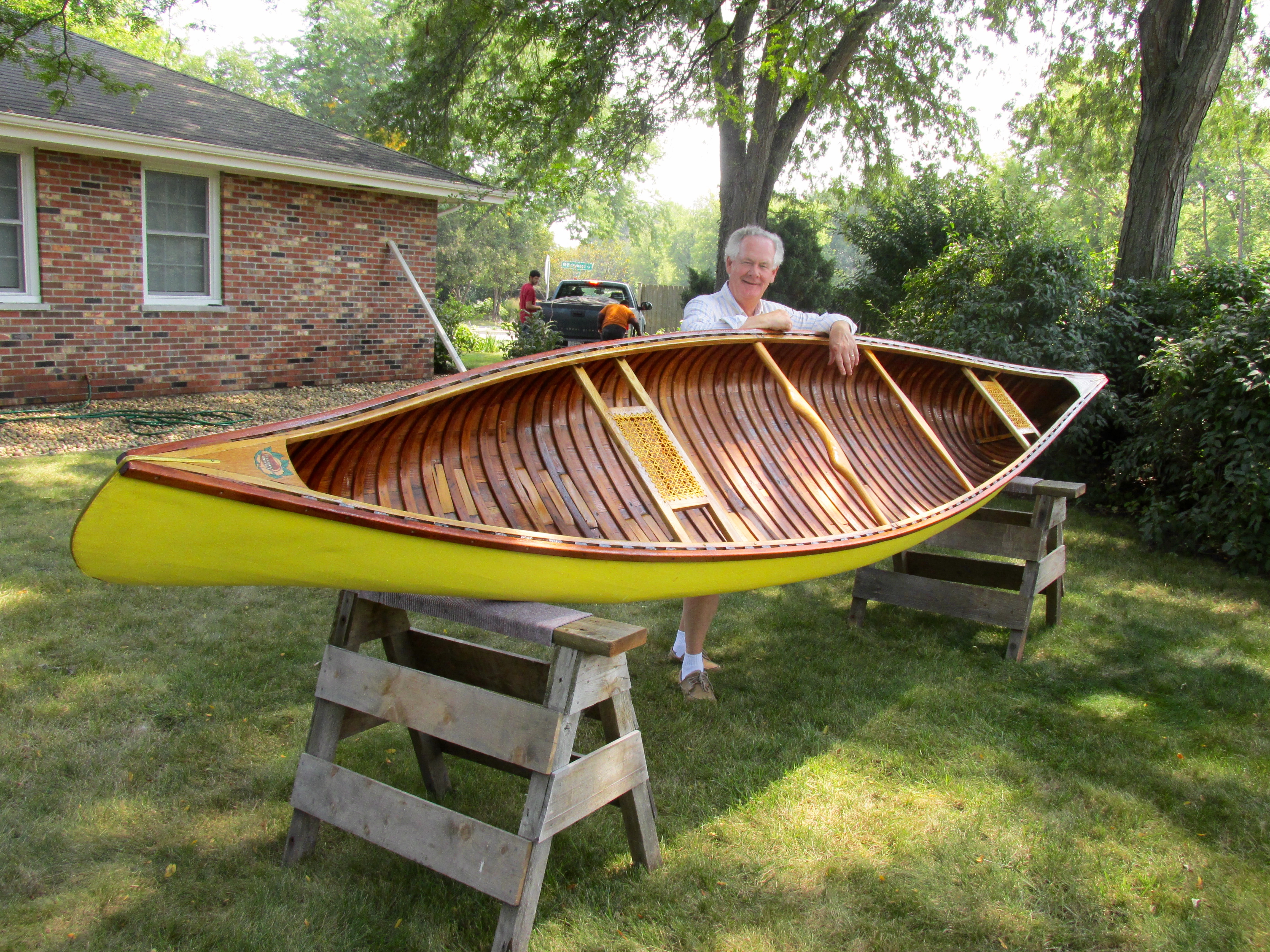
2015– My $100 Pal after a major overhaul, complete with mahogany gunwales.

Ultimately, we sold our cottage, which is a not uncommon phenomenon in Ontario where tax law makes inheritance of family cottages a costly consideration.

While we enjoyed the convenience of the cottage’s stable location, we now appreciate the canoe for its portability to other lakes and rivers.
IMG_6259

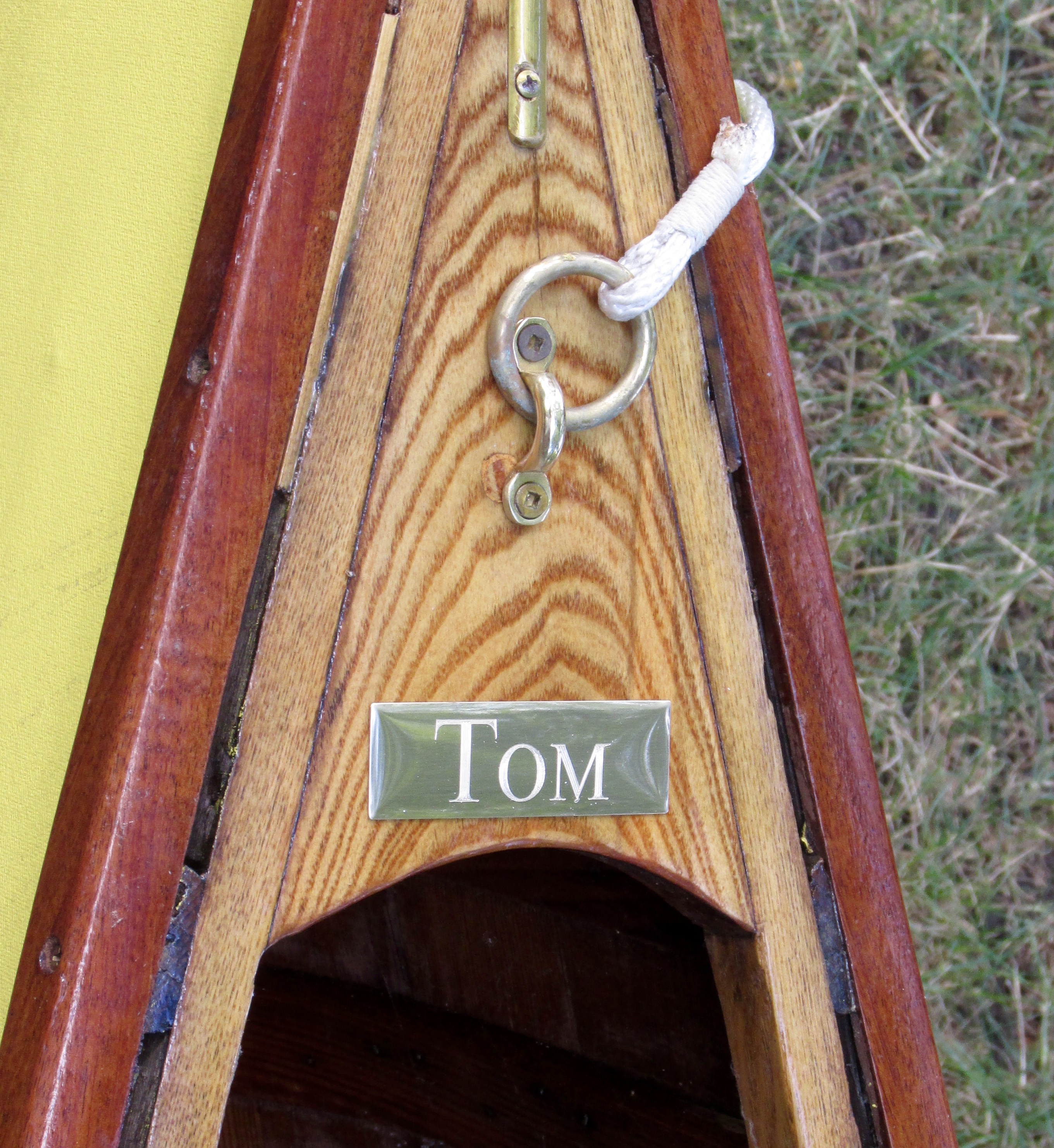
2016– Tom takes his place on the Chestnut.

As a result, the Pickle has visited Silent Lake and awaits its next trip, now likely next year.  Mean time it rests dry in storage outside Toronto.

And our $100 Chestnut has been on numerous lakes and rivers before taking up residence behind our house.   Mabel hangs from the garage ceiling, waiting for her next outing.

For me, the pleasure in all of this has been the fulfillment of Tom’s wish, that the canoe stays front and center in our family.

It has done that, and more so.


Thanks for sharing our canoe story!  “Paddles Keen And Bright” is lifted from a Canadian canoeing song, written by Margaret Embers McGee.  The song is sung as a round, a supposed assist for paddlers.

My paddle’s keen and bright, 
Flashing like silver,
Follow the wild goose flight, 
Dip, dip and swing.

Standard
Culture, Entertainment, Music

Hall, Oates, And A Soundtrack That Won’t Quit

Hall& Oates

The kids in leather, and launched.

We missed Hall & Oates the first time around, but 40 years later they paid us back with a superb performance in Toronto in June.

Years ago, the music of this creative duo crept into our consciousness with Blue Room’s rendition of “Every Time You Go Away” in Planes, Trains and Automobiles.

Little did I fathom at the time that he had covered this wistful piece from one of the truly great composing partnerships of the 70s and 80s.

IMG_1157

The tiny Apple Nano: 1200 songs in a Saltine.

Still unaware of Hall & Oates, I next captured “One On One” on my Apple Nano about 4 years ago.

Buying the Nano was an awakening long overdue.  I was looking for a storage device to hold some music that I was collecting: a couple lost decades of 70s-80s Pop melodies that I had shunned during my Folk and Classic Country years.

One day I was in Best Buy when I asked a helper,

“How many songs can I get on this little Nano?”   It was about the same size as a Saltine cracker, but sturdier.  Its black crystal hinted at deep, magical powers.

She answered, “About 1200.”

I laughed, “I don’t know 1200 songs!”

Four years later we have 957 cuts on the Nano, which include about twelve from our happiest discovery: Hall & Oates.

That evolved when I was given a publicity CD at a Direct Marketing Association trade show.  ULine, a container company–you know, “boxes”— somehow concluded that a free CD of 15 H&O cuts in a ULine-branded sleeve was a good giveaway item to promote itself to mail order companies.

H&O_5571

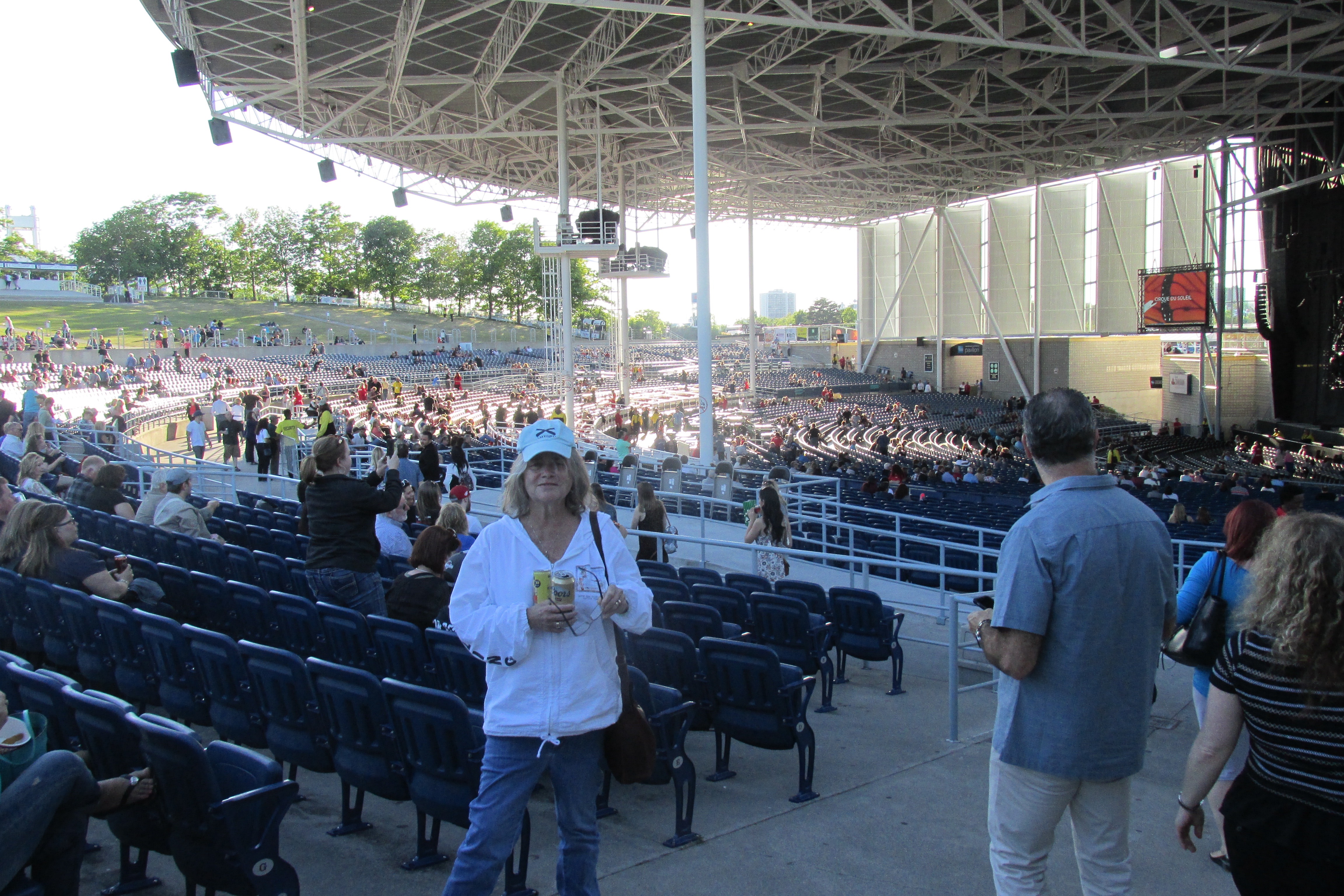
The Molson Amphitheater on a warm evening by the lake.

Not knowing who Hall & Oates were, I stuffed the CD into a drawer and didn’t retrieve it for a year or so.  One day I popped it into a player, and heard the iconic “Out of Touch” composed by John Oates.

My wife perked up when she heard “Kiss On My List”,

“I love that song!  Who is this?”

“It’s Hall & Oates.  You know them?”

“Nope, but I love this song.  What else is on the CD?”

With that we rolled through their top hits repertoire, and pinched ourselves several times as we knew these songs, but had never connected the composers.

IMG_5567

An enthused Hall & Oates fan arrives early.

The upshot is twofold.   First, we needed to get to a Hall & Oates concert.  Second, we now recognized ULine as a brand of… boxes.  That learning process took about 5 years, but I hope some advertising manager somewhere is having a small vindicating shiver, a frisson, right now, much to their puzzlement.

—Which brought us to the Molson Amphitheater on the waterfront of Toronto, looking out on Lake Ontario.

H&O_5580

Daryl Hall lights up on Man Eater.

This open air concert venue seats about 5,000 under the roof, and another 1,500 or so up on the lawn.   On a warm summer evening, with a cooling humid breeze coming off the lake, one can’t find a better place to enjoy a live concert.

There are auditoriums and arenas for McCartney, The Stones and Bruno Mars, but you are one of 60,000 fans holding your ears.  Instead, the Molson Amphitheater is the happiest compromise of a concert crowd and intimacy rolled into one.

The ticket prices are good, and there is no more politely enthused and amicable concert fan than a Canadian.   Every performance we have attended at the Amphitheater evokes a heartfelt thank you from the performers about how welcome, and safe, they feel in Toronto.

Wow!  It must be pretty tough everywhere else.

H&O_5584

Oates is the Yin in this timeless duo.

Our mental image of Hall & Oates is locked in the 70s.  A couple young guys, with hair and rugged good looks.  Up close today, on the jumbotron, it’s 40 years later.  But the genes still hold their ground.

Even better, so does their music.

Predictably, they opened with Maneater, a solid up tempo number that had the audience on its feet in an instant.  What followed was a succession of hits from the 70s: Sarah Smile, She’s Gone, It’s A Laugh, Kiss On My List.

IMG_5636

A friendly Toronto on Lake Ontario

Somewhere half way through their performance Daryl Hall hung up his guitar and went to the keyboard, which was a delight.  The camera focused on his hands pounding these hypnotic chords for 8, 12, 16 bars, typical of their best songs where the lyrics open only after the background music is solidly in place.

Hall’s voice has great range.  It’s remarkably soulful up on the high notes, and he is completely unchained in front of 5,000 fans, delivering melody and passion.  Meanwhile, he works the keyboard with complex chords, lots of 8-fingered flats and sharps, in minor and major…a true believer of “black keys matter”.

IMG_5576

Their music is complex, melodic, and memorable.

John Oates is the journeyman guitarist.  He switches between several during the night, and works up and down the neck effortlessly.   Strutting across the stage he occasionally sides up to Hall, which is the only time you see the physical Yin/Yang of these two: Oates the significant counterbalance to the tall and blonde Hall.

There is a third component to the Hall & Oates sound and that is the roving saxophone of Charles DeChant.  This ponytailed magician nuances every tune with mellow contemplation.   His signature delivery is an extended solo in “I Can’t Go For That, No Can Do” which really stretches the boundaries of contemplation to hard core introspection.  Too long for my taste, but for many, right on.

IMG_5585

The group returns for two ovations. We can’t get enough.

The team comes out for two ovations, after prolonged applause.  They close with Private Eyes and then back again with Rich Girl, which by then has the audience screaming for more.

But no more, they bid good night.

The genius of this pair is their melodic creativity.   It is complex music: hard to dance to I think, but easily remembered, expansive tunes that you can hum  long after the hall goes silent.

Indeed, the tunes play over and over, inside my head.  After walking 9 holes of golf I have re-sung Private Eyes a hundred times without thinking.

Unfortunately, I can also wake up at 3am, and still have the soundtrack bouncing along, varied, hypnotic, and without cease.


Thanks for reading!   If you are an H&O fan, you will find their tour dates here.


Standard
Culture, direct mail, USPS

Tremors At The Post Office

Spoiler Alert: Numbers That May Surprise You!

The latest USPS report on mail volumes is out, and magically, incredibly, it points up.    The number-laiden Revenue Pieces and Weights report January 1- March 31, 2016 tells us volume for the past quarter was up 1.4%.

Big Business

For many of you, the news is lame. After all, what is an additional 520,183,000 pieces of mail? Actually, it turns out to be 37,414 tons, the equivalent weight of 454 Space Shuttles.  Which again points to the enormity of the US Postal Service.

Critics tend to discount the post office for its supposed obsolescence, but if you hang around a mail sorting facility for a moment, you know this is BIG, massive business.

So I for one am excited that mail volumes grew this past winter.


Slide2

Direct Mail and First Class Up

The better question may be why are they up?   It turns out that Direct Mail increased 1.9% over the same quarter a year ago, 355,488,000 pieces.   That could be related to political fundraising mail, and a cautious optimism in the economy.

First Class mail increased by 0.8%, 135,253,000 pieces.   An astounding turnaround!  Mind you, that includes all business mail.  When it comes to individually stamped mail, like birthday cards, bill paying and charitable donations, it was down 2%.  There is more intriguing news on this personal category in a moment though.

The big winner is Parcels and Packages which are exploding, correction, booming, sorry, mushrooming 13.2%.   This past quarter the USPS delivered 1,121,723,000 parcels, total weight: over 1 million tons.

The Magazine Subscriber Fails To Renew

What the report also reveals is the continued slide of Periodical volume: magazine counts dropped by 5.6%– 81,070,000 pieces over the three months compared to 2015.   Magazine subscriptions continue their slide.

The eye opener in this display of numbers is how mail looked just five years ago.   In 2011, total mail count for the quarter was over 41 billion pieces.   Since then volumes have dropped 6.7%, about 3 billion pieces.

While this is a generally understandable result of internet and social media, it is worthy of note that direct mail dropped only 3.4%, thus illustrating its successful economics.   By comparison, First Class Mail dropped nearly 13% in the same period.  Magazines, down 22%.

Parcels On The Move

You have to hand it to USPS management for the growth in Parcels.   While the internet may have crushed letter mail volumes, it opened the door for USPS package delivery.

Slide3

In 2011, Q2 Parcels totaled 667 million pieces.  This past quarter, USPS delivered 1.1 billion parcels, up a whopping 68% over five years.  And revenues? $3.7 Billion, up 82% from 2011.  The more we buy online, the more the post office delivers.

The significance of Parcels growth is that these numbers represent the USPS position in a competitive market with peers like UPS and Fedex.

Is Internet Migration Finished?

The encouraging story about Stamped Letters is worth a peek.   Personal letter volume cratered in 2008 and 2009 by -17.2%, and in 2010 by another -16.3%.    Since then, like a plane pulling out of a disastrous dive, Stamped Letters have nearly leveled out this past quarter at only a -2% decline.


Slide1

This leads one to believe that the attrition of postal mail to email and social media has just about finished.

Next month marks the end of another quarter for USPS record keeping. It will be interesting to see how the impact of the recent 1-2 penny decrease in price might improve mail volumes.

The direct marketers will take note, and who knows, maybe someone will pick up their pen and write one or two more letters as well.

Here’s the report for you review.  Enjoy!

Standard
Cars, Culture, Thank You

Farewell To A True And Faithful Friend

Blue at Weslemkoon

Our first Olds Cutlass Cruiser.

It’s strange how we can instill heart and soul into material objects. Because of that, this is a wistful moment, bidding farewell to a member of our family for over 25 years.

Back in 1990 when we bought our home, the real estate agent said, “Hey, you have a few dollars left over from your loan, why don’t you buy a car?” So we acquired a brand new Oldsmobile Cutlass Cruiser, a mid-sized station wagon.

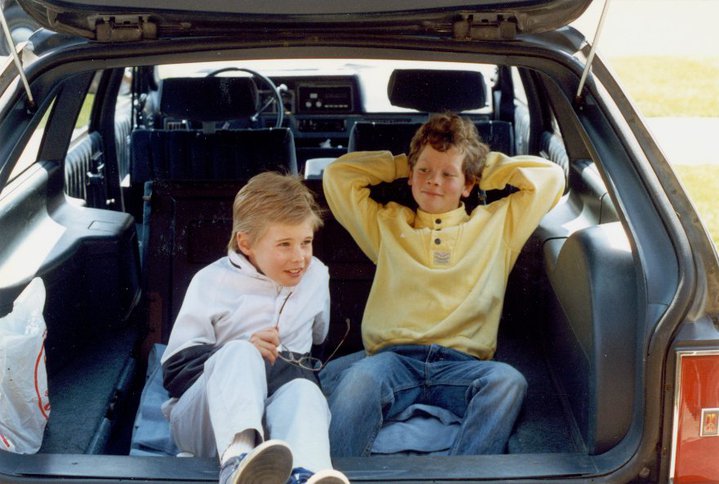
330,000 miles later, here we are, standing beside Blue, who is resting quietly in the driveway.

You may think it is a stretch to give a soul to a machine, but it is not uncommon. Sea captains adopt their boats. Hearst had his Rosebud, and Davey Crocket, his trusty rifle Old Betsy.

Blue after a wash

Blue, fresh out of the shower.

Olds Plywood

A rare talent: a 4×8 sheet of plywood through the window.

Actually, Blue is resting on the driveway, not in it. Family only goes so far.
The reason why this departure is so touching is that we remember when we first got Blue. We traded in an earlier Olds wagon, the exact same model.

It was the easiest order a car salesman ever took:
“Yes sir, can I help you some how?”
“Yep, see that Olds wagon in the lot outside? I want another, just like it.”
“Certainly. Just like it?”
“Well, yeah, but with air conditioning, fuel injection, and FM radio.”
“Power windows and door locks?”
“Nope. If we drive into a lake I want to be able to get out.”
“Same color? Blue?”
“Yup.”
“Done.”

The paperwork took much longer, but by the next day we had Blue.

Years later there’s no need to recount all the outings and family trips in Blue, but the car distinguished itself by its steadfast performance.   According to industry stats, Blue must have been made on a Wednesday, because he never suffered a quality issue.  Beyond the normal R&M costs, Blue lived a clean and pure life.

It was not until 14 years later, on a mild December evening in 2004, that we truly realized what a prize Blue was.  We had parked outside a restaurant for dinner, and walking in, spied a similar Cutlass Cruiser wagon, same vintage.

I was moved to scribble a note and leave it on the windshield:

“Hi! Great car!  We have one just like yours.  Look behind you. 210,000 miles, and runs like a clock!”

Olds Back Seat

Rear view treat: the seat of choice.

When we came out of the restaurant after dinner, the wagon was gone, but we found the note with a reply, under our wiper:

“This car just won’t die.   190,000 & runs great. Hope you make 300K.”

And here sits Blue today, well past the mark.

With a few makeovers mind you.   We have repainted Blue four times.   Maaco gives us respect, though honestly, the owner there may have succumbed to paint fumes.   On two different occasions we returned after a week to pick up Blue as scheduled, and he couldn’t remember us or the car.

Blue Possum

Varmint duty: airing out after trapping a possum.

But the new paint jobs breathe new life, just like a new suit, new carpet or a new kitchen.   People would stop to stare at Blue.

“What year is that?  How many miles you got on her?”

We never viewed Blue as feminine, but protocols demand the female gender for cars it seems, just like Pat Brady’s Nellie Belle.

Another common comment from admirers:

“We used to have one just like this.  Rode in the back seat.  Does it face backwards?”

You bet it does, kids loved it, but the D.O.T. put an end to that hazard, understandably.  Still, it was fun.

Olds Jerry's

The pitt crew: Don and the team.

But what Blue could do with its backseat and rear window was pack in a 4’x 8′ slab of plywood, thanks to General Motors’ patent on the hatchback window.   You can find the same feature on Cadillac Escalades today.

Unfortunately for Blue, General Motors lost its way, and designed a long series of geriatric, goofy looking Oldsmobiles through the 90s and into the new century.  Sales withered, and April 29, 2004, the last rolled off the line.

Mean time, Blue had become my main ride, and delivered me daily to work and home, racking up the miles.   One day, in 2006, around 229,318 miles, I filled in the new owner questionnaire.   I was 16 years late, but General Motors responded February 9, 2007.   Adam Dickinson, our designated Customer Relationship Specialist congratulated us.   After a stream of compliments, he suggested:

Olds March 2011 copy

15 minutes of fame, and a year’s free oil changes.

“We would be remiss, however, not to suggest that you look closely at our new Cutlass at your local dealership….”  That was three years after the demise of the Olds make.

Denial.

We wonder today if Adam is in a small cube somewhere, still writing optimistic notes to holdouts like me.

In summer 2009, Blue was worried.   The CARS program lurked.   Car Allowance Rebate System, popularly known as Cash For Clunkers, was the federal government effort to compensate GM and others for turning out a decade of lemons.   To the automobile, this was like plague, emerald ash borer and mad cow disease, all rolled into one.

Blue's Worst Fear

Blue’s worst fear: to be stripped at Pick & Pull.

All told, the feds grabbed 671,000 vehicles off the street.  Blue wasn’t one of them.

As a celebration, Blue had his own Facebook page.   It was revealing, listing his favorite movies, shows and songs: Bullitt, Dukes of Hazard, Knight Rider and Deadman’s Curve.

January 2011, the miles continued to climb as Blue enjoyed continuous 100-mile round trip sprints to the office every day.   300,000 loomed ahead on the odometer.   We contacted Jiffylube, which had been Blue’s choice since May of 1991, mile 5991, 20 years earlier.

They sensed a PR opportunity when easy math showed a century of oil changes: 100 visits.

Blue in Hebron

Under the State Champs water tower, Hebron, IL.

Jiffylube’s ad agency jumped on Blue and he had a day’s coverage in suburban Chicagoland’s news, taking interviews from reporters and an FM station in Dubuque.  Best of all, a gift of free oil changes for a year.

Celebrity is emboldening, if also a heavy responsibility.  We bought Blue a new set of tires, with the slim whitewalls to complement his spokes.

The daily commutes were Blue’s opportunity to let the ponies go.  There is a 4-lane strip of highway north of Chicago where we pushed the speedometer over two digits a number of times.  Only for a mile, but long enough to let him smell and feel the brisk air screaming through the rad grill.

Blues new wheels

New tires. Sweet!

Sadly, things change.   With our retirement, the commutes stopped, and not too long after, Blue saw his first signs of slowing down.   Kind of an automotive hardening of the arteries.   Don, the pit crew chief, who has managed Blue like an uncle cautioned us:

Blue at Mars Bar

A ride in the country, Lake Como, WI.

“Yunno, he’s stiff.   You’re not running him hard.   So he gets tired.  He’s gonna stall on ya every once in a while.   Nothing serious, but he really needs a good long drive.   And some Gum-Out.   Use high octane every once and again, just to clear the injectors.”

Then last week, a new wobble.   Driving out for a visit to the hardware, Blue couldn’t make up his mind on which gear he was in.  3rd? 2nd? Drive?  We got him home by slipping into Neutral at every brake and corner, just to keep the revs up.

Blue at 330,000

Blue notches 330,000.

He wouldn’t talk about it.   When we pulled the hood release to check the engine, the wire snapped, locking us out of a closer look inside.   Blue was suffering his pain quietly.

Back to Don again.

“It’s the solenoid in the transmission.   We’ve tried everything, but it’s dead.  He’ll still shift, but you might have to change gears manually.   There’s nothing else we can do.”

At mile 332,879, the automatic Hydra-Matic transmission that was perfected by Oldsmobile in 1939 was out of the race.

Our worst fear is that Blue could end up in the jaws of a car crusher at some junk yard.  It is  unpalatable.   Better to hide under a tarp in a barn.

Blue at Sunset

Sunset, Butler Lake in Libertyville, IL.

So we are hanging onto Blue, and will nudge him past 333,000, maybe with a trip or two to the golf course, or to a grassy park overlooking the tollway, where he can hear and smell the noise and speed of the thousands of cars that whine and hum along the lanes below, unaware of his watchful gaze.

It’ll be a sunny, breezy day.


Standard
childhood, Culture, Sports

For All The Marbles

There was a time when a young boy’s wealth was measured in marbles.   In my hometown, Delhi, Ontario, any 8- to 10-year-old was appointed rank according to how low his pants sagged after a lucky run at the alley pots in our school yard.

IMG_6985

Wealthy beginnings.

We called these beautiful pieces of glass “allies”, and we played on a hard-packed stretch of topsoil just east of the bike racks under a young oak tree.  Alley season started in late April, as soon as the ground dried up from winter, and lasted until school adjourned, end of June.

The alley “pots” peppered a 50-foot square of packed dirt, which looked like a miniature minefield pocked with tiny craters, and not one blade of grass in sight.   The dirt patch was as noisy and busy as any Vegas casino, with players hustling any comer when a pot freed up for a game.   Pint-sized spectators crowded the action like gamblers around a craps table.

The pot was a significant diversion from tradition.   Generally people describe “marbles” as a ring drawn in the dirt or pavement, and a bunch of marbles inside the ring.   Two players would flick marbles at the inner circle, claiming any they knocked out of the ring.  Like dodgeball.

Our game was a more like golf.   The pot was dug into the dirt.   Kids would rotate about ten times on their heel, and form a 4-inch- deep pot that measured about 6 inches across.     Do NOT try this at the golf course.   The pot was the target, and also held the stakes–a heap of 10, 20, 40, maybe a 100 marbles.   Each player would keep one marble out for play.    Stepping about ten feet back from the pot, they dropped their marble, and would alternately inch the marbles towards the pot, usually with their foot.

IMG_6973

Big stakes for the winner of the pot.

The moment of truth occurred when a player felt they could sink one of the marbles into the pot.   Crouching down on one knee, they pushed the marble with a curled forefinger.   Much like golf putting without the fancy shoes.  Or billiards, with no cue.  Or like curling, without the 40-pound rock.

That decisive shot may have been 5 feet away, or perhaps only 12 inches, depending upon the smoothness of the path, the break, and the depth, width and contents of the pot.  If the marble dropped, the player had another turn with the remaining marble.   He might inch that one along, or, take the long shot.   If it sank, he won the pot.   If he missed, then the next turn went back to the other player, who probably would sink it.

With that, fortunes were won and lost every minute with a chorus of cheers and groans around the alley pots.

IMG_7045

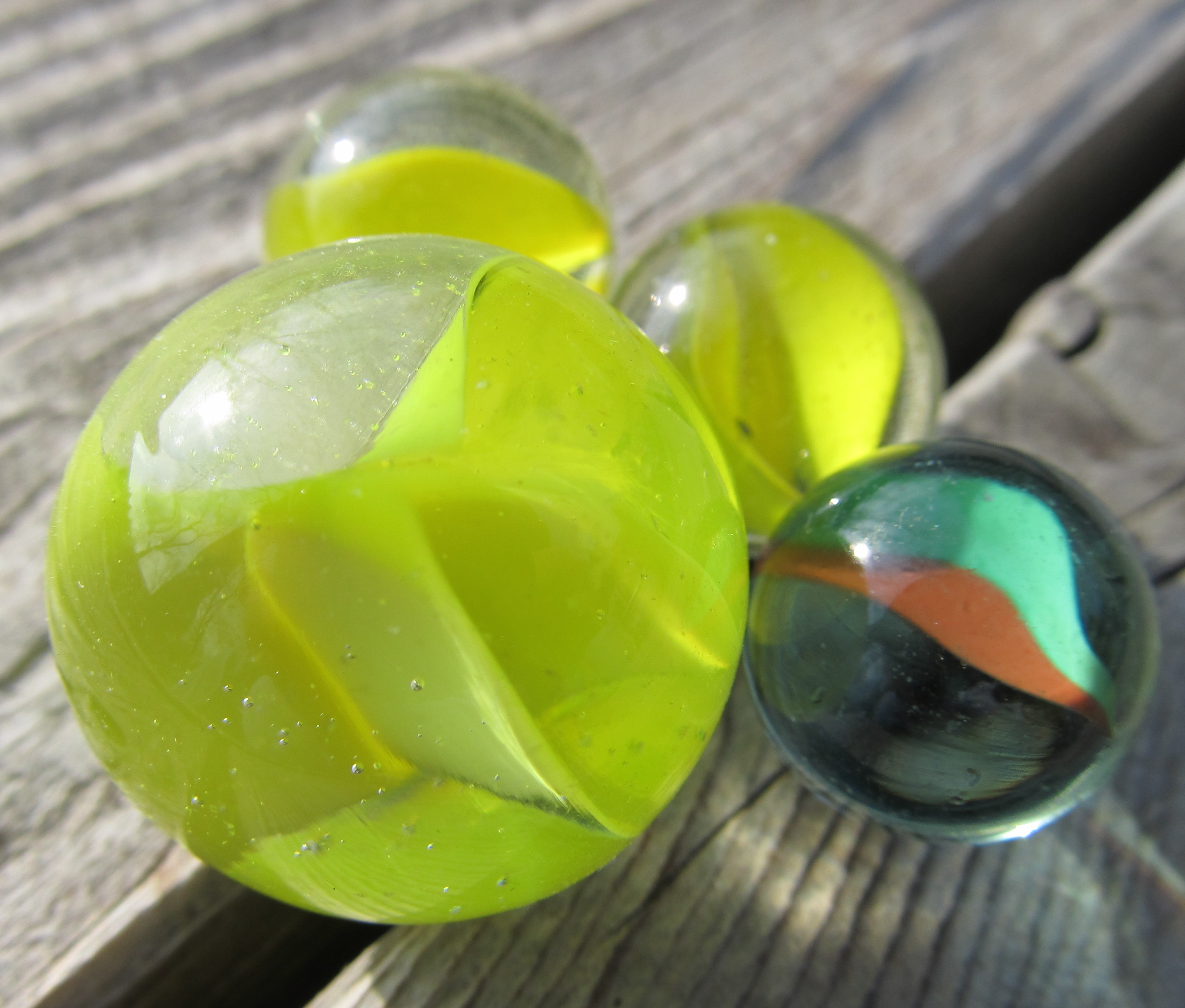
A “starry boulder” with three small friends.

And fortunes they were. The Chainway sold “starries”, 30 for a dime.   The starry was a half inch in diameter, and had a twirly colored pigment frozen into the center of the marble.   If you had the money, you might pick up a bag of starry “boulders”.   These were nearly an inch in diameter and went 6 for a quarter.  Pricey, but in the school yard, they traded around 10:1 against the smaller marble so there was room for arbitrage among the quicker thinking players in the yard.

Possessing a fortune in marbles was risky, too.

According to their job description, grade school teachers are hired to confiscate marbles.  In class, the sound of a vagrant marble clattering among the chair legs on a hardwood floor felt like money falling down a grate.

Aggies were the antiques of marbles.

“Aggies” were the antiques of marbles.

Logging the misdemeanor, the teacher would demand the marble be retrieved and placed in a mason jar on the corner of their desk.   You could buy them back, 3 for a penny, proceeds to the Red Cross.

This was a tension-filled time for big winners, whose loaded pockets would bulge like mumps.   Gingerly sitting down with the grace of a hemmorhoidal sufferer, the trick was to keep the pockets vertical to the fall line, and packed tight.

Kids with zippered cargo pants could plop, heavily laden, into their chair with impunity, but if they didn’t wear belts, they ran the risk of mooning the class which was a major felony.

A super boulder aggie, bigger than a quarter.

A super boulder aggie, bigger than a quarter.

Of all my childhood past times, allies made the deepest imprint.   In 5th and 6th grade, I played with stakes from one to twenty marbles, and had won pots as high as 400.

But I have lost 400 too, which twisted the sharp blade of experience, let me tell you.   So much so, that I cannot pass a marble display in a toy store today without picking up a bag or two.   Now, a marble costs about 10-cents each, a 3,000 % inflationary effect.

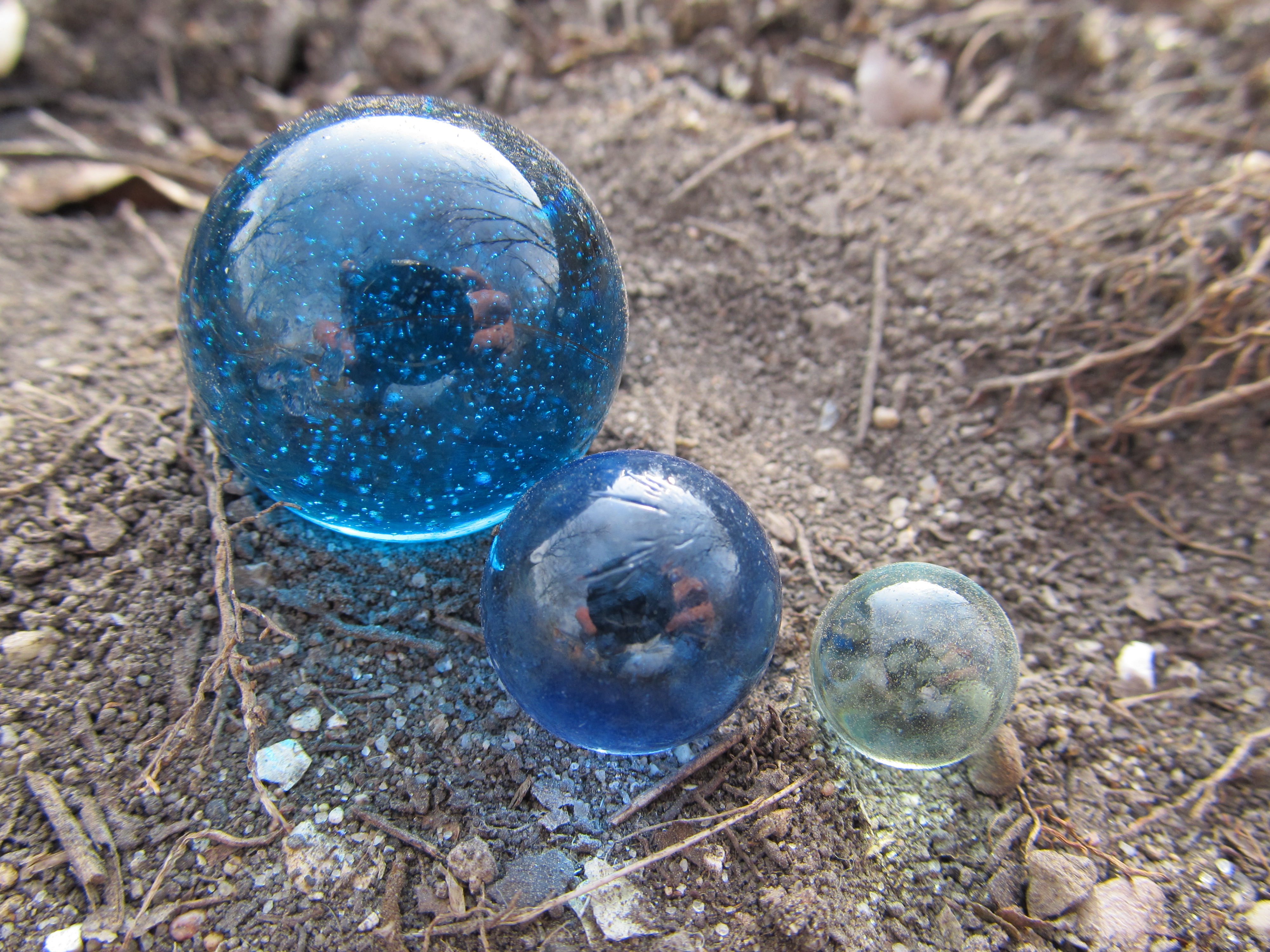
Do you know some popular brands of liquor use small marbles in the bottle neck to slow the flow?   I cut them out when the bottle’s empty.  So far, I am not buying liquor just to retrieve the marble.  My wife shakes her head, staring at me– a sorry junkie who can’t kick the habit.

IMG_7043

A “purie” boulder and marble. Johnny Walker Double Black provided the tiny one.

I am not sure what to do with my stash: two large Crown Royal bags.   While I want to give them to my grand kids, I have this shameful, miserly greed that won’t let them go.  Remember in “Ghost” when Whoopy Goldberg won’t let go of the $4,000,000 check?  It’s like that.    I am afraid they’ll end up at the bottom of a fish tank.   Or worse, inside a flower pot anchoring a bunch of tulips.  It would be okay if they were displayed in a glass table, maybe.

IMG_6987

The alley bag of choice.

But what I wouldn’t give to take the whole lot of them to a school yard next week and find a buzzing, hard-packed dirt casino, under the shade of an oak, churning with the yell of young risk takers, digging holes for a new game.


Thanks for sticking with me as I try to control this habit of mine.  I just can’t shake it.  If you “like”, say so, and please share or follow!

Marble Count 038

At the end of a long successful day.


Standard