direct mail, Marketing

DAV Makes The Numbers

I just received a mailing from the Disabled American Veterans, whose organization I frequently support.

DAV's Mailing to Past Donors

DAV’s Mailing to Past Donors

The mailing piece is illustrative of the investment DAV makes to raise money for their many services provided to America’s injured war vets.  If you have never received a DAV piece, you have not seen the abundance of gift stuff frequently mailed to potential as well as loyal donors: greeting card sets, bookmarks, calendars, and beautifully crafted address labels.   There’s nothing “junky” about a DAV appeal letter.

IMG_6191

46 cents postage, courtesy of DAV

What struck me about this recent letter was the inclusion of a reply envelope which was already paid with 46-cents of stamps.

Claiming austerity, most fundraisers ask you to provide your own postage.  Instead, DAV pays the bill.   Does it seem contradictory to you?   Or does it make perfect sense?   My guess is that providing the postage is a tactic to increase response, not necessarily the gift amount.   In other words, if a donor normally gives $10, the prepaid return postage tactic doesn’t get more dollars per donor, but it gets more donors: those folks who won’t allow 46 cents to go to waste.  And it’s unlikely many stamps get steamed off.

But here is where it gets interesting: what direct mail manager is willing to put their job on the line by suggesting they add 46 cents to the cost of every fundraising letter they send out the door.   “Are you nuts, or just plain stupid??” suggests their boss, popping TUMS once a minute.

“Riskophilic” may be the proper term.    Daring.  Or canny.  A little bit of math may reveal the truth.

You can look at DAV’s 2012 annual report which shows some numbers worth bragging about.  They earned $97 million in direct mail donations at a cost of $32 million.   Basically, for every dollar spent in direct mail they received 3 dollars in return.   The 3:1 ratio is pretty consistent every year, and by the way, their fundraising cost is only 19% of all their expenses, which is quite acceptable.

Anyway.  The letter I received had 5 Christmas cards and envelopes, a disclosure sheet, a letter, outer envelope and reply envelope.   With outgoing postage, I figure the kit was worth 75 cents in the mail.  $750/m.    Add an additional 46 cents, and you are at $1.21 for one piece of mail.   Multiply that by 100,000 and you have college tuition at Northwestern.

However: increase your cost by 60% and you need to increase revenues by 60%, to keep that 3:1 ratio.   Sounds challenging?   Just about miraculous is how I would define it.   You don’t get swings like that.  But the beauty of direct mail is that you can test it both ways, with and without the extra stamps.   Clearly, the test proved  positive, in a good way, so the DAV is keeping the USPS afloat while making money for its vets.

There’s more at work though.   That crazy manager also has another equation in his or her head.   It answers the question: how much revenue with every piece mailed?   If each piece costs $1.21, then each piece must earn $3.63 in donations.  3:1, right?    But only if DAV gets 100% of the people to respond.   What if only 15% of the people respond?   Then a $3.63 donation won’t cover the ratio.     Now the gift changes, and here’s the revealing equation: $3.63 divided by 15% response.   $3.63/15% = $24.20.   The average donation must be $24.20.

IMG_6190

The “ask” starts at $7.00.

Hmmm.  Look at the donation form on the letter.   DAV is asking for “$7… $10… $15…  or more”.  Whoa!   What if everyone just gives $7 dollars?    Well, again, this is what gets tested, and DAV is pretty confident that a $7 gift is acceptable.   My hunch is that if each gift is at least $7.00, DAV just about breaks even.   How’s that figured? Well, divide the piece cost by 15% response.   $1.21/15% = $8.07 average gift required to break even.  $7.00 is close.

Fortunately, my bet is that people give a lot more.   Without having any direct knowledge of DAV’s results, I can only guess that the scenario is something like what I have described.    And if it is anywhere close, DAV has some very good writers, and some very generous donors.    And some very deserving vets.

A salute to all of them!

Standard
direct mail, Marketing

DM: Cheaper By The Gallon

junk-mailIs it possible today that any direct mail we get is still worthy of the moniker, “junk mail”? Once upon a time it seemed that mailbox was overflowing with incredible stuff. But after the shenanigans of the 70s–no, not junk food; and in the 80s.. no, not junk bonds — that government and the USPS put the brakes on junk mail. Mean time, reputable cataloguers, mail order companies, insurance, fundraisers, retailers and publishers had raised the art to a science.

Today, there is a legitimacy hurdle so high for any direct mail business, that to clear it, you have to be very, very good. And what is that screen?  Economy.

110601-eggies

A typical all-in cost for a direct mail letter is around 30-50 cents a piece.   Compare that to 39-cents a pound for bananas.    Mail a 100 letters, and you can find the $30-$50 bucks in your back pocket. Mail a thousand, and give up your iPad. But mail 100,000 and you give up your new car. Mail a million pieces, and you have just mortgaged your home, or a boatload of bananas. That’s why direct mail is hardly junk. It is very expensive, and without this expense, it won’t work.  Time to re-think that Eggies-by-mail deal.

So who thinks it is junk? The persnickety consumer, of course. And why? Because they don’t want whatever is being sold that day.

The reality is that on any day, we consumers are suspicious, and very tight-fisted. I bet we only surrender to an unsolicited sales pitch about 2% of the time, regardless of medium: mail, phone, in person, on TV, radio, or email.  I do  admit caving for the Eggies, which for the record are a physical impossibility. The chickens had it right from the beginning.

IMG_5632
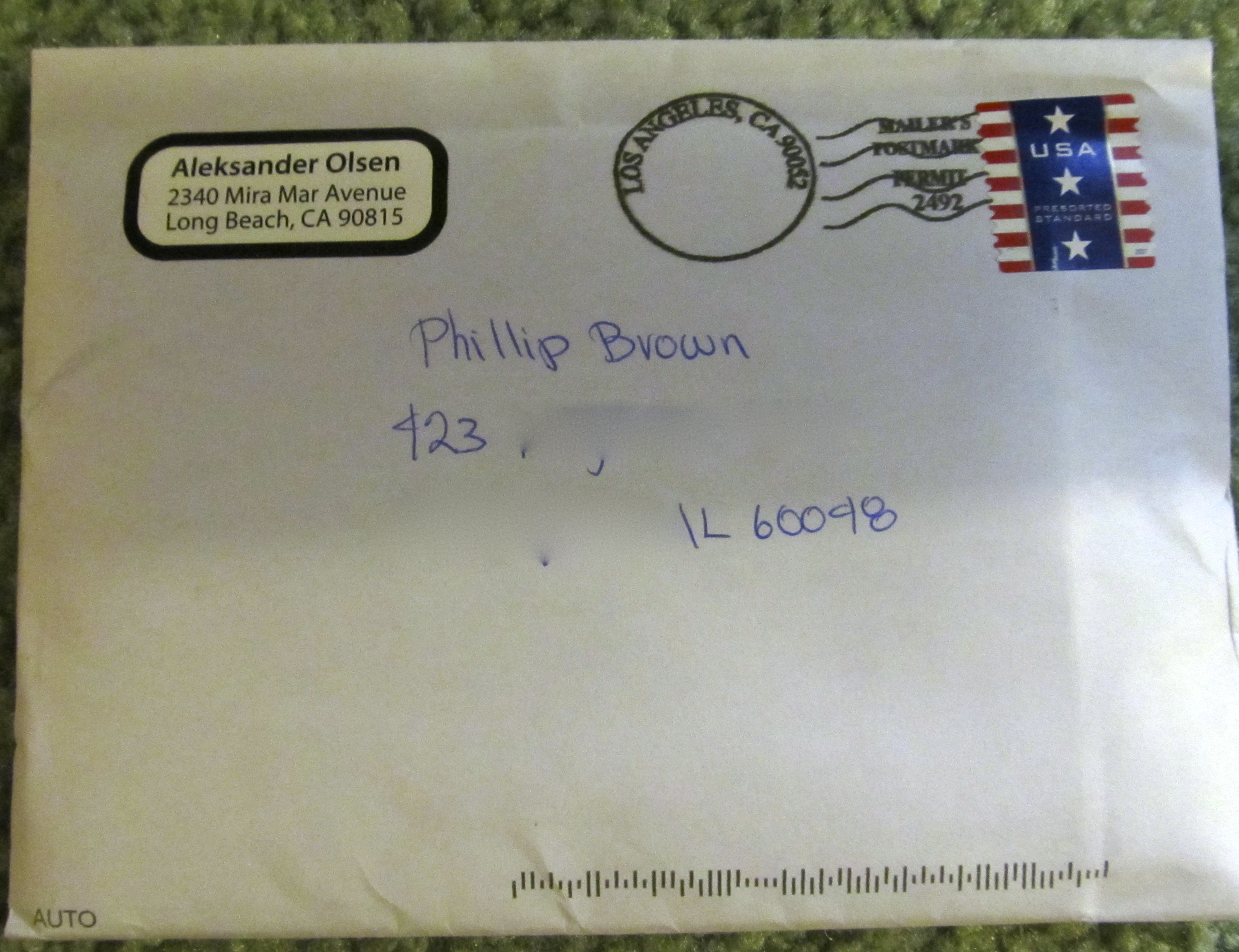
Which leads me to a piece I received earlier this summer. A mauve-colored, hand-addressed and stamped envelope, complete with a foil return address sticker. My antennae are up.   Would this be a well-wishing note from a long forgotten contact? A wedding invitation? Birth announcement? A request for money from a relative? All of the above?

No. Inside the envelope was a short note from the desk of Aleksander Olsen advising on the merits of a certain skin creme. Despite the tracks and furrows that criss-cross my shrine-like body, I was not hooked. Perhaps if his credenza had written, I might have been swayed.

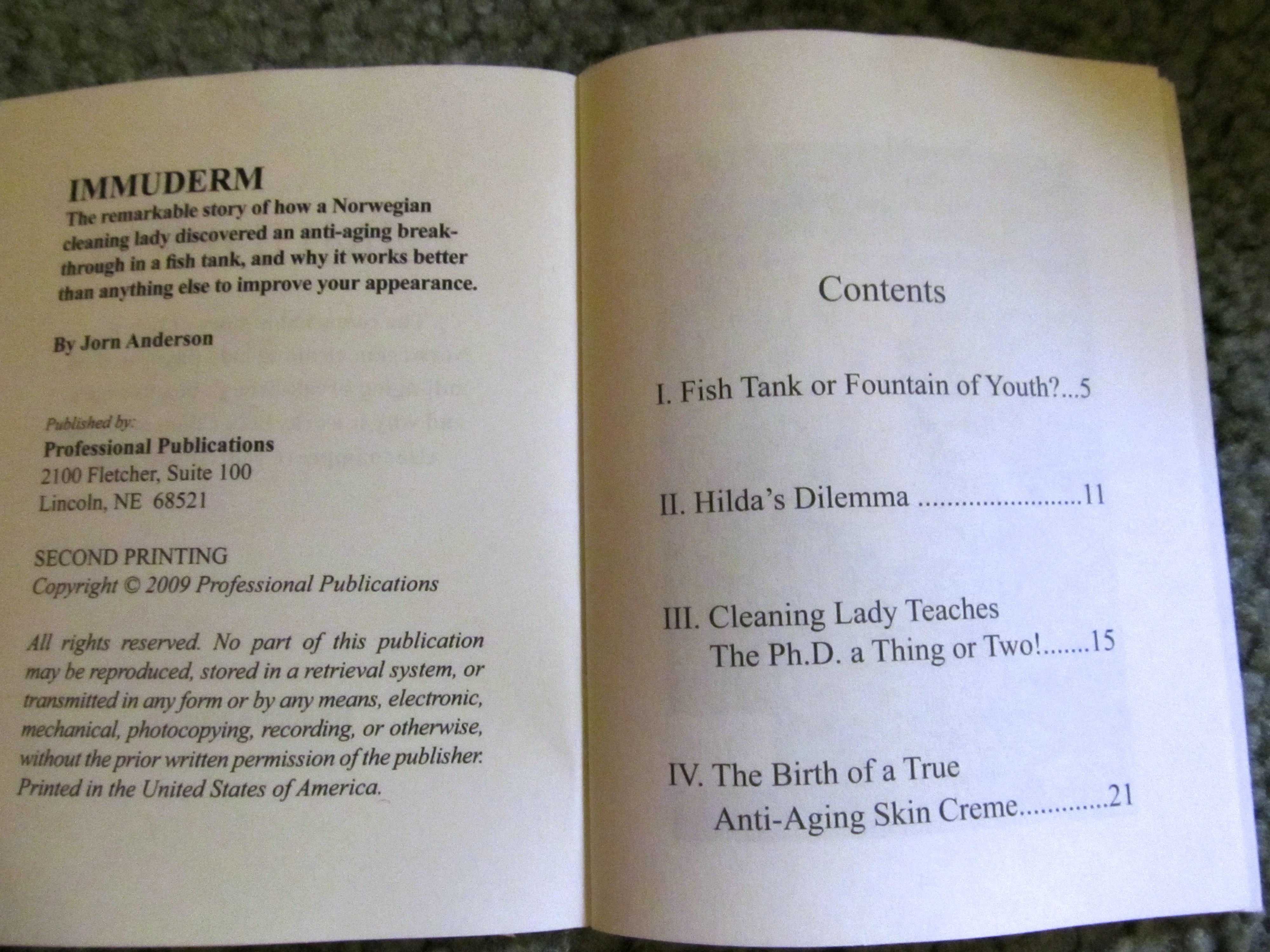
But Olsen’s desk also sent me a 32-page booklet, and it is a work of art.
IMG_5586
It is the tale of Hilda, a Norwegian cleaning lady, who, like her entire countryfolk has a crick in her neck from living on the side of a mountain overlooking icebergs in the North Sea. It turns out that she cleans fish tanks in Norway. If you haven’t been to Norway yet, fish is the main protein staple.   Hilda’s job would be similar to that of a stable cleaner on a Kansas beef farm.    Actually, I have never been to Kansas so I am only guessing on that.

In any event, the booklet unfolds a page-turning saga about Hilda’s travails in the tanks. Every evening at home, as she washes up for a night out on the town, she discovers under the layers of fish elixir a fresher, tighter, more supple Hilda.   She has reversed the hands of time!   The story introduces a series of sub plots, so spoiler alert, let me just say that she looks great, smells great, and I can too for just $60 on a tube the size of a shrimp.  Well maybe a lobster tail.

IMG_5587

The thing is, as obscure as this offer is, I don’t consider it miss-applied.   I have the money.   I certainly could use some air-brushing.    And who doesn’t have a secret wish to smell like a school of herring?   I wonder if Hilda has a cat.

So to my point: Mr Olsen’s desk probably holds a business plan that reveals  the path to riches selling oil of tank scrapings to prunes like me.    This is hardly a junk mail enterprise.

But it sounds fishy.

Standard
direct mail, Marketing

Turning Someday Into Now

What would be your reaction to mailing a hundred or so wedding invitations, and only 2 or 3 people show up?   After celebrating with champagne, a direct mailer would happily plot through the night about doing it again tomorrow.   And maybe bumping up the appetizers a bit.

the-godfather

Every good offer adds an incentive.

The challenge of direct marketing is to create the irresistible offer.    On a Don Corleone level if possible, but within the USPS regs.   The closest I can think of is the IRS: “Tell us how much money you have left and we will take it.”   Their mailbox overfloweth.

The thing is, all the targeting, the overlays, clustering, time-stamping and regression analysis can get you to the right person at the peak of their tumescent desires, yet, they don’t commit.  Why?

MW 2.30

Long after the grapefruit is gone, you can still treasure the free spoon.

It’s the offer, or course.  More to the point, it’s the added incentive offer that pushes the buyer over.

For instance: you may like the idea of four monthly $25 shipments of 15 ruby grapefruit, but you don’t budge.

Then, they throw in a set of 4 serrated, stainless steel grapefruit spoons and you can’t dial fast enough.    Or the showercap company that bowls you over with a “Fast Fifty” deal promising a Mystery Gift to the speediest responders.

That’s how to convert “someday” into “now”.   By the way, serrated spoons are impossible to use on a grapefruit, but once an idea has taken hold…

And give the IRS credit too.   They have learned how to move you from:  “I dream about some day when I will file my return” to  “Jiminy, I gotta do that right now!”

Their incentive offer–jail time!

I recently received a direct mail offer from a funeral service company.   Sorry, “Memorialization Service” company.   A discreet letter promoting the many benefits of cremation.

It is a ticklish subject only made comfortable to discuss, thanks to poet Robert Service.    He penned ‘The Cremation of Sam McGee’ so Johnny Cash could recite it to us.

Anyway, the company offers me a free booklet to help me make up my mind.   Am I reaching for my pen?     I don’t think so.

cremation

“I took the bill-me-later option!”

But then, they throw in the dealmaker: “WIN a pre-paid cremation.  Return this card etc…   Last month’s winner is…”,  and they go on to identify by name, one lucky fellow who can now pack his bags with confidence.

I won’t call it a barn burner, but it certainly ups the offer.

Still I was a little curious over the difference between winning a free cremation, versus a pre-paid cremation.  Does that mean I forfeit the bill-me-later option?

And then I wondered too, is this transferrable?    Say I was hit by lightning.   Will they do me like a twice-baked potato?

And then, if I did win, how do they break the news?   Did the lucky mope who won last month get told immediately, or is he waking each morning  wondering if today’s the day?     Will it be a knock on the door from the prize committee chairman himself?

“I have good news and bad news, Mr. Brown.”

grim_reaper_cartoon

So I have not quite tipped into the “now” column yet for the cremation offer.

But wait, there IS more!    Way down in the fine print on the reply form–tiny mouse type– is the statement: “Vermont residents may omit return postage.”

There it is!      The final component of the irresistible offer.

Vermont is beautiful in the fall.  I am packing now.

Standard
Marketing

Let Me Get This Call

A decade ago, we registered for the Federal Do Not Call service.   Happily, as forecast, the telemarketing calls stopped almost completely.    One downside was we no longer knew when to sit down to eat, because they no longer called us at dinner time.   As one could expect, nearly everyone registered for DNC.   Recent counts total in excess of 72% of all Americans’ phone numbers were registered.   Incidentally, you can tell when a government program IS popular, because everyone flocks to it.  Kudos to the team who put that website together, unlike the poor mopes who have spent gazillions to operationalize HealthCare.Gov.  So far, it would appear that their Do Not Call listing is working fine.

But ours no longer does.  That titanium-hard walled fortress surrounding our phone number has been breached, and we are now more popular than Bieber, Kardashian and PizzaHut all rolled into one.  The phone rings, starting around lunch time, and continues into the early evening, with the periodicity of a school yard alarm announcing classes, recess, and potty breaks.  And when we pick up, the pitch is always the same: a pause, followed by a recorded voice stating, “Hello.    The FBI reports significant growth of home invasions…” or “Hello.   This is the last warning we can provide about your bank account…”   or “Hello.   Triffids can reduce the value of your home…”.

I used to look forward to the telemarketers in the early days of DNC.    I could actually speak to the poor schlep on the line, and advise him that he was incurring a possible Federal felony charge with fines of not more than $5,000, and then listen as the line went dead.

But it is not like that any longer.   The telemarketing gurus figured out the perfect tactic.   Fire the schlep, and use a robot.   Give it a shameless pitch that goes on longer than an outraged legal beagle like me can wait.   Avoid identifying yourself or your brand.   Then, close the pitch with options to (1) Have a person call me back.   And when that happens, there’s no way to complain, because I asked for it!  (2) Remove me from the calling list.  At which time I will be removed from the 6pm rotation to the 9pm wave of follow up calls next day.

The fact is, the DNC program has successfully registered just about anyone but a dead voters’ list in Chicago.   As a result, there is no way the Feds can keep up with the complaints, even if we knew who to complain about.   In 2011, there were 2,200,000 complaints filed.    I wouldn’t be surprised that the complaint line number is on DNC too.  “We’ll get right on it!”

So as a last desperate step, I went to http://www.donotcall.gov .   Monkeys may have designed this site.    Or chickens with disabilities.   No Federal logos or impressive eagles nor any U.S. FCC or FTC seals.    I imagine a t-shirted hacker sitting in his mom’s basement waiting for the next registrant.   The home page cautioned me about tele scammers and other hazards of the phone world, and then offered to take my name, email address and up to three of my phone numbers.  Really?   I could not do it.   The whole act of supplying this contact info to a government department seemed like setting down a bowl of red meat in the lion’s cage.

Instead, I have developed a failsafe strategy.    It required changing our voice mail greeting, but I doubt any one would be disappointed with the new instruction.   “Hello.   Congratulations, you have successfully reached HealthCare.Gov.  Please hold.”

Standard