Culture, Entertainment, Music, Thanks

Tom Rush, Master

Tom Rush2

A Charles Giuliano Photos image of Tom Rush at work.

Occasionally a simple action sets a need in motion.

A couple years ago a college friend sent me a CD of folksinger Tom Rush.  This entertainer’s music first broke into our lives back in  1966, hung in there until graduation, and then evaporated as we moved on.

Competition with job, kids and new directions pretty much locked Tom Rush out of our daily routines.

But fifty years later, the brand new CD woke me up.   Not only was our musical hero from university days still alive, but he was also, still, at the the top of his game.

We decided to go see him again.

On stage, Rush is a quiet conversationalist.  He talks to the audience, and snares them into the context of his next song with the finesse of a master salesman.   His modesty hides his greatness in the genre.

Launching his career along with icons like Bob Dylan, Joni Mitchell, James Taylor, Eric Von Schmidt, Jim Kweskin, Richie Havens, Fred Neil today his body of work reaches across decades of accomplishment, from early blues to contemporary ballads.

If “ballads” sounds corny, think stories, worries and wishes put to music and rhyme, about things and events on our plates every day.

IMG_5339

Isis Restaurant & Music Hall occupies a renovated theater from 1937 in the heart of West Asheville.

Last Sunday Tom Rush performed at the Isis Restaurant & Music Hall in Asheville, NC.   Contrary to the those of many small cities across America, Asheville’s downtown is booming.

In the west end, also known as the West Village, the Isis theatre is a fixture built in the 1930s, and renovated to its current appealing look with bar, restaurant and stage.  Outside, the original marquee showcases the night’s act.  Across the street is a guitar shop, with nearby pawn shop, grocery, village market, cafe’s and gas stations.

The street is filled with cyclists and people enjoying their particular pursuits.  While there was plenty of curb parking we chose to park in the grocery lot.   There was a sign pointing to a steel box into which I folded eight dollar bills to keep my place.

IMG_5340

Across Haywood Road a guitar store stands ready to fulfill the next musician’s dream.

Seated at our table up front, we looked at our hopeful neighbors, ordering dinner.  The Isis is delightfully small.  It seats about 50 diners and another 100 or so listeners on the main floor and in an upper gallery.   It is a cool place, good food, with a restaurant out front which was packed when we arrived, 90 minutes before the show.  Louise, the show scheduler came by our table to welcome us– a nice touch.

Up on the stage, a young fellow is tuning instruments: pianos and guitar.   He looks like a stage hand but in fact is Matt Nakoa who opens for Rush.   I shake his hand, and ask him to pass a note to his partner, requesting a song.

I can’t believe I am doing this but the opportunity can’t be lost to communicate with this giant.

It helps when I add, “We saw you last September in Minneapolis.  You guys were just great, thanks!”  He got my name and finished his tuning, and left the stage.

A few minutes later after Louise opens the show, Nakoa reappeared and delivered a virtuoso performance.   His songs are rich, thoughtful and complex, with a voice that adds a layer of honesty to the words.

At the keyboard, he is incredibly efficient.  Not that he uses only one or two notes per bar, but rather that he uses all his fingers every second.  I was reminded of the Bruce Hornsby sound: full barreled piano, active and melodic.  Matt Nakoa could choose to be a powerful classic concert pianist, but he opted for the folk and jazz club scene, much to our good fortune.

matt nakoa on keys

A Neale Eckstein image of Matt Nakoa unwinding a tune.

Nakoa also played guitar, with a light and intriguing touch.   He is left handed, playing a left handed guitar, but strung for a right hander.

This forces an inverted chord formation which for most people would be like tying their shoes using a mirror.  I am guessing he had to borrow someone else’s guitar in his learning, and the habit stuck.  The result is golden: a unique and magical delivery.

He delivered a half dozen songs, each original and lush in melody.  You want to hear “Ballad of Jenny Kane”.  Just as enchanting however was his patter between numbers.  He plays while he speaks, reminiscent of  60s entertainer Mauri Hadyn who also spoke with the audience while she produced a continuous soundtrack of riffs.

Tom Rush walks on after Matt’s introduction, and the crowd cheers for both singers.

Two figures could not look less likely to work together, and that is the magic of this duo.   We are faced with mop-headed Gen-x musical prodigy standing beside a crusty, smiling, white haired, git-picking balladeer.  Unbelievable combination.
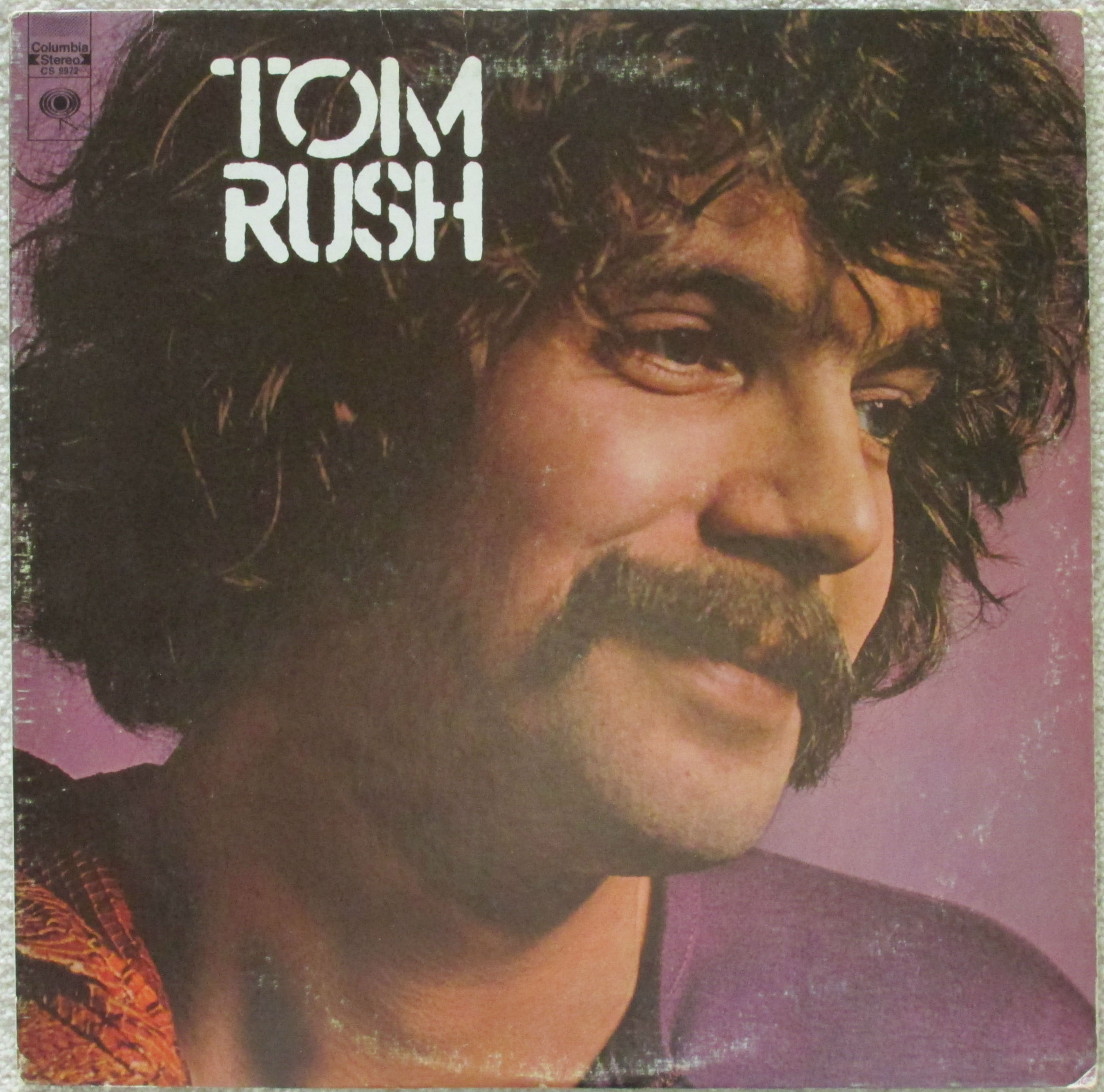
Tom Rush Purple

Early on Tom Rush started a following that just won’t quit. His ’72 Columbia Records release.

Our fascination is soon overcome by the quality of their product.   Rush commands the room with his good nature and low-key, self deprecating introductions.  He opens up his act with the confidence of a master woodworker unwrapping his blades, choosing one to carve a unique keepsake for the audience.

Launching into “It’s Gonna Get Hot Tonight” the crowd responds enthusiastically to Rush, encouraged by his beat and voice, both strong and happy.  In the background Nakoa has shelved the concert hall vibes to provide a wood-floor honky tonk sound that fills out the song perfectly.

The audience tonight is a following that has grown organically over 5o years of performances.   We drove 750 miles to see him.  True to his brand, Tom Rush delivers amusement and satisfaction by way of his story telling, singing and playing.

We know these songs, and they have legs.   The lyrics are his, in perfect measure, with stories we want to hear.   They are delivered by a voice that is both raucous and contemplative.   He can change our mood in line or two, all the while polishing that finished piece of work for presentation.

There is a side to Tom Rush which is remarkable, and it points to his generosity.   Yes, Matt Nakoa adds a dimension to his music, but it is the reciprocal nature of Rush’s partnership that is giving a younger generation the benefit of his experience.

He is hardly looking at the final days of his stellar career, with over 25 engagements scheduled in the coming months.  Despite that, he has taken on the onus of sharing what he knows with a new, younger talent.

Matt Nakoa has his own music and his own story, but he is following in the footsteps of a legend with full support.   In big business, the CEOs always say to hire people smarter than we are, but it’s scary.  Rush took that dare on Nakoa.   Our kids should all be so lucky.

A look at Tom Rush’s website unveils another gift.   While he has the usual display of story, news and events, he also has a page of FAQs .  What’s with that?   Countless questions from fans about how to play his songs, complete with guitar tunings.   In our world, it would be like a master vintner unveiling his secret recipe for a knockout wine.

Which leads to another puzzle in the Tom Rush narrative.  Why does a self respecting folk icon tour New England and the west coast playing in small venues for only the price of a good steak?  Celebrity has its costs, but modest ticket fees aren’t among them.

I think the answer is that the man loves what he does, and he wants to share it.   His audience loves him back. That is remuneration enough.

And by the way, he called me out, and played my request.

Thanks for reading!   This show is what coffee house music and jazz clubs are all about.   Who needs an auditorium for 20,000?  I pass on some websites for your interest, and feel free to share!

Tom Rush Show Schedule

His CD “What I Know”

Matt Nakoa’s Home Page


Standard
Fundraising, Media

Why Don’t You Just Ask?

Charitable Giving, Social Media and Stickiness 

online donationsWhy is it that fundraisers can’t write a note, or pick up the phone and just say what’s on their minds?
Why do they have to float it out there, like smoke, or a bad itch, on Facebook or Twitter?

It brings to mind a lesson from long ago.

As a kid of 10 years old, in Delhi, my hometown, ice and skates were intended for hockey.  You know you live in a hockey town when the rink is reserved every morning and night for guys loaded down with potato sacks of gear and sticks.

Anyway.  I didn’t play hockey.  I was in the figure skating club which was a popular girls’ sport.  Not so much for boys, but there you have it.

Every year our figure skating club hosted an ice carnival.  This is a 2-hour show where the whole town comes to watch this costume extravaganza on ice, down at the rink.  Little squads of 7-year-old Sugar Plum Fairies skoot out in a circle and pirouette.   Flocks of Skunks wobble on tiny skates across the ice while the town band plays “The Baby Elephant Walk”.

The senior girls kick line does a bouncy number to a Gypsy tune and the crowds roar their appreciation.  The whole time the blue and the red lines plus 5 face off spots map the ice for us.

The crowds are there because they bought tickets.  $3.00 for an adult, $1.00 per child.

Those tickets are sold because we figure skaters were told to go sell the tickets.  Which brings me to the current point in a round about way.   I hated selling tickets…scary and embarrassing, knocking on doors, asking people to hand over money for a non-hockey event on ice.

This was an annual debate between me and my parents:

“Why do I have to sell tickets?  Why can’t people just go to the booth and get them?”

“Because you need to learn to ask .”

“What do you mean?”

“Look, you need to learn to ask people face-to-face for things that you need.   We need to sell those tickets.  It’s for the figure skating club.   Most important, the audience wants to know who they are giving their money to.   This is business.   You are the connection. So get out there, and ask them to buy the tickets. Now.”

Today, with the power and saturation of the internet we can sell anything we want online.  More significantly, we don’t have to ask, beg, beseech, or grovel before anyone particularly.  It’s a non-contact vocation.  We can just float an open invitation out there, and see who bites on it.

Skywriting comes to mind.

If our follower numbers are big enough, we might get all we need without a repeat advertisement.  If not, the public plea is repeated, with urgency, and perhaps a shade of disappointment hidden between the lines.

The shame of this online power is that there is no need to commit, or worse yet, make a plea or promise in return to any one.  Just as bad, the buyer or donor doesn’t get any nod or recognition for rising to the occasion.  If they’re lucky, the online gifting site says “Thanks– your receipt is being emailed.”  And that’s about it.

So I am all for charitable giving.  And any time someone just asks me, I am happy–no, delighted– to give.  Charitable giving is a way for someone to participate and to help, and most importantly, the giver is thankful for being invited.  That was my lesson from home.

So drop a line, or pick up the phone, and just ask.

Standard
direct mail, Fundraising, Marketing, Media

Battles In The Mailbox

IMG_5172

The Memorial Day rush begins.

There is an ongoing, armed conquest being waged in our mailbox.

Whether it was my donation to a certain political party that flagged my name, or perhaps a popular consumer magazine subscription, the ensuing barrage of fundraising mail from veterans’ associations is non-stop in our mailbox.

Regardless, the creative pitches are stunners, and deserve a closer look.  You are hereby invited to read my mail!

Most of these charities are profiled and rated on Charity Navigator.org, which strips away the emotion to detail actual performance against their stated missions.

Turnkey Office 

IMG_5163

As big as a door mat, and packed, too.

The Disabled Veterans National Foundation takes overwhelming force to a new level with their glossy, Flat-sized embossed package.  Despite the red-stenciled “DO NOT FOLD” our faithful USPS carrier did just that to get it in the mailbox.   It measures 12 x 15, and according to the weigh scales at our grocer’s fish counter, weighs 13.4 ounces.  If that seems heavy to you, perhaps we have been paying too much for our halibut.

IMG_5169

The field ready office with solar powered personalized calculator and stationery.

Inside this doormat-sized kit is a desk pad, calculator, calendar book and ball point pen.  Along with this prefab office kit is a $2.50 check drawn on a Bank of America account.   Surely a mistake, it is signed, dated and made out to me.   In the enclosed letter, the writer, smitten with remorse, asks me to return the check.

Check mailings are iffy because in many cases the marketer needs to have funds held in escrow to honor the checks if, fates forbid, the recipients decide to take the money.

Disabled Vets FNDN182

“Made in China”–The disturbing bug that must be shown.

This kit ain’t cheap.   Postage alone is nearly a dollar, and considering the hand-applied “Philip Brown” label on the calculator, plus its die-cut and tensor-ribboned place mat, the overall cost has to be at least $4-$5 dollars each.

Which may explain why the kit was made in China– not an encouraging signal for U.S Veterans.  I wait to see if they will send me a typewriter next year.

Parade-Ready Flag

IMG_5170

Steel plate reveal: your own desk ready Stars & Stripes.

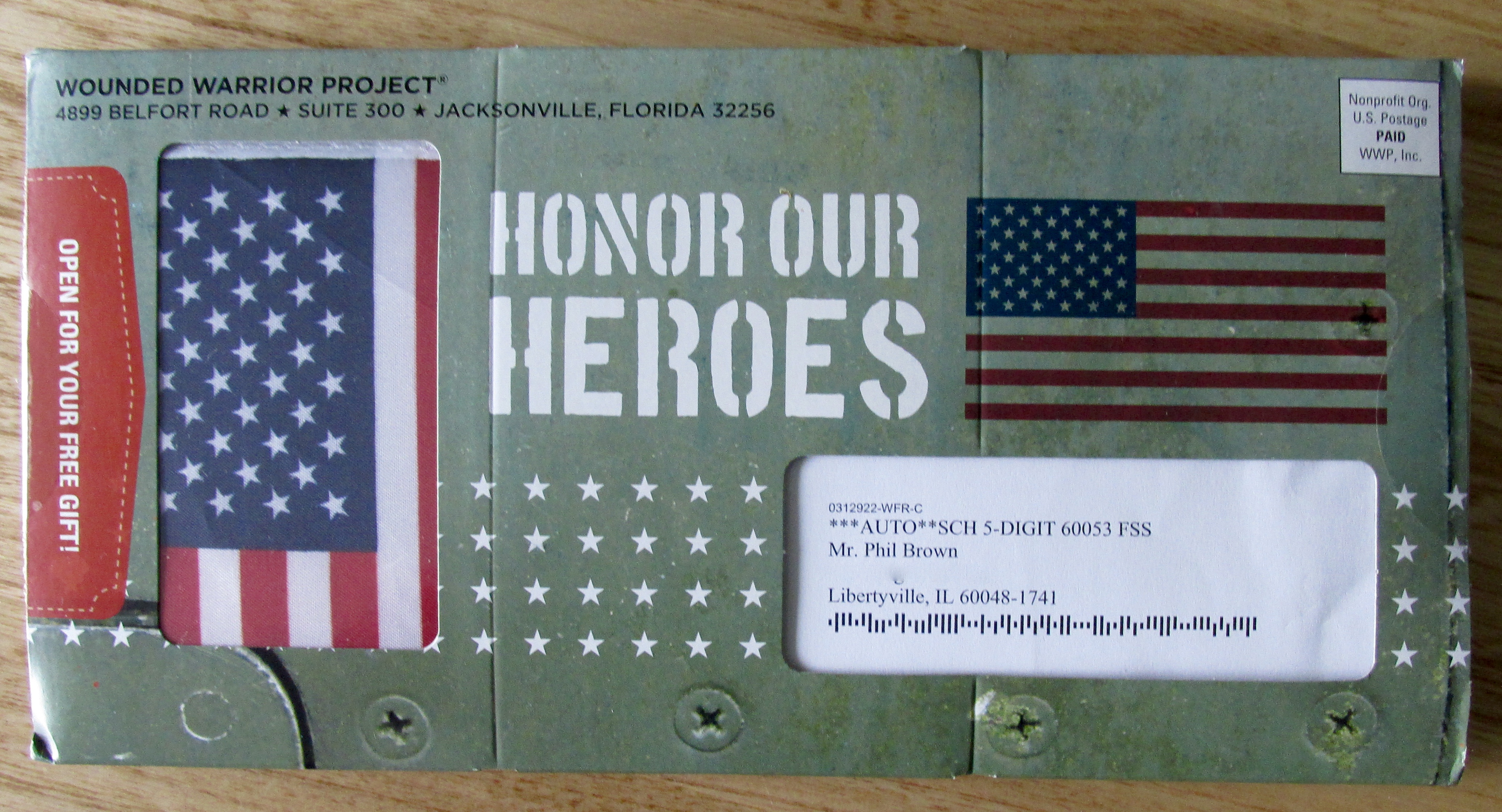
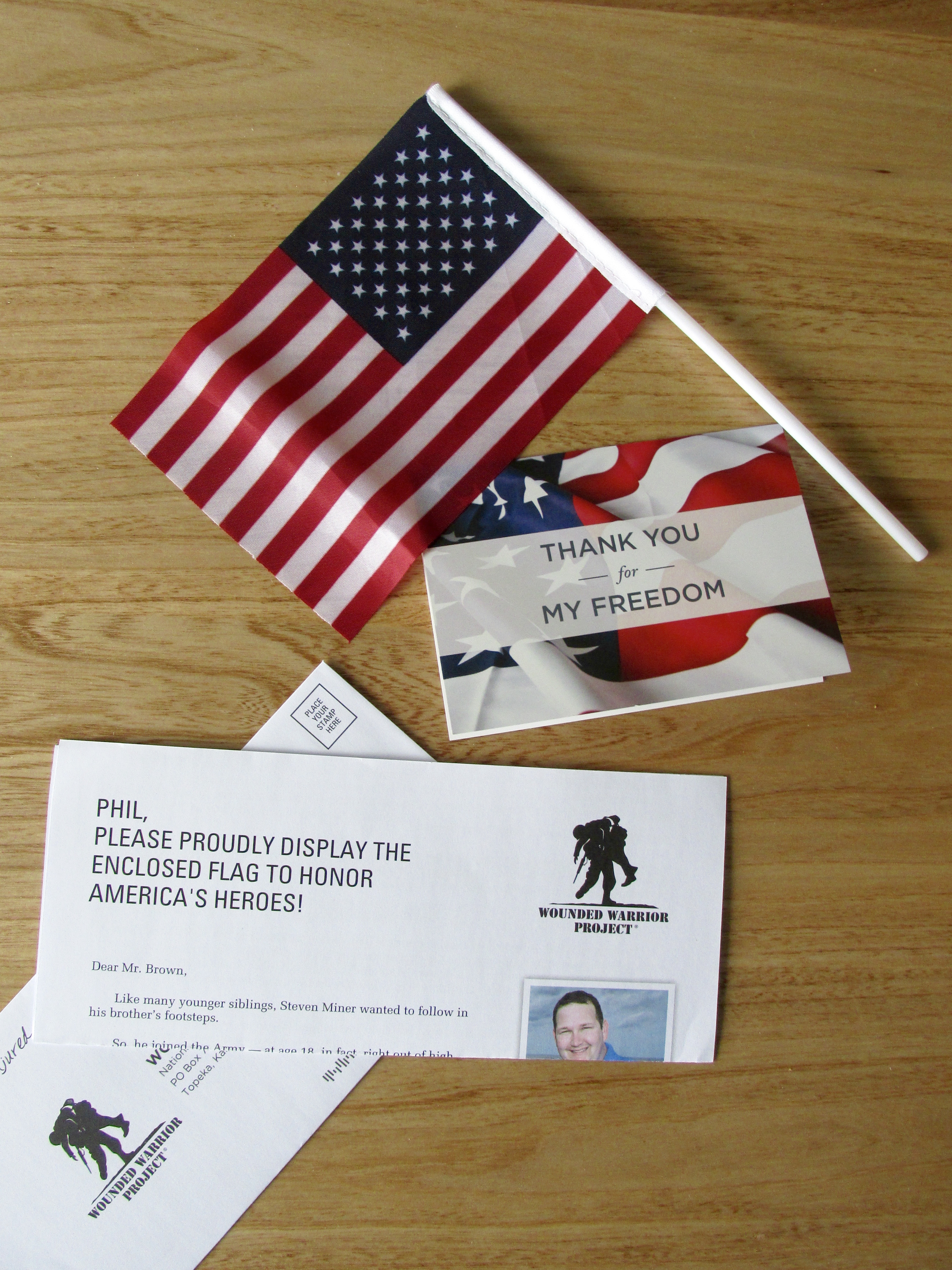
Wounded Warrior Project also approached us with a package, a 5 x 10 windowed boxlet   displaying a real flag inside.  This Army-green imitation steel-plated ammo box is nearly half an inch thick, so it’s non-automation all the way..40-45 cents to mail.   The flag is intricately folded into a die-cut foam holder that also holds the addressed donor form, a hand-assembled product for sure… which explains again, why it was made in China.   In the mail, $1-$1.50 each.

We’ll talk about cost/response in a minute.

Photo Wallet

IMG_5187

A photo wallet… a hard to discard gift.

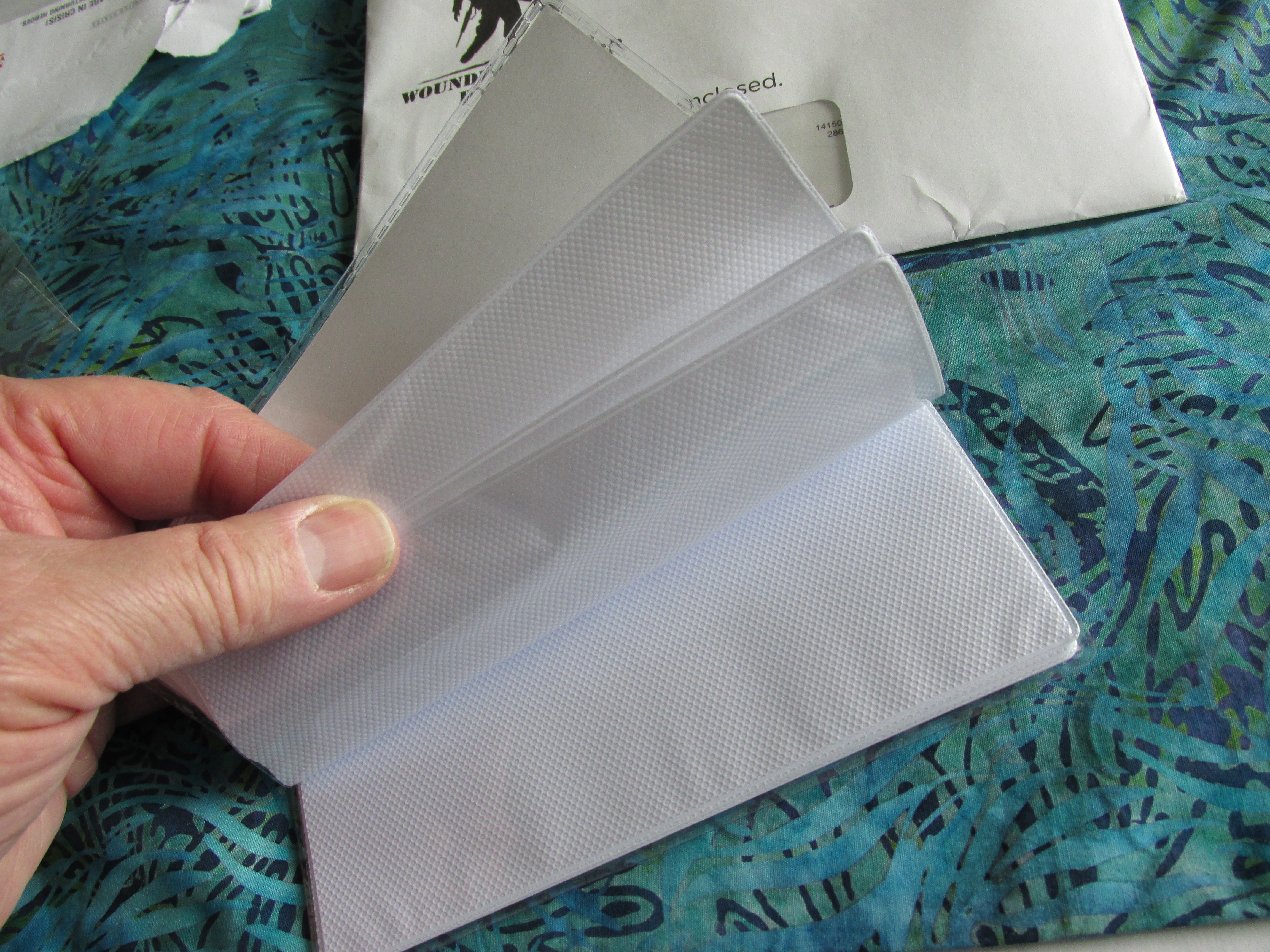
Wounded Warrior Project also sent along a separate request which included a 4×6, 20-page photo wallet.   Inside a regular 6 x 9 envelope, this gift actually made immediate sense, and the wallet now holds images of our ridiculously  brilliant, and beautiful grandchildren.  Not being one to take anything for granted, we will reward WWP for the effort.  Still, with postage, in-the-mail cost is 40-50 cents each.

Calling Cards

IMG_5174

Ersatz calling cards stuck in place to get the letter opened.

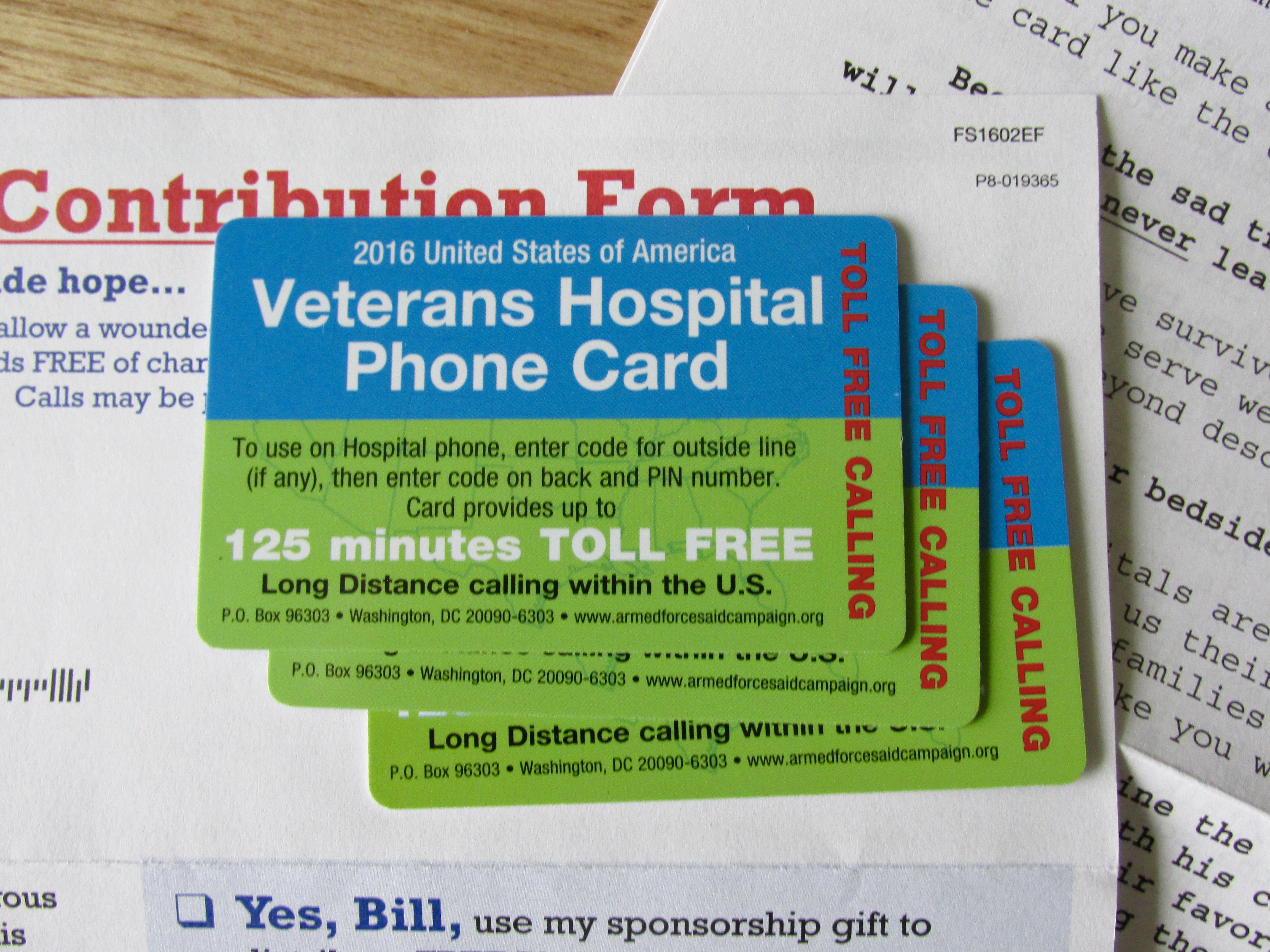
Help Our Wounded, and Armed Forces Aid Campaign have learned how to affix 3 plastic phone cards to a page.   Technologically, this is pretty cool, if not done by hand.  The cards are stuck on top of each other and appear jumbled through the large glassine window….as if they were thrown in quickly, sealed and run off to catch the 3 o’clock mail.  The impact, especially for the uninitiated such as me, is strong.   Their job is to get the envelope opened, and indeed, the ploy works.   Help Our Wounded, aka Healing American Heroes is not found on Charity Navigator.   My bet is the mailing costs 50-60 cents all-in.

Going For Our Stronger Feminine Side

IMG_5180

A pretty package with writing in mind. This one’s for Gramma.

Disabled American Veterans is the senior classman in veteran’s charities.  Despite that, they have assigned a female status to my record, so I receive kits that reflect more genteel tastes than one might expect.   Putting the gender bias aside, especially in North Carolina, this kit is in keeping with DAV’s efforts to send along quality gifts.

I can’t use any of this one, which is resplendent in lavender-hued Forget Me Nots.   Still, if I was desperate, making a struggling attempt to write to my passed on mother, or to scratch out a hasty last will and testament, I have notepad, and mauve colored, simulated vellum sheets for assigning my debts to chosen in-laws.

The kit is tasteful, if gender specific, and is certainly an eye opener.   DAV also uses real stamps on the reply envelope.  While the accountants may come unhinged at this largesse, DAV’s frequent use of the costly stamps is proof that the presumptuous gesture works in bringing in more donations.

One wonders how many codgers will steam off the stamps, versus cross out DAV’s return address and use the envelope to pay their water bill instead.

All in, this piece must tip the scales at $2.00 in the mail.  But it works.

Subtle and Cautious

USO 2016-05-02 185

Creative use of stamps–just enough to impress, but maybe a challenge for the USPS accountants.

The USO is the most conservative kit to ask us for a donation, and that is in return for a genuine Stars & Stripes Flag plus good feelings.   I included this under-played kit because of their creative use of postage.

Non-profit letters get a privileged postal rate, somewhere between 8-18 cents depending upon address density and automation compatibility.   USO chose to affix 5-cents worth of stamps to their outer envelope, and to use their postmark (#440) to make up the difference at the counter.

Their reply envelope reveals their cautionary approach to wasting postage money.  Rather than place the full 49 cents on the envelope, like DAV, they are willing to go for 5 cents, but left the Business Reply Mail (bill us) indicia in the corner.

We guess that this itsy-bitsy effort will drive the postal accountants nuts.

In the mail cost: 40 cents, tops.

Drop Another Nickel

Paralyzed V 2016-05-02 187

Just when you thought the nickel was yours, they want it back.

Paralyzed Veterans of America is one of several charities which has a conveyor belt from the US Mint to their mail room wherein millions of shiny new nickels are deposited on glossy label stock letters.

Just yesterday we discussed at lunch how many of us keep the nickel, which after all, adds up when everyone is mailing them, March Of Dimes excluded.

PVA’s piece is a max-sized letter, 5 x 11-1/2.   This is a smart move because the postage is the same large or small, so you might as well get the most paper into the package that you can for the same price.  However, nickel-enhanced gold foil labels are heavy, so the rule is to keep below 3.3 ounces or the rate goes through the roof.   $1.25-$1.50 in the mail.

Did You Get Our Card?

IMG_5188

Flowers, fuzzy puppies and kind sentiments… a happy birthday for some one.

The Veterans of Foreign Wars by comparison uses a tiny 3-3/4 x 7-1/2 envelope, aka a “Monarch” to ask the nagging question, “Did your special edition birthday cards arrive?”   Somewhat reminiscent of the neighbor’s kid who knocks on our door to sell Christmas wrap.  We still have six rolls from last year.

Well, yes, the cards did arrive.   I am sorry, but so far I have not found a suitable target for them which are best described as lovely and softly sweet.   My Mom might have liked one, but not from me.   Again, these are estrogen-energized, and if I get my hands on the person who tagged me as female, I am going to scratch their eyes out.

A simple little kit, probably 40-cents in the mail, at most.

How Do They Make Any Money?

As you can see, these kits range in cost from 40 cents to perhaps $5 each all-in.   Can a non-profit actually make a profit from these mailings?  Check the Charity Navigator for details. You will be enlightened.

But realistically, the acquisition of a brand new donor will always be at a loss.  The strategy is to keep that donor giving for a long time afterwards, hopefully with a final bequest of planned gift when they pass on.

accountant

“How the @#$%^%$$ will we ever make this work?”

For the accountancy gene in you however, rest assured that every fundraiser has a donor acquisition cost they won’t exceed.   This is the anchor point in a campaign.  To respect that restriction, a good forecast on the cost of a response is to divide the piece-cost by the expected response rate.

For instance, a piece costs $2.00 in the mail.  This is big money, and the accountants are squirming in their chairs.  But the marketing folks believe the kit will get a 7% response.

$2.00/7% = $28.57 cost per response.

If the charity can show that a new donor at that cost will stick around on average for 5  years and return $150.00 in donations, then that is a reasonable investment.

Meantime…

We are digging in for more incoming mail.   Hopefully without flowers.

Thanks for reading!   We do support our Vets and and respect all that they do.  If you are inclined to donate to a cause, check out their website for a financial report, or visit  Charity Navigator.

Standard