direct mail, Economics, Education, Fundraising

What It Takes To Raise A Buck

The Dream Catcher: the ultimate gift.

It may be a function of age, but we receive a fair share of fundraising direct mail. Occasionally we get kits that amaze us for their content, with the underlying question, how can this possibly make money?

St. Joseph’s Indian School uses a donor acquisition package that pushes the boundaries, but based on their frequent use, this kit makes money. But it still amazes.

A personalized lift note accompanies the letter.

The key to powerful direct mail is rolled up in this slogan: List-Offer-Format-Copy. You can figure it out. But a subset of “Format” is fundamental to understanding good design: Size-Cards-Labels-Diecuts-Personalization.

Take a look at St. Joe’s and how they go beyond the formula.
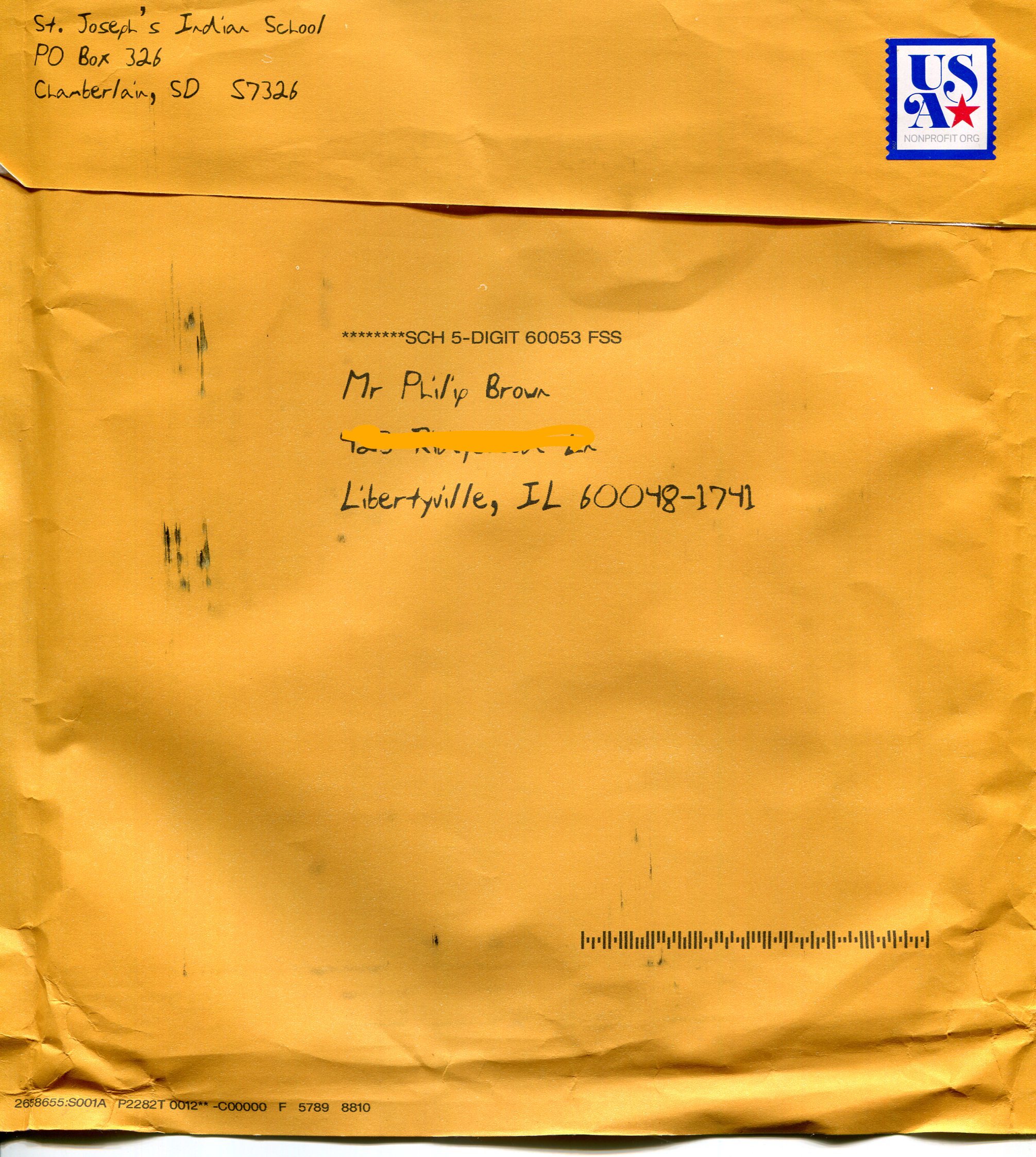
The 9×9-1/2 Flat kit is hard to ignore.

Size
The envelope is 9×9-1/2. No wait, it’s not an envelope. It’s more like a bag, a catch all, and it’s a half inch thick. Not normal! Right away, we are talking a Flat, not a letter. Odds are it weighs more than 3.3 ounces, so no kidding, this is a small trunk in the donor’s mailbox. Despite its bulkiness, it is still machinable, but I’ll bet the USPS would love to be rid of this mini-parcel bouncing through their multi-million dollar sorters. Remember, in direct mail, size counts.

The calendar is one of 8 personalized pieces.
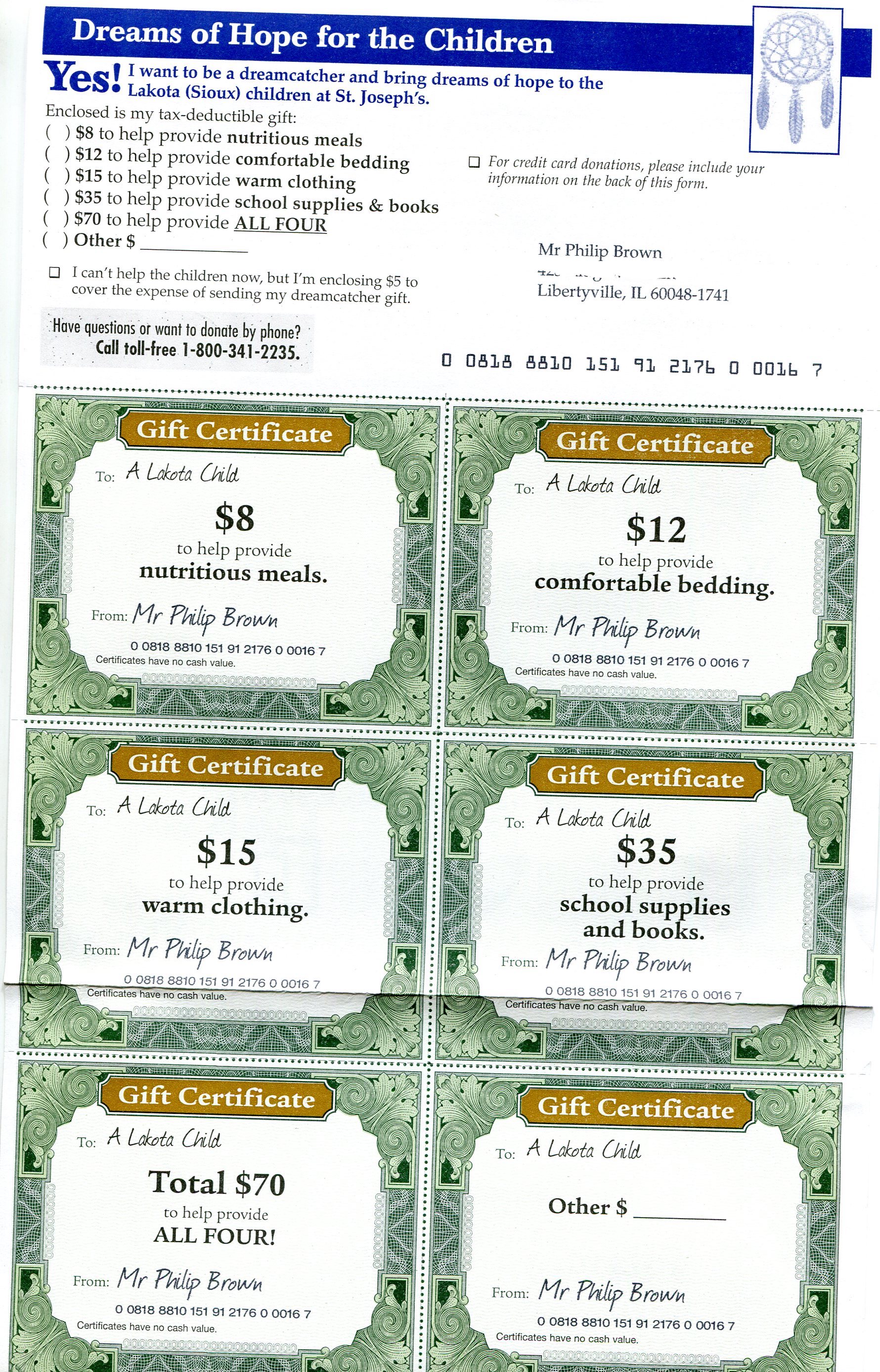
The perfed donor form highlights what your donation will buy.

Cards
Many successful kits provide a card. It’s personalized, perhaps laminated or plasticized, embossed, and maybe delivered in pairs. Very common in retail, insurance, service and association mailings, cards convey belonging and entitlement. While St. Joe’s doesn’t have a card per se, they do include personalized memorabilia like calendar cards, and gift certificates.
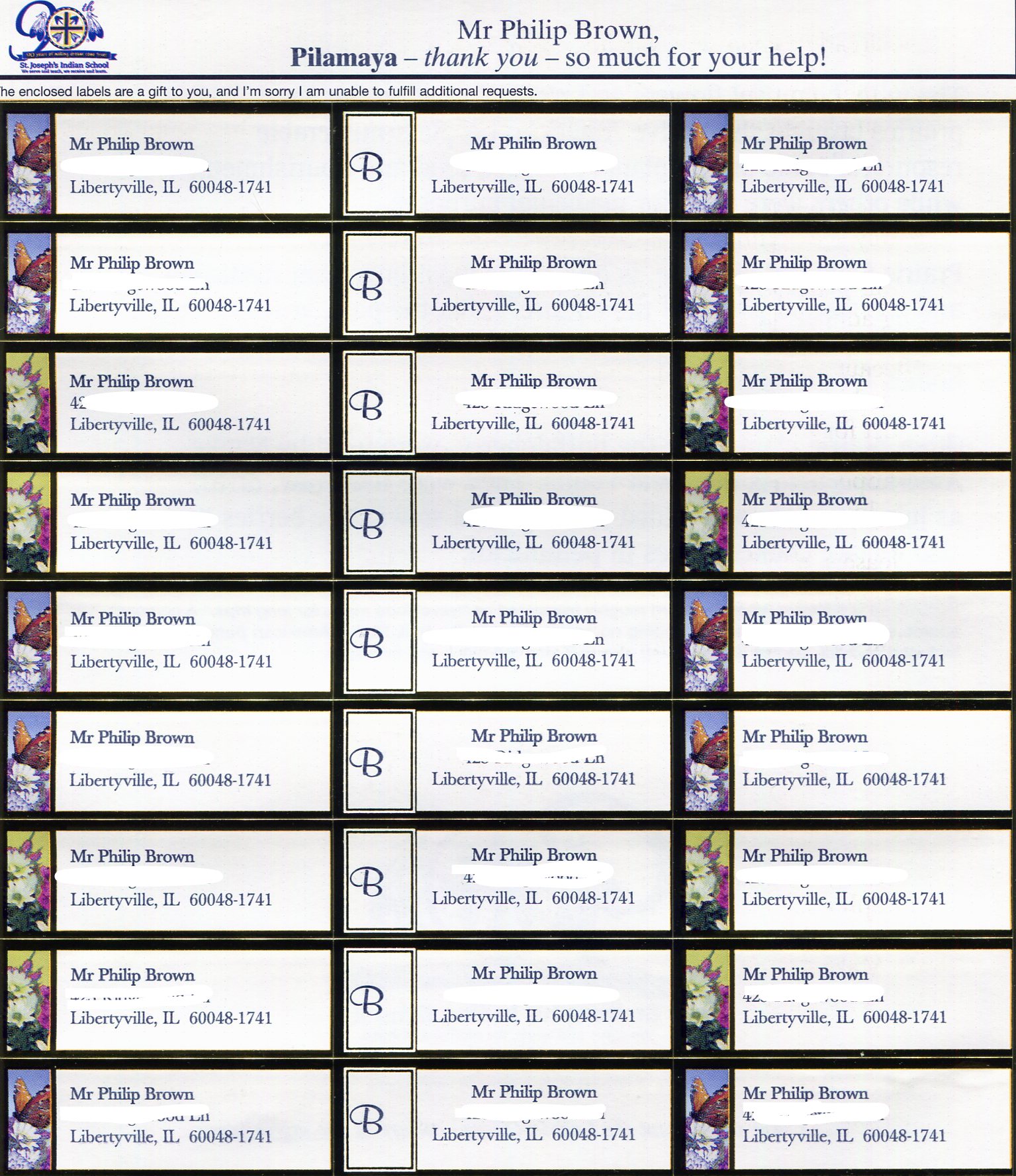
27 address stickers, enough for every utensil in the kitchen drawer.

Labels
Do we have enough address labels? Maybe, maybe not. Until you have labeled all your electronic gear, computers, cell phones, 14 golf clubs, CDs, Vinyl, USBs, chargers, staplers, umbrellas, Christmas cards, 3-hole punch and entire library of Clive Cussler books on loan, you aren’t done. And beside labels, anything that is pressure sensitive, like Post-it notes, velcro and magnets counts as an involvement device that draws your reader in a tactile way to your mailing. St. Joe’s goes over the top to provide stickers and labels for the donor, their children and the next door neighbor’s cat.

Mood aubergine: more labels for every occasion.

Die-Cuts
Really a technical obsession for printers and origami artists, the die-cut is a subtle paper carving that uses perforations, kiss-cuts, windows and trimming to create a 3-dimensional or engineered aspect to your kit. The recipient will work those die-cuts intuitively, without thinking, to unfold and self administer a little presentation for their personal viewing. Again die-cuts precipitate movement and finger work, which is involving your reader.
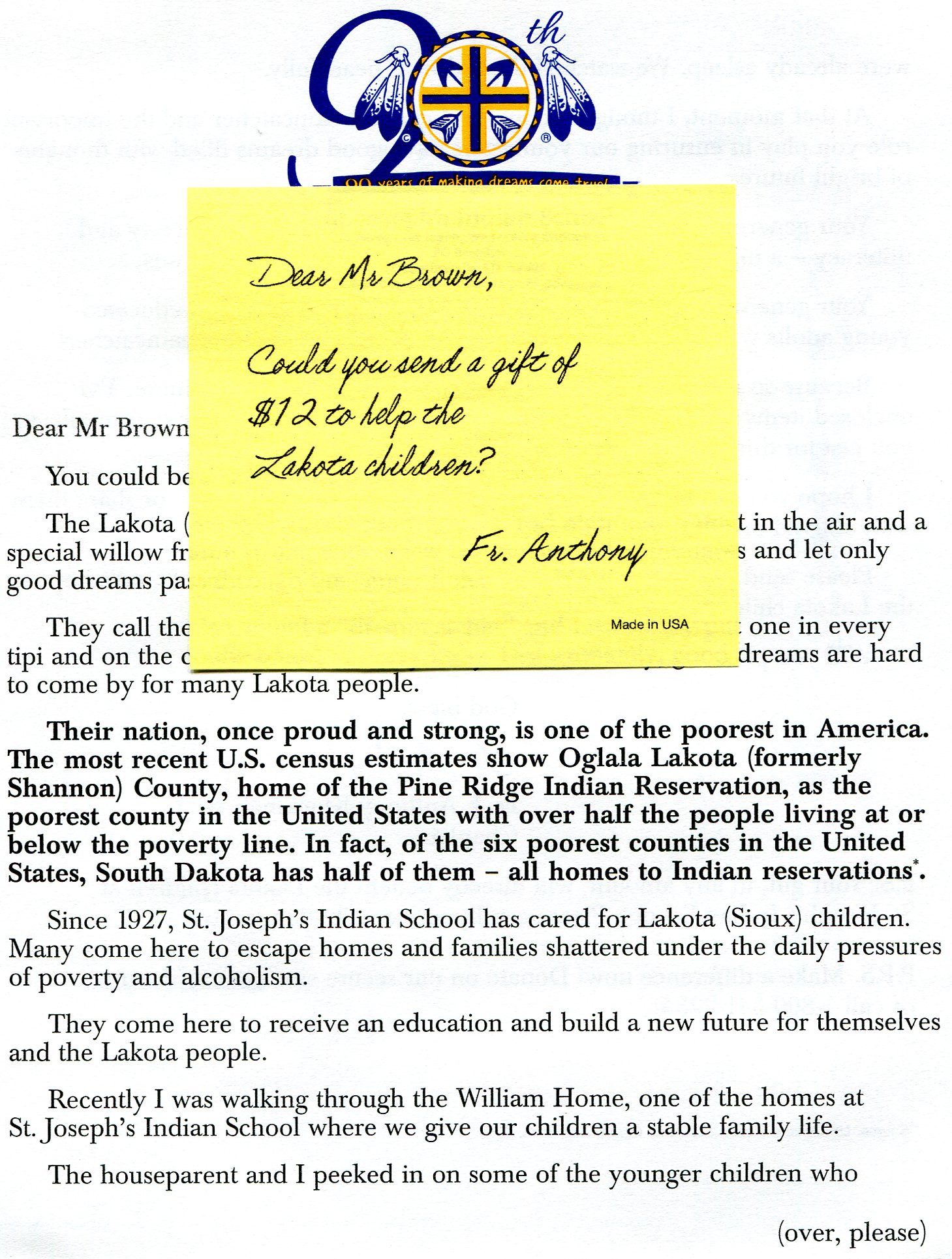
The Post-it note doubles down on the ask.

Personalization
St. Joe’s knows how to attract the eye, and that starts with calling out to the reader repeatedly. 8 times in fact. Envelope, letter, donor form, certificates, address labels, stickers, calendar, lift note…no matter your persuasion, it is hard to casually throw out a piece of paper that has your name on it.

I offer an additional element that may trump the 5 attributes above–
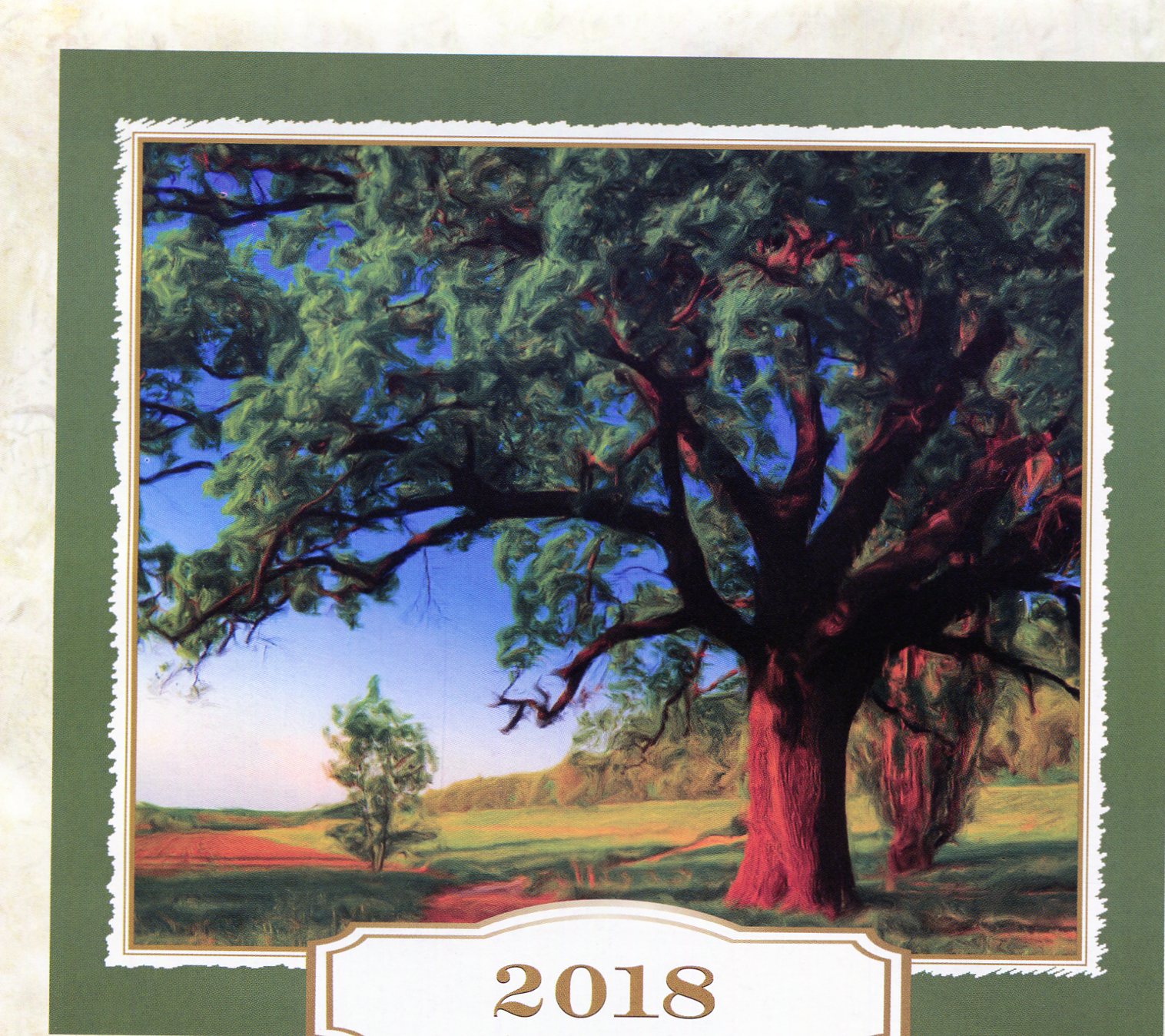
A 24-page calendar with original art makes this kit indispensible.

Indispensibility
Above and beyond the formula I gave you, the appeal of the St. Joe’s piece is that you just can’t throw it out. Why? Because in addition to all of the features, the envelope is packed with gifts, and useful items: three shrunk-wrapped greeting cards, a note pad, a 24-page calendar with art, the stickers or course, and the piece de resistance: the Dream Catcher. Not to mention the 3 penny stamps affixed to the reply envelope. Almost impossible to throw in the bin…just can’t do it. Arrrgh!

So there you have a fully loaded kit.   But can it pay for itself?

The first rule of fundraising: donors don’t come free. So management knows they must develop their donor files, which is what this kit is for.

The note pad’s backer explains the mission and prayer of the Lakota community.

It’s a bit of a guess, but based on a nickel a page, this kit probably cost around $2.50 to print and assemble, plus the Dream Catcher…, maybe $3.00. Postage will be around 50-55 cents, based on a 6.4 ounce kit, automation rate, non profit.  Add in the lists, freight and data processing and it has to be $4.00 a kit.

Wow!  “Who has that kind of money?” fret the accountants, and by the way, a lot of donors, too.

But here’s the thing, because of its impact, its stopping power, this piece could have a 5-8% response rate.  Let’s say 7%.
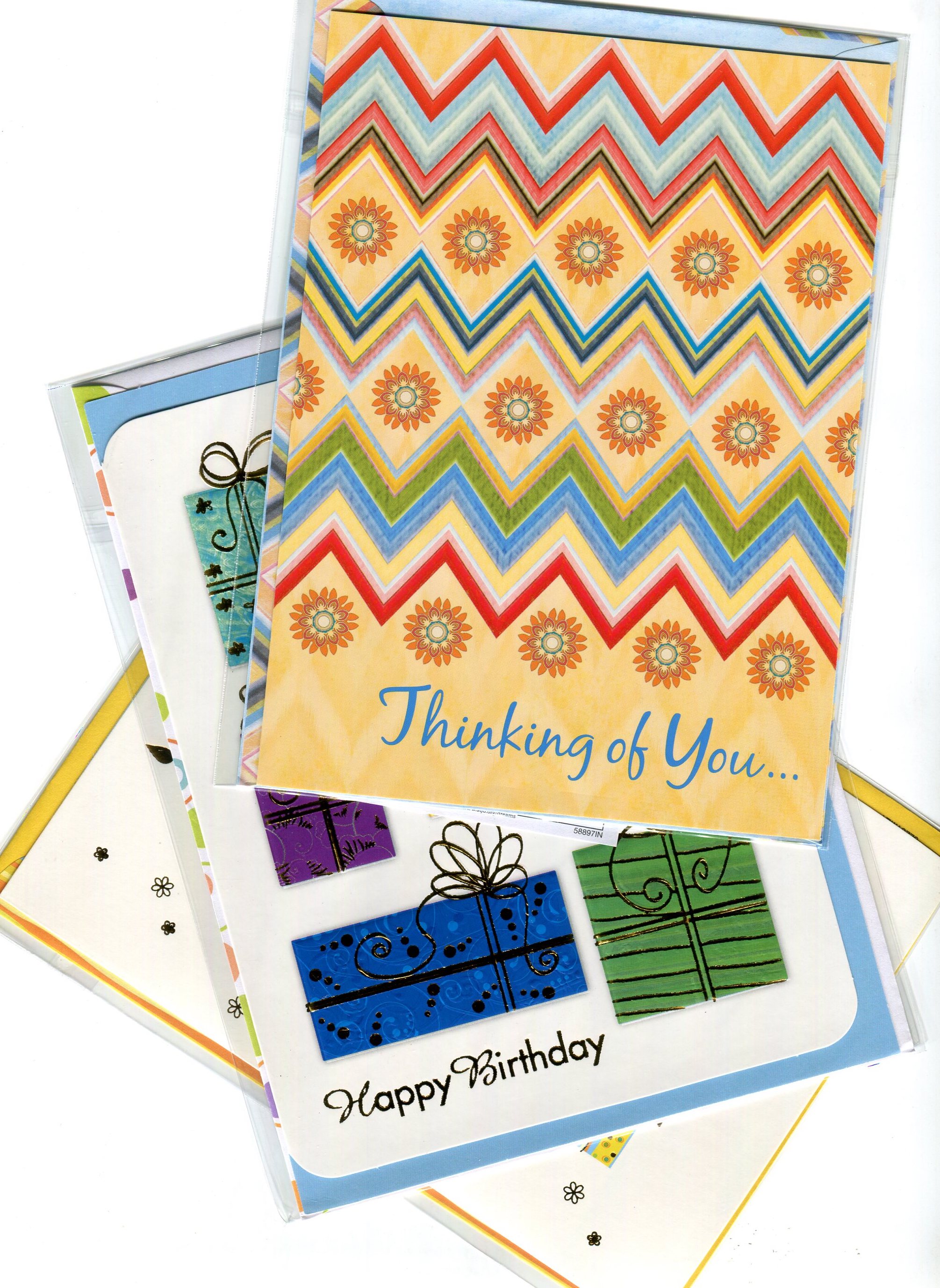
Three tastefully designed greeting cards, individually wrapped, are an extra push for donation.

Then $4.00/7% = $57.00 cost per response.  And what is the average gift? They are asking between $8-$70.  Again say it’s $30.  So the net cost is $27 to get a new donor.  That donor will have a longstanding, profitable relationship with St. Joe’s and looking at the financial statement, there is about a 10% chance that the donor may make a final bequest in their will to the organization.

Overall, St. Joe’s has a fundraising efficiency of about 31%, according to their financial statement. 31 cents to raise a dollar.

This may seem higher than some of the nation’s largest, more well known non-profits.  But keep in mind that those have strong, pervasive brands, high impact causes like hurricanes and disease, and oodles of corporate in-kind support, too.

Thanks for reading!  Please share!


Standard
Culture, Media, Science

Tip-a-Tip-a-Tap-Tap-Tap-Ching

Typewriters deliver a physical honesty.  No spellcheck!

My 8-year-old grandson cautioned me that to write important stuff in an email for posterity was not a very good idea.   “It’s technology'” he explained, and pointed out, “it’ll get lost really fast.”

After 40 years in the writing, printing and mailing business, I experienced a moment of happy vindication.

He made a good point. Despite the pervasive and indelible nature of social media, unless you know what you are looking for, ten years later, that little nugget of an email is crystallizing somewhere in a cloud far away, never again to fall to earth.

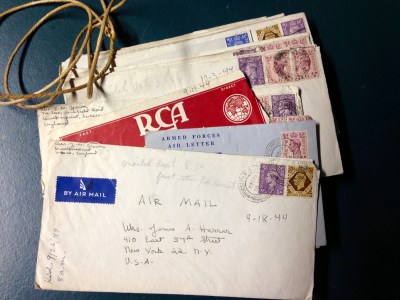
I have spent most of this summer reading hundreds of hand-written letters dated between 1943 to 1947. These nearly daily journals record my mother’s life in England as the war was finally won, and reconstruction had begun.

Mom’s letters to her dad 1944-1947.

It is a safe bet that had the stories been written as emails, they would never have resurfaced. But these did, unbidden, and made for an arresting and revealing read.

They appeared in a box from her estate, neatly tied together with a shoelace. The bundles were collected and saved by her father, in New York. No internet cloud at work here.   But without doubt, their physical presence could not be ignored; they had to be saved, and they were.  As a result, her story was available to be read, 70 years later. I’ll share more on that another time.

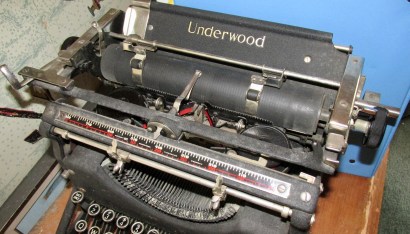
The workhorse 1915 Underwood–engineering marvel.

Along with the letters, I also inherited her Underwood typewriter. As a child I recall working this machine, struggling with its keyboard, stumbling through sentences like a child inebriate, unable to find the right letters, the right case, the right push.

Last year I purchased some new ribbon to replace the one that was now leathery dry. The new reels came from England.

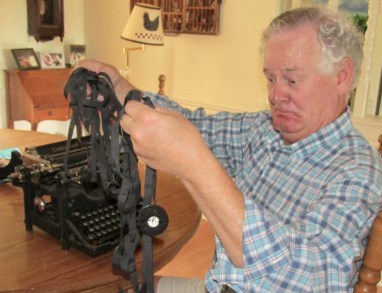
Today I installed the ribbon. It’s black and red, and very, very fresh.

Changing a ribbon: lost on today’s digerati

The Underwood is about 100 years old, and is an elegant, and beautifully engineered piece of machinery. It is built on a solid black cast iron base, and probably has about 500 moving parts, all in perfect working order. A priceless possession.

The Underwood’s engineering was as intricate as a Swiss watch…or a steam locomotive.

The QWERTY keyboard is easier to manage now, after a career of hammering away on computers. But there are some niceties, too. An exclamation mark (!) is accomplished by striking the apostrophe (‘) key over the 8 key. Back space, and drop in a period. Voila!

Wordwrap had not yet been conceived, let alone invented, so there is the iconic bell to warn that the margin is in sight. Better than that, there is NO spellcheck. What you type is what you get. The typewriter  has a physical honesty about it that today’s word processors cover up like embarrassed parents viewing a child’s essays.

Dad’s portable Corona was the picture of efficiency

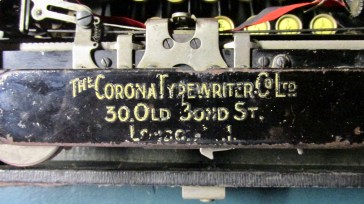
At the same time I acquired the Underwood, I also received my father’s Corona portable. It comes in a cardboard leatherette case, tied together with a length of electrical cord. This machine is remarkably lighter, only 10 pounds.

The 1914 Corona flipped open to reveal a tiny keyboard

Opening the 100-year-old container, I discovered that the upper half of the machine, ribbons and all, flips over revealing a modest set of keys. These are faithful to QWERTY, but there is special efficiency in the Corona. The actual slugs have 3 different characters each. An informed operator can do upper case, lower case and special figures off of the small keyboard.  My father wrote his doctoral thesis on this relic.

fullsizeoutput_4555

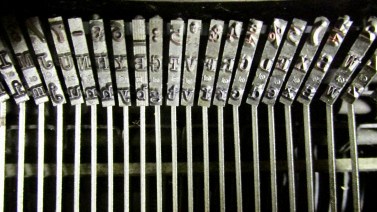
Three characters for every slug, a clever design.

Again, I marvel at the care and diligence of the engineers who designed these machines. They are quite exquisite pieces of working technology.

I recently read a book entitled, “The Iron Whim – A Fragmented History of Typewriting“, by Darren Wershler-Henry. This Canadian author has assembled a fascinating thesis about the role of typewriters in our culture. After our 30+ years of PCs and laptops and smartphones, his book is a brilliant perspective on how we have developed.  You think it’s just about stenos and typing pools?  Get the book.

IMG_0882

The #5 Underwood, 25 pounds of literary punch 

And then there’s Tom Hanks and John Mayer, who have just concluded a documentary “California Typewriter“.  They too are quick to tell you about the beauty of typewriters, especially as Hanks says– his typewritten messages “can never be hacked by the forces of evil.”  Apparently Hanks also has a book in the works, featuring three stories involving typewriters.  He has time on his hands?

So, returning to the advice of my grandson, I will continue to use my laptop, and thumb my way through the iPhone keyboard, but I am much more respectful of his intuition on these things.

Hard copy doesn’t go away, and especially in the long run, is probably easier to find.


Post Script: October 26–I just finished Hanks’ new book, “Uncommon Type”, a series of short stories written by the actor.  A great read!


Standard
direct mail, Marketing, USPS

Finally Closing The Mail Gap

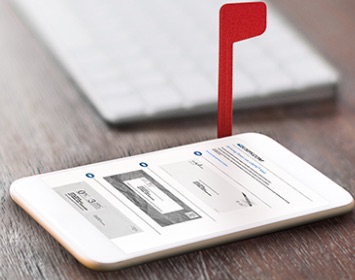
Out of town, or at the office, consumers can check their mailbox.

The USPS may be experiencing the continuing shrinkage in mail volumes, especially after the election season spike of 2016. But despite the trend to digital, the folks at L’Enfant Plaza, DC 20590 have come up with a winning service, “Informed Delivery”.

Householders and businesses can receive emails daily reporting what letters have been mailed to them.

You may have thought that Facebook or Instagram are the leading purveyors of new photography– the daily delivery of selfies, restaurant plates, goofy pets and family outings. In fact, it’s the USPS.  It takes approximately 411,000,000 new pictures every day.

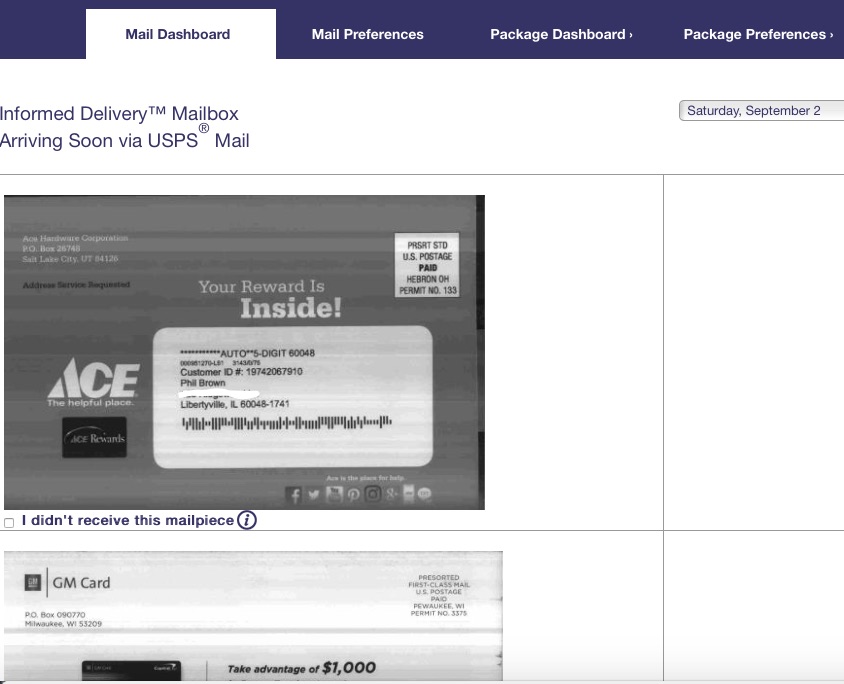
The images are emailed, and also displayed on the user’s web portal.

The automated sorting process for letters relies on instantaneous scanning of a bar code, or a ZIP code. In 2016, Americans dropped 150 billion pieces into the USPS mail stream, and the sortation machinery looked at every one of those pieces and took a quick picture of the bar code or ZIP.

Until recently, those images were probably trashed a nano-second later. But then someone, a marketer, an engineer, a postal clerk, thought, “Hey, we took a picture, let’s post it!” Pardon the pun.

Automation machinery scans the incoming letter-sized mail.

Thus, the invention of Informed Delivery.

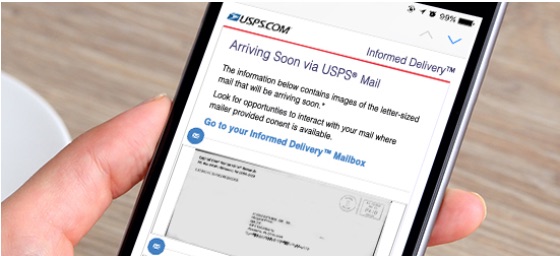
Every day, we at our household, receive an email from the USPS advising us of letter-sized mail making its way to us. The email includes an individual JPG of each piece, in black and white.

Now, you may feel that this is a weak attempt, a grasping at straws by a struggling old school business attempting to fight the digital tides. To me, it is enlightened genius. In a move that is worthy of a jiu jitsu artist’s praise, the USPS is using the power of digital to elevate its analog medium.

Every day a USPS email sends a photo album of coming mail.

Christmas Comes Early
For people at home, Informed Delivery may eliminate the excitement and anticipation of walking to the mailbox. ‘Kind of like peeking at your Christmas presents under the tree a few days before the event. Still, the service lets you know that a letter, check or invoice you are waiting for is definitely on the way. It also allows you to look at your mailbox, or mail-on-hold while you are out of town. ‘Kind of like scanning your voice mail–and you know you do that.

Many Happy Returns
Direct marketers will love Informed Delivery. Rather than waiting for the physical replies to show up from their latest mailing, they can see the reply envelopes as soon as the consumer drops it back in the mail. Admittedly, marketers can get digital reports now of bar coded reply mail, but Informed Delivery shows which replies, as there may be many outgoing mailings occurring simultaneously.

The USPS harnesses a digital app…who knew??

A Stronger Pitch
Every marketer considers the orchestration of messaging. We want to integrate email, social media and direct mail to complement a retail sales event. Informed Delivery alerts consumers by email of a coming promotion. The front of the envelope is the ideal canvas for the first tease of the event.

Intelligence At HQ
It should be pointed out, that if I have a dashboard of my incoming mail, so does the USPS. While you may worry that the USPS knows what I get by mail, I don’t. But if postal reform ever does get passed, the USPS may be able to offer user privileges to recipients based on the volumes of mail received. After all, if you do receive a lot of mail, you are a likely advocate of mail delivery, and to the USPS, that’s a high-five.

Kudos to the USPS on this latest innovation.  My bet is that as it takes hold, it will be leveraged, much to the benefit of one of America’s oldest and revered institutions.

Thanks for reading and sharing! If you want to see the Informed Delivery package, click on this!

(All pictures shamelessly taken from the USPS email and my personal portal.)

Standard