Culture, direct mail, Environment, Government, Marketing

Don’t Leave The Lights On

Got a light?

Just a few days ago we received a handy tool from ComEd, our power supplier. We have a light bulb guide.

ComEd’s 3 steps to lighting your home.

What seems like 10 years back, somebody governmental decided unilaterally that we should do away with those high-energy-consuming incandescent bulbs which we have been using since Edison. No longer would we squint in the warm glow of a 60-watt bulb while reading the newspaper.

This was because someone, probably in Shanghai Xiangshan, thought we were better off screwing mini-helical fluorescent bulbs into our light sockets. Touted as energy-saving devices, the ‘cool light’ replacements would use less electricity, and last 5 times longer. Incandescents all but left the market, unless you looked in an old variety store off a back road.

So we were prodded into changing out all the old bulbs.

The bright idea: mercury infused fluorescence!

Once all the houses in America were transitioned over to the helix models, then the mercury sleuths woke up, and said we could not dispose of the bulbs. Because after all, they do burn out eventually, and to my disappointment, faster than claimed. But who’s going to China to file a complaint?

Terrific!

So now the incandescents have returned, like swallows to Capistrano.

From watts to lumens. At the speed of light.

But at the same time, another Edison protege has risen, to suggest disposing again of all incandescents in favor of LED bulbs.  The light-emitting-diode bulbs are very efficient indeed.  Not only do they use less power, but they are also blindingly brilliant.

ComEd has taken the initiative in nudging the switch along by mailing us a helpful little card.  On one side, it converts incandescent strengths to LED, which is like shrinking a bagel to a Cheerio.

It goes from watts… remember him? ..to lumens, which is like from energy consumed to instead, brightness delivered.

A Canadian bookmark for the 1970s, still in use today.

But before I go any further, I just want you to consider a similar transition from ancient Canadian history.  Back in 1973 the federal government, of course, decided to change from Imperial measure…remember the Queen?… to metric.   This was purportedly to rationalize and expand Canadian exports to the non-U.S. metric world of commerce.

I think the real reason was to hoodwink the car-owning public.  We shifted gas prices from 45 cents a gallon to 15 cents a liter overnight– without a shred of understanding.  To further bamboozle the public, the government then commanded that car fuel efficiency should shift from mpg, miles per gallon to… kilometers per liter?….no wait for it,  liters per 100 kilometers!

What the heck is that?

Lenticular: lighting your home, as Kelvin would like it.

Not un-coincidentally, while this huge shell game was in process, the Feds decided to start a government-owned company called Petrocan to sell us gas for our cars!  They bought up all the Sunoco stations, changed the signs, and raised the prices like great Caesar’s ghost.  We didn’t have a clue.

So back to ComEd, which so far is not a government entity.

Lord Kelvin

The other side of the ComEd lightbulb card is a lenticular lens which shows you what your home will look like using LED lighting.  It’s pretty clever, and a great device for direct mailers to use.  When you wiggle the card, it changes the brightness of the living room pictured on the card.

You have three exposures: DAYLIGHT, SOFT LIGHT and BRIGHT WHITE.  Below each setting a number tells you what the bulb’s color temperature is, in…Kelvin?…remember him?

Of course you do.  Water freezes at 32′ Fahrenheit, or 0′ Celsius, or 273Kelvin.

Anyway, we now have a card to buy the right bulbs, defined by lumens and Kelvins.

The only remaining question, how many civil servants does it take to change a light bulb?


Thanks for reading!  Please illuminate your friends by sharing!

Standard
Agriculture, Culture, direct mail, Fundraising, Wildlife

The Forest, The Trees, Or The Beans?

It’s not a secret any more that I enjoy reading direct mail. Not much of a life, you might suggest. Still, it guarantees a walk to the mailbox everyday, and a chat with our favorite USPS mail carrier.

My current discovery revolves around the offer I could not refuse, straight from the Arbor Day Foundation.

These good folks in Nebraska City, Nebraska are on a mission to blanket the country in a thick, variegated quilt of forests.  So when they selected me to represent a small portion of the people in Illinois, I was hard pressed to decline.

Why?

Premiums often trump the original product offer for appeal.

It is a fact that in many successful direct mail offers, it is not the product that gets the sale, but the premiums which come along with good behavior.  Good behavior in this case is responding quickly, and munificently.  In other words, pay up, fast.

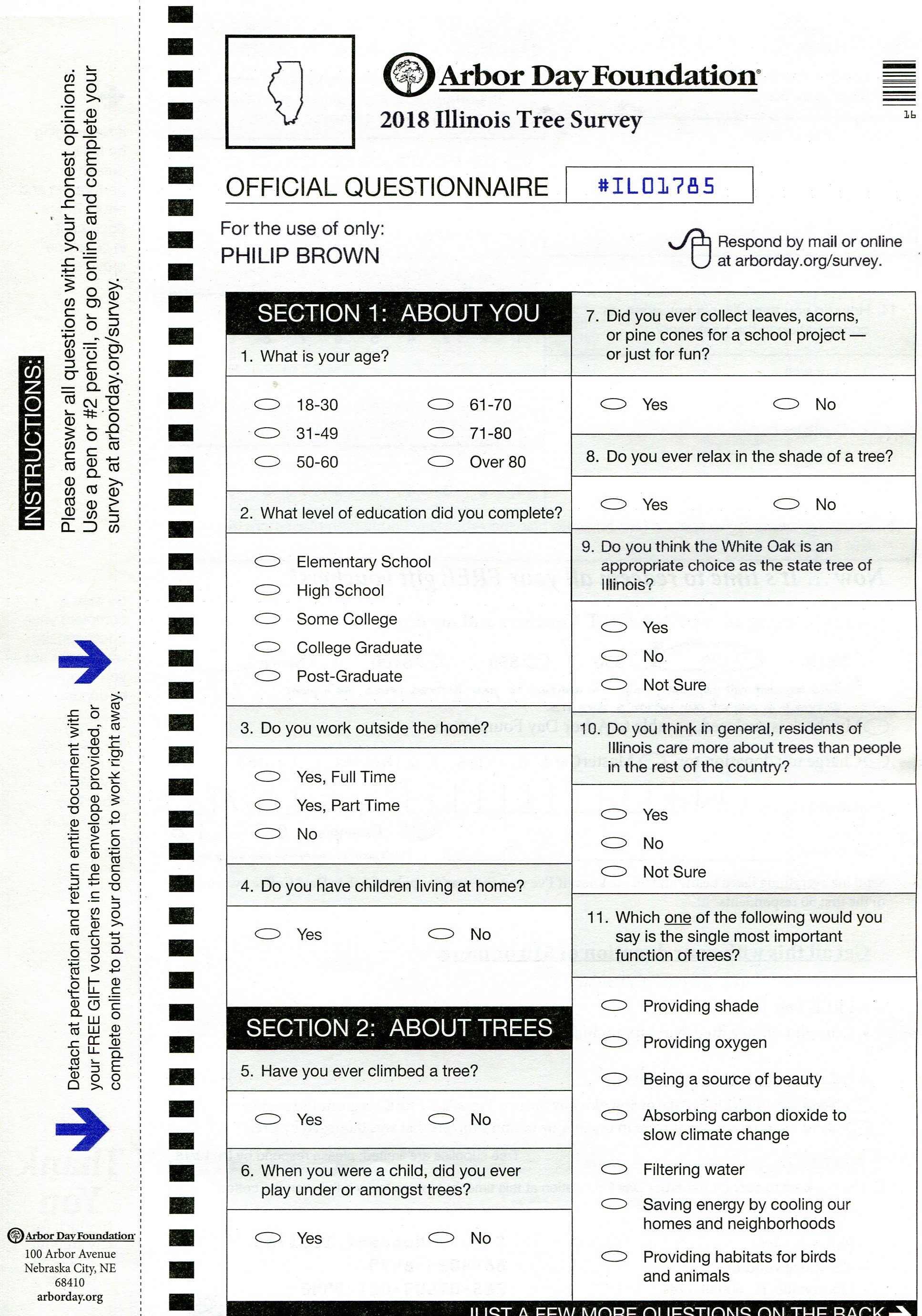
The survey is a powerful engagement device, selling all the way.

In return for my promptness, albeit somewhat stingy in retrospect, I might receive Arbor Day’s special rainforest, cool-shade-grown coffee for a year.  Wow!  I am supporting Starbucks right now, but I can be swayed.

It was with this initial buzz on my coffee nodes that I rushed to complete the Arbor Day Tree Survey, carelessly pushing aside any concerns about what would happen next.

The Arbor Day Tree Survey for Illinois is an excellent example of powerful sales rhetoric.

It helps that I am a tree lover.  We live on a third of an acre, and have 17 trees.  I feel rich, and enjoy the annual blooms, the blossoms, the pollen, the seed drops, and the mounds of leaves I rake.

Arbor Day is celebrated nation-wide, thanks to the Foundation’s efforts.

I think the survey deftly gets all the right answers from me.  It lulls me into a positive frame of mind.  I race through the harmless queries.

They ask, ‘have you ever climbed a tree?…when you were a child, did you ever play under or amongst the trees?… did you ever collect leaves, acorns, or pine cones for a school project–or just for fun?’

These questions are softballs, and I hit them all out of the park.  “Yes!  I climbed a tree!  I lived in a tree!…I built a small condominium in a tree!..Yes! I played under a giant Beech as a child!…Yes! I just finished a vast collection of leaves with my grandson!  Yes!  Yes! I did all of that!”

Sophie’s Choice: pick one. But how?

These are soothing thoughts.  For a moment, I slip into a gauzy reminiscence of TV’s defense lawyer Ben Matlock, asking woodsy questions in his unassuming, folksy manner.

But that reverie is smoothly swept aside by a troubling vision of Patrick Jane, the thoughtful, boyish, enigmatic Citroen-driving sleuth in CBS’s TV show, “The Mentalist”.

The questionnaire asks,  ‘Which ONE of the following is the single most important function of trees:    Providing shade?  Providing oxygen? Being a source of beauty?  Absorbing carbon dioxide?  Filtering water? Saving energy by cooling our homes? Providing habitats for birds and animals?’

Like, how to choose?  This is some kind of arboreal Sophie’s Choice, with the bark left off.

The motherlode of premiums: plant your own forest!

Really, the questionnaire does focus the reader to the countless benefits provided by a our forests, here and around the world.  So kudos to Arbor Day for the survey approach.  It segue’s to some opinion questions, and then asks for a donation which opens the gates for premiums.  Big premiums.

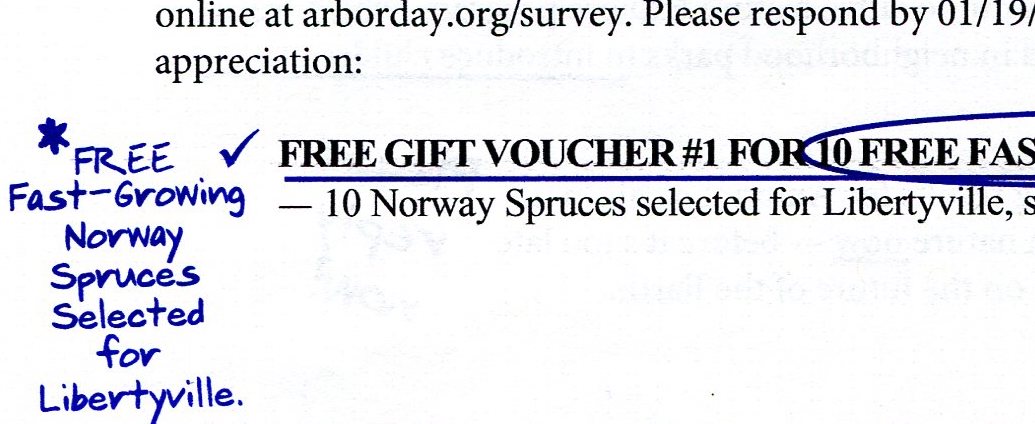
Because I have asked for them, I will be receiving 10 Norway Spruce Trees, 2 Fragrant Purple Lilacs, a copy of The Tree Book, and a Rainforest Rescue Calendar.

And the coffee, for a year, I hope.

It turns out that the coffee offer is part of a sweepstakes.  The fine print is found on the inside of the envelope.  500+ words in 10-point sans serif type, arranged in block paragraphs with no indents.  My hopes of those rainforest-cool-shaded coffee beans are evaporating like dew drops on a hot car hood in July.

The 10 x 14 envelope costs extra, but its impact, complete with faux label does the job: it gets opened.

Speaking of envelopes however… I do applaud the package.  It measured 10×14 inches, for no good reason other than to dominate the mail box, and to get my attention.  It was printed to look like brown kraft.  A knockout on the face presents the image of a label, but looking closely I find it is a varnish over the original white stock, masterfully done.  This kit looks impressive, official, and urgent.

The power of data-driven variable imaging: customization.

Inside, there is a personalized letter, and it has a personal note referring to the spruce trees, just right for Libertyville, IL.

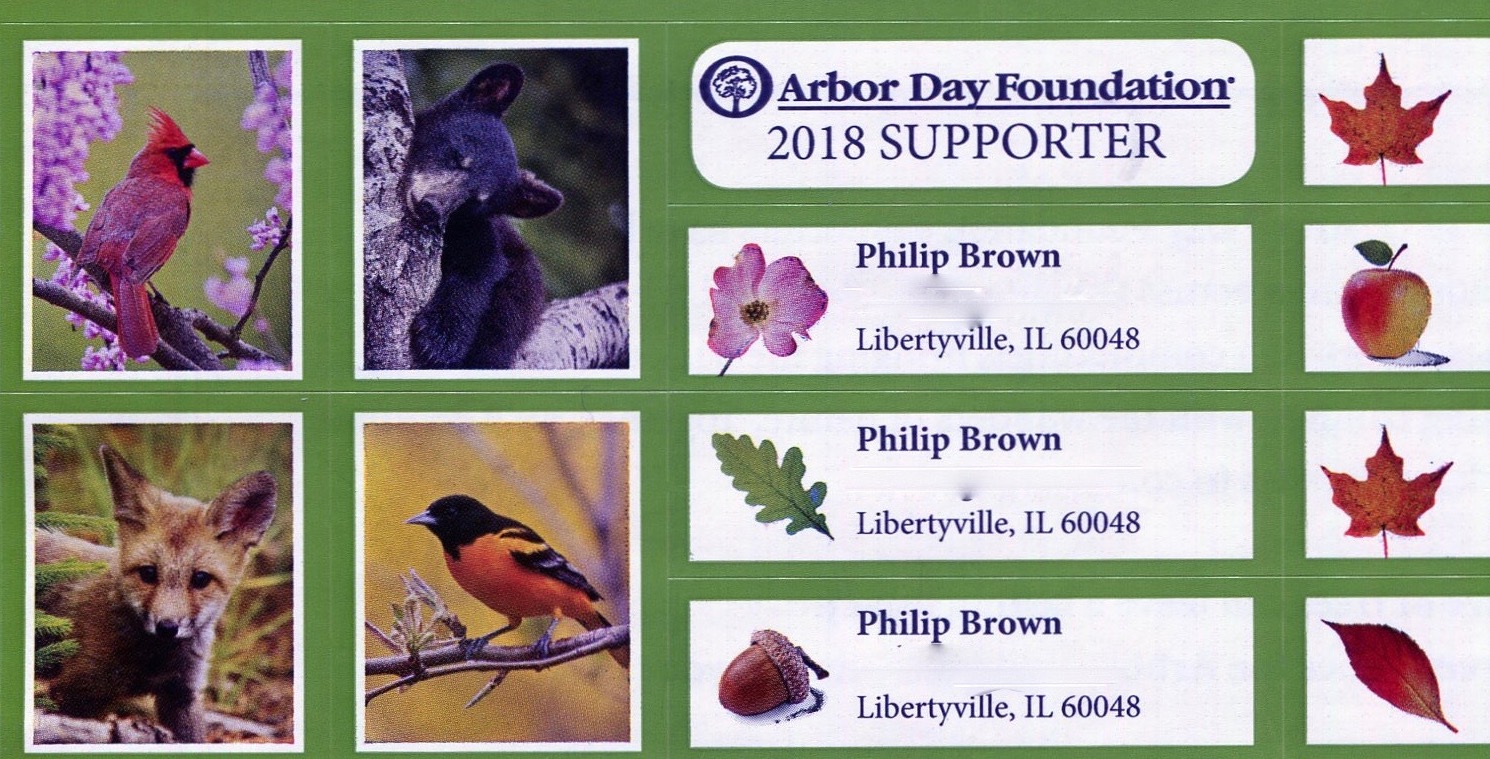
Alongside, I find a set of address labels, which are pretty much table stakes in fundraising, but they are optimistically entitled, “Arbor Day Foundation, 2018 Supporter”.  That must be me!  Their 2018 calendar further alerts me to Illinois’ Arbor Day being April 27th.

The mandatory address labels of fundraising, but tastefully designed.

So, I wait.  The trees are coming next spring.  The book and calendar, who knows?  The coffee, fearfully a long shot.  What I do know is that with every delivery, there will be a further prodding and arm-twisting for a gift.

While I am desperately trying to find a place to plant those trees, I’ll give it a thought.

Thanks for reading! If you would like the full appraisal of the Arbor Day Foundation, it is available here, at Charity Navigator.


Standard