Culture, direct mail, Fundraising, Marketing

It’s All In The Bag

A max-sized lumpy day-glo envelope from Disabled Veterans National Foundation

October comes around, and the non profits are making their first of several strong pitches for another discretionary dollar donation. I find my mailbox full, and refreshingly, with some new twists.

Kudos to the team at St. Joseph’s Indian School who have brought in some new creative to overlay their basic control kit.

St Joe’s gift vouchers go full color.

The Dream Catcher is the most unique gift of all.

As always, the Dream Catcher is a unique keeper. I have several, which make their way to the grandchildren. But the kits also deliver more colorful coupons. We’ll see if they repeat…or does the sterile, sober-looking appeal still trump happy colors?

As yet, St Joseph’s is not twigging to my male gender: I am getting stunningly beautiful foil labels with flowers and butterflies. I can’t use these, not even on my golf clubs.

The Post-It Note goes pointy for more attention.

Another St. Joseph first for me: a pointy Post-It note. It’s a little different, and catches my eye.
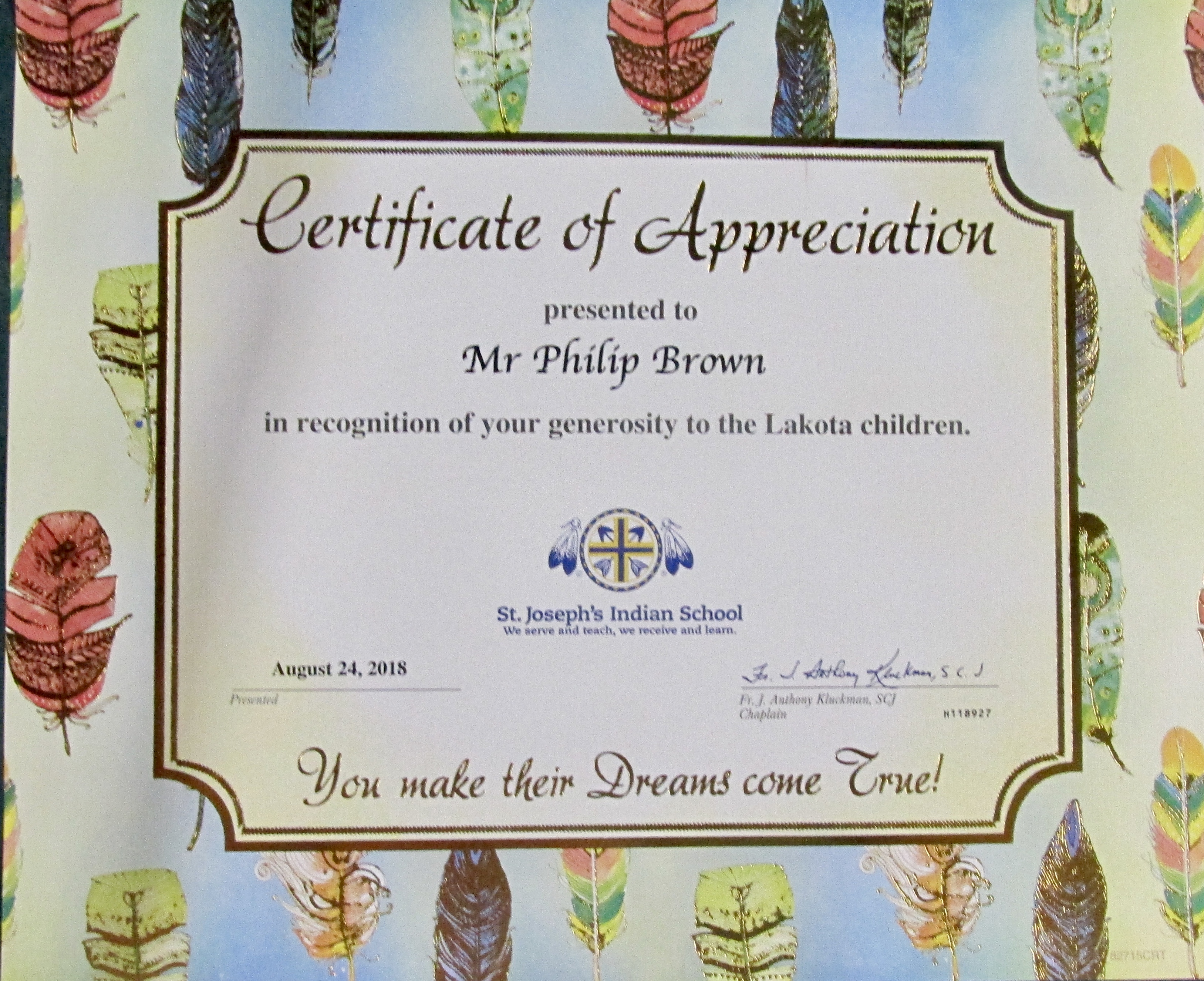
Certificates, suitable for framing deliver a message.

Plus, I have received a colorful, feather-imaged gold foil, embossed certificate of appreciation, on laid stock, no less!   Veterans of Foreign Wars sent me a similar recognition.

These certificates really are quite classy, as ‘thank you’s go. I am not going to frame them, but that doesn’t mean that someone somewhere else won’t frame theirs.

VFW targets the CD-player crowd with Christmas carols.

VFW also sent along a CD of Christmas carols! This may seem early to you, but actually is just in the nick of time: our new car no longer has a CD drive, but hey, it’s the thought that counts. I do have a cassette player in the basement, a.k.a., Santa’s Workshop.

Father Flanagan’s Boystown has sent me a Puzzles and Brainteasers booklet. You know, I mean to give it to the kids, but in an idle moment, I look at them too.

Beautifully designed gift bags are the pride of several organizations.

In an additional kit I was also treated to a colorful paper gift bag. These items show up across several charities, and I suspect there is a traveling paper bag sales rep who is shipping bunches of orders back to a printing plant in Shenzhen China.

The tote bag is a premium-with-donation offer from VFW.

Veterans of Foreign Wars has kicked the bag up a notch. They offer a full-sized  tote as a premium with donation.

DVNF throws in the bag and a T-shirt with their request for donation.

At the top of the pile however is Disabled Veterans National Foundation (not to be confused with Disabled American Veterans) which sent the whole bag, and a T-shirt, in a day-glo yellow max-sized envelope.

I am now thinking that there are regular flights for printing sales personnel from U.S. to Shenzhen.

St. Joseph’s vinyl totes are small, but classy.

Truly, the most impressive were printed plastic vinyl tote bags courtesy of St. Joseph’s, that aside from their modest size, sported quality designs.

Lateral Thinking

There is an artful expansion of thinking on applying postage stamps to the reply envelope.   Pasting real postage on a reply envelope is a riveting issue.   Donors shudder to waste the stamps, and I am sure the charity’s accountants aren’t thrilled about giving away postage.

But here’s the thing–you may remember in my book Many Happy Returns, the story of the fundraiser who coaxed the donor to please supply their own stamps. The reply envelope said, “Your stamp will save us money.”  In a manner of speaking, it did. Average dollar gifts rose 6%, but response rate dropped 15%. Go figure!

DAV fronts all of the postage on the reply envelope..50 cents worth.

Anyway, the pioneer in applying the full 49-cents (or so) postage was DAV. They primed the pump, and happily cashed our flood of checks. We Baby Boomer donors can’t see a stamp go to waste.

But now, there are some diversions in the path.

VFW fronts only 5 cents, but appearances count in their favor.

VFW provides 5, one-cent stamps to the postage paid BRE, and the USPS will charge the rest. The modest nickel cost looks like a lot of stamps–but it’s not 50 cents’ worth.  This effectively cuts VFW’s in-the-mail costs by $450 per thousand, while still appearing to offer the more expensive stamps.

St Joes includes a faux return address label with 3-cents postage.

St. Joseph’s sharpens their pencil a little more, and only provides 3 one-cent stamps, but adorns their BRE with a faux return address label in my name.  How can I throw this out?

Boystown decorates their BRE with zero-value greeting stamps, but they look great, regardless.

Not to be outdone, Father Flanagan applies 4 Greeting Stamps of no value whatsoever to their BRE, but they look great!

Who can deny the effort?

To date we have 46 greeting cards in inventory. Production quality is high.

Throughout all of the recent spate of mailings I have received, greeting cards still predominate. I counted 46, all high production quality, and which are now stored in one of those pretty paper gift bags.

We have a bucket of pens, but St Joe’s are the classiest.

As well, I have been issued with numerous writing pens…lots of them, and some very tastefully designed, courtesy of St. Joseph.

And speaking of writing, I have a mountain of note pads, some die-cut, none of which can be discarded.

A pencil case for the pens. A lunch box may be next.

They get used.  And when not, where do they go?  Into a pen and pencil bag, supplied by St. Joseph’s!  Wow, what’s next…a lunchbox?

There is an ongoing debate, stirred up by loyal donors about the exorbitant expense taken in these mailing pieces.  How can a charitable organization spend this much, and then ask for more money?

The fact is, the gift strategy works.  Especially if the gifts are exclusive and high quality.  When they are accompanied by personal, expressive letters, the efforts are rewarded by donors who are sitting on, or searching, for the summit of Maslow’s pyramid: self actualization.

Thanks for reading, and sharing.  If you wish to check on these charitable organizations, you can visit Charity Navigator, or the organization’s websites to see their financial disclosures and especially their direct mail fundraising performance.

Standard
Agriculture, Culture, Environment, Science, Wildlife

Marmoration Nation

The Brown Marmorated Stinkbug

I had to laugh when a recent plea came across our Village Facebook page, “Will they be spraying for mosquitos this year?”

The summer’s nearly over.  Fall’s coming.  Frost on the pumpkin.  Mosquitoes??

Skitters may be annoying, a nuisance, bothersome and carriers of West Nile disease, but other than that, well, they aren’t stink bugs.

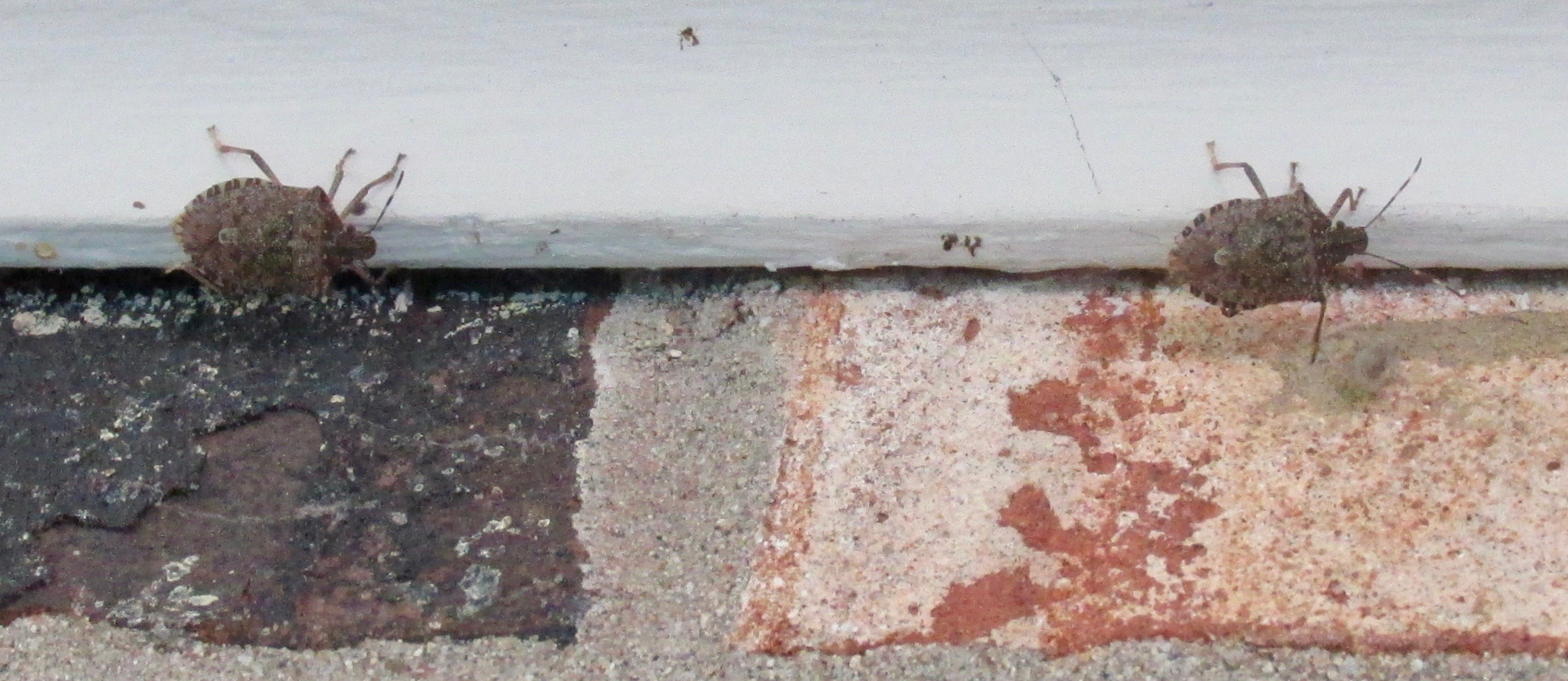
Last fall we found scads of these penny-sized twirps on the side of our brick ranch, an unsightly rash of brown measles, sunning themselves every afternoon through September and into October.  Mindful of the laws of karma, I did not kill them.  I flicked them off the sliding door screen and wished them a good life, but somewhere else.

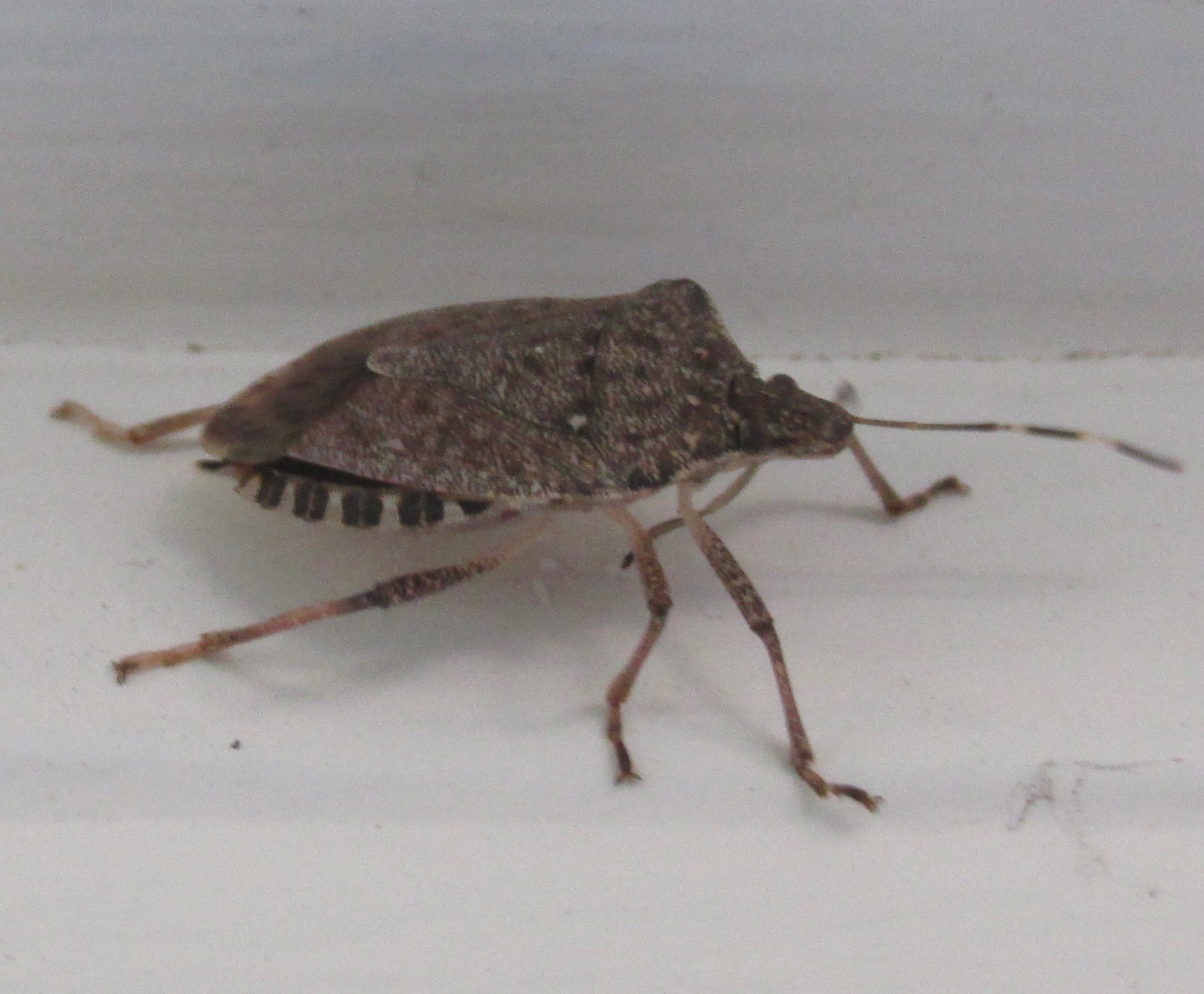
Brown Marmorated Stinkbugs are so named because they have a marbled camouflage suit.  Hard to see as they bask on the lilac leaves in the afternoon sun.

Halyomorpha halys: a member of the family Pentatomidae

They also smell.Before understanding what I was dealing with, I smacked one, and as it exploded under my hand, it shot off a dying waft of odor that resembled rotting, moldy underwear, which I say kindly.  Understandably, they are not tasty, so lack many natural predators.  Crows turn up their noses.  It turns out that wasps will go for them.  Terrific!

Stinkbugs are unpleasant creatures, only recently making it to our corner of the Midwest in northern Illinois. Apparently they originated in the far east, and hopped a ship to a harbor on the east coast, and with time, they have moved west.  Apparently they like soybeans which grow abundantly on a 33-acre field across the highway from us.

Time moved on, and as the snows fell in December, the stinkbug drifted out of our memory.   We passed the evenings in front of the fire, catching up on Survivor and other important social studies.

Then, one day in January, a black dot appeared on the family room wall, over the door.

“What the…?”  I stared.   “That’s a, a, a stinkbug!  What’s it doing in here?”

No longer spooked by the ironies of karmic payback, I grabbed the odiferous brown button in a wad of tissue, and walked it off to the toilet for a quick dispatch to the next world.

“Don’t know where that came from, but it’s history.” I flumphed down on the TV couch beside my wife to witness 8 publicity-hungry people attempting to dive into the Pacific ocean to retrieve a key, which would unlock a box of beanbags back on the beach to throw into a basket which would tip over and raise a victorious tribe buff.

Then, looking up over the fireplace, another brown button.

You can guess the conversation that followed, and that eventually, unbelievably, tortuously repeated itself for the next three months as every day, two more bugs appeared in the family room.

Under duress, their natural odor is intolerable.

Somewhere on the outer lining of our house, a gang of stinkbugs was holed up, waiting for spring.  We came to imagine that the ringleader would crawl among its cohorts asking for volunteers to go out and check the weather.

Everyday, without fail, two creatures would emerge, quietly, stealthily, and present themselves somewhere in the family room or hallway.  They never flew.  They just appeared, immobile, prostrate, stuck to a wall.   They stood out like 8-balls in a bathtub, and so quickly ended up mummified in tissue and expelled to a plumbing system which hopefully took them to a station miles way from us.

And then spring came, and the bugs one day missed their cue, not showing up.  We relaxed, and enjoyed the following months that scrolled through May and June’s fragrant flowers, thick lawns cut weekly, releasing the unforgettable aromas of fresh cut grass.  Deep into summer the garden fluttered under the visiting companies of butterflies, mindful robins, cock-eyed, frenetic squirrels and later the incessant, raucous buzzing of the cicadas.

As September arrived, the sun warmed our home on its west side.  Stepping out to the deck to light the barbecue, I lifted the lid, and looking up, spotted, there, on the wall, a brown, marmorated, stinkbug!

Stinkbugs: seekers of nook and cranny.

“Cripes!  A stinkbug!” I groaned.   Looking beyond this unwelcome visitor I found another.  And another.   “Holy crap!  They’re back!”  Sure enough, as I walked along the side of our house I spied more than a dozen.

The next day, I obtained a particularly bug-lethal concoction from the hardware store. Mixing approximately 3 tablespoons to a quart of water, I filled up a handheld spray bottle.   The solution was 5 times as powerful as recommended.

A crusade of epic proportions

For the balance of September I sprayed every afternoon and every morning, targeting bugs in twos and threes, clustered under the soffit, ensconced in the cracks between the bricks, hiding under the lilac leaves, perched on the window screens, and skittering along the edges of the gutters.

It was a crusade of epic proportions.   I had gone through a whole quart of the concentrate, and went back for a second, relishing the daily harvest I was taking on these annoying little bugs. The walls dripped in poison spray as the bugs plummeted to the ground, dead.

You may recall the adventure story, “Leiningen And The Ants” .  A plantation owner and his crew are defending the crops from a vast plague of soldier ants that devour every living thing in their path as they march, six-legged, towards the house.  Leiningen first attempts to fend them off with a moat. The crafty, unstoppable ants still cross. Next he douses his fields in gasoline to burn the ants, but they forge on.  Finally, he floods the entire plantation by diverting the river, only just escaping his own vivisection as the ants pulled him down.

Somehow, I felt like Leiningen, defending house and home, and winning.

Early this October, the weather turned cold and wet, and the stinkbugs were gone.  They had vacated the trees, the walls, the gutters, the screens, and the soffit.  It was over.

October in Illinois is a flighty month, climate-wise.  After raking all the fallen leaves, we were presented with three days of 80’F weather.  This past week, I surveyed the yard, and looking up to our gutters spotted more of the bug.  Returning to the house, I loaded up another quart of the juice, and like trigger-hyper Terminator in a video game proceeded to decimate the bugs, which by this time numbered a small mob.

“I just finished off 84 stinkbugs!” reporting to my wife, who rolled her eyes.  “The sun brought them out, and they got the juice.” I was triumphant.   The sides of our ranch looked like a target range for paintball, with little wet splats everywhere.

After lunch, I ventured out to the deck as the sun came around.  “Geez!!  There’s more of ’em!”  I went back to search and destroy mode, and sprayed 135 more bugs.  “That’s gotta be it.  Just gotta be.”  Indeed, it did seem like their rush was finally kaput.

Our yard hosts a forest of mature trees.  Closest to the house is a Moraine Locust.  This tall giant provides the most generous and pleasing canopy during the summer months.  Swinging in our hammock one can gaze up at the millions of tiny leaves that sway effortlessly in the wind like  green petals against a brilliant blue sky.  It’s an irreplaceable retreat, passing the time, thoughtless and serene.

The summer idyl is over in October however, and that is when the leaves turn yellow, and all one billion of them fall to the ground, and to our roof, settling in golden billows packing the gutters.  It is a regular ritual to blast them out of the gutters, and with that purpose, I climbed to the roof, leaf blower in hand, and started the excavation.

A little tank at the bottom of the summit.

Hardly into the first side, and I scan the roof for errant leaves to push over the edge, when before me creeps a stinkbug.  Crabbing across the asphalt shingles, it joins another stinkbug.  I take a moment to blow it away with the leaves.  And then I look towards the peak of the roof, and there is a long train of bugs marching along the summit like Sir Edmund Hillary’s Everest trek, complete with sherpa porters, numbering in the hundreds.

I am aghast.

Stepping up towards them I inspect the shingles at my feet, and watch as stinkbugs enter and exit every little groove in the overlapping sheets.  They are everywhere.  This is home.  Seekers of nooks and crannies, they have found refuge.  I walk up to the roof ventilators.  These are black, screened aluminum umbrellas which shelter vapor draft for the attic.  I tap on one, and 20 stinkbugs explode out from under in every direction like gangsters rousted from a crap game.

The neighborhood is a giant roof garden of marmorated chia pets.

I finish the leaf job, and descending to the deck pause to reflect.  Leiningen conquered the ants, but only after torching and flooding his land.  Not an option here.   It dawns on me, as I survey the gables and rooflines next door, that every house in town is hosting a giant blanket of stink bugs on their roofs like an enormous marmorated chia pet.  There is no defense.

We’re done for, until the frost comes, and it can’t come too soon.

Thanks for reading and sharing!  The Department of Agriculture sees these as an economic pest.  But a solution is hopefully underway.

Standard