Culture, Government, Legal

Red Light-Green Light

The Church’s 148-Unit Subdivision continues to bubble.

Libertyville: The Village had its day in court this morning, with a brisk Q&A between a panel of three appellate court justices and two lawyers who represented both sides of the debate– “Did the lower court make a mistake when it green-lighted the Church’s plans to build a 148-unit subdivision on Butterfield Road?”

As you can guess, the proposed answers were, “yes” and “no”.

As you will recall, in February 2019, the Lake County 19th Circuit court held in favor of the Church that their development could go ahead. The court ruled that the Village could offer no credible proof that the traffic on Butterfield would be dangerous to the health and safety of Libertyville residents. This ruling hinged on the court’s belief that Lake Street at Butterfield Road would not be a dangerous intersection, and that the development’s single access point further south would also not be dangerous to residents entering and exiting the development.

Inherent in that decision was the court found the Village had been unreasonable and capricious in refusing to change the zoning of the area to accommodate the development.

Northbound traffic on Butterfield: tough for left turns.

The Village chose to appeal this ruling.  It’s reversible, on the basis that the developer had not complied with the Village’s subdivision code. The code is steeped in engineering and planning requirements, out of which bubbles a concern for our health and welfare. To wit: traffic is dangerous.

The 2nd Appellate Court is located on the banks of the Fox River in Elgin, Illinois just off route 25, and south of I-90.  It’s a well-dressed building with free parking and pretty efficient entry, unlike Lake County’s 9th Circuit Court in Waukegan where parking is iffy, conflict is more apparent and real, and the justice is being dispensed retail.

Inside the Elgin courthouse you can see large, high-ceilinged courtrooms, paneled in cherry, with a raised bench for the three black-gowned justices.  A foot lower is the single-miked podium and desk for the attorney.  There is ample desk space to lay out volumes of material.  But frankly, not enough time to use it all.  The counter-space could afford two attorneys lying nose-to-nose in a final thumb wrestle if necessary.  The court room also provided for a couple visitor rows.  Interesting to note, there is no steno taking minutes of the proceedings.

What the courthouse does enjoy however is the continual train whistles echoing across the Fox as the freights labor their way back and forth, oblivious to the closed-door grumbling and pleading going on just yards away.

The justices–who commendably had prepped by reading the Village’s 3,000-page appeal statement, plus review the lower court’s 8 days of testimony and final decision– peppered the Village with questions. In 15 minutes, the basic question was formulated, “Where in the lower court trial did the Village ever talk about the subdivision code, while instead only testifying to the traffic safety issue?”

Our response was that the Church never complained about the subdivision code, only the negative zoning decision. So that’s all we defended against.

With that established, the Church’s attorney stepped forward to bat away the justices’ questions. These generally focused on any challenges or approvals that might alert the developer to change plans to comply. “No, in fact we were agreeing to comply, or getting approvals in every negotiation of a planned development. A planned development allows for Village and developer to side-step zoning rules in favor of creative alternatives. For example, narrow alleys and no driveways with small lots provide room for more open space for all residents.”

Following that 15 minute dialogue, the Village attorney resumed for a 5-minute rebuttal where again he re-iterated that both zoning compliance and subdivision code had to be upheld, and that the lower court ruling should be reversed.

The chief justice then closed the session with a promise to find a decision. No time-line was offered, but outside the court, we heard it could take months.

When I asked the Village’s attorney to sum up our position, that despite the Planned Development process, both the Zoning Ordinance and the Subdivision Code both had to be upheld, to paraphrase, he observed: “You can’t have one without the other.  You can’t plead innocence to the judge that you were obeying the speed limit while you ran the red light.”


Standard
Agriculture, Culture, Marketing, Thank You

Own Your Burger!

A welcome sign on route 94 into Wisconsin.

One of the great treats of living in northern Illinois is being able to hop over the state line into Wisconsin. The land of beer, cheese, sausage, milk, football, hunting, fishing, camping, farming and hard work is a near infinite portal to the pursuit of happiness.

I need to tell you about just one of those diversions: the Culver’s Butterburger.

In an era when dairy products are viewed as gateway fats, it’s crazy to promote a burger naming butter as a signature ingredient.  But in Wisconsin, what else is more appropriate?  This burger is not politically correct.  It’s frank, and honest.

In fact, the Butterburger is a winning trademarked name that has been touted proudly since 1984.  And its sidekick?  Fresh Frozen Custard, which is made with, yes, you guessed it, eggs.  Not a lot, but they are in there.

The Butterburger is raw culinary honesty at its best.  Culver’s makes no bones about promoting the zest and robust fullness of their foods.  Yep, it’s got fat, and it tastes good.   The Butterburger is a visual treat too.  Packed with yellow cheddar, red tomatoes, green lettuce, pickles, and purple sweet onion, it looks like a miniature carnival carousel.  It lacks only a calliope and an operator.

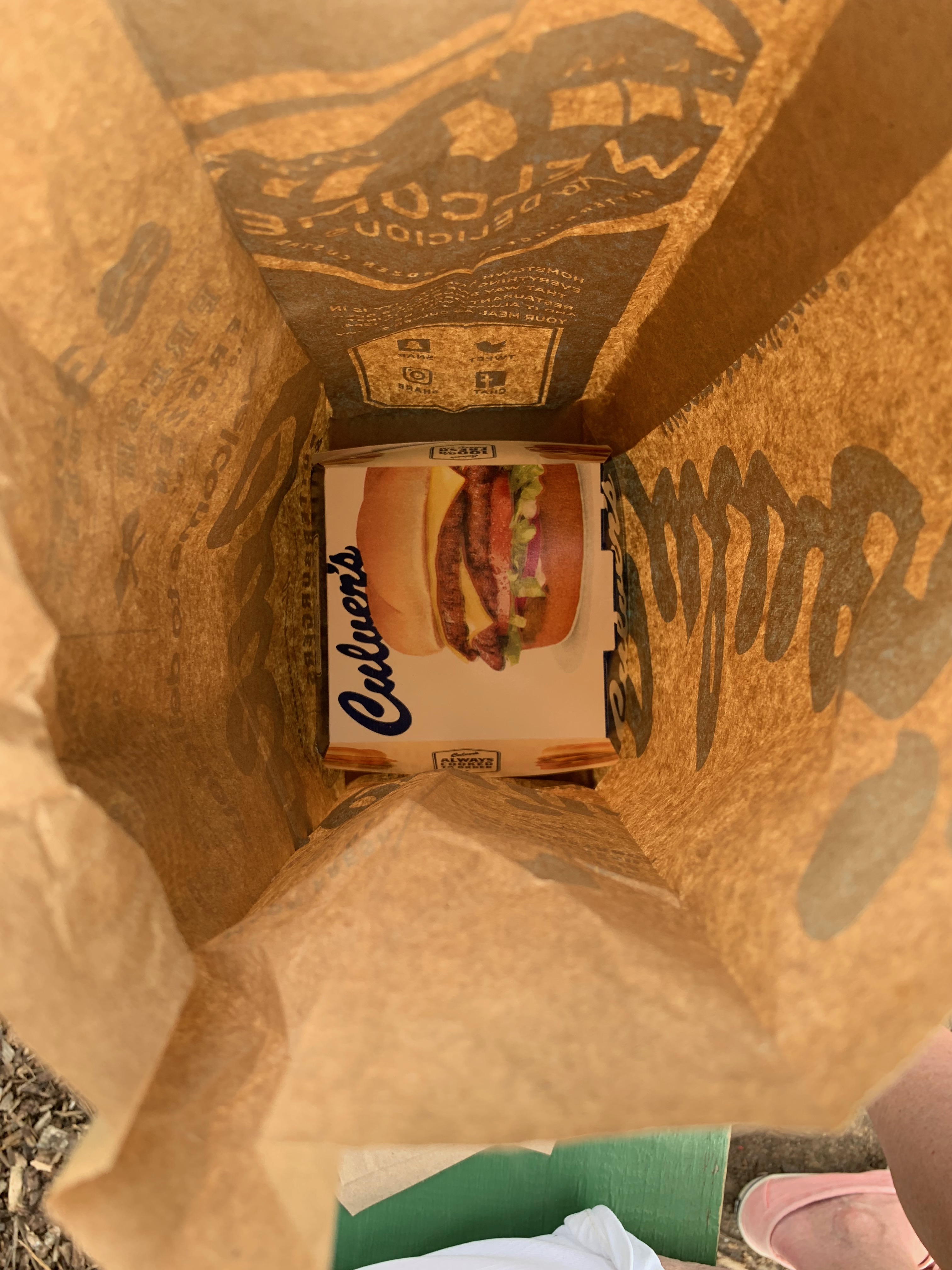
The Culver’s bag is all message. “Welcome to delicious”.

We were told about the Butterburger nearly 20 years ago, but never had the temerity to go to Culver’s and try one on. The thought of it repelled.  We visualized a hamburger swimming in butter, squirting mayonnaise, dripping juice with every bite.

And then the ads started.  We saw Craig Culver, capped and jacketed in blue, coaching the cook staff on the proper way to flatten the fresh beef patty on the grill.   It had a family feel about it, and somewhat reminiscent of another family burger business, Wendy’s.

We ordered two sandwiches, well beyond our appetites and good guidance.

But the ads persisted, and one day, they introduced the Butterburger Deluxe Double.  Two beef patties, mayo, and all the colorful rest.  That was when I learned that the butter was actually brushed onto the bun and grilled before the burger was assembled.  Well, that’s not so bad, is it?

So on a hot day in September, we drove to a Culver’s in Wisconsin, just over the line, and against all dining habits and trashing healthful instincts, guiltily ordered up two Deluxe Doubles to go. We waited a full five minutes as they actually cooked the burgers for us, squashing them down just like Craig instructed. Then, presented with a bulging bag of two you-know-whats, we drove like bootleggers off to a neighboring lakeside park to enjoy our feast with some ice-cold beers.

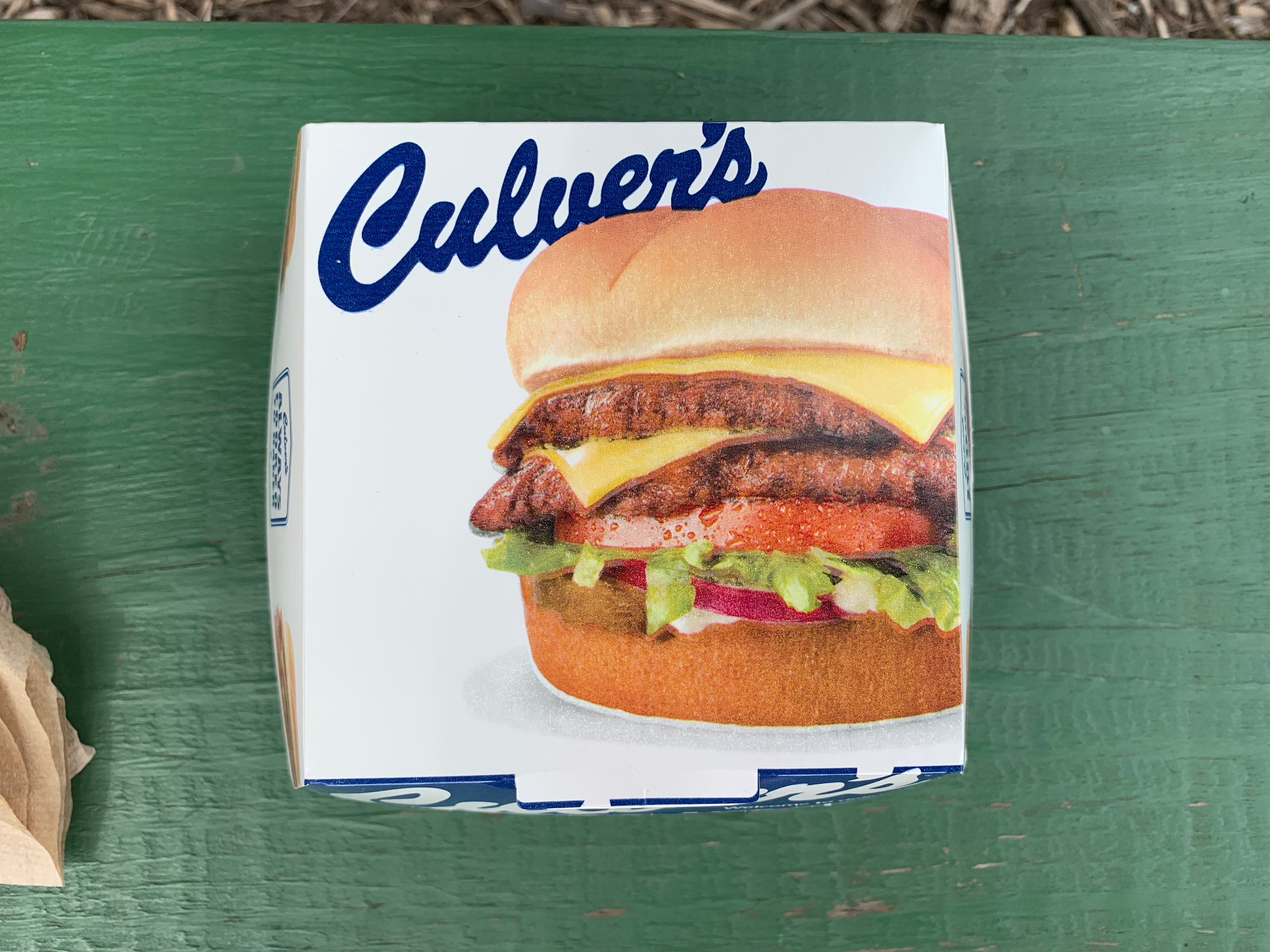
The experience was “our first” of a sort, and it was sinfully delightful.  Forbidden foods should be like that.  Reaching into the bag, we pulled out two promising, boxed beauties.   They looked just like the ads.  Sitting down on a bench, we marveled at the sensory delights of a bulging fat, colorful, shameless sandwich, dripping in beef juice and mayo.  It was hot, succulent, cheesy, and messy, with chunks of tomato and purple onion escaping out the sides of our mouths.  To some it might just be a burger.  To me, it was ambrosia.

The sandwich bulges with color, meat and veg, and oozes cheese and mayo.

Just wondering how deeply we had entered into the badlands of fat, I checked the Culver’s website, and found that our Butterburger Deluxe Double weighed in at 810 calories, with 155 mg. of cholesterol.  Bad?  Eaten every day, not good.  But once in a while, I could live with.

Incidentally, I took the fight to Wendy’s and bought a “Double Dave” named after the late Dave Thomas, founder, and felt the experience similar, but lacking the purple onion and extra mayo and raucously celebrated butter, it was a second place presentation.  The Double Dave also boasted 810 calories and 175 mg. of cholesterol, but without the hutzpah, the bravado of the Butterburger’s brazen image, it didn’t deliver the guilty satisfaction I felt in Wisconsin.

To some, a burger. To me, ambrosia.

The Culver’s website also gave me a look at the larger picture.  It’s a family run, privately owned business, 736 restaurants sprinkled across the midwest and south.  Wendy’s has 6,000.  The company is HQ-ed in Sauk Wisconsin, a smallish town north of Milwaukee.

Culver’s targets its charitable giving and philanthropy towards agriculture, supporting the education of young farmers with activities in the National Future Farmers of America, Farm Wisconsin Discovery Center, and most intriguing, Cows on the Concourse, in Madison Wisconsin.

Welcome–a burger most proud!


Standard