Economics

What’s Coming Next

String Ball

Life time savings.

There is a major, seismic shift in assets occurring while you read this.  You are thinking of the $12 Trillion which is pouring into the pockets of Baby Boomers as their hardworking, scrimping and saving parents pass into the great beyond.  But you are off.

In truth, the money is peanuts.  It moves from one bank account to the next, and nobody lifts a finger.

So, it’s not about their money.  It’s really about their stuff.
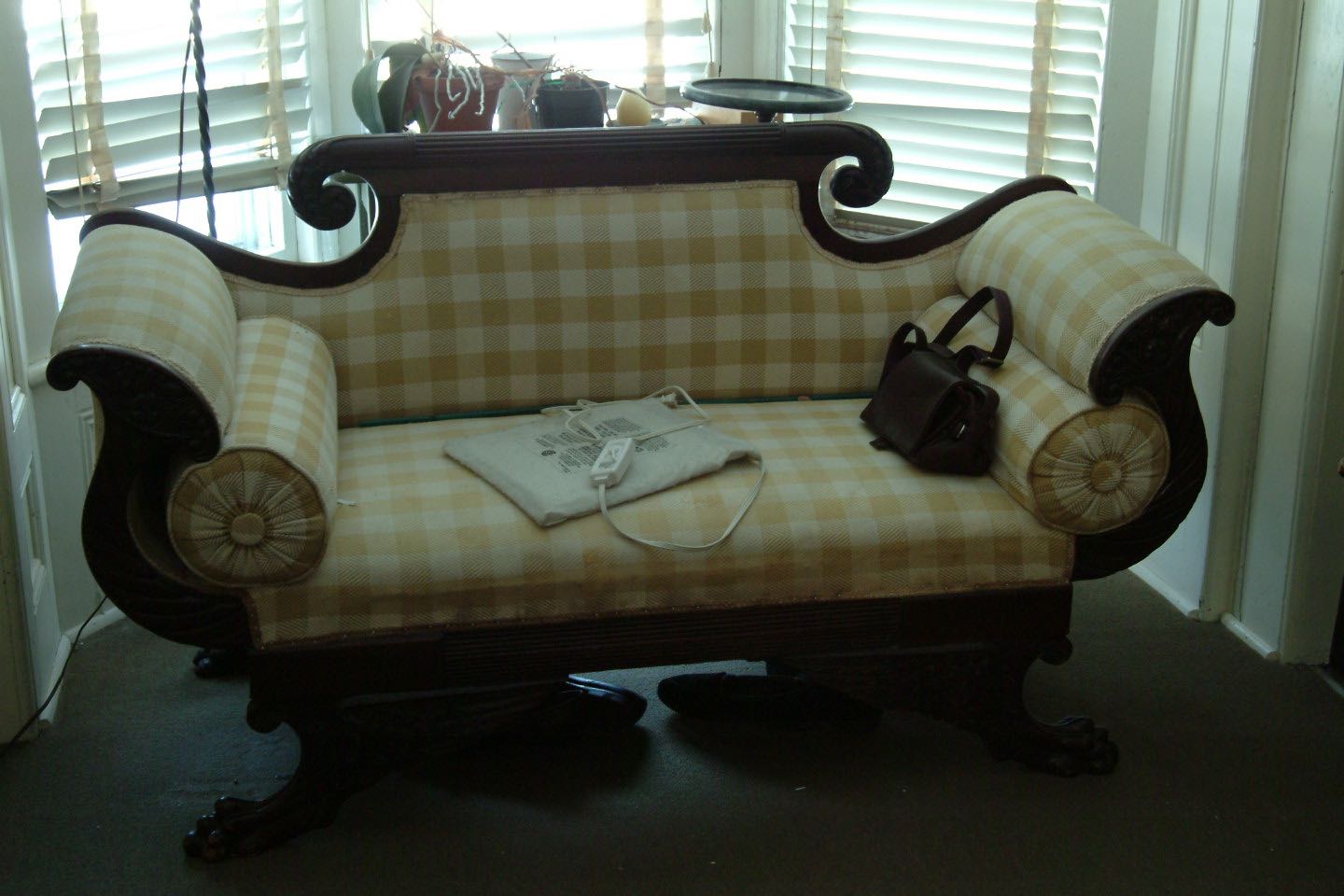
Sofa

This may not fit in with the kids’ Ikea.

There are two legacies which those post-wartime parents are sending along.  They promise profound effect upon us, and to generations still coming.

The first is a treasure of property which they struggled to build and acquire through thick and thin.   Too vast to itemize, but most Boomers will recognize the impact of their parents’ fully executed Last Will.

They are manifested in crowded basements, overflowing garages, leases on storage space, impenetrable walk-in closets, jammed kitchen drawers, and cabinets crammed with silver and china.

IMG_6466

A perfectly good pull cord, with some help.

The second legacy, even more profound, is a culture of saving.   The Baby Boomer was raised in a household characterized by frugal economy.   Nothing half-used ever got thrown out.   A broken item was in queue for repair, some day.

Again, the inventory of leftovers is virtually infinite.  Its aura a phenomenon.

Christmas Lights

Half of these work very reliably.

And you know it when you see it in the eyes of a Boomer.  That wince of remorse as a half-good string of Christmas lights hits the garbage bin.   Or the guilt attached to an old set of dull drill bits, that holds its place on the workshop bench, right beside a brand new set.

The reality is, while the Boomer is swamped in their folks’ stuff, they still can’t throw it out.   What’s worse, they are adding to it.

For example, a few days ago while driving down Milwaukee Avenue, I spied four baseballs resting in the gutter.   To me, it was like driving by a bank vault with the door wide open.

dumpster-hero-resi

“No, we are keeping the dumpster too.”

As kids, we could only envy the one on our street who had a baseball.   In fact, most of our youth was focused on scavenging for baseballs knocked out of the park, hockey pucks stuffed in snowbanks, broken hockey sticks, errant golf balls found on the road.

In our garage is a 5-gallon bucket full to overflowing with tennis balls, golf balls, lacrosse balls, wiffle balls, softballs…all items I have brought home like trophies from a jog around the park.

So I collect these play things like gold nuggets, feeding an appetite that was spawned a couple of generations ago when people just didn’t have much money.

Back to Milwaukee Avenue.   I pulled over, parked, and scurried across the street and retrieved the balls.   I could not believe my find.   These were in excellent condition, leather covers, no scuffs, and laces still waxed and shiny.   Bonanza!   The motherlode.

Balls

Cornucopia of finds on the jogging trail.

They are now on the shelf beside the bucket, which is full.

The significance of this perpetual foraging will become apparent to the next generation, those GenX-ers and Y-ers, and wet-eared Millennials who will finally have to deal with The Stuff.

Desk

One day, this may be a chicken coop.

You may want to give The Stuff to them, but you can’t.   They are still living with their parents.

My suggestion: this is the time to invest and build.   Look closely at your business prospects in:

1.   Storage space

2.   Trailer rentals

3.   Thrift stores

4.   Auctioneering

5.   Waste management

Golf Tees

Saving for the next round.

Regrettably we haven’t yet found a way to load it all onto a freighter, and sail it to a Third World depot, but that would be the next best opportunity.

Thanks for reading this far. It’s a puzzle I really can’t solve.  

I have to get back to repairing our Monopoly board.



Standard
Economics, Environment

Gassed: How Our Utility Co Turns Down The Heat

Odds are, if you get a gas bill, you are also getting a report card in the mail too.

      "Loser!"

             “Loser!”

Our gas company mailed us a Home Energy Report for last month, telling us how we stacked up against our uproariously wasteful and spendthrift neighbors.

Turns out: WE are worse than them.

It is a sad reality that I respond to competitive taunts, and right now, our gas company is yanking my chain.

You see, they previously sent us a report for last winter.   It had a little smiley face–which really is smirking–that says “GOOD”.

But I know what it’s thinking: “LOSER!”

"Good maybe, but not great."

“Good maybe, but not great.”

Beside Mr. Smiley is a bar chart that highlights our “Efficient Neighbors” in green. These are the raucous ones last New Years Eve that roasted a quarter steer on the gas grill while they played Marco Polo in a mammoth hot tub.  They have 9 kids, two washing machines and a greenhouse.

"With all due respect, your numbers suck, big time."

“With all due respect Mr. Brown, your numbers suck, big time.”

Then the report shows a longer blue bar — which is bad–that is entitled “YOU”.  In bold.

So I am now energized (hah hah) to understand how our humble little household can possibly respond to this blatant miscall.

I wonder if the gas company is playing with me.

There was once a TV movie in which a dad and his son fill up the neighbor’s gas tank every night to listen to him brag about his car’s great mileage.    Then after a few weeks, they siphon gas out every night to hear him complain about the guzzler he is driving.

Is there a prankster somewhere in the seventh floor of an office building in Chicago who is twiddling with my score, just to see how I react?

dr-zhivago-datcha-600

                                               “Just check that thermostat again.”

Worse yet, maybe they are not playing tricks at all.   Maybe our modest ranch is actually a gas-guzzling super nova.  A galactic black hole sucking energy into a cosmic chimney.

That might account for the drafts.

I am going to give the gas company the benefit of the doubt for the moment.   When I investigated the source of these reports, I learned that they come from a company called Opower.

There is a lab-coated millennial there who is modifying my “demand response behavior” while flipping through Hunger Games.

Essentially, Opower has placed my house on a giant leader board with about 50 million other households, and lo and behold, we are not on the top of the list.

Dinner at our neighbors.

Dinner at our neighbors.

I’d like to see the hermit who is.  Probably dressed in yak skins and eating his fish raw.

To their credit, however, they have shamed enough people in the last few years to reduce natural gas consumption nearly 2%.

And what is more confounding, improved consumer satisfaction ratings for the gas company by 5 points!

Talk about a world upside down.   Running against the natural order of things.

Our new HVAC guy, en repose.

Our new HVAC guy, en repose.

I am not beaten though.   I will climb that list.   I will lay down a 2-foot-thick blanket of moss in our attic.   Line the windowpanes with hay bales.   Wrap the basement in a giant Snuggie and remove the furnace.

Better yet, I will hang out with our neighbors.

Thanks for reading!  If you get these reports too, I feel for you.   But they are actually a pretty useful tool.   Unless you live in the woods.

Standard
Economics

11 Ways To Avoid Paying Your Bills — A Reminiscence

Shell GameIn a previous corporate life, I worked for one of America’s most well known and longstanding brands in the financial sector.

We once used the following pamphlet as an advertising specialty for the company’s pre-eminent and trusted commercial collection division.    This one-pager was a distillation of the numerous, incredibly brazen dodges companies would use to avoid paying a bill.

I lack the original direct mail piece, and would love to have it, and to credit the creator. It’s brilliant.

Instead, I am sharing my memory of it with you, for a chuckle:

11 Ways To Avoid Paying Your Bills

1. Always wait for the third past due notice, and then write and ask why you never received an invoice.
2. Next, ask for an itemized account. When it arrives, write back and say that’s not what you wanted at all.
3. Don’t ignore sales taxes. These give you unlimited scope for delay. For instance, if they charge sales tax, advise them your purchase order said you were tax exempt. Never mind that there was no purchase order. And if they don’t charge tax, why not?
4. Always ask for the invoice to be broken into two installments for accounting purposes. Then get somebody else in accounting to start the process all over by asking why there are two bills?  And then only pay one.
5. Send a check with figures not matching words. When they call, ask them to return the check. Send a new one, but don’t sign it.
6. Mail back a copy of the invoice, and staple the torn corner of a check to it. They will turn their department upside down looking for your check. When they call back, tell them you will check with your bank.
7. Tell them you will need two signatures, and the co-signer is on a world cruise with someone in their company for two months.  Discretion suggests keeping this quiet.
8. Send a check for the exact amount, but made out to a fictitious company. When they call you back, tell them you will check with the other company.
9. Ask for a breakdown of labor and materials. When you get it, insist that the numbers are reversed.
10. Tell them that all of their invoices have been seized by the Department of Commerce, as part of a nation-wide investigation.
11. Finally, insist that you already sent them a check, and fax a copy of a previous cancelled check. When they track that down, they will ask for new check. Mail them the fax.

There you have it! As I said at the outset, this is from my written notes, copied from the original, author unknown. If you can track that person down, please let me know, and I will credit them.

And of course, this is my reminiscence of a tongue-in-cheek direct mail piece, by no means a recommendation or endorsement.

Mean time, pay your bills.

Standard
direct mail, Economics, Environment

Zapped: How Your Utility Saves Energy

ComEd 2014 -06 273 doubleCommonwealth Edison is craftier than you might think, compared to the traditional image of the big, dumb, power company.

We are used to receiving their monthly ransom note.   It is comprehensive in detail, reducing our extravagant lifestyle to bar charts that rise and fall with every change in the weather.  But beyond the normal appeal for money, we now receive a separate Home Energy Report.

The statement has no billing or stern demands.   Instead, it reports how your household is doing compared to the neighbors.   ComEd 2014 -06 barsThat’s right, compared to the igloo on your left whose roof is sooted with burnt whale oil.  Or to the right, your very private neighbor who has lights blazing in the basement, around the clock.

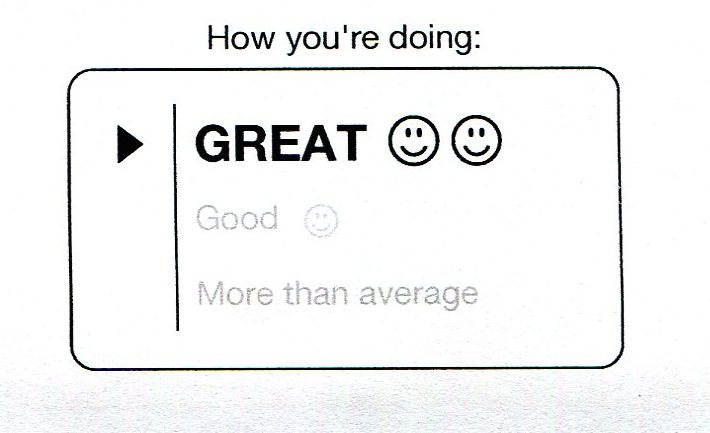
ComEd 2014 -06 270 SmileyOur report gave us a couple of smiley faces.    In the energy world, happiness is about abstinence, and we have aced, barely on the grid at all.

The report said in essence: “Compared to 100 close-by neighbors you are living the life of Scrooge in the dark; you must be cold at night, and survive on canned food and powdered eggs, since you don’t have a fridge, let alone AC.   P.S. Have a nice day.”

Careful review of this colorful, and highly personalized report reveals that the news comes from a company called Opower.

Not to be mistaken for, or associated with a day-time talk show queen, Opower serves some 93 utility companies across the U.S., Canada and globally.   It ingests and assembles all energy usage information to create report cards for over 32 million households.

ComEd 2014 -06 270LinesAt first, this looks like an unnecessary expense, adding to our monthly bill.  It turns out however, that peer pressure is a powerful motivator.   Opower’s reporting service has reduced electrical energy usage by 4 billion kilowatt-hours since inception.     That is roughly one-third of your average nuclear power plant’s yearly production.

So why does Com Ed benefit from cutting output?   ComEd 2014 -06 SavingsAnd why spend extra money generating reports to reduce utility billings?  Because building new plants to meet energy demand is very, very expensive, and guess who is paying for them– us.   It further turns out that Com Ed’s customer satisfaction rates have bumped up since the reports started.   Consumers are educated and empowered (haha).

The darker side of the energy reports is the growing suspicion about our 100 neighbors.   I think they are having more fun.


If you enjoyed this, or know someone who would, be sociable, share!  Thanks for reading.


Standard
direct mail, Economics, Marketing

Just Like Money

<<Spoiler Alert: The incredible reason why retailers flood our pockets with cash every day.>>

Mailbox Money

The mailbox delivers the green– for consumer and marketer alike.

We are having an outrageously good time with store coupons.  As we exit the mall, it takes a 50-pound anchor tied to our belts to stop us from running frantically, eyes over our shoulders, across the parking lot to our get away car.

Why?

Kohl’s, one of America’s most renowned stores, mails us $10 cash coupons with no strings attached.  “Just spend it!”

Hunh? 

"Here's a discount card, no wait, here's TWO discount cards!  Go shop!"

“Here’s a discount card, no wait, here’s TWO discount cards! Go shop!”

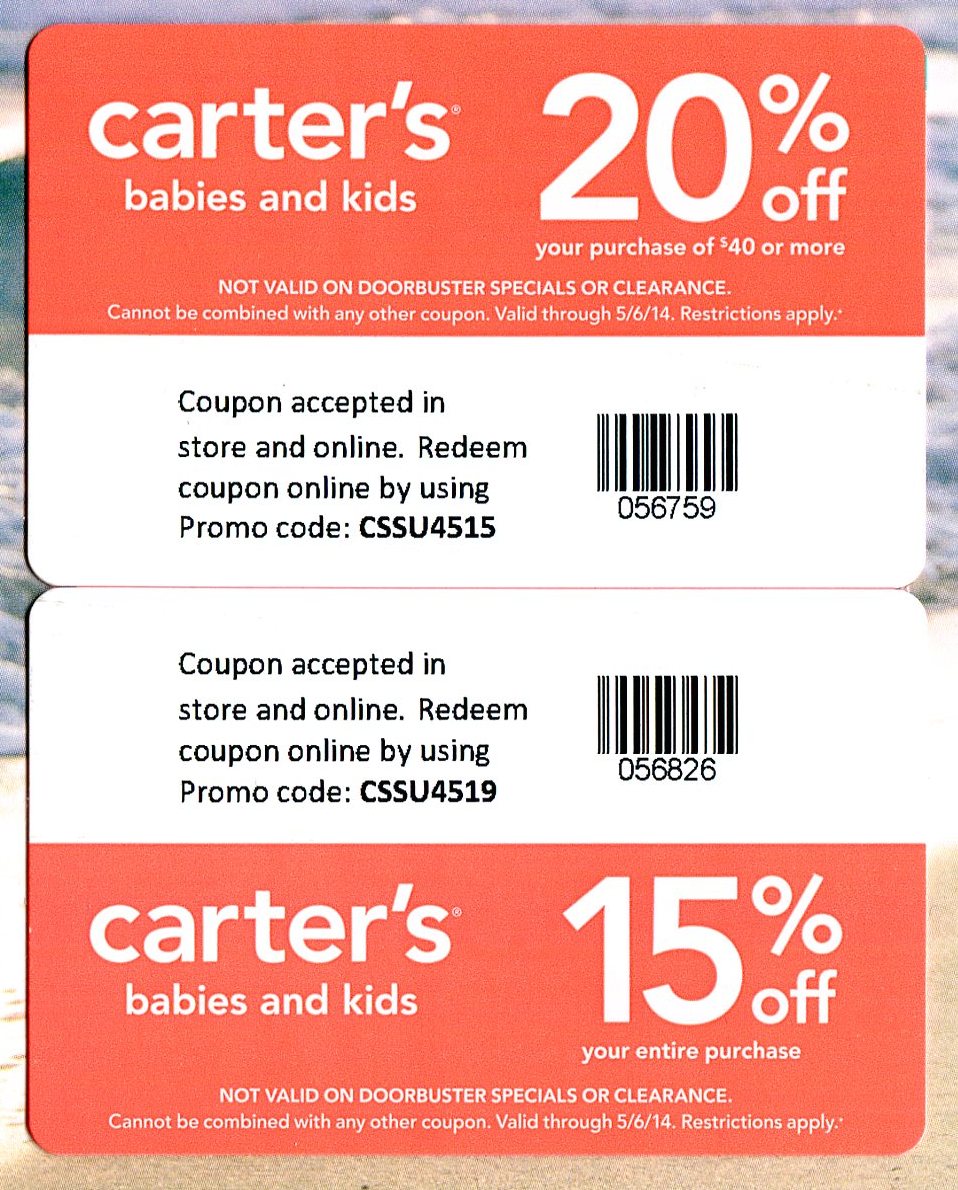
Carter’s throws in a 20% discount for a $40 purchase.  And another– 15% off everything, period.

Bed Bath & Beyond churns out $5 coupons faster than the U.S. Treasury, which is saying something.

Ulta hands us $3.50 just to spend $10.   We have enough conditioner for the entire cast of Muppet Movie 3.

BBBY coupons come so quickly we bale them.

BBBY coupons come so quickly we have to bale them.

For some, coupons are clutter in the mailbox.  For many, they reveal how weak we really are.  Despite our supposed disdain for direct mail, we read each coupon carefully…. and then sneak into the store late Sunday night with a fistful, and a bag over our head.

holeinpocket

‘Just can’t spend the coupon fast enough.

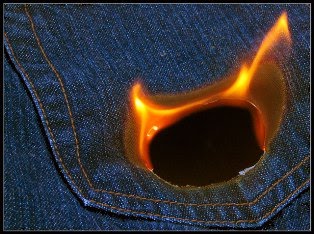
At our house, coupons are incendiary devices, capable of exploding into flames when placed in the pocket.

For instance, I am mailed a $5.00 rebate card from ACE Hardware.   The card sits between the salt and pepper shakers, Tasering me to rise from my chair, go to ACE and buy something, even a bag of sheep manure, just to use the money.

ace manure

Buy something— anything!

My wife is a coupon maven.  She gets the deal, but escapes the accompanying load-up the marketer hoped for.

For instance, that $10 cash gift from Kohl’s?   She tenders it, usually on a $20 item marked down to $10.00.  “Look honey:” she beams, “7 pairs of  underwear, for nothing!”   Totally void of guilt.   Butter would not melt in her mouth.

So how does the retailer really fare with these incredible deals?

Not bad, if you look at the right numbers.

CouponCabin.com does an excellent job of capturing all the publicized deals of a retailer.   It spins them back to any shopper savvy enough to ask for them online.   The company regularly totals results, and in the case of Kohl’s, reports the average shopping cart is $66.43 before $18.04 in coupon savings.  A 22% discount.    That’s a promotional cost, and it comes out of gross profit.

"Take this money, please!"

“Take this money, please!”

January 2014 Kohl’s gross profit margin was 36.49%….. 7 and 11 points better than Target and Walmart respectively.

Kohl’s cost of goods (COGS) was 63.51%.

So are the Kohl’s people nuts, or is this normal business to throw gobs of money out the window?

It boils down to how much Kohl’s will pay to get an extra visitor into the store.

Bottom line: a profit with every sale.

Bottom line: a profit with every sale.

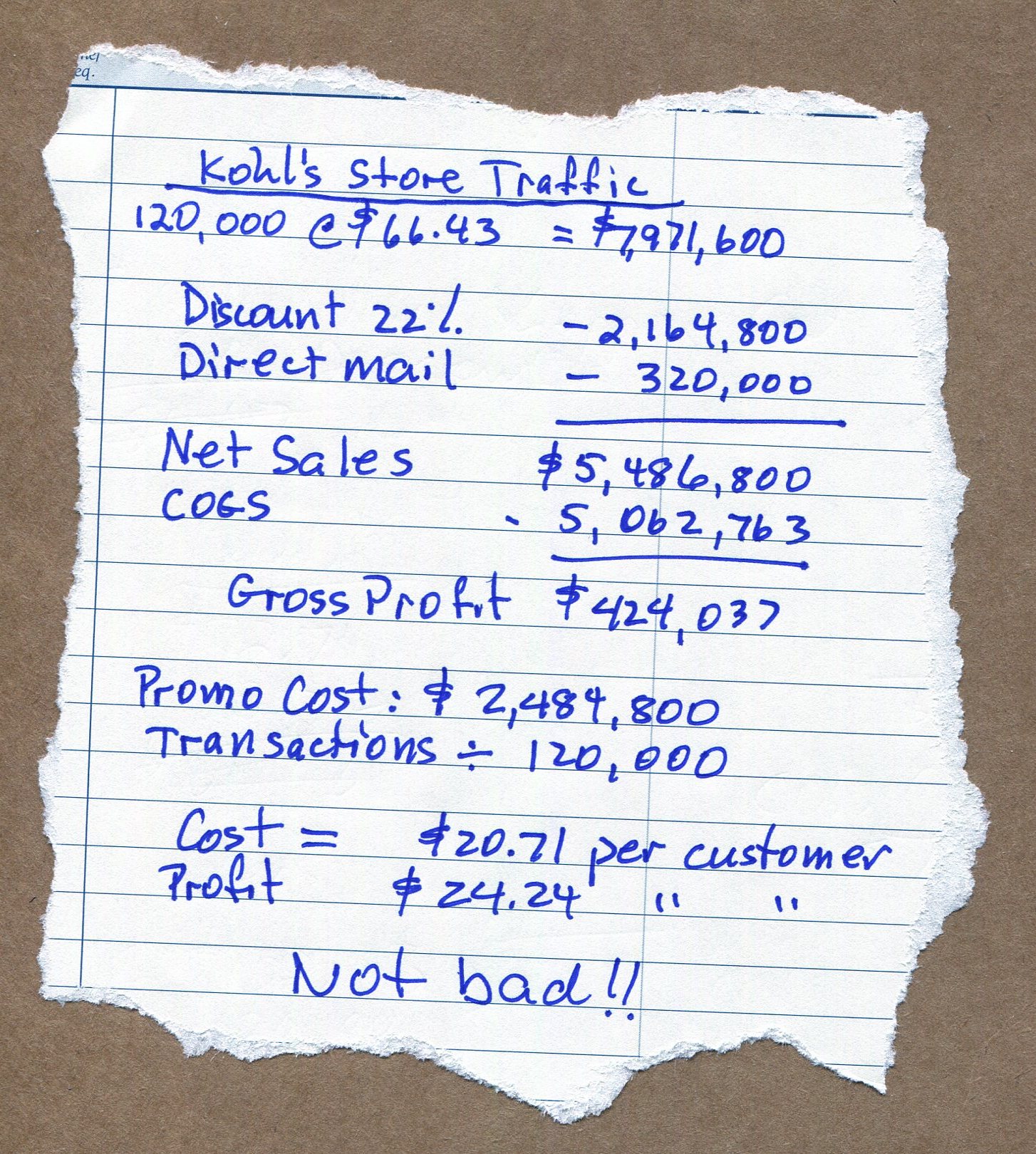
Say they mailed a 1,000,000 coupons, and 15% were redeemed.   150,000 purchases!   But set aside 30,000 purchases for those folks who would have bought the items anyway.   So the mailing generated 120,000 additional transactions, each with a shopping cart of $66.43.  That’s $7,971,600 in extra sales.   But the 22% discount takes away $2,164,800.  And subtract the mailing cost of $320,000.   Kohl’s is left with $5,486,800 cash to pay for the goods sold: $5,062,763 ($7,971,600 x 63.51% COGS).

Bottom line, Kohl’s promotion cost $2,484,800  and delivered $424,037 in extra profit. That is a 17.1% ROI.  Not bad.  You can’t run your whole business that way, but to generate extra sales and margin, still a pretty good day.

And here’s another perspective: the promotion delivered 120,000 extra store visits at a cost of $20.71 each.  And because the gross margin on each cart was $24.24 ($66.43 x 36.49%), Kohl’s did better than break even.

So that is why you find oodles of deals in your mailbox every week.   They work!

Boots

“Buy one, get one free!”

And my bottom line? I am looking for a deal on rubber boots.  To spread the sheep stuff.


If you got this far, I hope you took in all the math.  As with all retailers, these are big, scary numbers.   But well targeted direct mail makes them work.   Please share this article if you liked it!  Thanks.


Standard
Economics

A Nickel For Your Thoughts

penny-1936-7877445Our neighbor nation to the north– those hardy, conscientious folks who are the first line of defense against the arctic chill lost a battle this past spring.    The Canadian penny was removed from the endangered species list, and officially extinguished, i.e.. it is extinct.

The argument against its survival was that it cost more than it was worth.  Which is a stunning confession to be made by any government official anywhere.

But there you have it.   The upside is that every child in the nation will now learn the important arithmetic of rounding up and down to the nearest five cents.   There is the clever, political subtlety that the Canadian government did not eliminate “cents”.  It is still legal to use a cent: talk about it, write it, or include it in important bank interest statements.   Retailers can still charge you cents, but you will pay according to nickels.  The penny is the ghost on the sales counter that haunts all transactions.   Everyone senses its presence, but it can’t be seen.

The move has rocked the net worth of the country.   According to the Royal Canadian Mint, there are 35 billion pennies at large in Canada.    About $10 per person.    Turns out there are nearly 19,000 tons of pennies stashed away in cans, desk drawers, pants pockets and chesterfields which have been devalued by a factor of two.   You thought you had a jar of $12 bucks in pennies?  Nonsense.   You have enough copper and zinc for a Venti Frappuccino.  

Where this new found economy takes us, is to another government agency in on the conspiracy: the post office.    Canada Post has announced its new plan to modernize and overhaul the postal system.   This includes raising the price of a single first class stamp to $1.00.    A buck!  Unless you purchase stamps in bulk, when you will only have to pay 85-cents.    See how that works?   No pennies!!

lady letterbox

Compounding this elaborate pricing strategy is the plan to curtail household delivery.   Before long, Canada’s mail will be delivered to a community box at the end of your street.   This will precipitate two additional behaviors.  First, neighbors will have to speak to each other when they visit the box.  Second, they can remove the riveted, burnished steel “No Junk Mail” signs from their doorsteps.

junk.letterbox

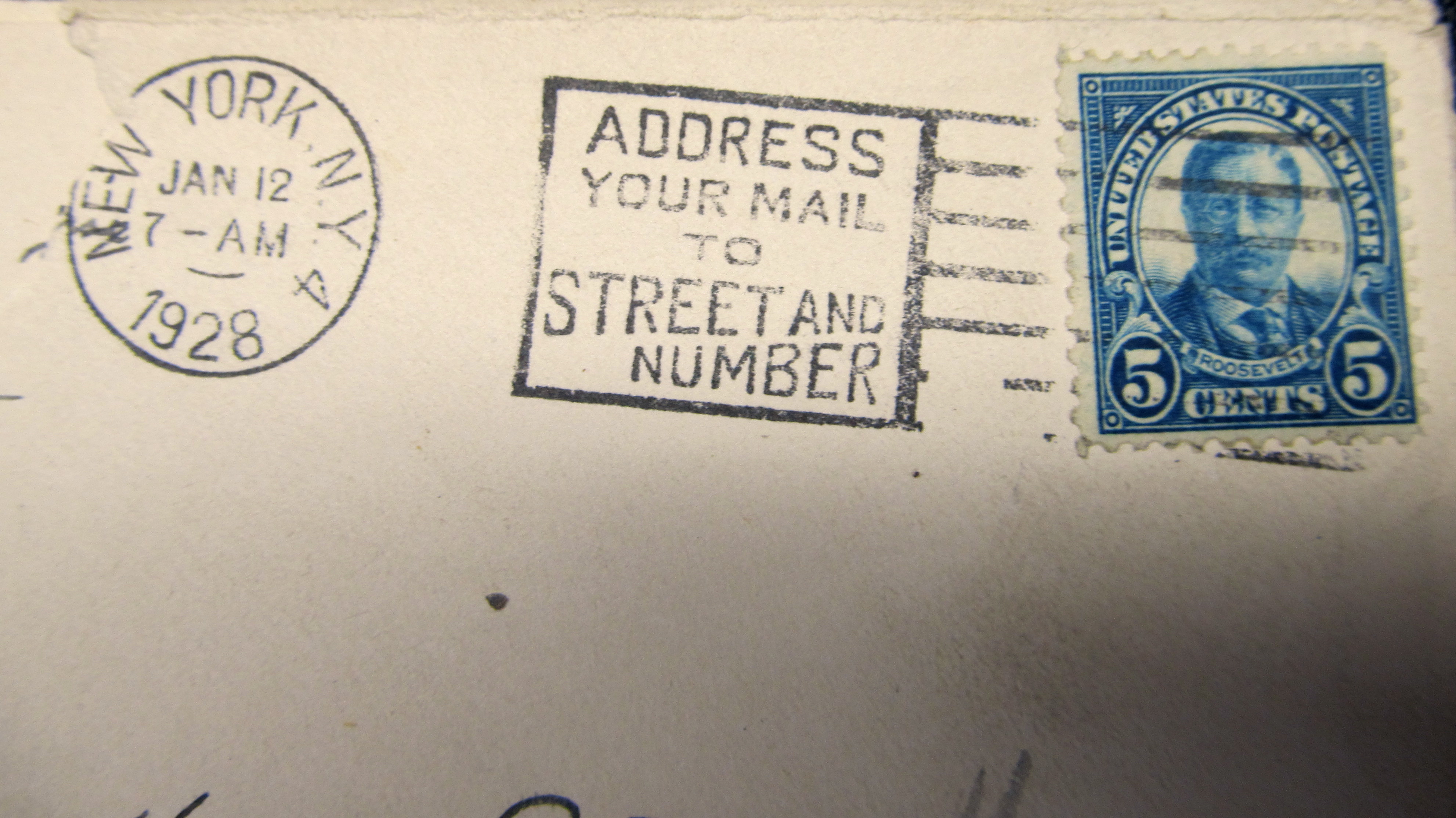
Truthfully, the United States Postal Service has a similar history of thriftiness.   They too decided that the customer should share in the work of delivering the mail.   In 1928 they thrust the responsibility of addressing onto the back of the writer!   No longer was it acceptable to merely place your aunt’s name on the envelope.   The USPS unilaterally demanded a street address and number.   Another typical example of  heavy-handed government.  Added to that insult was the price of a stamp: 3 cents.

IMG_6200And if you couldn’t find the pennies, you had to round up to a nickel.

Standard
Economics

Breezy Money

Following up on my amazement yesterday about the glut of wind farms…the whole thing about wind farming is that it looks so easy. Like dew worm farming. Or mushrooming. You just put up a fan, and the wind blows it, and a little machine turns it into electricity. And it’s free! Almost growing wild on the beach.
beach-money

Like many, I was so enchanted with the concept of getting easy money that I did some figuring –not my strong suit– but I calculated that if I had just one of these giant wind turbines, say the 250-footer, I would have a 2- megawatt wind farm. A megawatt turns out to be a thousand kilowatts, and just to explain it in terms you understand, a 100 watt bulb costs about 55 cents up at ACE Hardware, and it’s good for a 1,000 hours they say.

incandescent-light-bulb

Rounding that all up, I stood to pull in about $43,000,000 per year, before taxes. Mind you, there are no taxes because the government is subsidizing the whole thing for me.

Actually, I may have that slightly wrong. On good authority, I learned my new turbine would really cost $3,500,000.

If I borrowed the money from friends, my operating costs, maintenance and loan interest would work out to $290,000 per year. Which is, admittedly, more than I am making now, so I am really interested in selling one of these contraptions to somebody else.

But nevertheless, once it’s all in place, it is guaranteed to deliver 5,260 Megawatt Hours of power per year. I am just thinking about the batteries I am going to purchase to hold all that electricity. When all is said and done, my cost to produce a Megawatt hour is around $55. That’s like, only 100 lightbulbs, which I can handle.

When I whittled this down to Kilowatt hours, which I know is more comfortable for you, it’s a measly 5-1/2 cents each.

Awesome, right? Now you’re up for it, I can feel it.

This is where it gets interesting though. I looked at the latest ransom note we received from Commonwealth Edison, and they are only demanding 4-3/8 cents per Kwh. Hah! No wonder they can’t make any money! If they sold my wind farm product, they could shut down Niagara Falls, and still be in the black by Tuesday.

american-falls

Niagar Dry

As a practical business person however, I am doing nothing at this time, pending sage advice from my accountant who is allowed one phone call a week.

If you are eager to get in on this, but looking for something a little more in your income bracket, there is a company out there now, Southwest Windpower, which is installing back yard wind turbines faster than you can say “Oklahoma” .

Their Skystream 3.7 goes for $12-$14,000, and they are flying –haha– off the shelves.

Myself, I am forever teetering on the innovative edge. I am preparing a personal, hand-powered turbine. This one is all natural, 100% environmental, multi-directional, and can be used on the calmest, or windiest of days without pause.

Slick Whimmy

See, I told you this would be easy.

Standard