Culture, direct mail, USPS

Tremors At The Post Office

Spoiler Alert: Numbers That May Surprise You!

The latest USPS report on mail volumes is out, and magically, incredibly, it points up.    The number-laiden Revenue Pieces and Weights report January 1- March 31, 2016 tells us volume for the past quarter was up 1.4%.

Big Business

For many of you, the news is lame. After all, what is an additional 520,183,000 pieces of mail? Actually, it turns out to be 37,414 tons, the equivalent weight of 454 Space Shuttles.  Which again points to the enormity of the US Postal Service.

Critics tend to discount the post office for its supposed obsolescence, but if you hang around a mail sorting facility for a moment, you know this is BIG, massive business.

So I for one am excited that mail volumes grew this past winter.


Slide2

Direct Mail and First Class Up

The better question may be why are they up?   It turns out that Direct Mail increased 1.9% over the same quarter a year ago, 355,488,000 pieces.   That could be related to political fundraising mail, and a cautious optimism in the economy.

First Class mail increased by 0.8%, 135,253,000 pieces.   An astounding turnaround!  Mind you, that includes all business mail.  When it comes to individually stamped mail, like birthday cards, bill paying and charitable donations, it was down 2%.  There is more intriguing news on this personal category in a moment though.

The big winner is Parcels and Packages which are exploding, correction, booming, sorry, mushrooming 13.2%.   This past quarter the USPS delivered 1,121,723,000 parcels, total weight: over 1 million tons.

The Magazine Subscriber Fails To Renew

What the report also reveals is the continued slide of Periodical volume: magazine counts dropped by 5.6%– 81,070,000 pieces over the three months compared to 2015.   Magazine subscriptions continue their slide.

The eye opener in this display of numbers is how mail looked just five years ago.   In 2011, total mail count for the quarter was over 41 billion pieces.   Since then volumes have dropped 6.7%, about 3 billion pieces.

While this is a generally understandable result of internet and social media, it is worthy of note that direct mail dropped only 3.4%, thus illustrating its successful economics.   By comparison, First Class Mail dropped nearly 13% in the same period.  Magazines, down 22%.

Parcels On The Move

You have to hand it to USPS management for the growth in Parcels.   While the internet may have crushed letter mail volumes, it opened the door for USPS package delivery.

Slide3

In 2011, Q2 Parcels totaled 667 million pieces.  This past quarter, USPS delivered 1.1 billion parcels, up a whopping 68% over five years.  And revenues? $3.7 Billion, up 82% from 2011.  The more we buy online, the more the post office delivers.

The significance of Parcels growth is that these numbers represent the USPS position in a competitive market with peers like UPS and Fedex.

Is Internet Migration Finished?

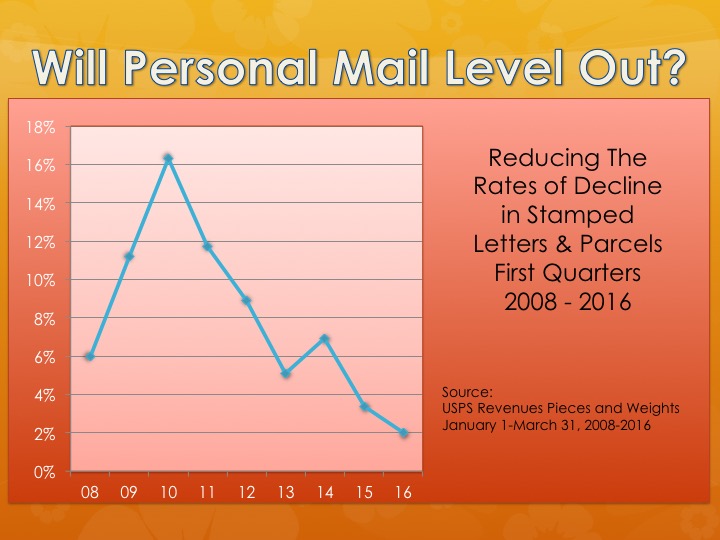
The encouraging story about Stamped Letters is worth a peek.   Personal letter volume cratered in 2008 and 2009 by -17.2%, and in 2010 by another -16.3%.    Since then, like a plane pulling out of a disastrous dive, Stamped Letters have nearly leveled out this past quarter at only a -2% decline.


Slide1

This leads one to believe that the attrition of postal mail to email and social media has just about finished.

Next month marks the end of another quarter for USPS record keeping. It will be interesting to see how the impact of the recent 1-2 penny decrease in price might improve mail volumes.

The direct marketers will take note, and who knows, maybe someone will pick up their pen and write one or two more letters as well.

Here’s the report for you review.  Enjoy!

Standard
Culture, Entertainment, Music, Thanks

Tom Rush, Master

Tom Rush2

A Charles Giuliano Photos image of Tom Rush at work.

Occasionally a simple action sets a need in motion.

A couple years ago a college friend sent me a CD of folksinger Tom Rush.  This entertainer’s music first broke into our lives back in  1966, hung in there until graduation, and then evaporated as we moved on.

Competition with job, kids and new directions pretty much locked Tom Rush out of our daily routines.

But fifty years later, the brand new CD woke me up.   Not only was our musical hero from university days still alive, but he was also, still, at the the top of his game.

We decided to go see him again.

On stage, Rush is a quiet conversationalist.  He talks to the audience, and snares them into the context of his next song with the finesse of a master salesman.   His modesty hides his greatness in the genre.

Launching his career along with icons like Bob Dylan, Joni Mitchell, James Taylor, Eric Von Schmidt, Jim Kweskin, Richie Havens, Fred Neil today his body of work reaches across decades of accomplishment, from early blues to contemporary ballads.

If “ballads” sounds corny, think stories, worries and wishes put to music and rhyme, about things and events on our plates every day.

IMG_5339

Isis Restaurant & Music Hall occupies a renovated theater from 1937 in the heart of West Asheville.

Last Sunday Tom Rush performed at the Isis Restaurant & Music Hall in Asheville, NC.   Contrary to the those of many small cities across America, Asheville’s downtown is booming.

In the west end, also known as the West Village, the Isis theatre is a fixture built in the 1930s, and renovated to its current appealing look with bar, restaurant and stage.  Outside, the original marquee showcases the night’s act.  Across the street is a guitar shop, with nearby pawn shop, grocery, village market, cafe’s and gas stations.

The street is filled with cyclists and people enjoying their particular pursuits.  While there was plenty of curb parking we chose to park in the grocery lot.   There was a sign pointing to a steel box into which I folded eight dollar bills to keep my place.

IMG_5340

Across Haywood Road a guitar store stands ready to fulfill the next musician’s dream.

Seated at our table up front, we looked at our hopeful neighbors, ordering dinner.  The Isis is delightfully small.  It seats about 50 diners and another 100 or so listeners on the main floor and in an upper gallery.   It is a cool place, good food, with a restaurant out front which was packed when we arrived, 90 minutes before the show.  Louise, the show scheduler came by our table to welcome us– a nice touch.

Up on the stage, a young fellow is tuning instruments: pianos and guitar.   He looks like a stage hand but in fact is Matt Nakoa who opens for Rush.   I shake his hand, and ask him to pass a note to his partner, requesting a song.

I can’t believe I am doing this but the opportunity can’t be lost to communicate with this giant.

It helps when I add, “We saw you last September in Minneapolis.  You guys were just great, thanks!”  He got my name and finished his tuning, and left the stage.

A few minutes later after Louise opens the show, Nakoa reappeared and delivered a virtuoso performance.   His songs are rich, thoughtful and complex, with a voice that adds a layer of honesty to the words.

At the keyboard, he is incredibly efficient.  Not that he uses only one or two notes per bar, but rather that he uses all his fingers every second.  I was reminded of the Bruce Hornsby sound: full barreled piano, active and melodic.  Matt Nakoa could choose to be a powerful classic concert pianist, but he opted for the folk and jazz club scene, much to our good fortune.

matt nakoa on keys

A Neale Eckstein image of Matt Nakoa unwinding a tune.

Nakoa also played guitar, with a light and intriguing touch.   He is left handed, playing a left handed guitar, but strung for a right hander.

This forces an inverted chord formation which for most people would be like tying their shoes using a mirror.  I am guessing he had to borrow someone else’s guitar in his learning, and the habit stuck.  The result is golden: a unique and magical delivery.

He delivered a half dozen songs, each original and lush in melody.  You want to hear “Ballad of Jenny Kane”.  Just as enchanting however was his patter between numbers.  He plays while he speaks, reminiscent of  60s entertainer Mauri Hadyn who also spoke with the audience while she produced a continuous soundtrack of riffs.

Tom Rush walks on after Matt’s introduction, and the crowd cheers for both singers.

Two figures could not look less likely to work together, and that is the magic of this duo.   We are faced with mop-headed Gen-x musical prodigy standing beside a crusty, smiling, white haired, git-picking balladeer.  Unbelievable combination.

Tom Rush Purple

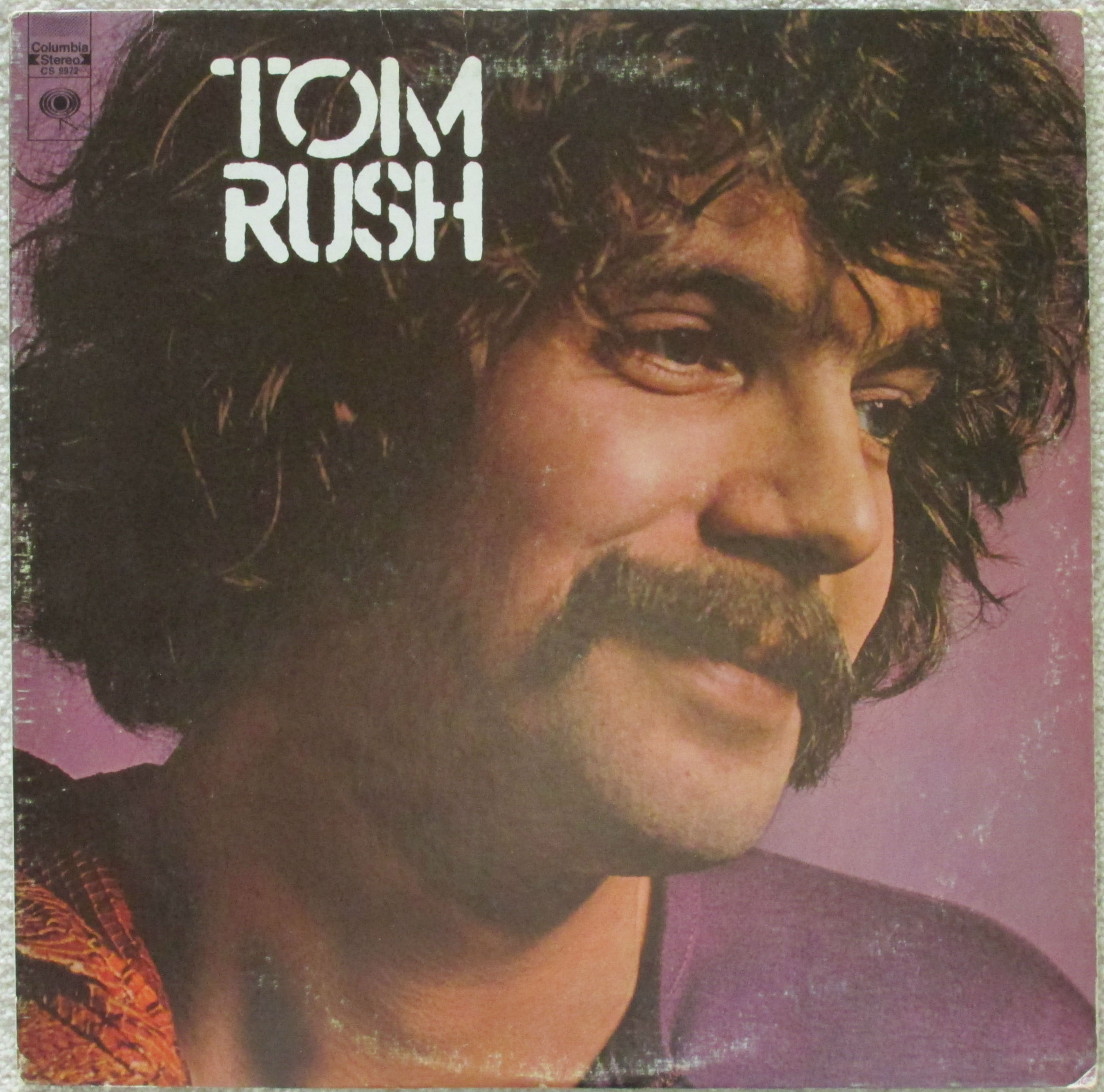
Early on Tom Rush started a following that just won’t quit. His ’72 Columbia Records release.

Our fascination is soon overcome by the quality of their product.   Rush commands the room with his good nature and low-key, self deprecating introductions.  He opens up his act with the confidence of a master woodworker unwrapping his blades, choosing one to carve a unique keepsake for the audience.

Launching into “It’s Gonna Get Hot Tonight” the crowd responds enthusiastically to Rush, encouraged by his beat and voice, both strong and happy.  In the background Nakoa has shelved the concert hall vibes to provide a wood-floor honky tonk sound that fills out the song perfectly.

The audience tonight is a following that has grown organically over 5o years of performances.   We drove 750 miles to see him.  True to his brand, Tom Rush delivers amusement and satisfaction by way of his story telling, singing and playing.

We know these songs, and they have legs.   The lyrics are his, in perfect measure, with stories we want to hear.   They are delivered by a voice that is both raucous and contemplative.   He can change our mood in line or two, all the while polishing that finished piece of work for presentation.

There is a side to Tom Rush which is remarkable, and it points to his generosity.   Yes, Matt Nakoa adds a dimension to his music, but it is the reciprocal nature of Rush’s partnership that is giving a younger generation the benefit of his experience.

He is hardly looking at the final days of his stellar career, with over 25 engagements scheduled in the coming months.  Despite that, he has taken on the onus of sharing what he knows with a new, younger talent.

Matt Nakoa has his own music and his own story, but he is following in the footsteps of a legend with full support.   In big business, the CEOs always say to hire people smarter than we are, but it’s scary.  Rush took that dare on Nakoa.   Our kids should all be so lucky.

A look at Tom Rush’s website unveils another gift.   While he has the usual display of story, news and events, he also has a page of FAQs .  What’s with that?   Countless questions from fans about how to play his songs, complete with guitar tunings.   In our world, it would be like a master vintner unveiling his secret recipe for a knockout wine.

Which leads to another puzzle in the Tom Rush narrative.  Why does a self respecting folk icon tour New England and the west coast playing in small venues for only the price of a good steak?  Celebrity has its costs, but modest ticket fees aren’t among them.

I think the answer is that the man loves what he does, and he wants to share it.   His audience loves him back. That is remuneration enough.

And by the way, he called me out, and played my request.

Thanks for reading!   This show is what coffee house music and jazz clubs are all about.   Who needs an auditorium for 20,000?  I pass on some websites for your interest, and feel free to share!

Tom Rush Show Schedule

His CD “What I Know”

Matt Nakoa’s Home Page


Standard
Fundraising, Media

Why Don’t You Just Ask?

Charitable Giving, Social Media and Stickiness 

online donationsWhy is it that fundraisers can’t write a note, or pick up the phone and just say what’s on their minds?
Why do they have to float it out there, like smoke, or a bad itch, on Facebook or Twitter?

It brings to mind a lesson from long ago.

As a kid of 10 years old, in Delhi, my hometown, ice and skates were intended for hockey.  You know you live in a hockey town when the rink is reserved every morning and night for guys loaded down with potato sacks of gear and sticks.

Anyway.  I didn’t play hockey.  I was in the figure skating club which was a popular girls’ sport.  Not so much for boys, but there you have it.

Every year our figure skating club hosted an ice carnival.  This is a 2-hour show where the whole town comes to watch this costume extravaganza on ice, down at the rink.  Little squads of 7-year-old Sugar Plum Fairies skoot out in a circle and pirouette.   Flocks of Skunks wobble on tiny skates across the ice while the town band plays “The Baby Elephant Walk”.

The senior girls kick line does a bouncy number to a Gypsy tune and the crowds roar their appreciation.  The whole time the blue and the red lines plus 5 face off spots map the ice for us.

The crowds are there because they bought tickets.  $3.00 for an adult, $1.00 per child.

Those tickets are sold because we figure skaters were told to go sell the tickets.  Which brings me to the current point in a round about way.   I hated selling tickets…scary and embarrassing, knocking on doors, asking people to hand over money for a non-hockey event on ice.

This was an annual debate between me and my parents:

“Why do I have to sell tickets?  Why can’t people just go to the booth and get them?”

“Because you need to learn to ask .”

“What do you mean?”

“Look, you need to learn to ask people face-to-face for things that you need.   We need to sell those tickets.  It’s for the figure skating club.   Most important, the audience wants to know who they are giving their money to.   This is business.   You are the connection. So get out there, and ask them to buy the tickets. Now.”

Today, with the power and saturation of the internet we can sell anything we want online.  More significantly, we don’t have to ask, beg, beseech, or grovel before anyone particularly.  It’s a non-contact vocation.  We can just float an open invitation out there, and see who bites on it.

Skywriting comes to mind.

If our follower numbers are big enough, we might get all we need without a repeat advertisement.  If not, the public plea is repeated, with urgency, and perhaps a shade of disappointment hidden between the lines.

The shame of this online power is that there is no need to commit, or worse yet, make a plea or promise in return to any one.  Just as bad, the buyer or donor doesn’t get any nod or recognition for rising to the occasion.  If they’re lucky, the online gifting site says “Thanks– your receipt is being emailed.”  And that’s about it.

So I am all for charitable giving.  And any time someone just asks me, I am happy–no, delighted– to give.  Charitable giving is a way for someone to participate and to help, and most importantly, the giver is thankful for being invited.  That was my lesson from home.

So drop a line, or pick up the phone, and just ask.

Standard
direct mail, Fundraising, Marketing, Media

Battles In The Mailbox

IMG_5172

The Memorial Day rush begins.

There is an ongoing, armed conquest being waged in our mailbox.

Whether it was my donation to a certain political party that flagged my name, or perhaps a popular consumer magazine subscription, the ensuing barrage of fundraising mail from veterans’ associations is non-stop in our mailbox.

Regardless, the creative pitches are stunners, and deserve a closer look.  You are hereby invited to read my mail!

Most of these charities are profiled and rated on Charity Navigator.org, which strips away the emotion to detail actual performance against their stated missions.

Turnkey Office 

IMG_5163

As big as a door mat, and packed, too.

The Disabled Veterans National Foundation takes overwhelming force to a new level with their glossy, Flat-sized embossed package.  Despite the red-stenciled “DO NOT FOLD” our faithful USPS carrier did just that to get it in the mailbox.   It measures 12 x 15, and according to the weigh scales at our grocer’s fish counter, weighs 13.4 ounces.  If that seems heavy to you, perhaps we have been paying too much for our halibut.

IMG_5169

The field ready office with solar powered personalized calculator and stationery.

Inside this doormat-sized kit is a desk pad, calculator, calendar book and ball point pen.  Along with this prefab office kit is a $2.50 check drawn on a Bank of America account.   Surely a mistake, it is signed, dated and made out to me.   In the enclosed letter, the writer, smitten with remorse, asks me to return the check.

Check mailings are iffy because in many cases the marketer needs to have funds held in escrow to honor the checks if, fates forbid, the recipients decide to take the money.

Disabled Vets FNDN182

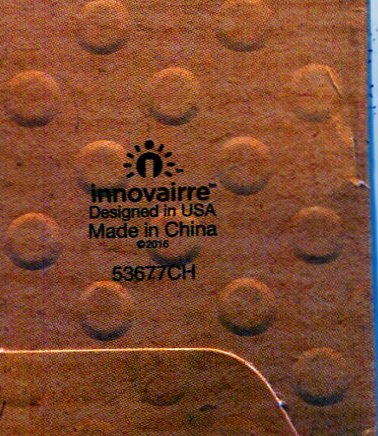
“Made in China”–The disturbing bug that must be shown.

This kit ain’t cheap.   Postage alone is nearly a dollar, and considering the hand-applied “Philip Brown” label on the calculator, plus its die-cut and tensor-ribboned place mat, the overall cost has to be at least $4-$5 dollars each.

Which may explain why the kit was made in China– not an encouraging signal for U.S Veterans.  I wait to see if they will send me a typewriter next year.

Parade-Ready Flag

IMG_5170

Steel plate reveal: your own desk ready Stars & Stripes.

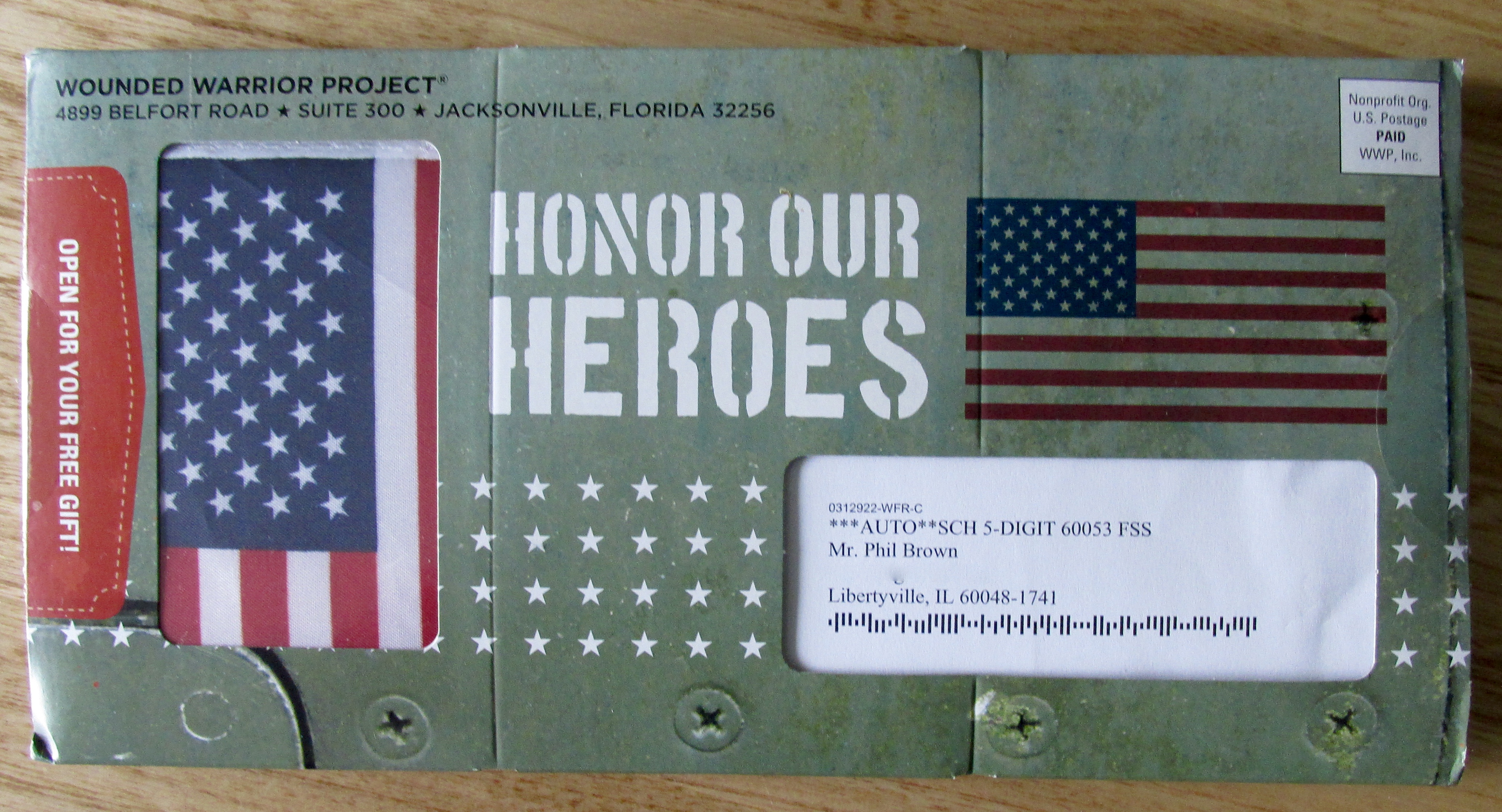
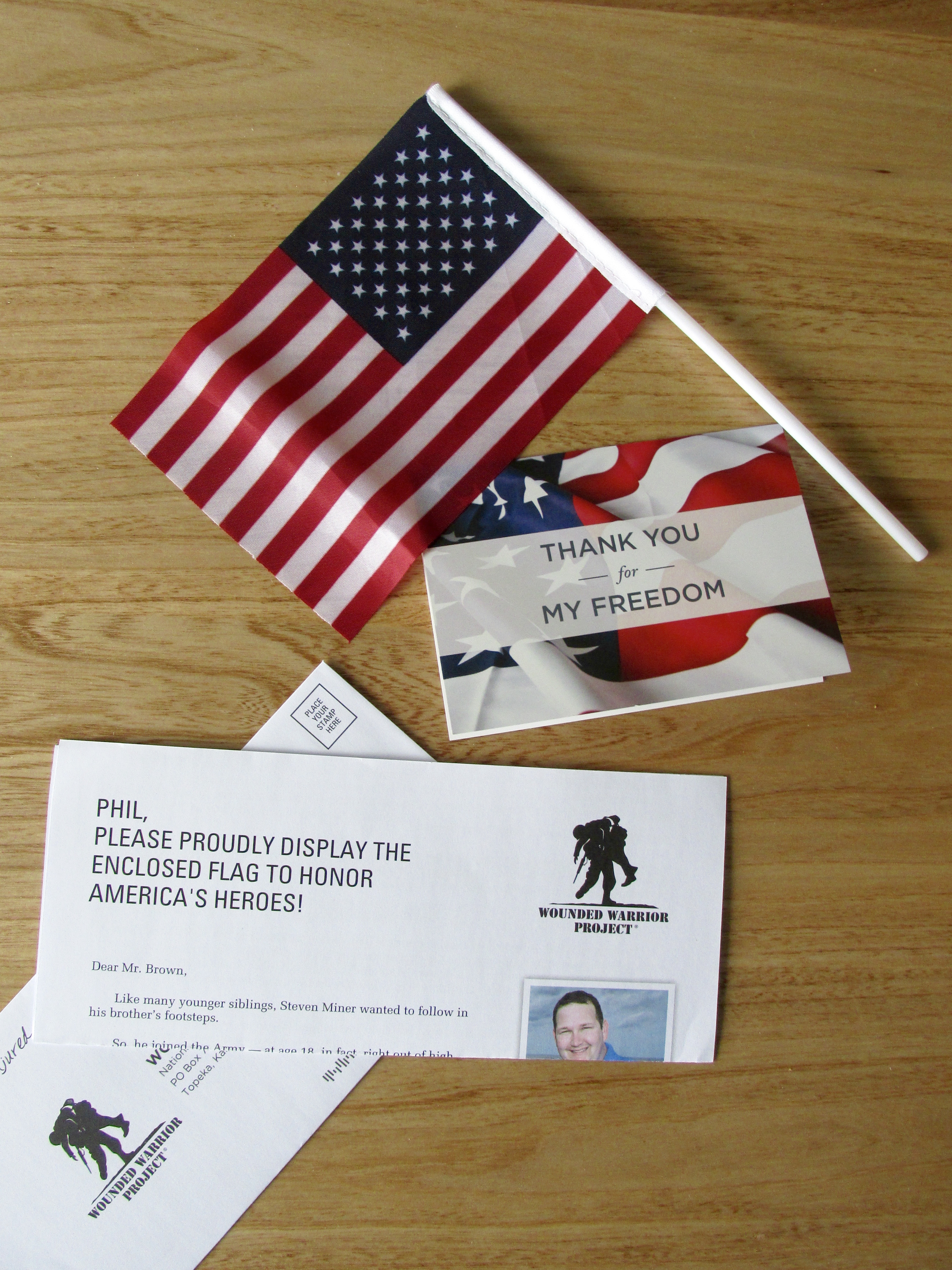
Wounded Warrior Project also approached us with a package, a 5 x 10 windowed boxlet   displaying a real flag inside.  This Army-green imitation steel-plated ammo box is nearly half an inch thick, so it’s non-automation all the way..40-45 cents to mail.   The flag is intricately folded into a die-cut foam holder that also holds the addressed donor form, a hand-assembled product for sure… which explains again, why it was made in China.   In the mail, $1-$1.50 each.

We’ll talk about cost/response in a minute.

Photo Wallet

IMG_5187

A photo wallet… a hard to discard gift.

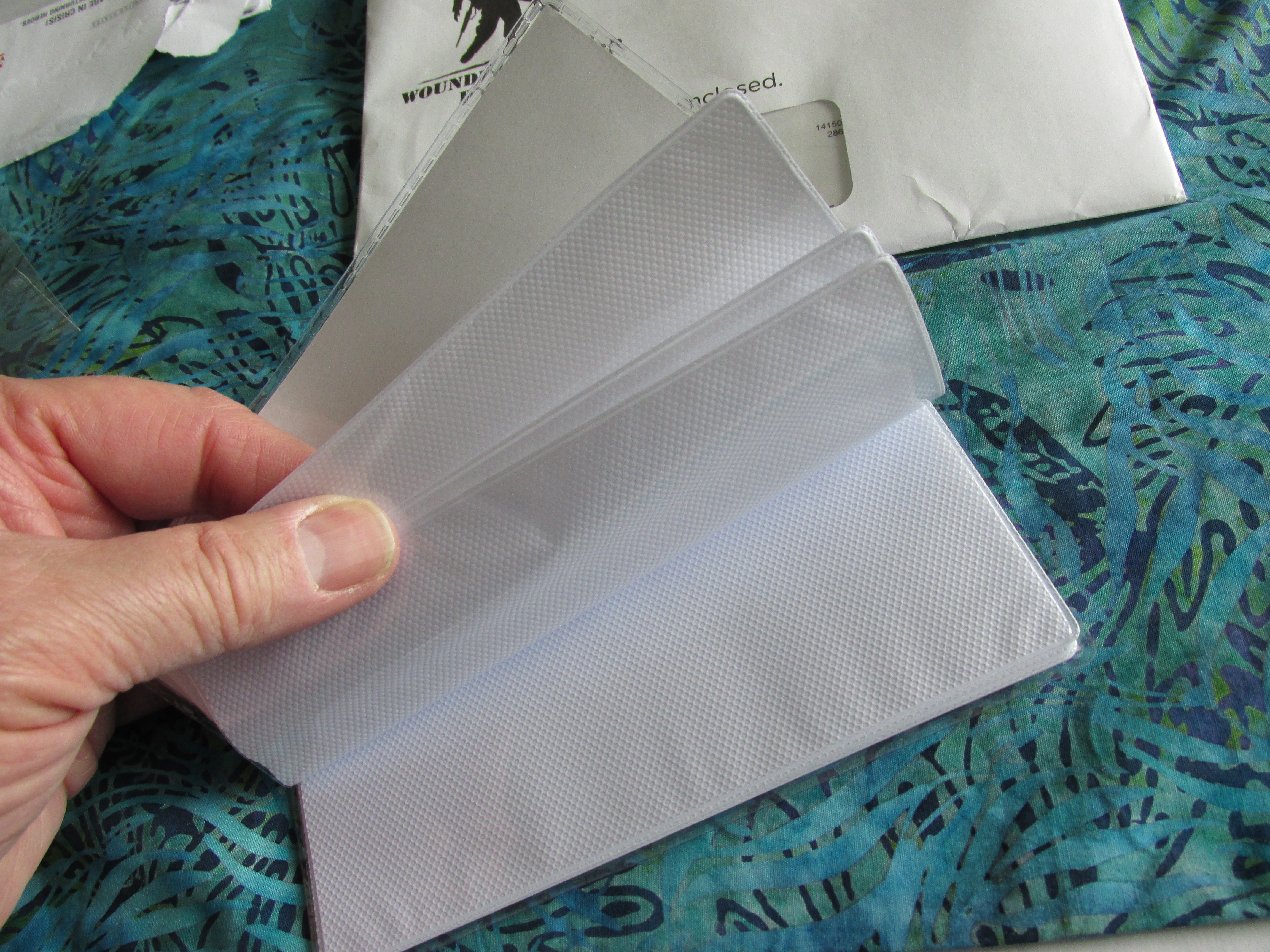
Wounded Warrior Project also sent along a separate request which included a 4×6, 20-page photo wallet.   Inside a regular 6 x 9 envelope, this gift actually made immediate sense, and the wallet now holds images of our ridiculously  brilliant, and beautiful grandchildren.  Not being one to take anything for granted, we will reward WWP for the effort.  Still, with postage, in-the-mail cost is 40-50 cents each.

Calling Cards

IMG_5174

Ersatz calling cards stuck in place to get the letter opened.

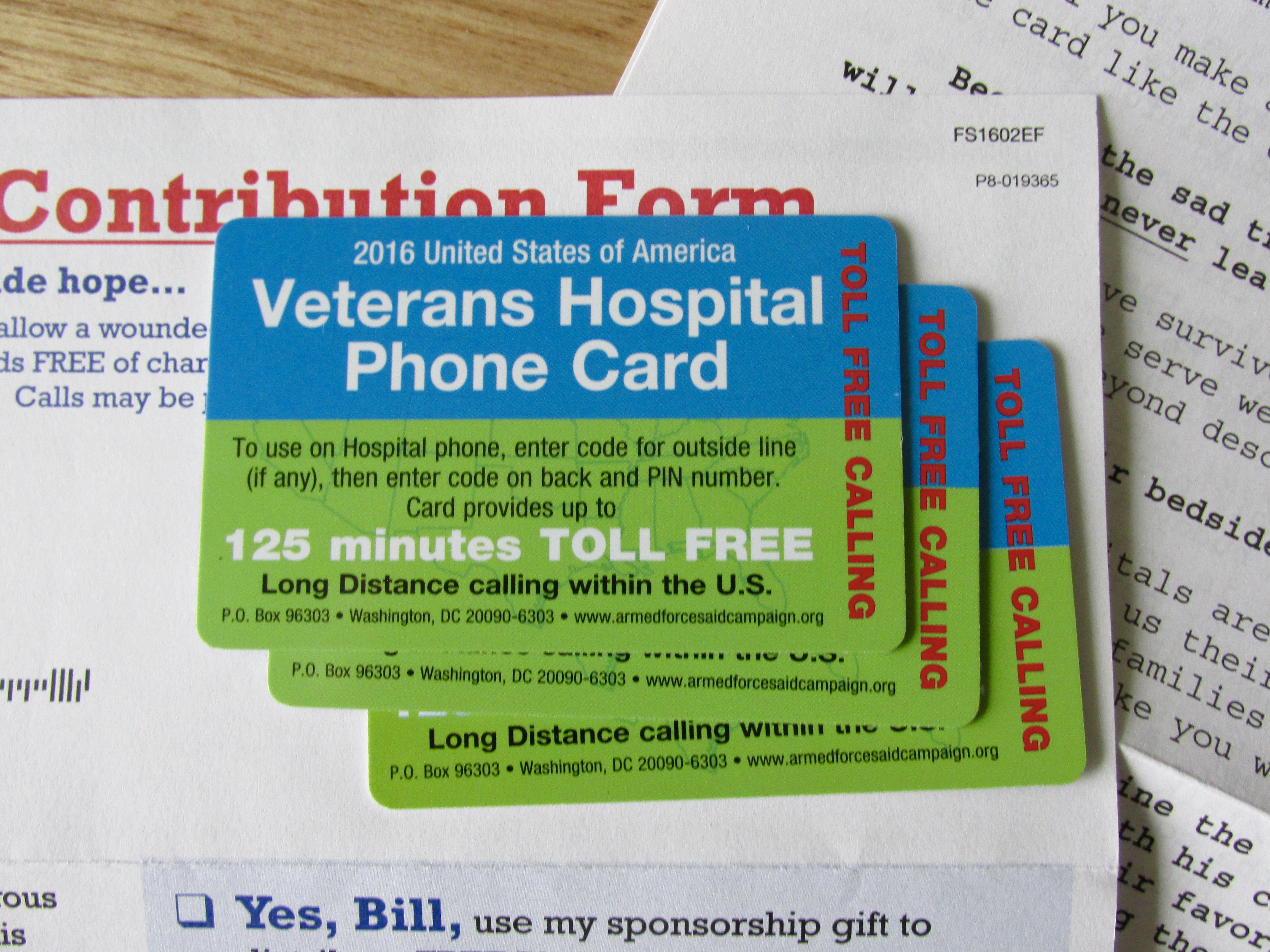
Help Our Wounded, and Armed Forces Aid Campaign have learned how to affix 3 plastic phone cards to a page.   Technologically, this is pretty cool, if not done by hand.  The cards are stuck on top of each other and appear jumbled through the large glassine window….as if they were thrown in quickly, sealed and run off to catch the 3 o’clock mail.  The impact, especially for the uninitiated such as me, is strong.   Their job is to get the envelope opened, and indeed, the ploy works.   Help Our Wounded, aka Healing American Heroes is not found on Charity Navigator.   My bet is the mailing costs 50-60 cents all-in.

Going For Our Stronger Feminine Side

IMG_5180

A pretty package with writing in mind. This one’s for Gramma.

Disabled American Veterans is the senior classman in veteran’s charities.  Despite that, they have assigned a female status to my record, so I receive kits that reflect more genteel tastes than one might expect.   Putting the gender bias aside, especially in North Carolina, this kit is in keeping with DAV’s efforts to send along quality gifts.

I can’t use any of this one, which is resplendent in lavender-hued Forget Me Nots.   Still, if I was desperate, making a struggling attempt to write to my passed on mother, or to scratch out a hasty last will and testament, I have notepad, and mauve colored, simulated vellum sheets for assigning my debts to chosen in-laws.

The kit is tasteful, if gender specific, and is certainly an eye opener.   DAV also uses real stamps on the reply envelope.  While the accountants may come unhinged at this largesse, DAV’s frequent use of the costly stamps is proof that the presumptuous gesture works in bringing in more donations.

One wonders how many codgers will steam off the stamps, versus cross out DAV’s return address and use the envelope to pay their water bill instead.

All in, this piece must tip the scales at $2.00 in the mail.  But it works.

Subtle and Cautious

USO 2016-05-02 185

Creative use of stamps–just enough to impress, but maybe a challenge for the USPS accountants.

The USO is the most conservative kit to ask us for a donation, and that is in return for a genuine Stars & Stripes Flag plus good feelings.   I included this under-played kit because of their creative use of postage.

Non-profit letters get a privileged postal rate, somewhere between 8-18 cents depending upon address density and automation compatibility.   USO chose to affix 5-cents worth of stamps to their outer envelope, and to use their postmark (#440) to make up the difference at the counter.

Their reply envelope reveals their cautionary approach to wasting postage money.  Rather than place the full 49 cents on the envelope, like DAV, they are willing to go for 5 cents, but left the Business Reply Mail (bill us) indicia in the corner.

We guess that this itsy-bitsy effort will drive the postal accountants nuts.

In the mail cost: 40 cents, tops.

Drop Another Nickel

Paralyzed V 2016-05-02 187

Just when you thought the nickel was yours, they want it back.

Paralyzed Veterans of America is one of several charities which has a conveyor belt from the US Mint to their mail room wherein millions of shiny new nickels are deposited on glossy label stock letters.

Just yesterday we discussed at lunch how many of us keep the nickel, which after all, adds up when everyone is mailing them, March Of Dimes excluded.

PVA’s piece is a max-sized letter, 5 x 11-1/2.   This is a smart move because the postage is the same large or small, so you might as well get the most paper into the package that you can for the same price.  However, nickel-enhanced gold foil labels are heavy, so the rule is to keep below 3.3 ounces or the rate goes through the roof.   $1.25-$1.50 in the mail.

Did You Get Our Card?

IMG_5188

Flowers, fuzzy puppies and kind sentiments… a happy birthday for some one.

The Veterans of Foreign Wars by comparison uses a tiny 3-3/4 x 7-1/2 envelope, aka a “Monarch” to ask the nagging question, “Did your special edition birthday cards arrive?”   Somewhat reminiscent of the neighbor’s kid who knocks on our door to sell Christmas wrap.  We still have six rolls from last year.

Well, yes, the cards did arrive.   I am sorry, but so far I have not found a suitable target for them which are best described as lovely and softly sweet.   My Mom might have liked one, but not from me.   Again, these are estrogen-energized, and if I get my hands on the person who tagged me as female, I am going to scratch their eyes out.

A simple little kit, probably 40-cents in the mail, at most.

How Do They Make Any Money?

As you can see, these kits range in cost from 40 cents to perhaps $5 each all-in.   Can a non-profit actually make a profit from these mailings?  Check the Charity Navigator for details. You will be enlightened.

But realistically, the acquisition of a brand new donor will always be at a loss.  The strategy is to keep that donor giving for a long time afterwards, hopefully with a final bequest of planned gift when they pass on.

accountant

“How the @#$%^%$$ will we ever make this work?”

For the accountancy gene in you however, rest assured that every fundraiser has a donor acquisition cost they won’t exceed.   This is the anchor point in a campaign.  To respect that restriction, a good forecast on the cost of a response is to divide the piece-cost by the expected response rate.

For instance, a piece costs $2.00 in the mail.  This is big money, and the accountants are squirming in their chairs.  But the marketing folks believe the kit will get a 7% response.

$2.00/7% = $28.57 cost per response.

If the charity can show that a new donor at that cost will stick around on average for 5  years and return $150.00 in donations, then that is a reasonable investment.

Meantime…

We are digging in for more incoming mail.   Hopefully without flowers.

Thanks for reading!   We do support our Vets and and respect all that they do.  If you are inclined to donate to a cause, check out their website for a financial report, or visit  Charity Navigator.

Standard
Culture, Media, Thank You, Thanks

Running Off The Cliff

wile-e-coyote-2You know the Wiley Coyote scene where he runs off the cliff in hot pursuit of the Roadrunner. There, hung in blind suspension of disbelief, he looks at the camera before reality sinks in.

Then he falls with a vviipp or a boink. We chuckle happily at his dusty, bruised remains in the canyon below.

So it is that I now admit to a similar, sad and painful realization.

Last December 6 I advised you that despite the falling volumes of the post office, one thing blossomed like a fresh spring crocus on a sunny hill… our continued, warm-hearted custom of sending greeting cards.

Stamps 965 copy (1)Christmas, Hannukah, Thanksgiving, Halloween were all good reasons to pick up our pens and write.

I detailed in colorful charts how “Single Piece Cards and Letters” sky-rocketed in the last quarter of the year, from October to December. Poring over the figures from the regular USPS reports, I found that the numbers went up, even while general mail volumes went down.

It was, as I said, revealing our brighter side.

Mail may be an antiquity, but by golly, we are sending a card anyway.

wiley's canyonRevisiting that article, I discovered to my shock and dismay, that I had reported on revenues, not pieces. Aaarrrggghh!

Yes, patient reader, I misled you, big time.

The truth is, Cards and Letters for Q4, October 1-December 31, remain virtually the same share of the total, for the years 2004 and 2014— 27.5% to 27.7%.  Meanwhile the whole category tumbled 55% over ten years.

Do they jump up in the last quarter as our good intentions begin to materialize?

Yes, as always.  In 2004, an uptick of 18%, and 2014, up 22%, just in time to make delivery by Christmas.

But who’s going to calibrate a blip…a minor swelling…a mild burp in goodwill based on these numbers?  The fact is, we have laid down our pens.

With that, Wiley Coyote looks down into the abyss.  In his descent, he contemplates what went wrong.

wile-e-coyote-off-cliff-largeYes, email for sure.  Good grief, why send a thank you card for a dinner when a two-liner on Gmail will tick that off the list?  Want to bang off a birthday greeting fast?  Hit “send” and it’s done.   And is there any need to spin post card carousels in some tourist trap when you can celebrate your vacation on Facebook?   Hardly.  And so much for mailing pics of the Grandkids when there’s Instagram.

“Ahhh, to heck with it,” Wiley concludes as the ground rises before him, except… there is one factor to consider…

The physical delivery of the letter made a big, personal-brand impact.   When someone took the time to compose, and write, in ink, on a nice card, address and lick an envelope, buy a pretty stamp, and find a mail box, it communicated in ways far beyond digital.

It’s a nice thought.

~Splat.

Standard
direct mail, Economics, Marketing, Media

Awakenings: What Happens When USPS Cuts Prices

Spoiler Alert: This Is All About Direct Mail Math

It was not a well publicized announcement, 10 days before Christmas, that the USPS will most likely cut the price of a first class stamp by 2 cents, April, 2016.  That’s a 4% cut!

Whether the consumer figures out that a letter will mail for only 47 cents is a question, but for the direct mail community, the news is big.

First of all, direct mailers don’t talk cents. They communicate in thousands. (‘000’s.) A 2-cent drop in mail cost is worth $20 per thousand pieces mailed.

Hopefully the marketing folks at USPS have now awakened to the merciless mathematics of direct mail. In the civilian world, when we experience a cost of living increase, we suck it in, or look for a raise in pay to compensate.

In direct mail however there is a brick wall facing an increase in mailing costs.   The reality is, mailers don’t manage by total program cost. Rather, they manage by cost per response.

For instance, if a charity spends $1,000 to mail 3,000 letters, it is because they expect to get a 2% response…60 donations, at a cost of $16.66 each.

That cost per response (CPR) is bedrock..an anchor around which all other budgeting decisions are made. So when the USPS issues a 1% increase in postage, the CPR goes up, which is unacceptable.

The Story Behind The Story

When the post office raises its prices, we experience the inelasticity of direct mail performance, because mailers must preserve that cost per response.  The only way to do that is to spend less on something else, and that is exactly what happens: smaller envelopes, fewer pages, cheaper paper, less ink, for example.

The bogeyman in this reduction process is that the cheaper the package, the lower the response, which drives up the cost per response again!

The end game option in this vicious circle is to cut out lower responding markets, by mailing fewer pieces, and diverting funds to other direct media.

None of this helps the USPS.

Mail Trends 2008-2015 Prove The Point

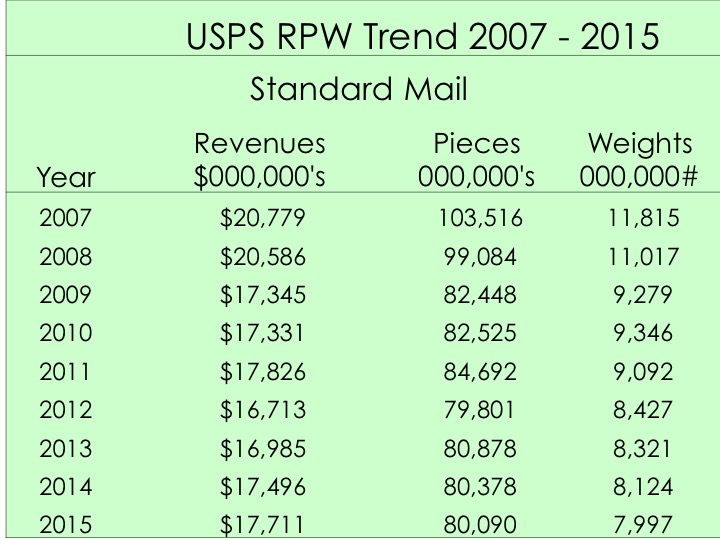
In 2007 the USPS delivered 104 billion pieces of direct mail, its highest performance in a 240-year history.  Next year, the U.S. economy had a collapse, and there was a 4.3% drop in direct mail.  In 2009, there was another drop of 16.8%, eroding 21 billion pieces over two years.

Slide1

From 2007 to 2015 Direct Mail volume shrank 24 billion pieces.

Revenues likewise fell from $20.8 B in 2007 to $17.3 in 2009.  $3.5 billion dollars–gone.  Looking for cash, the USPS raised its prices nearly 13% from 2006 to 2009.

The bottom line is that the USPS has held direct mail revenues in the $17 B tier ever since, with three more price hikes from 2009 all the way up to 2015.  Its actual revenue per piece has gone up from 20 cents to 22 during that time.  Direct mail volumes have stabilized around 80 billion pieces, down 23% from its stellar 2007 year.

What You Don’t See

Slide2

Revenue per piece grew 10% while weights decreased 13%.

While the USPS has been able to weather the economic storm, the quality of mail has deteriorated.   In 2007 the average piece weighed 1.83 ounces.   In 2015 that shrank to 1.60 ounces, a 13% decline in paper, ink, pages and envelope.  More post cards, fewer envelopes, fewer flats.

The irony in this is that the USPS is actually earning more money for every ounce delivered: 11 cents in 2007, versus 13.8 cents in 2015, a 25% increase.

The Good News

A 4% reduction in postage in 2016 may not mean much to the consumer, but to the direct mailer, it opens the door to better creative, design, and production.  These lead to better response, lower cost per response, which drives up mail volumes.  Whew!

This price cut is good, good news.

PS: Kudos to you for getting through this important math lesson!  Please share.

PPS: You can check all the numbers by reviewing the USPS Revenues, Pieces and Weights report which they faithfully publish very quarter.


Standard
Education, Media

One Mail Date You Can’t Miss

IMG_4675

Early cursive, having graduated from a straight pen to a fountain pen.

Valentine’s Day is nearly upon us. You need to prepare.  But just yesterday, in an important and related circumstance, our world was jiggled.

The news is that the State of Washington is considering a bill to re-install cursive writing as a mandatory subject in elementary school.

These things creep up on you.

It’s not that we missed cursive writing so much as we just didn’t notice that our children no longer write.

They print.

This is because the key pads of every digital device in the world host simple characters, void of any “joined up” writing.

In schools today, writing is no longer a strength. QWERTYUIOP is. This is the real impact of an analog world that went digital.

OMG!

Love Script 9

~”Steel Rail Blues” 

On closer inspection we find a more destructive force at work.

When our kids were divested of their writing skills, they likewise lost their will to communicate on paper. And what follows that is the total lack of understanding about commitment, letters, and the mail.

Love Script 1

~”P.S. I Love You”

In just over two weeks’ time it will be Valentines Day.   February 14th is the penultimate delivery day for personal mail.

Miss this date, and you are sunk, pretty much for the year.

The magic of Valentine’s Day is all about writing and receiving cards, and letters, which are totally tricked up and enhanced for impact.

Love Script 3

~”Mr. Postman”

Cursive writing plays a big role.

Getting Letters
Since the invention of papyrus we have lived in a world where written communication was executed using mail delivery.

A note arrived, not at the speed of light, but at the speed of foot. Replies were expected within weeks, not seconds.

Love Script 5

~”Return To Sender”

There is an argument that speed is of the essence. Why wait two weeks to learn that a love is requited when you can know thumbs up or down in nano seconds?

Answer: the wait is part of the experience.

Not knowing for sure can extract days of wistful, sometimes excruciating, wrenching anticipation of an answer.

Why spoil that with a text reply that will fit on a license plate?

Love Script 8

~”Nights In White Satin”

The effort of putting it on paper, combined with the plodding slowness of mail have been the guard rails of civility for centuries.

Writing gives time for the distillation of emotions.

Committing thoughts on paper gives solemnity and gravity to an otherwise flippant, momentary impulse.  By contrast, the most powerful, and potentially destructive word in the lexicon today is “Send”.

Love Script 4

~”Song For A Winter’s Night”

So we need cursive.   It takes practice and time to perfect.  It also looks nice, even when young hands, and older ones too, have difficulty forming the words.

There are two weeks remaining before a trip down to the mail box reveals your true feelings to a certain someone.

Make the most of your time.

Standard
Marketing, Thank You

How To Save Your Brand

AA TicketerThe most successful companies are those that everyone can place in a good story with a happy ending.

So it is that I can report to you that American Airlines gave us back our money, no questions asked.

It is a seemingly daunting challenge to get money out of a mega-giant company.  $45 billion in sales, 339,000 employees, protected by walls of service teams separated by deep moats of phone boards, websites, fax numbers, procedures and protocol.

Still, it only took two phone calls and a personal letter to initiate a resolution that delivered two valuable e-vouchers which we will use by January, 2017.

The Customer Relations Department looked at our problem and said, “Yes!”

Ironically, the same day we received the prized e-vouchers we also received an email from an earnest worker in the “Refunds Department” saying, “No.”  That was a belated response from our website submission of the original request, over three weeks ago.

We were delighted and satisfied with the turn of events, on many levels. First, we got our money back, no small deal in itself.   Second, American did the right thing quickly, within 4 days.  Third, and most important, American had recognized the value of a happy customer.

This last accomplishment is a twofer: of course, we will advocate on AA’s behalf, contributing to that word-of-mouth phenomenon wherein reputations are defined for good or bad.  But on top of that, American reinforced our belief in the goodness of the relationship, and that is the ultimate customer satisfaction, knowing we haven’t been ripped off by someone we thought was our friend.

I can’t stress this last point enough.  Brands live by their customer relationships.  The better a customer knows a business, the more profitable the relationship.  That’s because we buy more, we come back often, we cost less to service, and we bring our friends.

American Airlines’ Refunds Department, inappropriately named, failed on this test, but kudos to the Customer Relations Department that got it right.

Thanks for reading!  Please share, and to the readers who wished me luck in this venture, I can say it all worked out just as I hoped, and expected, that it would.


Standard
Marketing

Customer Loyalty In The Balance

PrintCan a world class company get out of its own way to keep a satisfied loyal customer?

Hopefully by the time this thought is completed, the answer will be “Yes”.

Right now I am waiting for a phone call from American Airlines, whose world wide revenue is $42 billion with 1500 planes in the air.  339,000 employees and 11.9% profit.  The satisfied, loyal customer is me, and I am banking that AA will understand its role as my first choice in air travel.

Actually, it’s my second choice. My first choice, since I was a child has been to fly without mechanical aids of any sort. Or feathers. After that however, American it is, all the way.

We all have flight horror stories.   Actually, not true again.

I do not have any nightmarish tales of terror-filled dives from 30,000 feet. No images of luggage bound for Hawaii disintegrating into shreds under a marauding gang of monkeys in Mumbai. I have never been displaced by an AA employee who didn’t try to make amends efficiently and with a smile. I like to think of myself as the perfect customer, and I want them to think that way too.

So it was, on September 22, 2014 that I paid American $1520 for two round trips to Barbados, departing February 3, 2015.

On flight day however, a severe medical event put our plans on hold. Speaking to American, the reservationist said, “No problem, we will get you on the same flight tomorrow. Here’s two new tickets. Hope you’re feeling better!”

Next day comes, and we don’t feel any better, so the trip is off.

Calling the reservationist at American, they take it all in stride.

“That’s okay Mr. Brown. You have until February 3, 2016 to use these tickets. It’ll cost you $400 in change fees, but there it is.”
Writing all of this down, we circled our calendar to plan a trip before February 3, 2016.

I am pausing here to listen for my phone to ring. I was told to expect a call from American shortly.

Anyway.    Just before Christmas, I opened up the AA website, and scheduled a trip to California. Then I called American to see how to use my old Barbados tickets.
“Oh, sorry Mr. Brown. You needed to use those tickets by September 22, 2015, the anniversary of their purchase.”
“That’s not what I was told.”
“You were misinformed.”
“What do I do now?”
“You can go to our website and try for a refund. Is there anything else I can help you with?”

All those warm and cosy feelings of customer loyalty and goodwill are drifting away, like 1,520 dollar bills swirling around the sewers of my jaded imagination.

No call yet, as I stare at my phone, but I am still confident that the Supervisor of Customer Service Supervisors is going to call me with understanding, and good news.

As instructed, I submitted a claim for our two tickets to be refunded.   This was tricky, because they only give 250 words capacity to state one’s case.   This is compounded by the site timing out, which means I  had to enter it twice.   I recorded the case numbers, as the site said it would require 4 days to review the request.   Ever hopeful of a logical, fair-minded manager seeing the obvious justice of my request, I closed out and went on Christmas break.

Yesterday, recovering from Christmas, I visited the website, plugged in my case number, and was informed, “No.”

Stunned, I troubled myself with doubt. There has to be a mistake.  Heck, there IS a mistake.  They said “No.”

So, an hour ago I decided to re-wind the tape and try again.    Back onto American’s website, I scheduled our California trip again, put the booking on hold, and then called American reservations to use my Barbados tickets.

I had my story prepared.   The California trip is $984, so I figure this is a satisfactory deal: they honor their $1520 client with a less costly trip.

Linda, a friendly and concerned reservationist listened to my story.

“Yes, you were misinformed all right.  Let’s talk to a supervisor.  Please hang on.  Don’t go away; this may take several minutes, but I won’t lose you.”

I think then she may have gone to help some hapless flier whose baggage was crushed by a forklift, but as promised, she came back on to introduce me to Stacy, another friendly and concerned, super-supervisor.

After hearing my story, she advised that I need to speak to a Super-super-supervisor, who unfortunately does not take incoming calls,  but will call me within 2 hours.

Before we hung up, I asked Stacy, “Do you know what it’s like to have $1520 taken from you?  If you had that money right now, what could you buy for yourself?”   I went on, “I am a loyal American Airlines customer, an AAdvantage member since 1990.   I have earned over a million miles.  Please be sure you pass that along to your supervisor.”

I nearly tore a hamstring just now as the phone rang.  Leaping to the desk to answer, after a pause I heard a tinny voice on the line: “Hello, this is Carmen.  This is about your credit card, and will be your last notice…” .

I wish.  Slamming down the receiver, I returned to the keyboard to wait for the important call.  It should be soon.   Within the next 60 minutes or so, anyway.

Since this issue first arose, I have had time to think back over the years of traveling on American.  Living in Chicagoland, I have parked  hundreds of times next to the south elevator on Level 4 at Terminal 3, and taking the escalator to AA ticketing.

Back then, security was pretty simple.  A pat down and you’re on your way.   The main concourse of H&K gates is festooned with flags from all the countries American flies to.  There was a time I walked under those flags as US troops were welcomed home from Kuwait.  That was a moving experience.

I recall a late night trip from LaGuardia which was ground-stopped due to weather.  That night I slept on the ventilator in LaGuardia, in my suit, but with a chuckle thinking of the tireless, patient ladies standing in tight shoes behind the ticket stand at the gate, making reservation changes until 11pm.

I was last in a long, grumbling line to greet them.   They had just finished with a noisy, self-important little man whose world was not revolving on its axis right.   They were hammering away at the keyboard for his satisfaction.  He walked off in a huff after unloading on the ticket crew.

I was next.  This lady looked up.  She could have been Mom.

“Boy! I’ll betcha you’re gonna be glad to see me!”  I added, “Won’t they at least give you a chair?”

Her face broke into a smile.  Just then, her colleague noticed,

“Do you know that last fellow has put himself on standby on over ten different flights??”

With that, she looked over.

“Hmm.  We’ll fix that.  Delete all those.  Leave the Wichita on.  He earned it.”

These ladies were gracious under the most demanding conditions, and they got me a spot, not direct, but quicker than a stopover in Kansas for the martinet before me.

Well, no call yet. But I am still optimistic that I am in queue for some relief.  

The last time I flew, I opened up American Way magazine to the North American map of AA’s destinations.  I checked off the city dots I had flown into.  Thanks to the airline’s network I have seen virtually all of the majors and nearly three quarters of the intermediate cities on the page.  I may not know much about the cities, but I know the airports.  This may not be the feat of a Magellan or a Captain Cook, but I can claim that American took me there.

The call just came in.

“Mr. Brown, this is Starr.  I am sorry you are having difficulties.  Tell me again what happened?”

Starr and I discussed the situation.  She has news.  “I can’t help you.   Reservations doesn’t have authority to refund tickets.   You need to write a letter to Customer Relations in Phoenix.  Here’s their address.  They have a fax number too.”

“Starr, do you think this is an unreasonable request?  Asking for an exchange based on the misinformation?”

“Oh, not really… I don’t know, but it’s over my head.  You have to write them.”

Starr gives me the name and title of the Director of Customer Relations.  Hopefully, that person has authority.   We hang up.

So, ever optimistic, I am preparing my written request to a manager.  It’s going UPS tomorrow.  My hope is that their antenna are up and sensing this pivotal opportunity to make this customer happy, to reinforce the goodwill I have cultivated and nurtured for a quarter century.

All it takes is “Yes.”


To be continued….


Standard
Thank You, Thanks

What You Do When Disaster Strikes

IMG_2660

Last minute arrival.

March 31, at 6:10pm central time a 2006 black Acura sped out of control on Butterfield Road next to our house. Witnesses in front of the car saw it weave across three lanes from their rear view mirror.

Abruptly the car turned hard to the right and side-slipped 75 feet across our lawn hitting the back corner of our bedroom. It did not come to a halt. Rather, the vehicle and occupants continued through the brick wall, spun 90 degrees in the bedroom, and drove through the bathroom, grinding to a stop half way through our living room.

IMG_2762

Perfect targeting avoided the fence and the stop sign.

Moments before that we had sat down in the living room to watch the new springtime sun set over the row of budding trees beyond our bay window. It would be the last peaceful scene we would see for weeks.

At the moment of impact, we were stunned by the deafening explosion. Our first thought was a falling plane, or perhaps a meteorite had crushed the house. Then the wall of the living room imploded before us, pushing couch and armoire ahead of it, and blasting a framed picture across the wall to land on our other couch. Glass, plaster, wood and dust everywhere.

Running down the hallway to the bedroom, we looked in, and there was a clear view of the highway. The entire wall was gone.

I could have written about this incident months ago, but decided to hold off until the dust had settled, and not just literally. While I don’t recommend this approach to understanding the role of first responders, I can say we learned a lot about what to do when disaster strikes you, or someone else.

IMG_2667

Passengers were extracted by Libertyville’s first responders. The child in the back seat only had a scratch over her eye.

So this is what you do when you are the object of the disaster.

1. Are you okay? Apparently we were, because we both jumped from our seats and looked around. No pain, no numbness, and no bleeding. The fact was, we weren’t touched, but certainly shocked.

2. Anybody else around? Once we saw the rear of the car in our bathroom, it was pretty clear we weren’t alone, but there was no way to get near the car with the tangle of rubble, conduits, joists and furniture blocking the path.

3. Call 911. Did that immediately. First item: name and address. Closest intersection. Phone number. Bring a couple of ambulances, a car crashed through the house. Stay on the line. Literally within two minutes the Libertyville police were knocking at our door, and the fire department appeared moments later. It turned out that an officer had just driven past our house on the highway when he heard an explosion. Looking in his rear view mirror a plume of white smoke blossomed over our yard, and he knew something was up.

IMG_3158

Road repairs this summer–check the new boulders as our first line of defense.

4. Shut everything down. It became obvious to us pretty quickly that professional first responders know the routine, and we were the lucky beneficiaries of their experience.

In the next ten minutes, the gas was turned off. The power was cut. It took a little longer to get to the water, but that was turned off too.

5. Follow orders. Despite our own assessment, we really were more shook up and addled than we knew. That’s when the police and fire fighters stepped up. They kept us away from the house, pending a careful review of its structure. It could cave in. Or blow up. As things turned out, the building was stable despite missing one corner, and the presence of a 3,600 pound car resting on the main floor.  Kudos to the architect who designed this house.

6. Call insurance. Quite amazing… the fire department chief asked for our carrier and he had their speed dial on his phone. We were hooked up with our “good neighbor” State Farm, in seconds. A few moments later, our fire chief also provided a list of company names to manage the board-up of our house. After picking one from a list of ten, a truck of workers arrived 30 minutes later with a load of plywood to board up the missing wall of our house.

IMG_2730

The business side of the Acura. Our CDs were found under the dashboard.

7. Take pictures. Thank goodness for digital photography. We took over 100 pictures on our own from every angle. These became invaluable later on for filing claims, identifying lost articles, piecing objects together.

The insurance claims adjusters request a digital picture of everything lost or damaged. My advice to you now is to photograph your entire house and contents, wall by wall, ceiling to floor.  It’s easy, and effective.

8. Think big. When it comes to placing a value on that couch you bought 25 years ago, it’s worth a trip to the furniture store first. Our homeowner’s policy provided for replacement value. But something that cost $1,000 in 1990 probably costs $3,000 now. Take your time filing your claims, and get the numbers right first.

IMG_2674

Home renos on the horizon. The wall imploded around us.

9. Rationalize. When fate strikes a blow, there is an urge to blame someone, especially when other people are involved. The fact is, the driver had blanked out due to an attack. Nobody’s fault to speak of.

Looked at another way, the car could have left the road ten yards earlier, or later, with no serious consequences to anyone.  Let it go.  If you have retribution beyond repair compensation on your mind, get your legal gown out, because you will be in court for a long time.

10. Keep notes. We kept a diary of daily developments during the recovery from the crash. Six months of hand written notes recording names of workers, dates, what happened. These can be useful for insurance purposes but just as important, it telegraphs to the hundreds of people who are in your home that you know them, and care about what they are doing.

IMG_3211

Masterful repairs by the contractors. We saved and re-used over 1,300 bricks.

11. Be private. Within 30 minutes of the big boom, we had a Channel 5 helicopter hovering over our home. Reporters were lined up across the street interviewing neighbors. That was because the police chief asked if we wanted the media on the property. No thanks, not tonight, actually.

Next day, the newspaper crew came by, and in the light of day, it was easier to tell the story, complete with pictures. The resulting publicity is electric, with news feeds delivering your story to people nationwide.

12. Be gracious. Human nature is that we all like to stand on our own feet. Accepting help is a weakness.

IMG_3206

A subtle return to the old look with new bricks.

But the fact is, help is the best medicine for the giver and the recipient alike.

Our neighbors demanded we use their spare bedroom, We took it. Others demanded we come to dinner. We did. Strangers came up to us in town and asked after our well being. Hugs and handshakes.

One very concerned and generous lady–whom we did not know–came by to give us a Panera gift card. The meal was excellent. Another thoughtful neighbor counseled us on insurance claims. We needed it.

IMG_2654

Libertyville’s first responders performed flawlessly, and quickly.

The lesson we learned over six months is that people want and need to help. Our job as the injured party is to take it, and treasure it, which we did.

The fact is, every time someone extended a hand, we were flushed with encouragement, and I think they felt better themselves too.

Now, everything is just about back to normal, eight months later.  We don’t recommend this experience to anyone, but for all of that, we are thankful for the way things turned out.

Never ignore the opportunity to help someone, or to make the effort to check them out.  There’s no downside to it! 

Standard