

Yesterday the United States Supreme Court ruled 6-3 that the current tariff situation is unconstitutional. Essentially, the Executive Branch, ie, President Trump, does not have the authority to change or charge taxes without congressional approval, ie, without a passed law. Canadians for one will be ordering up seconds in rye-infused poutine at this announcement.
This is encouraging news, but not just for what you might think. While many will cheer with vindictive satisfaction at the defrocking of the tariffs, I find the real lesson is that the legal structures of the Constitution are still in effect. “You can’t get away with it, just because you say so.”
This has shone brightly for several years during the appearance of President Trump. For every charge, there is a Grand Jury which can approve or cancel a trial. For every acquittal or conviction, there is an appeals route, which ultimately can land in the laps of 9 appointed judges. When they rule, the case is closed.
So three cheers for the legal system. While it may be convoluted, there are currently 1,374,720 lawyers (according to the American Bar Association) who participate in exercising their clients’ rights under the law. They have been busy this year and for several years back.
The fall out from this decision will take some time. How will refunds be made? To whom? Meanwhile, the prime concern in the tariff/negotiation debate, is, does it work? Has the tariff carrot and stick moved the needle?
First, how has US trade changed since April 2025? According to census figures published by the Bureau of Economic Analysis the US trade balance has only improved by $2.1 billion. A paltry 0.15% improvement. This translates to the US having clawed back $2 billion dollars that it won’t have to borrow from other countries. Still, the overall trade deficit remains at an inconceivable, unimaginable and eye-watering $4.3 trillion dollars. That is, US consumers sent that amount out of country, in excess of what they brought in.
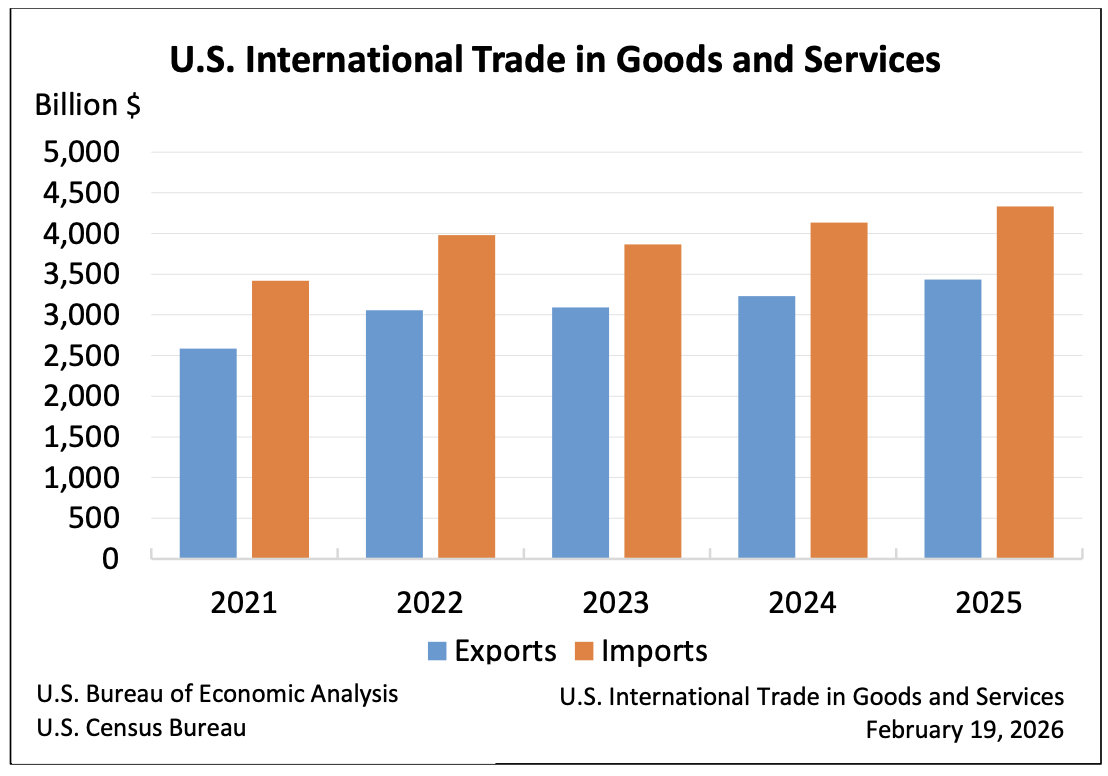
Chalk it up to a strong economy, and an insatiable demand for imports, supported by a strong US dollar which impedes other nations from buying more US stuff.
Still, a deficit leads to a shortage in money over time, so that the US has to borrow money from its trading partners to purchase their goods. Long term, this is unsustainable. Today the US national debt is $38.4 trillion. $8 trillion of that debt is held by Japan, Great Brittain, China and other countries.
Closer to home, how is the US/Canada trade balance faring? In 2025, the US deficit shrank by 25%– $15billion dollars. Put another way, the financial relationship has improved itself by $15billion dollars in US terms.
But what about in Canadian terms?
The imposition of tariffs, coupled by bombastic and unfriendly, accusatory rhetoric has torn a huge hole in what used to be the most friendly relationship in modern geo-political history. I have repeatedly said that the tariffs on Canadian goods and services were more than a slap in the face; they were a stab in the back. Is the unanimous rancor and animosity of 40 million close neighbours worth $15billion in savings?
It is clear that the President’s use of the tariff stick has something to do with trade deficits, but more often, that stick is swung or carrots are dangled to get something else. The ostensible purpose of tariffs on Canada was to reduce illegal immigration and fentanyl trafficking. Despite impressive Canadian efforts to respond, the tariffs remain. An arbitrary pivot!
Looking at the BEA report, (table 19) it is interesting to see how Canada ranks as a trading partner. Canadians spent $337 billion on US goods and services. Americans spent $383 billion on Canada. An impressive $720 billion compact in 2025. Canada is the #3 trading partner with the US, exceeded only by Mexico ($873B) and the European Union ($1,047B).
It is a fair bet that the US tariff has been used to reduce conflicts, to wit, Israel and Iran, Egypt and Ethiopia, India and Pakistan, Democratic Republic of Congo and Rwanda, Kosovo and Serbia, Armenia and Azerbaijan, Cambodia and Thailand. No doubt, the tariff has motivated other nations to cooperate in other ways.
But the end financial result of the tariff gambit, globally, is that the US has reduced its deficit by only $2.1billion. Canada contributed $15 billion to support that effort. Right neighbourly.

