Culture, Government, Legal, Marketing, Media

When Your Number Comes Up

You know that funny feeling when the cell phone vibrates in your tight jeans pocket, and you struggle to extract it before the caller hangs up. Sitting in a movie theater is tougher because you know to leave it alone. But, it continues to zing—zing—zing, vibrating like a terrified june bug caught in your pants.

A couple days ago, my phone wouldn’t stop zinging. Starting at 10:30 in the morning, I got a call from San Antonio, TX. I know no one there. It’s hot, dusty, and except for the Alamo and the acclaimed Riverwalk, San Antonio doesn’t figure on my list of destinations, let alone origins. But the phone zings insistently.

It’s an unrecognizable number. Area code 210. I skip it.

A few minutes later, another call. San Antonio again. Flush it.

Two more calls after that, and I decide to pick up.

“This is to inform you that your Social Security Number has been suspended, and that there is a warrant for arrest under your name. Please call back immediately…”

I give high marks for originality on this call. It turns out that so does the caller, because they continue to zing in my pocket until a little after noon. 13 calls in total. 13 spoofs: each number changed, but the origin and area code remained San Antonio, Texas.

Next to our annual plague of stink bugs, I think the robo call is the most obnoxious–and noxious–element in our midwest existence. What amazes me is that nothing much is ever done about it.

The telemarketing channel has been a constant irritant to me, and to probably 99% of the adult American public.  In fact, it was the subject of my very first post in 2013: Let Me Get This Call.

In a typical day, we will receive at least 5 calls.  I am thankful for these, as:

  1.  They force me to get up and walk to the phone, providing necessary joint movement;
  2. They frequently remind me that I am eating dinner when they call;
  3. The calls provide a fleeting moment of excitement thinking a family member is calling.

We’ve nearly reached the tipping point to give up our land line, which was the main robo conduit into our normally quiet existence.  And then the cell phone becomes the new target.  What to do?

I looked up the Do Not Call registry, and confirmed that all three of our phones have been registered since 2005.  Fat lot of good that has done.

Checking the FCC page, I read some business-like claims by the department head that multi-million dollar fines have been handed out recently.  $80 million.  $40 million. Serious money, but the zinging doesn’t stop.

The government site points to the measures that phone companies are taking.  AT&T, my server, offers a Call Protect App for the zinging cell phone.  It’s free, and I install it.  Then quickly and effortlessly the app reports I have had no robo calls in the last 30 days!  What about the last three hours?

A Facebook friend has suggested I take a third party anti-robo app.  I may do so. We’ll see how AT&T performs over the next few weeks.

Surely AT&T wants us to keep all of our phones, right?  But mean time, I have this nagging concern.    AT&T is now HQ-ed in Dallas, Texas, area code 210.

Could it be possible?   No, don’t even think of it.


Standard
Cars, childhood, Culture, Thank You

Gus’s Coffee Shop

Mobs of students crossed Hwy #3 every day to Gus’s.

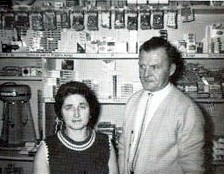
Gus Vander Elst was a genius. He was a father, uncle, pump jockey, counter clerk, cop, teacher and short order cook. But most of all, he was a genius who bought the Cities Service gas station directly across from Delhi District Secondary School.

Can one grow wealthy selling burgers and 10-cent coffee?  Yes.

My first memorable experience with a diner hamburger was Gus’s, and like 800 other high schoolers, I reveled in the unshakeable aromas of grilled hamburgers served up under chopped raw onions, and spiced with the intoxicating clouds of cigarette smoke that floated across the tables of this busy, bustling hangout.

Gus’s was our off-property school cafeteria. Like the M*A*S*H Rosie’s Bar, Gus’s attracted a majority of kids, just for its noise, warmth, foggy windows, forbidden foods, back room and unstoppable traffic.  The coffee shop was a magnet, a cash cow, and Gus was king.

So it was that every lunch hour we exited the school driveway to the eastern curb of highway #3 and strode across to the center line in crowds, intimidating the stream of drivers going to and from town. With a break in the oncoming, our hungry mob would cross over the second lane to the white, two-story concrete block building, occasionally pounding on the bell wire by the pumps, and enter ground zero, our family teen haunt.

Lunch counter, or teen haunt, prepared for the daily rush at noon time.

Inside Gus’s was a lunch counter with six red, swivel stools. Diners could face the cook’s window, or turn to the two large picture windows that looked out onto the gas pumps. But more likely they faced two banquettes separated by a Wurlitzer juke box. The banquettes were perennial turf of the seniors–that’s high school seniors– and pretty much filled with bubbling squads of girls who laughed, screamed, rolled their eyes, primped, gushed and stared dismissively at the guys shuffling in front of them, the guys who studiously ignored their looks as if the table was circled by bags of oats.

At the south side of the small diner were two more tables where a junior or soph may get lucky to be invited to sit, but space was limited, so most visitors took their lunch standing up, the whole time, bumping shoulders and elbows while they downed their burger.

Gus managed the crowd like the Music Man. He was loud, smiling and all business, hustling orders to the cook’s window, spinning burgers onto buns, and dressing the patties as they appeared, “what’ll you have, mustard, relish? Onions with that? Cheese?” He bantered with his young eaters flipping on the extras.  He knew everyone’s name.  When an order was built he’d smack a bun top onto the mountain of condiments with a cupped hand like he was slapping down a set of dice on a sponge. We took our food happily, while his wife Jeanie took our coins in payment.

Wurlitzer: the heart beat of Gus’s Coffee Shop

The jukebox was a powerhouse.   It was always in motion, pounding a super bass speaker that shook around our ankles.  Sounds of Freddy Cannon, Little Eva, Gene Chandler, Chubby Checker, and Dion moved pairs of girls to dance in the crowd.  The guys would swagger and slouch as Dion would tell his story of The Wanderer.

The back room was where Gus stored the empty pop cases: stacks of large worn wooden crates that nested four 6-packs of empty Coke, Canada Dry and Wishing Well bottles.  These were lined along the walls, and leaning up against them was a cadre of guys, staring at each other through the haze, smoking, and telling impossible, implausible, and richly impressive stories about girls, cars and teachers.

Out front were the cars.  Old Fords and Chevys mostly, but always with doors and windows open for more conversation and music.  These were driven by seniors, all in grade 13, ready and restless to escape, off to university, off to work, back to the farm, off to the lake.  One drove a beautiful plum-coloured Volkswagen, and with help from four of his buddies, would rev up the engine, spinning the wheels while they lifted the rear of the Beetle a foot off the ground.  As the engine whined its loudest, they would let go of the bumper, and the car came down on those tires that screamed as he scooted across the pavement.

When Gus couldn’t reach the pumps in time, the guys would get their own gas.

Jeanie and Gus fed us from 1951-1969.

Gus looked after his customers like a parent.  On a wintry January day, a silly joke nearly turned violent until Gus walked out to settle the score.  It was cold, and the frozen, Brylcremed hair of a young student looked like it might repel water.  Experimenting with a bottle of Coke, a second student poured a couple drops on his head, and indeed, the Coke did bead up and roll off.  Moments later, a third student decided to pour a whole bottle of Coke down the neck of the second in retaliation.  That was enough to enrage student #2 who then smashed his bottle against #3’s bottle.  The tense exchange was viewed through those picture windows as the two kids faced each other with broken Coke bottles raised towards each other.   Gus suddenly appeared between the two, and with a few words took their weapons and shut them down.  I was thankful he showed up when he did.

Everyone who went to DDSS has a story about Gus, and the student body loved him and Jeanie for the place they took in our youth: steady, reliable, hard-working, dependable and non-judgmental, they were the older couple who parented us for an hour every day as we journeyed through our high school career.  He watched over us for nearly 20 years.

The last time I saw Gus, he was a much older man.  He lived in the Delrose Retirement home at the south end of town.  Always the spark plug in a crowd, Gus led a daily exercise and work out routine for the residents who lived with him there.  They loved him too.  He was wealthy in the best way.

Thanks for reading and sharing!   You can add your Gus memories below, too!

Standard