Science

The Rescue Clock

During a mid-summer road trip through Ontario we picked up a hitch hiker. Much against my wife Jane’s admonishments, I retrieved a broken, rusted and chipped clock from a roadside park waste bin.

Saved from the dumpster!

The piece was part of a pile of junk that someone had stuffed into the garbage can where I was also placing our left over picnic lunch.

Missing something, but what?

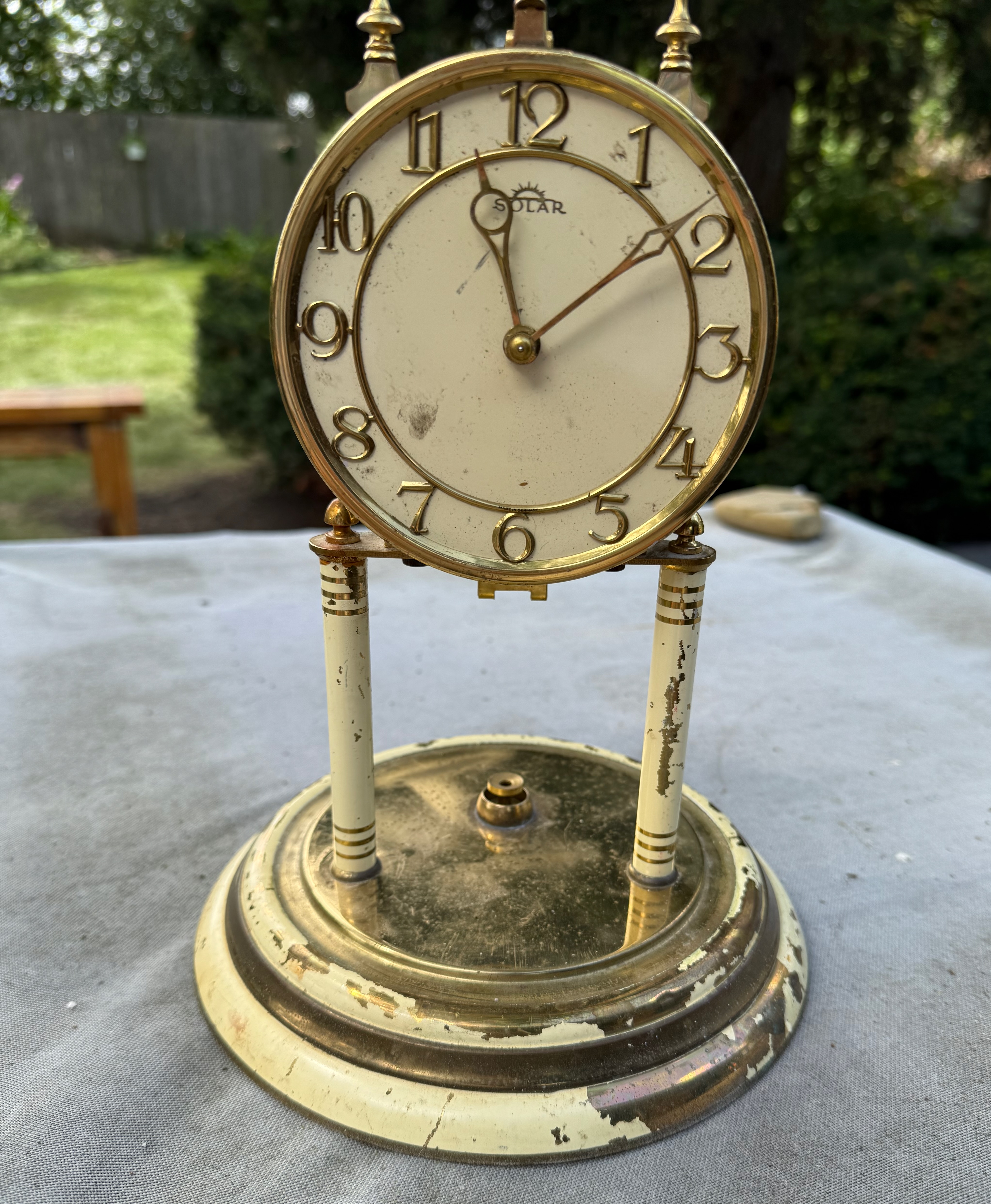
As I stared into the bin, I could see a dirty clock face and hands. Its cream and gold inlaid appearance distracted me from the other detritus and garbage it lay in. Reaching in, I pulled out a strange assembly: the clock face, some obvious brass works, and a dingy, corroded stand. It stood about 12 inches high, and was clearly abused by water, dirt and rough handling. While I couldn’t recognize the contraption as a time piece, it was easy to conclude that it wasn’t all there– less than whole.

I stuffed the thing into the car trunk, and we left the park.

Finally returning home, I placed the clock on the workshop bench, and prodded at its parts and works, turning it over, inspecting the wheels and gears. They were filthy dirty, and stuck in place. An unloved gadget that was no longer wanted by its owner. But on the face I found the brand name “Solar”. Scrolling through pages of Google listings, I found an image which looked like this clock.

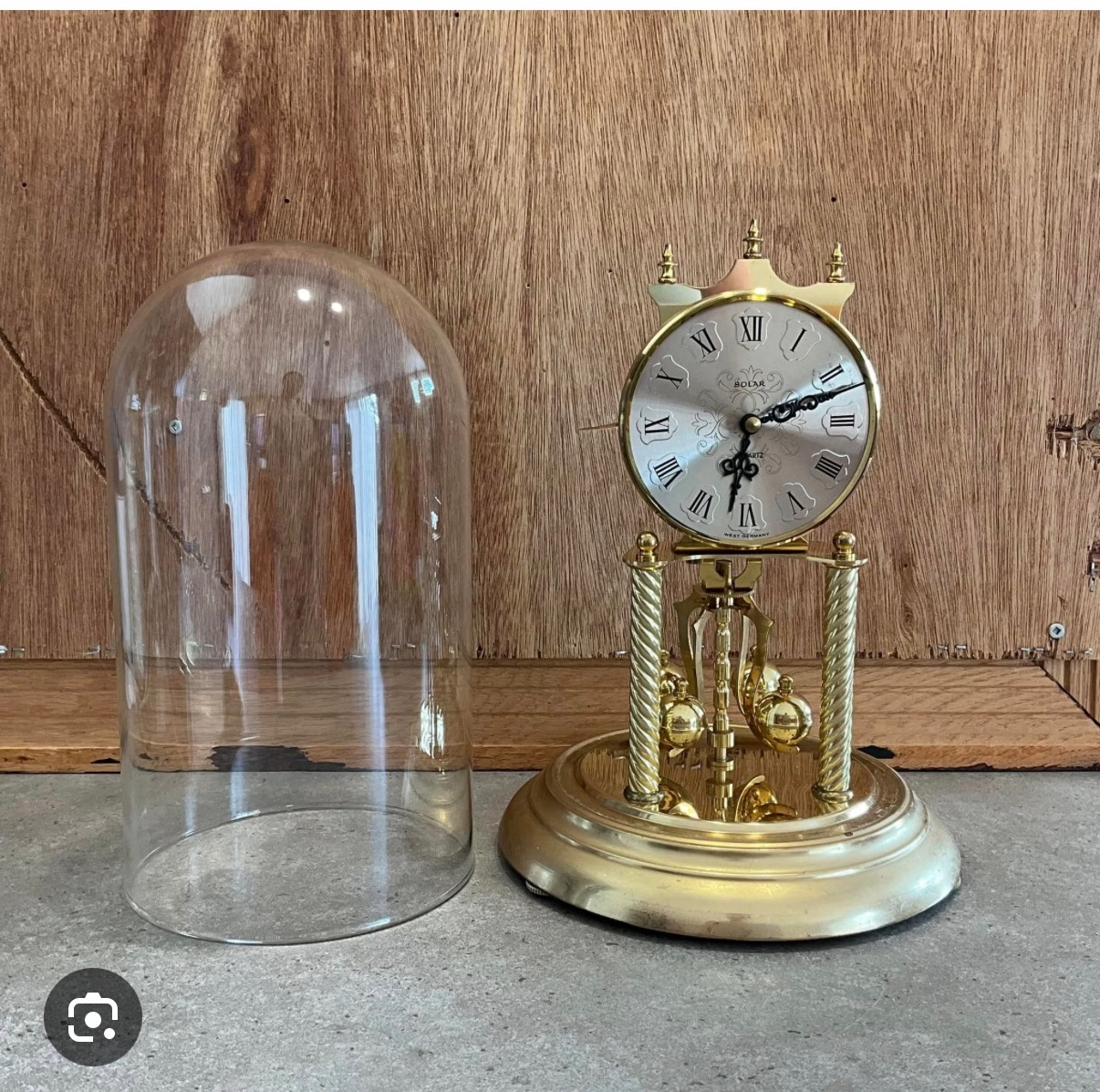
A anniversary clock cousin listed on Etsy.

It was on Etsy, and showed a sparkling, clean assembly encased in a glass dome. The piece was called an ‘anniversary clock’. The seller would part with the item for $215 bucks.

Intrigued, I researched ‘anniversary clock’, and learned that these clocks were historic, vintage works of machine art. They originated in America, invented by one Aaron Crane, and patented in 1841. The peculiarity of this antique is that it could run for over a year with only one winding of its mainspring, hence the anniversary.

What was also remarkable about the anniversary clock was its pendulum. Rather than using the familiar swinging ‘bob’ to parcel out the energy of the main spring, it instead periodically twisted a fine wire, back and forth, that suspended four globes beneath the works. They rotate slowly, also back and forth. The wire is almost invisible, thinner than a human hair. This technology is drily called, a torsion pendulum.

Franz Hermle left his mark.

I was fascinated by the anniversary concept. I have three other ancient clocks in our home that are all heirlooms, and each requires a bit of love and winding every week. So to wind a clock only once a year… what a feat!

On the clockworks’ back brass plate I found a brand stamped into the metal. ‘FHS’ with tiny clock hands indicating twenty-two after seven, or 7:22 for you digerati. More internet digging, and I confirmed that I had the partial works of a Franz Hermle & Sons clock. It was built in Germany, sometime between 1950 to 1970.

Excited by this discovery, I decided to bring the piece back to life. Knowing next to nothing about clockworks, I approached the big decision: take it apart, or leave it alone?

Go for it!

As I loosened every bolt, I waited for the piece to either explode from a runaway mainspring, or disintegrate into a jumbled paella of gears, nuts and bolts, with no handy instruction manual. I took a lot of pictures to record the disassembly of this foreign object.

During this time I started conversations with clockworks people across the globe, watched Youtube demonstrations, and spent a few dollars obtaining the missing parts. There are thousands of these clocks, sought after, and coveted by collectors. My pursuit included complete disassembly, special cleaning, more research on parts, locating pieces, re-assembly and literally days upon days of testing, which turned into months. I interrupted trips anywhere in the house with a quick visit to the workshop to see if just maybe this time, finally, the clock would still be running.

Occasionally it was, but never for long.

Along the way, I became so familiar with the many wheels, I counted how many teeth each had, which pinions they fit into, and how many turns one wheel would generate on its mated pinion.

The most remarkable find was the power of the 18″ mainspring that was wound tightly inside a brass drum.

The drum housed an 18″ steel spring: massive energy under restraint.

The 1-1/2″ diameter drum would complete only one whole revolution in 80 days. One rotation– less than 5 inches. But as the irresistible force drives through four sets of wheels and pinions later, that glacial movement telescopes to over 1,900 rotations of the hour hand. Five rotations of the mainspring: 400 days.

Finally, I have revived the clock. It has a complete assembly of working geared wheels and pinions, bright sparkling components, ultra-sonically washed at a local clock repair shop. Vlad, the technician, shook his head grimly at the possibility that the clock would ever work. He correctly identified a wheel with bent shaft. I ended up buying a new wheel, and put in place, the clock purred its assent.

Rescued and recovered!

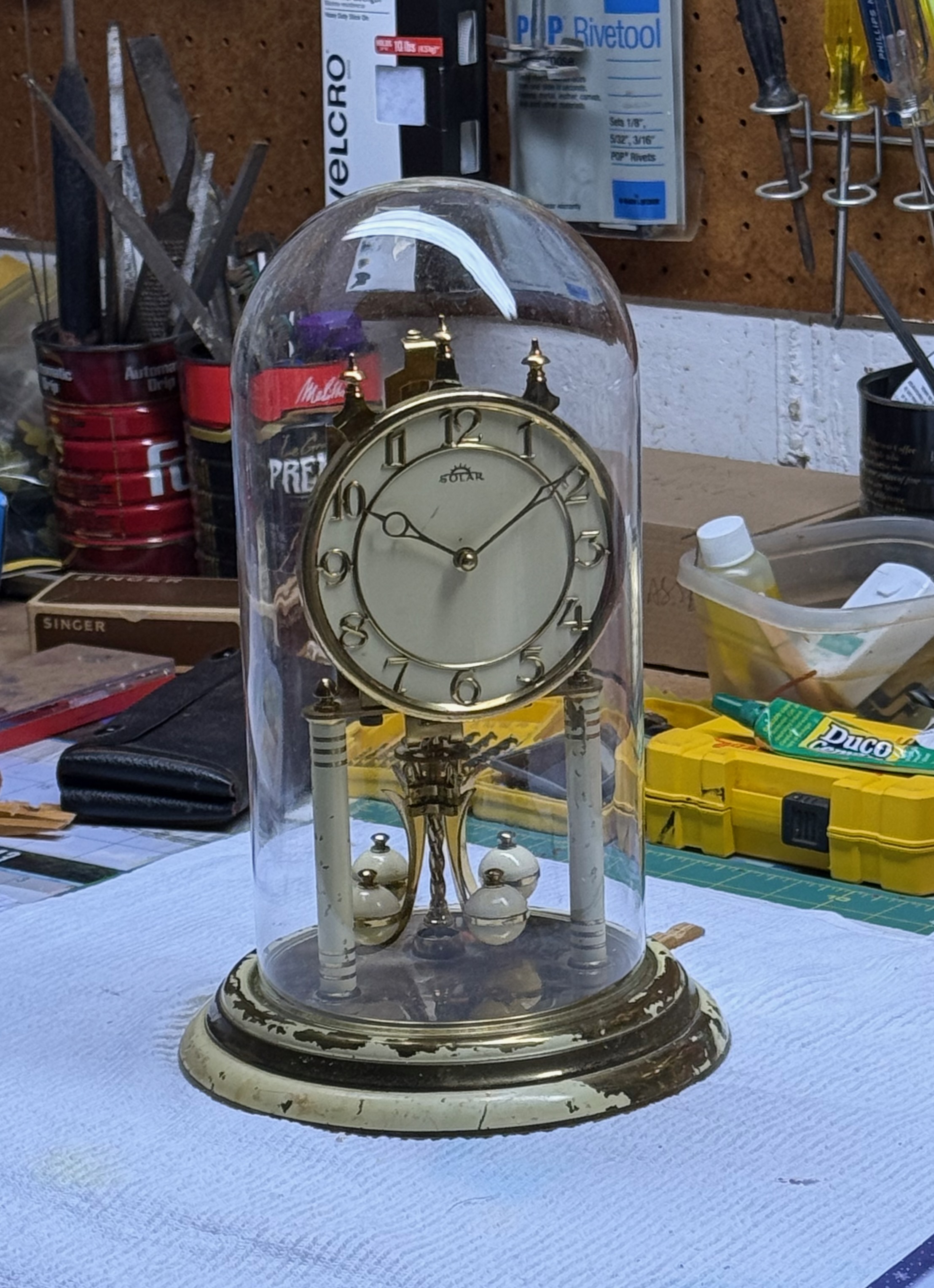
The Franz Hermle now rests quietly on the work bench. I bought it a brand new shiny glass dome.

I come down to visit it, gaining more confidence that it continues to run without pause. Rescued, serendipitously, from a nasty fate, it silently spins its globes, eight beats to a minute, and subtley pushes its hands past the numerals on its face.

I will wind it up again, next December.

Standard
childhood, Culture, Sports

Up Against The Wall, Tantalized

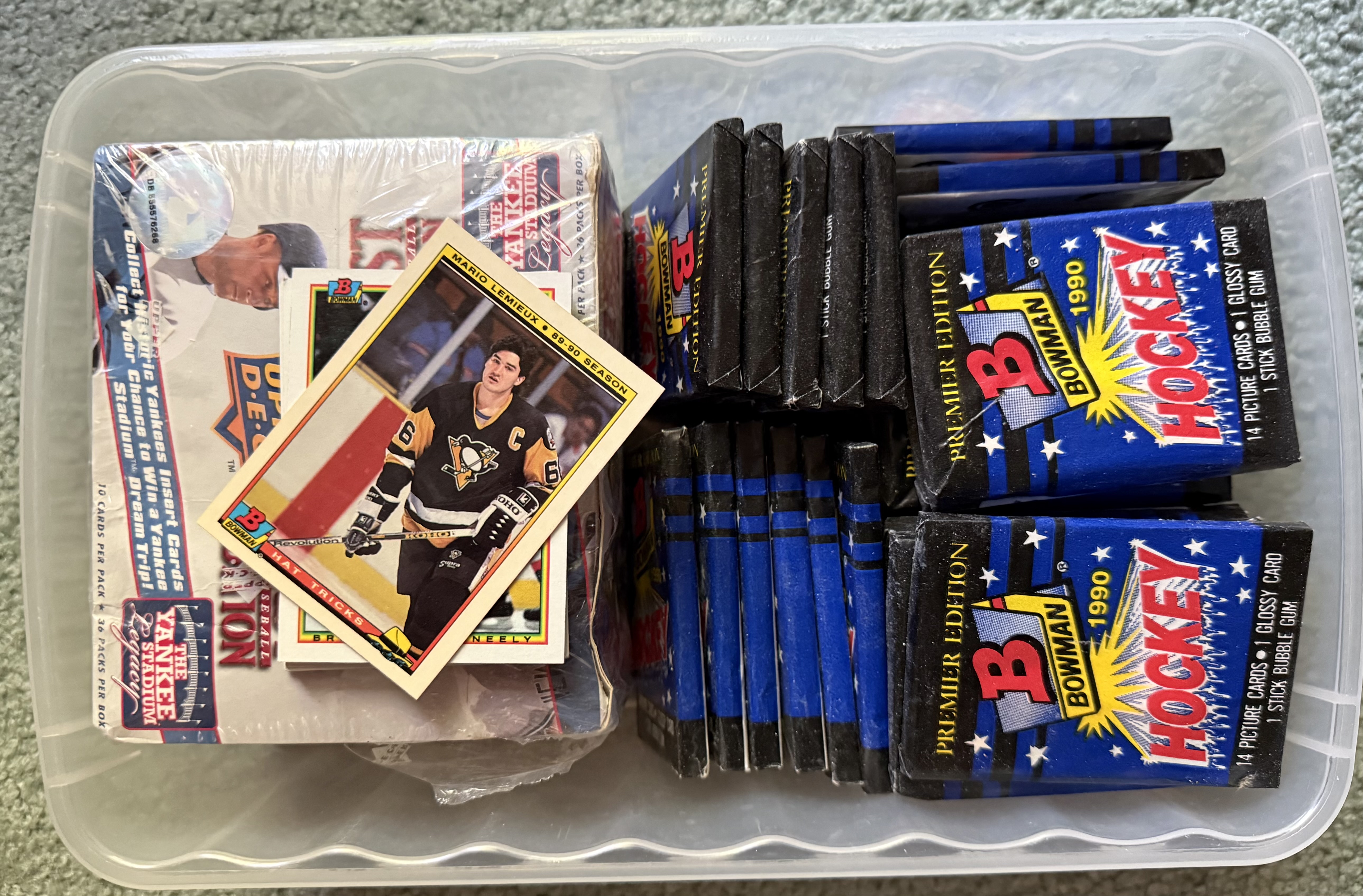
Scanning the shelves of our walk-in closet on a rainy Tuesday afternoon, I stumbled on an old, forgotten box of hockey cards.

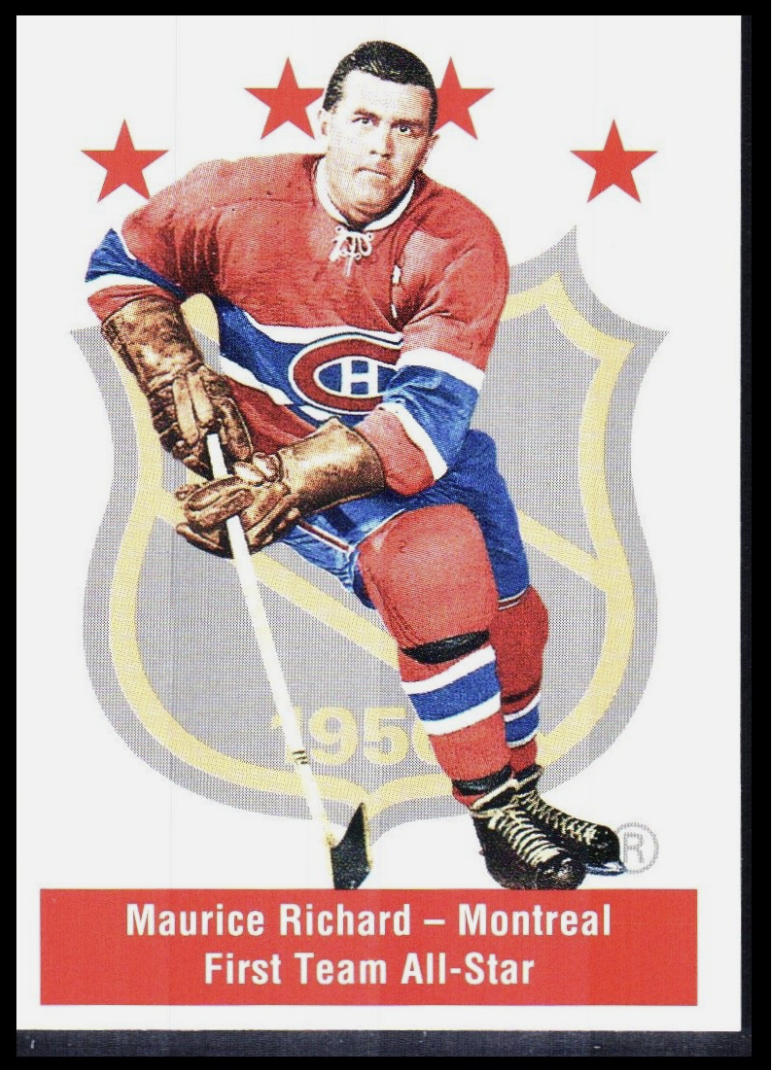
Rocket Richard, the cornerstone card in any young boy’s collection.

I bought these over three decades earlier, and it was a moment of extravagant impulse, paying out a wallet of bills for a small carton of one hundred un-opened wax paper packages. They exuded a sour, sweet smell of aged bubblegum. And teased the prospect of hidden gold.

I don’t make purchases for the sake of locking them away. Not for weeks, let alone years. But there it was, a testament to the impression that ‘trading cards’ made upon me as a child.

In my primary school years, nearing the age of ten, or eleven, every kid had a wad of cards in their pocket: frayed, colorful, bent cardboards held tight by rubber bands. They fit well into back pockets, but best in front to avoid permanent warping.

Ernie Banks, dauntless short stop for the hapless Cubs.

According to the season, we could be collecting hockey cards, football cards, TV show cards, and notably World War 2 collections like “Operation Overlord”. The importance of these collectibles was ownership. As kids, we didn’t own much: bike, hockey stick, puck, baseball glove, pellet gun, jacknife, comics, and a box of special junk which we had filched, found, foraged for, or occasionally bought. The cards, like marbles, were the special treasure in our possession.

Trading cards entered us into an economy. We had collateral, something worth trading, or in most cases, gambling for. Wealth was easily defined by the thickness and heft of your wad of cards. We bought them in nickel and dime packages, and after chewing the accompanying bubble gum, we sorted through the ten or fifteen numbered cards which were randomly included in the purchase.

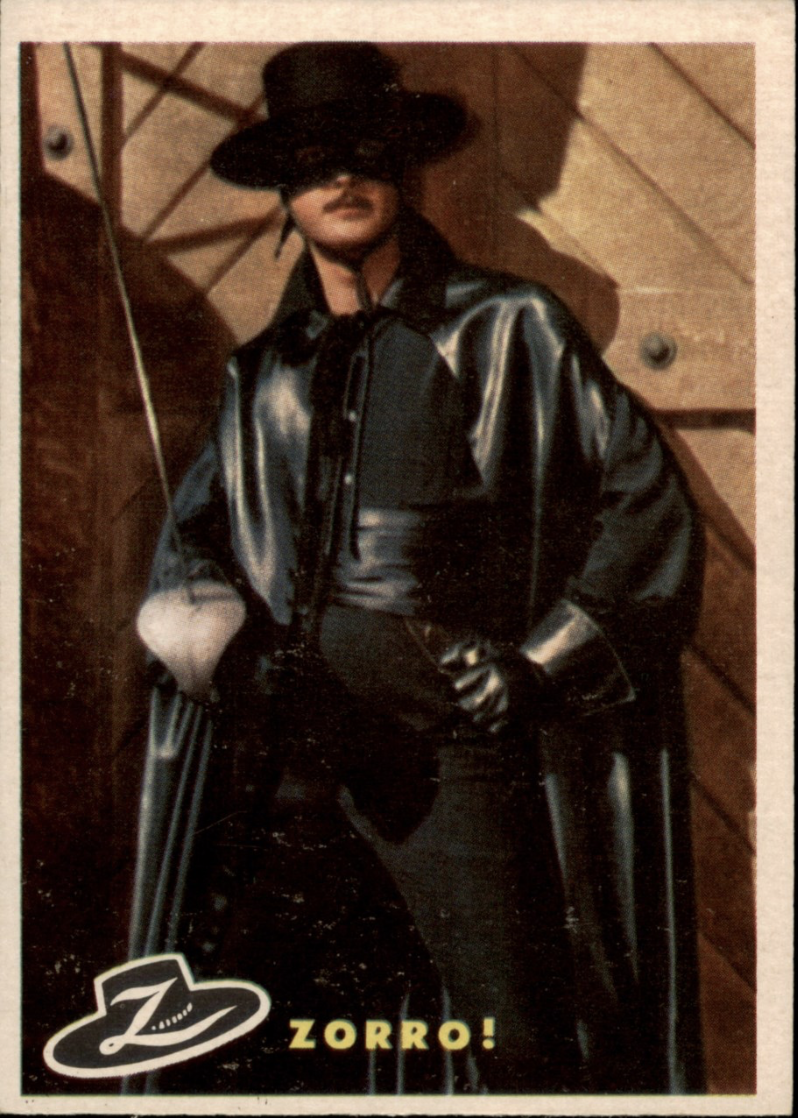
Don Diego!

The sortation was essentially to find ‘keepers’. For instance, Maurice ‘Rocket’ Richard was a natural keeper hockey card. Angelo Mosca, the carnivorous Hamilton Tiger Cat football player, too. But if you had more than one, you had a ‘trader’: one to parlay into other missing cards you wanted, held by other kids at school.

The east side of Delhi Public School’s yard had a sizable square of pavement for playing hopscotch, skip-rope, wall-tennis and occasionally hockey. In the fair weather days of early fall and late spring however, the main sport was cards. Numerous pairs of boys were lined up around ten feet from the wall of the red brick school building, making outlandish bets with their cards. The game: closest to the wall wins.

Unlike the Vegas-style, raucous and loudly cheered alley pits to the north side, the cards pitch was quieter, more like a tense game of Texas Hold’em. But the crowds were still present.

Our playing field was the ancient school’s foundation, a three-foot-high wall of dimpled, weathered concrete block, punctuated by large wire-screened basement windows. Essentially, the trick was to spin the 2-1/2″ by 3-1/2″card like a frisbee towards the wall, avoiding the rusted wire screen. Gingerly gripping the piece between two fingers, and flicking the wrist for the right trajectory, the player took aim, and launched the small piece of illustrated sports history. It floated through the air, arcing slightly before descending to slide into place, close to the wall. The competing player, and perhaps more than one, would likewise fire off their respective card.

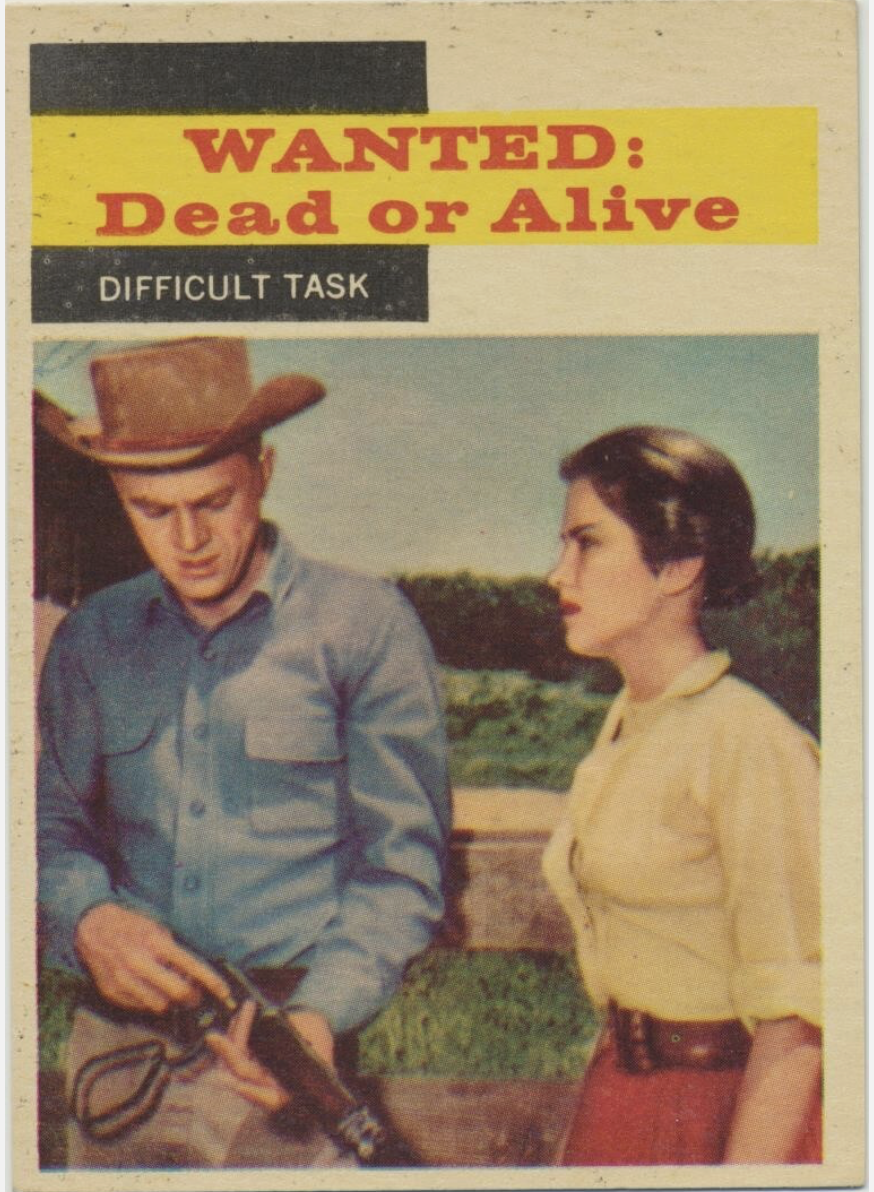
Steve McQueen makes his debut.

The closest to the wall won the cards. While the pot was the cards on the pavement, side bets among the players could include additional cards. In this way, fortunes of changed hands– simple objects blown about by errant winds, tripped up on rough asphalt, or flubbed by nervous fingers.

Tim Horton, whose indelible legacy was unknown to him.

A less challenging and extremely fickle game was ‘odds and evens’. Two opposing players would simultaneously drop a card to their feet, watching it tumble, heads and tails to the ground. During the descent one player would call for an odd, or an even match. This game required no skill and relied entirely upon the immutable laws of physics and binary logic, subject to wind direction.

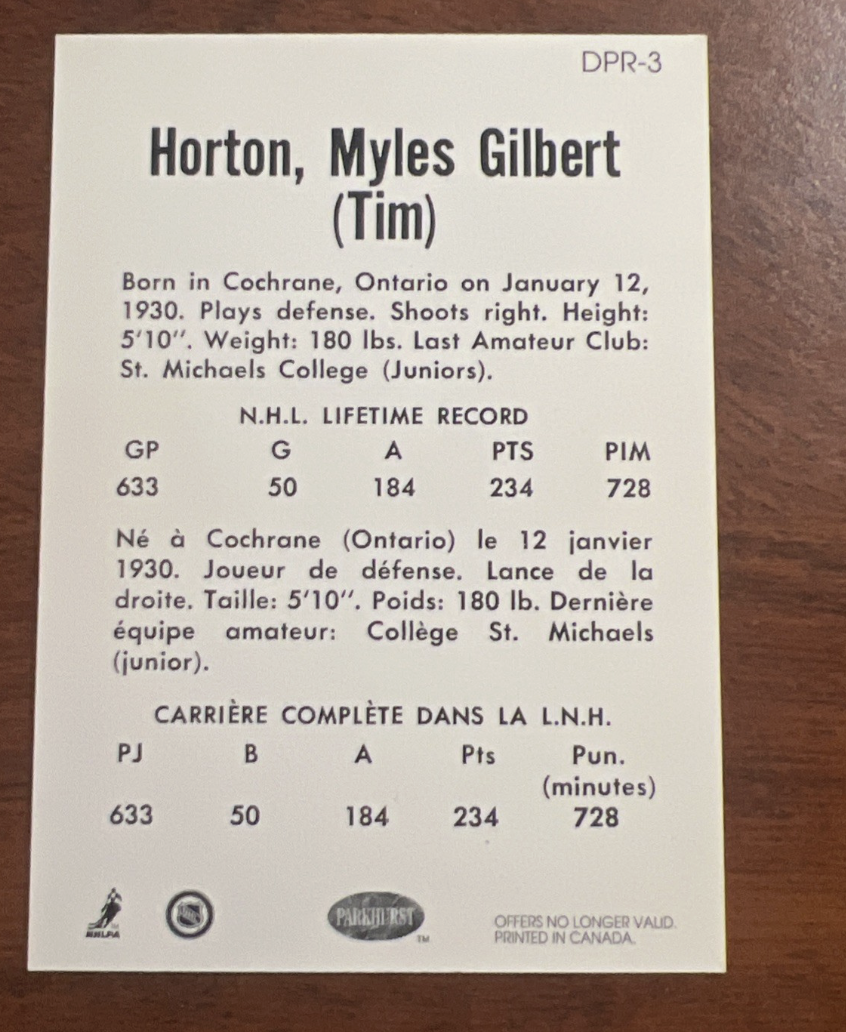
Fortunes were won and lost in these simple contests, and that formed our values and memories for the coming decades. Ironically, the numbered cards held no value except as collections. Few of us really knew the subjects on the colored faces of the cards, let alone the significance of the player statistics quoted on their backs.

Vital statistics for the aficionado.

Narratives for military cards and TV show cards were context at best, but few told the whole story.

So here I am now, seated in the closet, poring over the sealed collection of card memorabilia. I bought these sets years ago, purely for future value. A 1990 Bowman set of NHL cards– who knows what’s inside? 150 mint-condition images of Hall of Famers? Each one stained with 30-year-old gum? A 2016 set of Topps baseball cards celebrating the beloved Chicago Cubs, returned from 100 years of World Series drought?

The closet discovery: what could be hiding here?

Agonized with the thought of thumbing through these pristine, untouched treasures, I return them to their places up on the shelf. Some day, someone else will cross the river, and open the packages. I wish them well.

Standard
Cars, Culture, Economics, Government

Dear President Trump:

Dear President Trump:

I voted for you. I understand your strategy of America first. But your decision to tariff Canadian auto exports to the United States makes no sense.  As you know, the automotive trade between Canada and the United States is virtually balanced. While Canada’s exports of cars to the U.S. may create a U.S. deficit, the United States exports an excess of automotive parts to Canada, balancing the automotive trade between the two countries.

This is clearly stated by the Toronto Dominion Bank’s economics team, January 28, 2025: “Potential Hazards Ahead” by Andrew Foran.

So why tariff Canadian exports of automotive products?

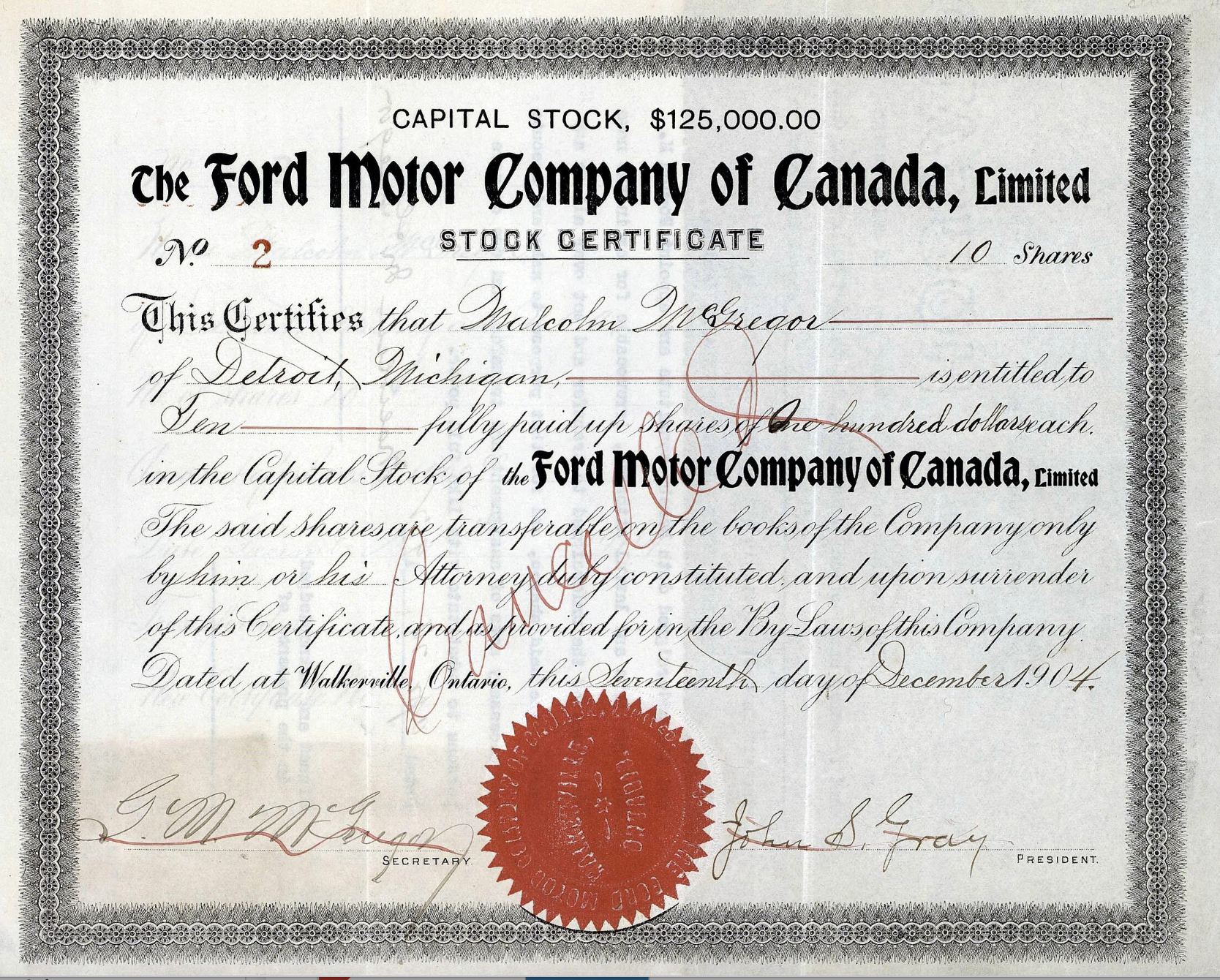
Your position to re-patriate the automotive industry to the United States is supposed to “bring back” jobs lost to overseas countries.  The truth is that in Canada, many of those jobs were created over a hundred years ago, long before you and I were born. Look at these Canadian subsidiaries, and their starting dates in Canada:  

The Ford Motor Company of Canada, founded 1904

General Motors Company of Canada 1918

The Chrysler Corporation of Canada 1925

Kaiser Willys Jeep 1954

American Motors Corporation (Nash & Hudson) 1954

Honda Canada Inc 1986

Toyota Manufacturing Inc 1988

The Big Three were building and shipping cars in Canada for Canadians long before WWII. Four, and five generations of Canadian families have worked in the factories, the shops, accessories and parts businesses feeding these successful companies. It’s in their DNA. They have taken loans to buy cars, mortgages to build homes, grow towns, and slogged to work for their families. The profits were returned to head office.

Sir, why are these companies in Canada? Market opportunity. This expansion wasn’t about finding cheap labor. This was about mining Canadian dollars.

Now you suggest that Canada is “ripping off” the United States by building cars and trucks. I think it’s a fair bet that every automotive trade investment that has been made on Canadian soil in the last seventy-five years has been supported by Canadian loans and a motivated labor force.

These industries existed decades before NAFTA. The 1965 US/Canada Auto Pact designed this relationship, which is balanced, and has been a cornerstone in supplying both countries equally.

I must remind you, Mr. President, that Canada is not just a neighbor. It is our friend and ally. Canadians have pitched in whenever the need arose: Dieppe, Vimy Ridge, Juno Beach, Afghanistan, Iraq, Iranian hostages, emergency 911-housing. Canadian first responders have convoyed to floods and tornados in the US heartland, quakes, hurricanes in the south, and to forest fires in the west.

These tariffs are worse than a slap in the face, they are a stab in the back.

Please explain why this balanced relationship is being burdened by tariffs which will harm citizens on both sides of the border.  Better yet, Mr. President, please stop the tariffs on the automotive trade.

                                                Yours truly,

                                                Phil Brown

                                                Libertyville, IL 

Standard
Cars, Culture, Government, Politics

Shuttering A Family Business

The US administration’s current tariff policy is gutting a family business. Not that most Americans would think about it. The push to re-patriate the automotive industry to the United States is supposed to “bring back” jobs lost to overseas countries. The truth is that in Canada, many of those jobs were created over a hundred years ago.

The Ford Motor Company of Canada, founded 1904

General Motors Company of Canada 1918

The Chrysler Corporation of Canada 1925

Kaiser Willys Jeep 1954

American Motors Corporation (Nash & Hudson) 1954

Honda Canada Inc 1986

Toyota Manufacturing Inc 1988

The Big Three were building and shipping cars to Canadians before WWII. Four, and five generations of Canadian families have worked in the factories, the shops, accessories and parts businesses feeding these successful companies. It’s in their DNA. They have taken loans to buy cars, mortgages to build homes, grow towns, and slogged to work for their families.

And why are these companies in Canada? Market opportunity. Historically, Canada had no native manufacturers to serve its consumers, and the automakers in Detroit and Japan saw the potential of exploiting this virgin market. This expansion wasn’t about finding cheap labor. This was about mining Canadian dollars.

Now we are led to believe that Canada is “ripping off” the United States by building cars and trucks in facilities that have been financed by Canadian manufacturers. I think it’s a fair bet that every investment that has been made on Canadian soil in the last seventy-five years has been supported by Canadian loans and a motivated labor force.

These industries existed decades before NAFTA. The current tariff action isn’t a market correction. It’s a government-driven, grand-theft-auto: generations of jobs and livelihoods stolen by Presidential edict.

I have to remind you, gentle reader, that Canada is not just a neighbor. It is a friend and ally. Canadians have pitched in whenever the need arose: Dieppe, Vimy Ridge, Juno Beach, Afghanistan, Iraq, Iranian hostages, emergency 911-housing. Canadian first responders have convoyed to floods and tornados in the US heartland, quakes, hurricanes in the south, and to forest fires in the west.

Worse than a slap in the face, this is a stab in the back.

Yesterday, Canadian Prime Minister Mark Carney said it best: “The old relationship we had with the United States… based on deepening integration of our economies and tight security and military cooperation… is over.”

April 2, 2025 will be remembered as the shameful day the U.S. shuttered a family business.

Standard
Culture, Economics, Government, Marketing, Politics

Spin City: “Shop Local”

Last week I shared my frustration and shame at President Trump’s brutish and uncaring treatment of Canada, a treasured friend of the United States. My letter was to the Republican National Committee.

The gist of it was that under the pretense of stopping drugs and illegal immigration, Canada was forced into increasing secure borders, or risk tariffs. After complying to the President’s demand, the subject pivoted. It wasn’t about drugs and borders, it was about a $60 billion trade deficit between our two countries, favoring Canada. I called the pivot a “bait and switch”.

But I have finally settled on the ultimate truth of this pivot, and it’s not what we thought at all.

First, to confirm, a trade deficit exists when two bodies don’t equal each other’s bank accounts. To wit, Canada’s tills received $413B from Americans, and America’s tills received $349B. from Canadians. Canadians would be right in saying, “We need a bigger cash register!”

To put this in perspective, the trade deficit has not been $63B in recent history. In fact, from 2017 to 2020, the deficit has averaged $20B per year. So the latest is a jump.

This deficit phenomenon is not unique.

If I was mayor of a small town, and noticed with some gloom that my local residents all went to the neighboring town to buy groceries, because they were cheaper, or more varied, I would expect the grocer in my town to come banging on my desk, with a grievance. “Nobody shops here. I’m going out of business at this rate!” I would apologize, and hoist signs on every lamp standard, “SHOP LOCAL”. I would also tell the grocer to get smart: “Bring in better stuff, and lower your prices.”

This is logical enough, but it doesn’t necessarily work if the out-of-town grocer has better suppliers.

So placing this on an international scale, the USA is taxing imports, with punishing tariffs paid by American importers.

But here’s the real twist. I finally glommed onto this as I ate my last Dad’s Cookie which was baked in Toronto Canada. While the President has charged that “Canada is ripping us off,” what he was really afraid to admit is, “I am going to punish American consumers for purchasing desirable Canadian product. By collecting a tariff on those imports, U.S. consumers will learn to shop local.”

It would be political suicide to come out and just say that, so instead, this “rip off” language targets Canadians, and all other countries as bad actors. The end game however, is to bring offshore jobs home. And while it may seem that Canadians are the bad guys, they aren’t. We are the bad guys because we like our Dad’s Cookies. The President’s hope is that one day, those cookies will be made here.

You can see this happening now in Canada. With new Canadian tariffs on U.S. goods, Canadians are encouraged to buy Canadian: SHOP LOCAL. To which they are proudly responding.

Mean time, the home-wrecking language and bombastic posturing from the White House has had a toxic effect on the USA’s goodwill account. Who knows how long that major faux pas will take to smooth over?

Standard
Culture, Economics, Government

An Open Letter to Michael Whatley, RNC Chair

Bait and Switch

Dear Chairman Whatley: I am staring at my Sustaining Member card for the Republican National Committee, and I am debating whether to return it to the RNC.

I am dismayed by President Trump’s transparent attempt to fool his electorate into believing he is imposing tariffs on Canadian exports to the USA just to stem the flow of illegal aliens and to stop the production of fentynyl. He revealed his real goal: to balance trade between our two countries.

You well know he announced his tariff plans were contingent upon Canada bearing down on illegal crossings and drug controls. When he was satisfied, the tariffs would go away. Canada responded and is working with US agencies to comply.

Now President Trump is accusing Canadian exporters of “ripping off” the United States over a $68 billion trade deficit. In a $762 billion trade relationship, this is a 9% differential. Never mind he negotiated this trade pact.

The outcome of this capricious and arbitrary action is that we have lost the best friends we could ever have. Canadians are rightfully angry and scalded by this abusive action and language. You will witness that our flag is lowered from Canadian businesses. The national anthem is booed at sports. Provincial governments are canceling contracts with US vendors. American sales people are refused entry to Canadian offices. One wonders how American tourists will ever be welcomed in Canada.

The numbing question over this infamy is whether Americans are even aware, and if so, do they even care? The tariffs have created 40,000,000 enemies without a single shot fired.

I would remind you of an important test for what we say, think and do. It is the operating rule of the Rotary International, here in Evanston, Illinois: The Four Way Test. Is it the truth? Is it fair to all concerned? Will it build goodwill and better friendships? Will it be beneficial to all concerned?

I believe that the President’s treatment of Canada fails this test abysmally.

I am urging you to communicate my anger and disappointment to the President with respect to this ridiculous and deceitful tariff ruling.

Yours truly, Phil Brown, Libertyville, IL USA.

CC: KC Crosbie, CoChair; Kathy Salvi, Illinois State Chair; Dean White, Illinois National Committee Man; Rhonda Belford, Illinois National Committee Woman; Daily Herald, Chicago Tribune.

Standard
adventure, Culture, Romance

Leaner, Meaner and Faster

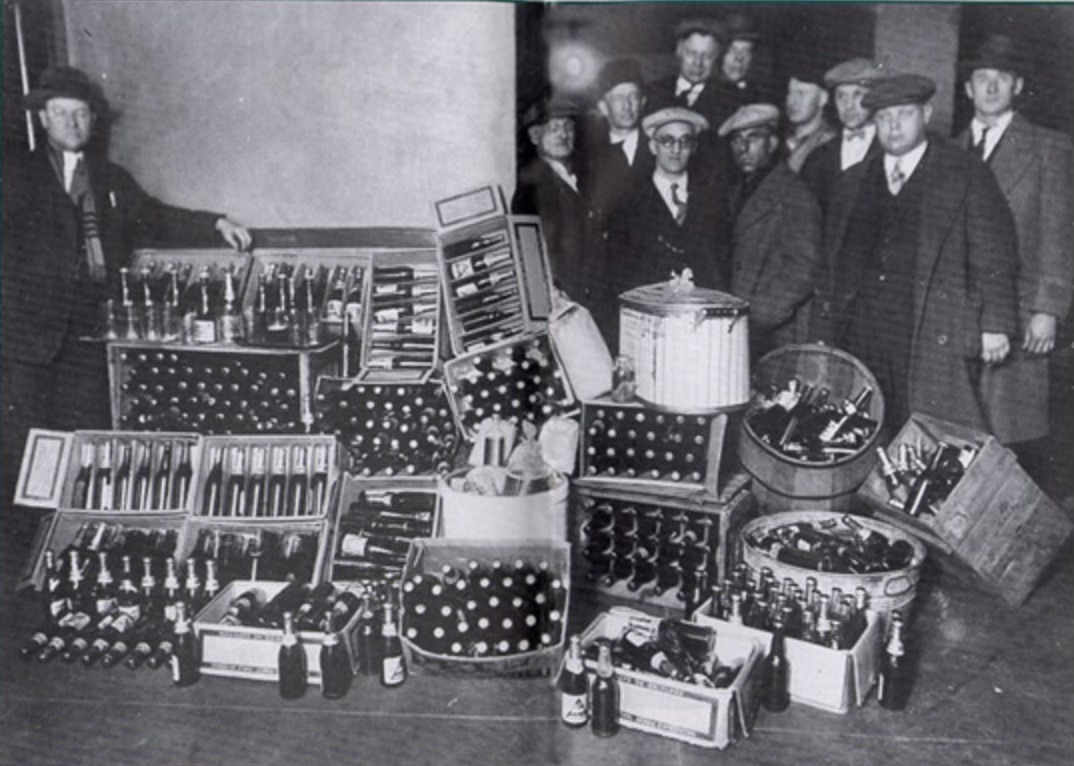
One of my most fascinating discoveries in researching the Prohibition days of Norfolk County was the building of the ‘Grey Ghost’.

It was literally 100 years ago that small lakeport communities along Lake Erie’s Ontario shore were forced to transition from commercial fishing to other sources of income.

Turtleback Racey, courtesy of the Port Dover Harbour Museum

Not all fishermen, but many, resorted to delivering shipments of whiskey and beer. The primary vessel was their main asset, the Turtleback fishing tug. That is, until the Grey Ghost appeared.

Turtlebacks are gill-netting fish tugs. They got their name for the box-like construction that covered the hull of the boat. The canopy shielded the crews and their fish from the punishing effects of sun, wind and cold. The tugs themselves weighed anywhere from fifteen to thirty tons, stretched thirty to fifty-plus feet, and their cruising speeds, around eight to fifteen knots.

HMCS Vigilant patrolled Lake Erie

These vital statistics put the tug, and its crew, in fairly even competition with the US Coast Guard, and Canada’s own revenue cutters. Those large navy boats were armed and armoured, and could cruise between 10-15 knots.

Rum-running was a risky, but respected sideline opportunity for some fishermen. When not being pursued by the law, both in Canadian and US waters, the midnight mariners also had to beware of hijackers. Those gangs were the nautical arms of organized crime. Not surprisingly, they had contacts in Detroit, Chicago, Hamilton, Montreal and New York. What bubbled up from these associations was a radical concept: the speedboat.

‘Patricia’ built by Gambles Shipyard, Port Dover, Ontario. ~Courtesy Port Dover Harbour Museum

The Grey Ghost was a steel-hulled, low profile, armoured delivery boat powered by one, or two aircraft engines. It was sinister in appearance, and undeniably designed to race across the lake waters undetected. Its Liberty-12 engines were army surplus. Ordered up during World War 1, the engines were originally intended to be installed in army planes that flew over Europe.

The Liberty-12 changed the rum-running business.

The Liberty-12 was a V-twelve-cylinder engine with an aluminum block. It had enormous power for lifting a biplane into the air. Who guessed it should power watercraft as well? While some tugs were still coal-fired steamers, the majority had moved to diesel. Gasoline was powerful, but dangerously flammable.

Along the Atlantic seaboard rum-runners had experimented with installing these engines in the steel speedboats. A fully-laden Grey Ghost could carry as many as fifty cases of liquor. When loaded, it could streak across the waters at speeds approaching fifty knots, over 90 kph. Today’s replica would be the monstrous, multi-coloured cigarette boats that roar along the urban shorelines of the Great Lakes.

Suffolk County Historical Society, Riverhead, NY

The Grey Ghost’s advantage was timeliness and escape. No one saw it coming, and no one could catch it. This enabled smugglers to elude the clutches of the US Coast Guard and Canada’s revenue cutters, and to do it in broad daylight. Multiple deliveries in a day. It ruled the waves until the coast guard itself launched its own speed boats, well into the waning days of Prohibition.

The USCG fleet, including speedboat lower left.

The Grey Ghost was a winning solution for rum-runners, but understandably, it had some drawbacks. First, it traveled over the water, not through it, and if the seas were not calm, it was a bone-jarring ride. Second, it was noisy. Even with submarine mufflers engaged, the ride was so noisy that by the time it arrived, everyone was alerted. Third, and not to be ignored, it was so noisy it could scramble the brains of its drivers.

But that was the risk of rum-running. For all the excitement and story, get a copy of Fish & Whiskey, and see how two young lovers, Joey and Belle, survive the time. I include an American and Canadian Amazon link for you!

Enjoy!

Fish & Whiskey in Canada

Fish & Whiskey in USA

Standard
adventure, Culture, Legal, Romance

Rough Water, Tough Drink

In my research for ‘Fish & Whiskey‘ I learned just what a devilish work place Lake Erie could become. It is beset by capricious and powerful gales which rile the waters. Waves can reach ocean-like heights that would topple any small craft like children’s toy boats in a bath tub.

Lake Erie’s Angry Moments

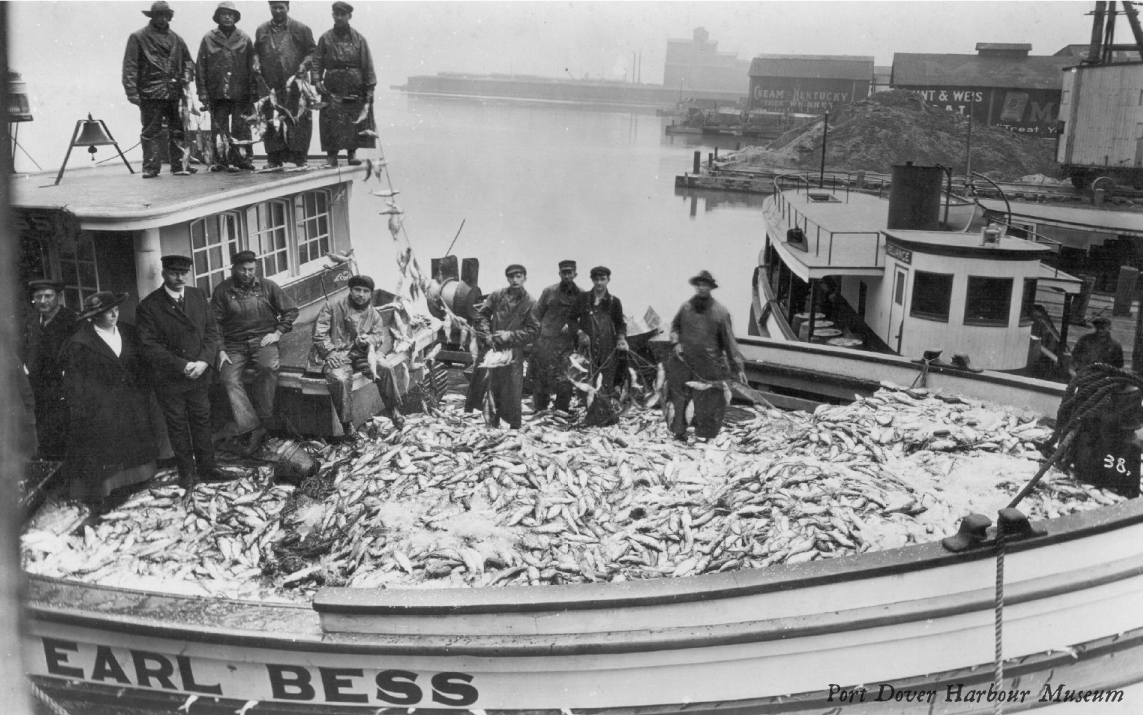
Despite that, fleets of fishing tugs would venture out on to the lake in search of fish, bringing home tons of herring, walleye, whitefish, perch and bass. The men and occasionally women who made those forays into the fog, rains and winds did so to maintain a livelihood that was as stable and familiar as any landlubber’s.

In the 1920s however, two unanticipated events occurred, colliding together to bring the fishing life to a sudden halt. First, the fresh water herring catch disappeared. Not overnight, but within a decade, the catch had plummeted from 40,000,000 pounds in a year to barely a million. Fishing communities all along the shores of Lake Erie reeled under the loss. The capital investment in boats and machinery, nets and equipment was unsustainable. The loss of income deprived family dinner tables of food.

Photo courtesy Port Dover Harbour Museum

Second, the governments of Canada and the United States stumbled into a confused tangle of laws that prohibited alcohol from the general populace. While temperance and prohibition were on the radar, no one had foreseen the real menace of alcohol restriction: organized crime.

Within a year of the passage of the laws to prohibit alcohol, many fishermen had transitioned from setting and lifting nets to making cross-lake, night-cruises laden with cases of whiskey, gin and beer. An insatiable demand for booze in America drove the price of a 40-ouncer from $3 up to $15. This profit bailed the fishing industry out. But more importantly, it brought the Mob in. Gangs in Detroit, Hamilton, Toronto, and Buffalo organized impenetrable networks and shipping lanes to deliver an estimated hundred million gallons of illegal booze annually, from 1920 all the way to 1933.

Lake Erie’s Path To Riches, courtesy Ted’s Vintage Art

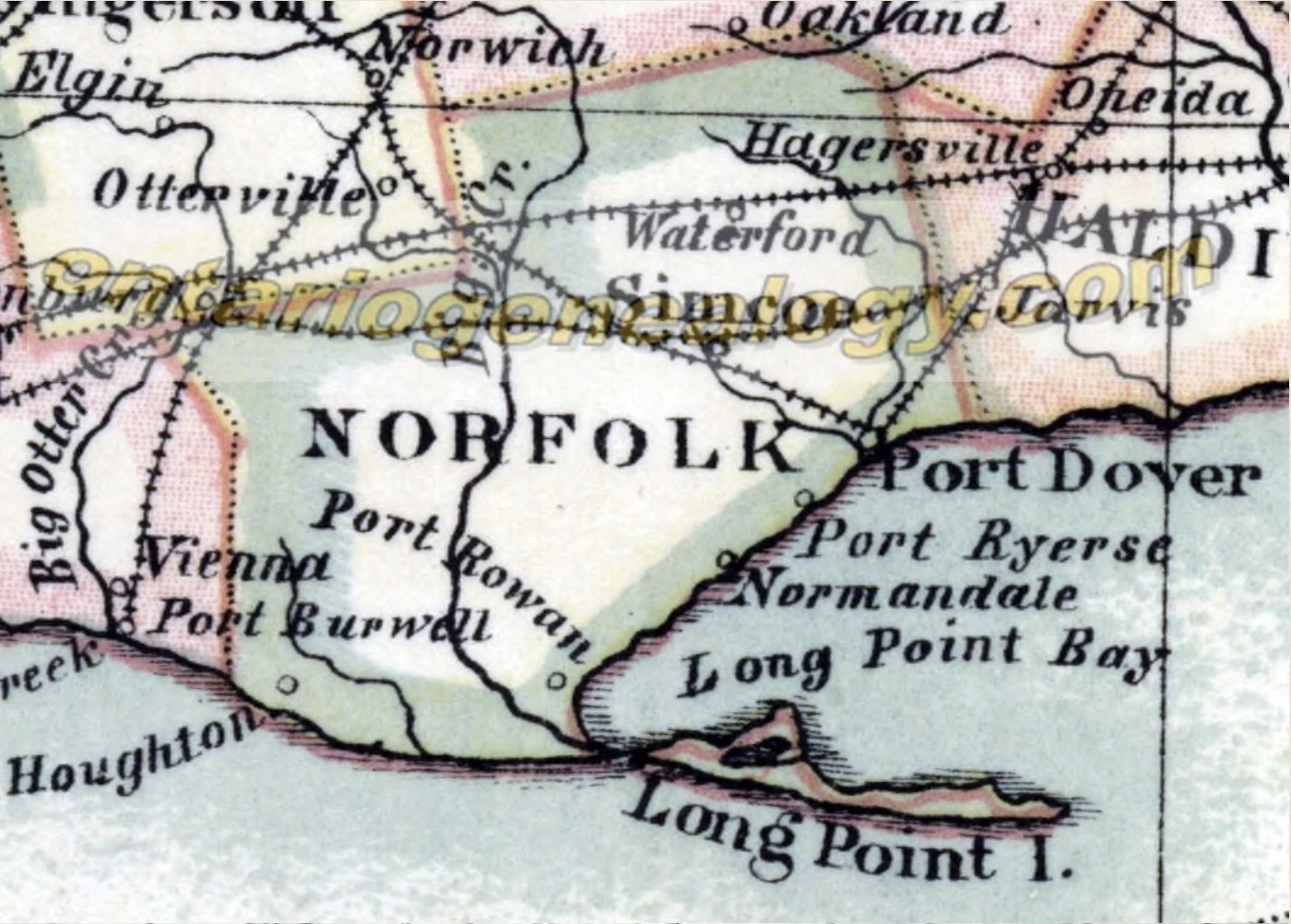
One of the principal conduits was from Norfolk County’s shores to Erie Pennsylvania, just over 40 miles away. To get there, Lake Erie had to be calm, free of coast guard, hijackers, and daylight. That was not always the case.

What facilitated this industry was the Canadian federal government’s allowance for Canadian distillers and brewers to continue their work. Ironically, while the local populations were not allowed to possess or purchase alcohol, the factories were encouraged to produce it.

At Amazon Now!

Fish & Whiskey‘ is the story of a small town in Norfolk County, and its residents who learned to cope under the new drinking laws, the unruly laws of nature, and the ascent of violent crime. In the midst of this, Joey and Belle are a young couple who navigate the new terrain while they learn more about each other, and themselves.

You can get your copy of Fish & Whiskey on Amazon anywhere the company has a presence. I enclose the Canadian link and the American link for your convenience.

Enjoy!

Standard
adventure, Romance

Fish & Whiskey

Sounds like a weird combination? Sort of a Baltic Sea appetizer? I apologize for my absence; I just finished my fifth book, whose curious title is above.

“Fish & Whiskey” came into being as the result of picking up an old book my parents had given me nearly fifty years ago. Harry B. Barrett wrote “Lore & Legends of Long Point”. It is a charming collection of stories and myths about the historic and scenic Long Point peninsula which juts out into the middle of Lake Erie. Ancient communities lived and hunted on this sandy, marsh-laden, mystical spit of land . Along its shores, the fishermen of Norfolk County had netted for their catch for hundreds of years.

Most intriguing however was Barrett’s tales of bootleggers and rum-runners who shipped millions of gallons of illegal liquor from Norfolk to Erie, Pennsylvania for thirteen wild, risky and profitable years. It led me to investigate further, and before long, I had dug into a story about the Prohibition years, and how the fishermen and communities along the Norfolk County shores participated in a trade revolution of mammoth proportions.

Fish & Whiskey is the fictional story of a small harbor town called Riverport. The year is 1925, Prohibition is in effect, and the town is reeling from the collapse of the fresh water herring catch.

The fish nets are coming in empty. The only recourse is to smuggle illegal booze into the U.S. To complicate issues, organized crime on both sides of the border are muscling in to Riverport with deadly ramifications.

Joey and Belle are two young lovers In the middle of this maelstrom of trouble. They wrestle with the circumstances, as best they can, all the while, exploring their mutual attraction.

The story is revealing of the times, and is told to keep the pages turning. Events occur, decisions are made —with consequences— and the tale concludes with a surprise and ironic ending.

You can find Fish & Whiskey on Amazon. I include two links, one for Canada, and one for the U.S.

Enjoy the read, and let me know what you think! I especially appreciate your review on Amazon!

Standard
Uncategorized

Disney’s Heavy Hand

September 3, 2024

Mr. Brad Schneider

US Congressional Representative 

District 10, Illinois

Re: Disney’s Heavy Hand

Dear Representative Schneider:

            It is disturbing and worrisome that the argument between Disney Entertainment Content Group and DirecTV should impact viewers. On Monday morning we were advised by DirecTV that we could not view any TV channel that carried Disney content.  These channels include:

  • ABC including ABC News
  • ESPN
  • FX
  • ABC Family, aka Freeform
  • National Graphic

There may be others. The DirecTV basic service is now lacking these contents. Chief among these features is ABC News. It is profoundly upsetting that we cannot view the news.

When two corporations are so large that they can arbitrarily withdraw a basic news entitlement, the American public is being abused.  

I urge you to voice our displeasure and serious concerns in the House. I also urge you to push the FCC to do its job: “Providing leadership in strengthening the defense of the nation’s communications infrastructure.” The American population is being held hostage by these giant corporations. It’s indecent, and fundamentally wrong.

Yours truly,

(Signature withheld)

Phil Brown

Standard