Culture, Entertainment, Music, Thank You

America’s Time Warp – 2

IMG_0863

The marquee at The Packard Music Hall


How We Came To See America

Forty-six years after their first concert, we finally saw America, that classic rock band that formed the soundtrack for many of us in the 70s.

Had it not been for the accidental bump into Bill Worrell, their genius lead guitar, we may have still missed an unforgettable concert, just this week, in historic Warren Ohio.

After meeting Worrell, we followed America’s tour schedule and targeted the closest drive to see them. We bought two seats at the Packard Music Hall for June 15 in Warren, Ohio, an hour outside of Cleveland.   This venue was a small, old, yellow brick auditorium which seemed an unlikely spot for a famous group to appear.  But with some reassurance from the folks at our hotel, we headed into town.

W.D. Packard, builder of the Packard automobile provided for a music hall in his estate.   That building didn’t materialize for some years, but eventually, in 1955 it opened, and became the home of the W.D. Packard Concert Band.   The hall since then has attained renown for its regular hosting of concerts for all tastes.  It is the go-to place for music in Trumbull County.  You would liken it to a small Ryman Auditorium.
IMG_0880

70s– life is good and easy.

Our image of America consists of three young faces with lots of hair.  But neat.  Their album covers telegraph thoughtful rock melody, with some leather and tie-dye.  We weren’t sure what to expect, but given that they graduated from high school in 1969, a quick look in our mirror would set the tone.

Driving down Mahoning Street in Warren, we sense an event about to take off.  Warren is a grand old city, but it has endured some devastating challenges with the collapse of the Ohio steel industry.    Our earlier drive across West Market Street coming into town is heartbreaking and disturbing.  Urban decay in full bloom.

But here, on Mahoning, the cars–all new, all shiny, SUVs and hobby convertibles– signify that money has arrived.   The parking security wave us in like ground control, and we are placed within bumper distance of a classic 80s Corvette.  The crowds are moving to the doors, and after scanning our online tickets, we are admitted to the front room.

Our Crowd Packs In

The Packard only seats 2,500 fans.  So this event will be close, and if not intimate, still friendly, unlike the massive takes at the United Center in Chicago.

IMG_0872

Some happy fans, these sisters and cousins are here to hear their band.

Around us, pony tails, tees, shorts, and sandals abound.  And those are the men.   Beside them are women outfitted in jewelry, dresses, capris and well made up.  This crowd is the picture of the Boomer: under 50, over 70, need not apply.  They are a happy, satisfied bunch who are eagerly looking for a reminder of just how good and innocent those raucous 60s and 70s really were, compared to now.

The Lights Go Down.

The host of the Packard appears and welcomes us all.  He thanks us for being in this hallowed hall, and introduces Brennin Hunt, who opens for America.

brennin-hunt-x-factor

Brennin Hunt, from Oklahoma by way of Nashville

Hunt, aka, Brennin is a smart guitarist/writer who finds a melody and picks it over repeatedly until it is glued into your head.   He has a vocal range that hits Vince Gill highs, and with whom he has co-written songs.

“I have some CDs out front, and I’ll be there to sign ’em for ya.  I’m a nobody so I have time to talk with you too.  Thanks!”

He has fronted for America for only a couple of weeks, but he is the perfect appetizer.  His music is calculated to attract and articulated with a free range across his Martin D-28.   Lots of passion in his tenor voice, he delivers a strong melody.   His best, and most phenomenal delivery is a cover of Michael Jackson’s Billie Jean.   He was brave enough to take on this iconic piece, and he serves it beautifully, acoustic guitar booming out the hypnotic bass line.  Quincy Jones would applaud.

IMG_0875

Brennan and Billy The Kid Worrell render New Kid In Town

Closing his act, Brennin invites our personal hero, Bill Worrell to the stage.  It turns out that Worrell, aka “Billy The Kid” also played guitar for a tribute concert tour  for The Eagles.   To acknowledge that, Brennin and Worrell duet on New Kid In Town.   Worrell’s smiling addition is effortless, and before the crowd can reseat themselves, America romps onto the stage.

IMG_0890

A 70s light show entertains. Easy to set up and take down for the next show in Detroit, tomorrow night.

Dewey Bunnell sports wire frames tucked in beneath neatly combed back silver hair.   He may be seasoned, but he is in good shape, and with a confident, upright pose launches into Tin Man.  He is playing a beautiful black, mother of pearl inlay Taylor acoustic.

To his side, Gerry Beckley is likewise be-spectacled, and strums his six string, tucked under his arm.  Behind them, Worrell plays a third acoustic.  To his right, Ryland Steen, a mere youngster is on drums, and to his right, Rich Campbell nimbly fingers a five string Spector bass.

I mention the band’s gear because the electrified acoustics give a full body of sound.  You think you are listening to an orchestra, but it’s just five guys and a powerful amp.

Just then, I asked myself, why do guys like this keep at it?  This is work, big time.

The crowd is on its feet.   We have been waiting for this sound since 1976.  For a moment, tonight it’s all music and light.

With hardly a pause, the group turns over “You Can Do Magic”, “Don’t Cross The River”, and “Daisy Jane” .   We are enraptured, and a spotlight on the audience would show a sea of pasty, wrinkled faces with wide grins singing back at the band.

The guys perform their hits flawlessly like shooting bottles off a fence rail, one after another.  They introduce Billy The Kid, and he takes off on an instrumental break, one of many in the show.

IMG_0886

America’s classic logo sustains and endures, like the band.

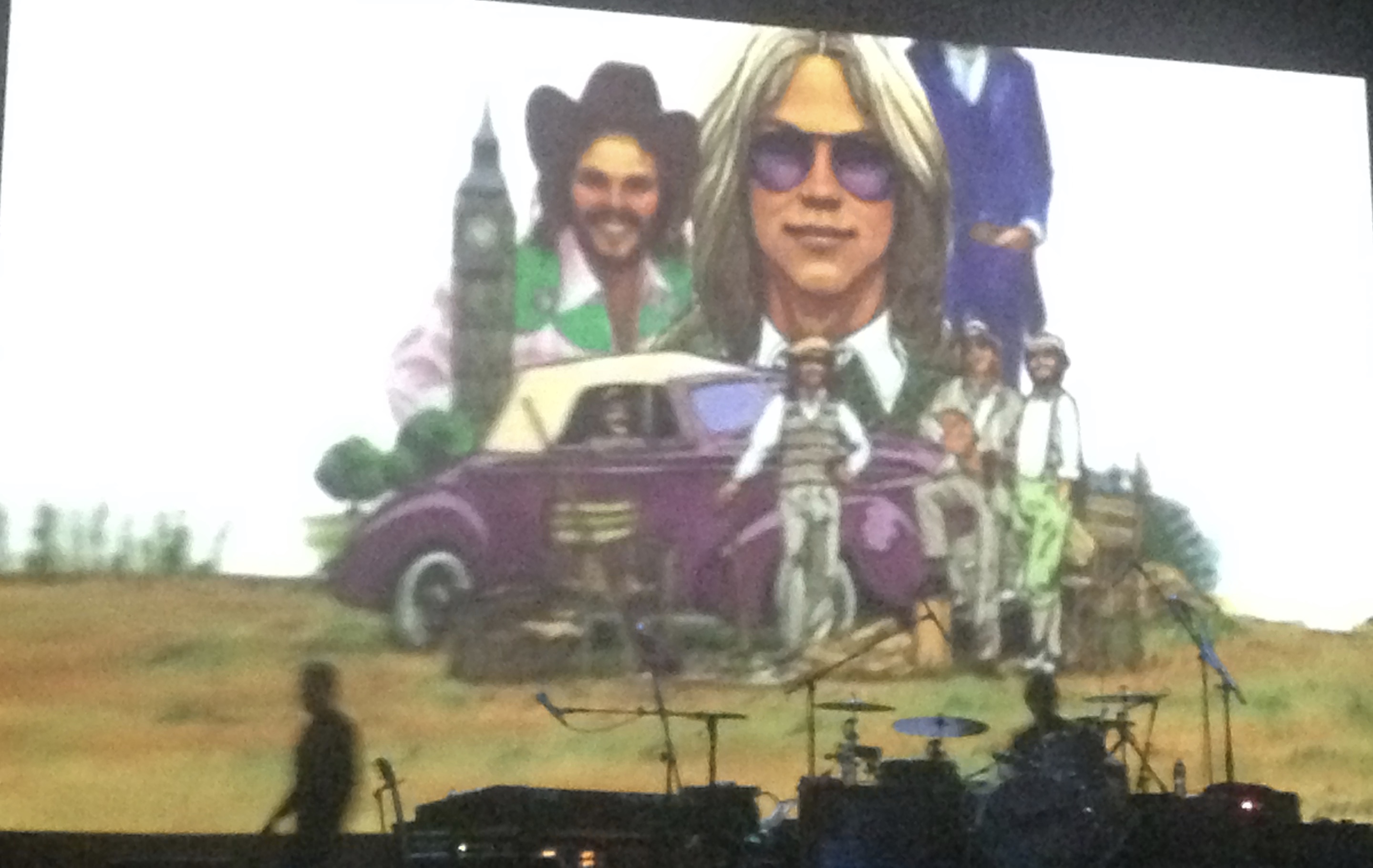
Meanwhile, the back stage screen flashes an encyclopedia of America images.  From album covers to Peyote Indian meetings to Viet Nam gunboats and helicopters.

What is enchanting about this 70s light show, is that it is a 70s light show.  No fireworks.   No pedestals or trapeze work.  No swinging microphone stands and no dance groups.

In all, America played 20 of their tunes.  They were all good, and fresh.

You might expect that like other vintage groups, a back up team of vocalists would deliver the high notes.

Instead, Gerry Beckley hits them, if like climbing out on a drooping limb at the top of a tall tree, he was careful, and plucked the peach he was after, every time.  A fearless display of singing.

The group soaked up several standing ovations, and only then did they turn over “Ventura Highway”.  Beckley fingered that one on his Taylor acoustic and made it look devilishly simple.

In a quiet moment, Bunnell smiles and thanks us for listening, and remarks that they have been performing over 100 concerts a year, for 46 years.

“People ask why?  Well, as long as you keep coming, we’ll keep playing.”

Asked and answered.

IMG_0898

In front of a U.S. gunboat we get “Sandman”.

The band unloads a solid “Sandman”, heavily enhanced by Bill Worrell against a grey tone backdrop of Huey helicopters in flight over Viet Nam.  They goose us up with “Sister Golden Hair”  and then leave the stage.

We cheered them back, and then, like Christmas, they unleashed “A Horse With No Name” which made the evening complete.

Watching this enduring 70s band do its best stuff with cheerful ease awakened some dormant yearnings and memories.   School.  College.  First love.  First job.   Money and independence.

It made me imagine the high times on West Market Street in Warren, when the steel industry was in its heyday, and wealth and the plans for future wealth were effervescent in everyone’s imaginations.   Those days are long gone here, but as the town continues to remake itself, and this music plays on at Packard Hall, they will come back.

That is the joy of America.


Thanks for reading!  Here’s some websites you might value:
America Concert Tour Dates

Brennin Hunt

Bill Worrell

Warren Ohio

Warren Photo Tour


Standard
Culture, Entertainment, Music, Thank You

America’s Time Warp – 1

How We Nearly Missed A Classic Rock Band, Again

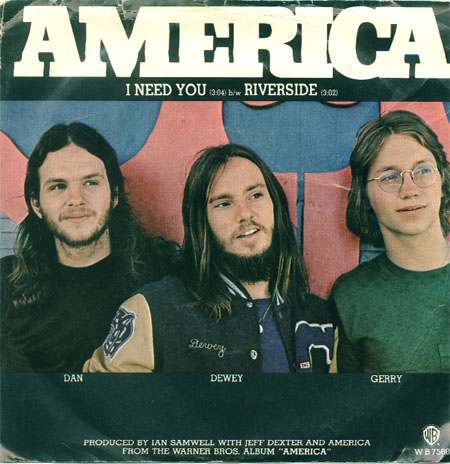
I_need_you_-_AmericaAt the time we first were raising kids we managed to survive without a television, stereo, or car radio.  Only occasionally did we hear those magnetic tunes of America by Dewey Bunnell, Gerry Beckley and Dan Peek.   In the background, George Martin produced.

Years later, the kids now have kids of their own, and we have lots of sound equipment.  And a collection of America’s Greatest Hits which are an irreplaceable soundtrack of the 70s, and still captivating today for their lyrics and melodies.

On a flight back from LAX last spring we sat beside a polite young gentleman who stared at his laptop, ears plugged in, for most of the trip.   Coming into O’Hare, we all powered down, and said hello.  A casual, perfunctory conversation followed:

“So, what do you do?” I asked.

“I’m a musician.”

“Really?  In a band?”

“Unhunh.  I play in a classic rock band called America. My name’s Bill Worrell.”

“Oh, cool. Well, nice to meetcha.  We’re Phil and Jane. Safe trip home.”

The plane landed and we all scrambled for our bags, got onto our feet and into the aisle to get off the plane.  The guy walked out ahead of us and disappeared into the crowds at Terminal 3.

“Do you know who that is??” my wife asked, incredulous.

“Uh, Bill somebody.  Nice guy.”

“You twit!!  He’s with America.  You know, the band.  Ventura Highway?  Horse With No Name?  Tin Man?  Sister Golden Hair?  Daisy Jane???”  By now she is dragging her bag ahead of me straining to spot Bill Worrell in the crowd.

We never found him, but the enormity of my density hung over my head the entire ride home in the car.

bill warrell

A Steve Gaglio Photography image of our seat mate, Bill Worrell.

I felt badly.  On the one hand, this kid is looking for fame and recognition, and I crush him with indifference.  On the other hand, he sees me as a wizened old goof probably humming Dion tunes.

I made things up by contacting him on his website and blaming my doziness to jet lag.  He immediately responded, and graciously gave me a pass with a chuckle.  I wrote back adding that anyone who could play the opening riff to Ventura Highway was a hero in my books.

Ever since then we have tracked America, and a few months ago booked tickets to see them last weekend at the Packard Music Hall in Warren, Ohio.  It’s a 450-mile drive but we have the time.

A Wrong Turn, And A Crisis

Warren is southeast of Cleveland.  We approach this historic city from I-8o and a solid line on the map entices us to skip the beltway outside the city to our hotel, and instead, drive through town on West Market Street.

Center of the World

Great expectations, questionable today.

Just off the interstate, our first introduction is to the hamlet, Center of the World.   It is distinguished by a few small roadside stores and the shell of a burnt out, collapsed garage.  We drive on.

Getting closer to Warren on West Market street we drive past closed shops, discount stores, pawn shops and unkempt properties.  We see a couple walking toward the Superpawn Shop, him with bareback in shorts, festooned in tattoos.  She shuffles by his side in tee and flip flops.

Our trip to downtown continues dismally.  The ruin continues with no cease.

“How could they book a gig here?”

“An aggressive agent, I guess.  Wow. What an eye opener.”

Deflated by the west side, we head up to Packard Music Hall to check out the venue, look for safe parking and quick getaways if we need them.

Warren City Hall

Warren’s City Hall, a beautiful building decked out in petunias.

Along the way we see the greatness of Warren.  Founded in 1798, this city has some of the most stunning architecture in its public buildings we have ever seen.  Along the wealthy streets there are some enormous, and beautifully built antebellum homes.  Flowers are everywhere.

The music hall is small.  Which means a cozy concert, and that’s good.  But beyond it is a park with groups of people milling about, not so much picnicking, but lazing about, because there is nothing else to do on a Wednesday afternoon.  The view among the ancient oaks and green lawns is strangely unsettling.

We drive back through the city center amid vacant store and office buildings, out along East Market Street where the real estate improves.

Trumbull_County_Courthouse_2

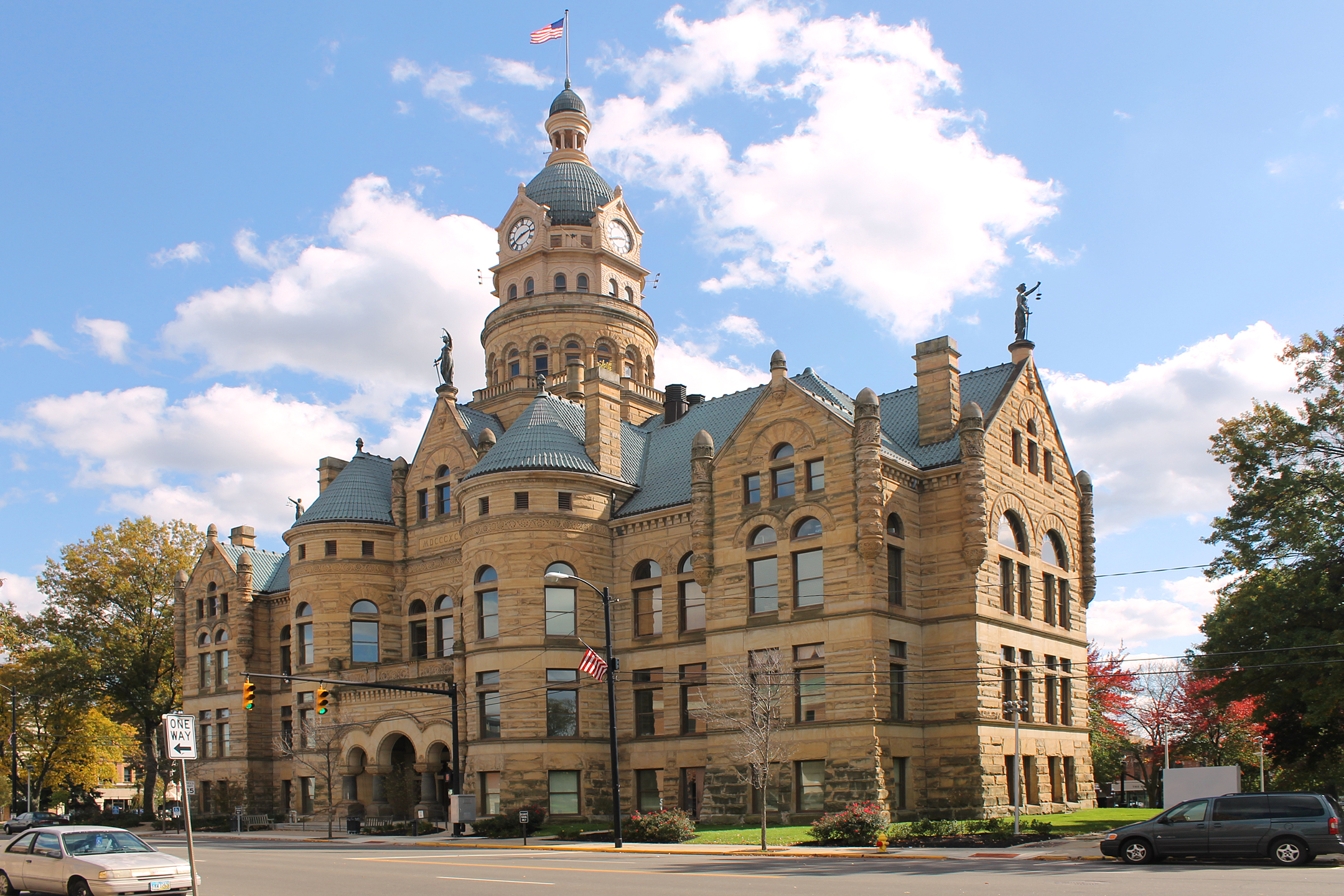
Trumbull County Court House in downtown Warren is majestic.

But it doesn’t improve enough to lift a feeling of dread about going downtown at night to see America.

By the time we reach our posh hotel in the suburbs we have decided to go home.  I inform the front desk folks, and with that, we elect to have a lunch in the mall, and start the 450-mile return trip, extremely disappointed.

The Turning Point

We sit at the bar of an Outback Steakhouse.  Bar sitting is great when you are splitting a meal.  It also gives license to speak with neighbors.

Lynn is running the bar.  I opened:

“Hi Lynn.   We just got into town, but I made a huge mistake driving in on West Market.  It’s pretty scary.  What happened?”

She paused before answering, maybe wondering if I was worth explaining to.

“Well, we used to have about six steel mills in the area.  They all went out of business in the 80s and it’s been a struggle for many.  All the people and business who supported the economy went away. Welcome to another country.”

With that I started to synchronize the news of Ohio’s past with my sheltered life in Illinois. But concerns persisted.

IMG_0863

Our first look at the concert hall.

“We’re going to the Packard Music Hall to see America.  It looks kinda rundown.  Are we crazy?”

“Oh no.  You’re perfectly safe there.  It’ll be a good show.  The east side is quite different than the west side.”

With that, a lady came up to us from behind.

“Are you going to see America tonight?”

She wore a black and white summer dress.  Bracelets on her tanned arms telegraphed upscale success.  Her 20s-something daughter hung back at their dining table.

“We are going.   It will be great.  You’ll love it.  We are having dinner at Leo’s first, and then drive in.  The Packard is perfect, and the place will be packed.  You’ll feel right at home.”

Her name was Diane, and she unloaded a ton of dining advice, hotels, and sights to see.  Had I asked, she may have admitted to being a real estate sales rep.  Regardless, she was good.

With that, we decided to rebook our hotel room.

More tomorrow, and I tell you how this trek to see America ended up.


Standard
Culture, direct mail, USPS

Tremors At The Post Office

Spoiler Alert: Numbers That May Surprise You!

The latest USPS report on mail volumes is out, and magically, incredibly, it points up.    The number-laiden Revenue Pieces and Weights report January 1- March 31, 2016 tells us volume for the past quarter was up 1.4%.

Big Business

For many of you, the news is lame. After all, what is an additional 520,183,000 pieces of mail? Actually, it turns out to be 37,414 tons, the equivalent weight of 454 Space Shuttles.  Which again points to the enormity of the US Postal Service.

Critics tend to discount the post office for its supposed obsolescence, but if you hang around a mail sorting facility for a moment, you know this is BIG, massive business.

So I for one am excited that mail volumes grew this past winter.


Slide2

Direct Mail and First Class Up

The better question may be why are they up?   It turns out that Direct Mail increased 1.9% over the same quarter a year ago, 355,488,000 pieces.   That could be related to political fundraising mail, and a cautious optimism in the economy.

First Class mail increased by 0.8%, 135,253,000 pieces.   An astounding turnaround!  Mind you, that includes all business mail.  When it comes to individually stamped mail, like birthday cards, bill paying and charitable donations, it was down 2%.  There is more intriguing news on this personal category in a moment though.

The big winner is Parcels and Packages which are exploding, correction, booming, sorry, mushrooming 13.2%.   This past quarter the USPS delivered 1,121,723,000 parcels, total weight: over 1 million tons.

The Magazine Subscriber Fails To Renew

What the report also reveals is the continued slide of Periodical volume: magazine counts dropped by 5.6%– 81,070,000 pieces over the three months compared to 2015.   Magazine subscriptions continue their slide.

The eye opener in this display of numbers is how mail looked just five years ago.   In 2011, total mail count for the quarter was over 41 billion pieces.   Since then volumes have dropped 6.7%, about 3 billion pieces.

While this is a generally understandable result of internet and social media, it is worthy of note that direct mail dropped only 3.4%, thus illustrating its successful economics.   By comparison, First Class Mail dropped nearly 13% in the same period.  Magazines, down 22%.

Parcels On The Move

You have to hand it to USPS management for the growth in Parcels.   While the internet may have crushed letter mail volumes, it opened the door for USPS package delivery.

Slide3

In 2011, Q2 Parcels totaled 667 million pieces.  This past quarter, USPS delivered 1.1 billion parcels, up a whopping 68% over five years.  And revenues? $3.7 Billion, up 82% from 2011.  The more we buy online, the more the post office delivers.

The significance of Parcels growth is that these numbers represent the USPS position in a competitive market with peers like UPS and Fedex.

Is Internet Migration Finished?

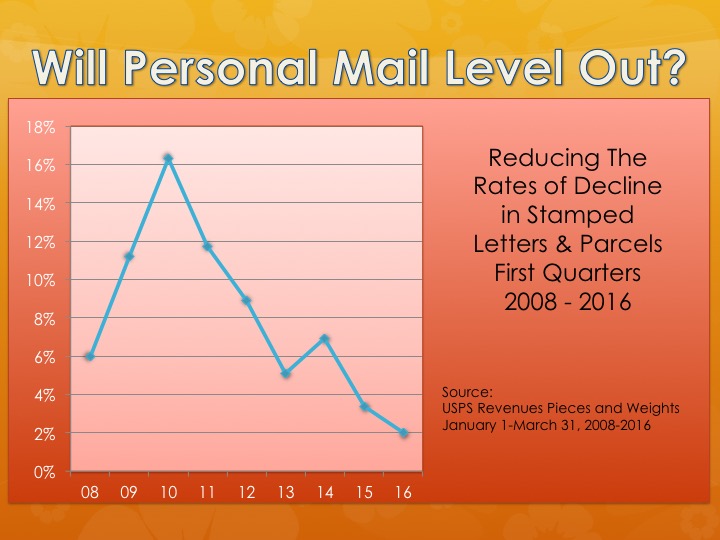
The encouraging story about Stamped Letters is worth a peek.   Personal letter volume cratered in 2008 and 2009 by -17.2%, and in 2010 by another -16.3%.    Since then, like a plane pulling out of a disastrous dive, Stamped Letters have nearly leveled out this past quarter at only a -2% decline.


Slide1

This leads one to believe that the attrition of postal mail to email and social media has just about finished.

Next month marks the end of another quarter for USPS record keeping. It will be interesting to see how the impact of the recent 1-2 penny decrease in price might improve mail volumes.

The direct marketers will take note, and who knows, maybe someone will pick up their pen and write one or two more letters as well.

Here’s the report for you review.  Enjoy!

Standard
Culture, Entertainment, Music, Thanks

Tom Rush, Master

Tom Rush2

A Charles Giuliano Photos image of Tom Rush at work.

Occasionally a simple action sets a need in motion.

A couple years ago a college friend sent me a CD of folksinger Tom Rush.  This entertainer’s music first broke into our lives back in  1966, hung in there until graduation, and then evaporated as we moved on.

Competition with job, kids and new directions pretty much locked Tom Rush out of our daily routines.

But fifty years later, the brand new CD woke me up.   Not only was our musical hero from university days still alive, but he was also, still, at the the top of his game.

We decided to go see him again.

On stage, Rush is a quiet conversationalist.  He talks to the audience, and snares them into the context of his next song with the finesse of a master salesman.   His modesty hides his greatness in the genre.

Launching his career along with icons like Bob Dylan, Joni Mitchell, James Taylor, Eric Von Schmidt, Jim Kweskin, Richie Havens, Fred Neil today his body of work reaches across decades of accomplishment, from early blues to contemporary ballads.

If “ballads” sounds corny, think stories, worries and wishes put to music and rhyme, about things and events on our plates every day.

IMG_5339

Isis Restaurant & Music Hall occupies a renovated theater from 1937 in the heart of West Asheville.

Last Sunday Tom Rush performed at the Isis Restaurant & Music Hall in Asheville, NC.   Contrary to the those of many small cities across America, Asheville’s downtown is booming.

In the west end, also known as the West Village, the Isis theatre is a fixture built in the 1930s, and renovated to its current appealing look with bar, restaurant and stage.  Outside, the original marquee showcases the night’s act.  Across the street is a guitar shop, with nearby pawn shop, grocery, village market, cafe’s and gas stations.

The street is filled with cyclists and people enjoying their particular pursuits.  While there was plenty of curb parking we chose to park in the grocery lot.   There was a sign pointing to a steel box into which I folded eight dollar bills to keep my place.

IMG_5340

Across Haywood Road a guitar store stands ready to fulfill the next musician’s dream.

Seated at our table up front, we looked at our hopeful neighbors, ordering dinner.  The Isis is delightfully small.  It seats about 50 diners and another 100 or so listeners on the main floor and in an upper gallery.   It is a cool place, good food, with a restaurant out front which was packed when we arrived, 90 minutes before the show.  Louise, the show scheduler came by our table to welcome us– a nice touch.

Up on the stage, a young fellow is tuning instruments: pianos and guitar.   He looks like a stage hand but in fact is Matt Nakoa who opens for Rush.   I shake his hand, and ask him to pass a note to his partner, requesting a song.

I can’t believe I am doing this but the opportunity can’t be lost to communicate with this giant.

It helps when I add, “We saw you last September in Minneapolis.  You guys were just great, thanks!”  He got my name and finished his tuning, and left the stage.

A few minutes later after Louise opens the show, Nakoa reappeared and delivered a virtuoso performance.   His songs are rich, thoughtful and complex, with a voice that adds a layer of honesty to the words.

At the keyboard, he is incredibly efficient.  Not that he uses only one or two notes per bar, but rather that he uses all his fingers every second.  I was reminded of the Bruce Hornsby sound: full barreled piano, active and melodic.  Matt Nakoa could choose to be a powerful classic concert pianist, but he opted for the folk and jazz club scene, much to our good fortune.

matt nakoa on keys

A Neale Eckstein image of Matt Nakoa unwinding a tune.

Nakoa also played guitar, with a light and intriguing touch.   He is left handed, playing a left handed guitar, but strung for a right hander.

This forces an inverted chord formation which for most people would be like tying their shoes using a mirror.  I am guessing he had to borrow someone else’s guitar in his learning, and the habit stuck.  The result is golden: a unique and magical delivery.

He delivered a half dozen songs, each original and lush in melody.  You want to hear “Ballad of Jenny Kane”.  Just as enchanting however was his patter between numbers.  He plays while he speaks, reminiscent of  60s entertainer Mauri Hadyn who also spoke with the audience while she produced a continuous soundtrack of riffs.

Tom Rush walks on after Matt’s introduction, and the crowd cheers for both singers.

Two figures could not look less likely to work together, and that is the magic of this duo.   We are faced with mop-headed Gen-x musical prodigy standing beside a crusty, smiling, white haired, git-picking balladeer.  Unbelievable combination.

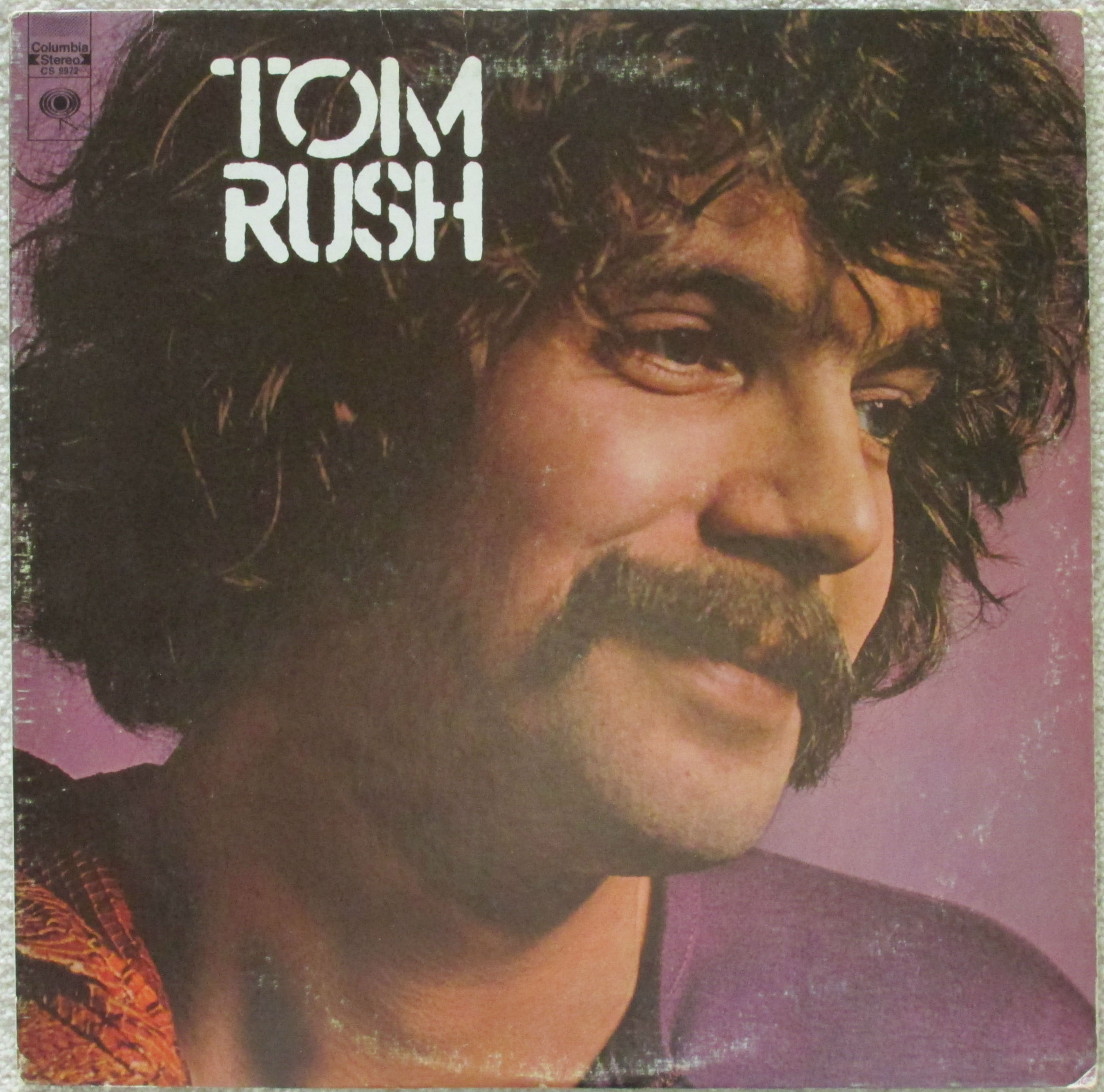
Tom Rush Purple

Early on Tom Rush started a following that just won’t quit. His ’72 Columbia Records release.

Our fascination is soon overcome by the quality of their product.   Rush commands the room with his good nature and low-key, self deprecating introductions.  He opens up his act with the confidence of a master woodworker unwrapping his blades, choosing one to carve a unique keepsake for the audience.

Launching into “It’s Gonna Get Hot Tonight” the crowd responds enthusiastically to Rush, encouraged by his beat and voice, both strong and happy.  In the background Nakoa has shelved the concert hall vibes to provide a wood-floor honky tonk sound that fills out the song perfectly.

The audience tonight is a following that has grown organically over 5o years of performances.   We drove 750 miles to see him.  True to his brand, Tom Rush delivers amusement and satisfaction by way of his story telling, singing and playing.

We know these songs, and they have legs.   The lyrics are his, in perfect measure, with stories we want to hear.   They are delivered by a voice that is both raucous and contemplative.   He can change our mood in line or two, all the while polishing that finished piece of work for presentation.

There is a side to Tom Rush which is remarkable, and it points to his generosity.   Yes, Matt Nakoa adds a dimension to his music, but it is the reciprocal nature of Rush’s partnership that is giving a younger generation the benefit of his experience.

He is hardly looking at the final days of his stellar career, with over 25 engagements scheduled in the coming months.  Despite that, he has taken on the onus of sharing what he knows with a new, younger talent.

Matt Nakoa has his own music and his own story, but he is following in the footsteps of a legend with full support.   In big business, the CEOs always say to hire people smarter than we are, but it’s scary.  Rush took that dare on Nakoa.   Our kids should all be so lucky.

A look at Tom Rush’s website unveils another gift.   While he has the usual display of story, news and events, he also has a page of FAQs .  What’s with that?   Countless questions from fans about how to play his songs, complete with guitar tunings.   In our world, it would be like a master vintner unveiling his secret recipe for a knockout wine.

Which leads to another puzzle in the Tom Rush narrative.  Why does a self respecting folk icon tour New England and the west coast playing in small venues for only the price of a good steak?  Celebrity has its costs, but modest ticket fees aren’t among them.

I think the answer is that the man loves what he does, and he wants to share it.   His audience loves him back. That is remuneration enough.

And by the way, he called me out, and played my request.

Thanks for reading!   This show is what coffee house music and jazz clubs are all about.   Who needs an auditorium for 20,000?  I pass on some websites for your interest, and feel free to share!

Tom Rush Show Schedule

His CD “What I Know”

Matt Nakoa’s Home Page


Standard
Culture, Media, Thank You, Thanks

Running Off The Cliff

wile-e-coyote-2You know the Wiley Coyote scene where he runs off the cliff in hot pursuit of the Roadrunner. There, hung in blind suspension of disbelief, he looks at the camera before reality sinks in.

Then he falls with a vviipp or a boink. We chuckle happily at his dusty, bruised remains in the canyon below.

So it is that I now admit to a similar, sad and painful realization.

Last December 6 I advised you that despite the falling volumes of the post office, one thing blossomed like a fresh spring crocus on a sunny hill… our continued, warm-hearted custom of sending greeting cards.

Stamps 965 copy (1)Christmas, Hannukah, Thanksgiving, Halloween were all good reasons to pick up our pens and write.

I detailed in colorful charts how “Single Piece Cards and Letters” sky-rocketed in the last quarter of the year, from October to December. Poring over the figures from the regular USPS reports, I found that the numbers went up, even while general mail volumes went down.

It was, as I said, revealing our brighter side.

Mail may be an antiquity, but by golly, we are sending a card anyway.

wiley's canyonRevisiting that article, I discovered to my shock and dismay, that I had reported on revenues, not pieces. Aaarrrggghh!

Yes, patient reader, I misled you, big time.

The truth is, Cards and Letters for Q4, October 1-December 31, remain virtually the same share of the total, for the years 2004 and 2014— 27.5% to 27.7%.  Meanwhile the whole category tumbled 55% over ten years.

Do they jump up in the last quarter as our good intentions begin to materialize?

Yes, as always.  In 2004, an uptick of 18%, and 2014, up 22%, just in time to make delivery by Christmas.

But who’s going to calibrate a blip…a minor swelling…a mild burp in goodwill based on these numbers?  The fact is, we have laid down our pens.

With that, Wiley Coyote looks down into the abyss.  In his descent, he contemplates what went wrong.

wile-e-coyote-off-cliff-largeYes, email for sure.  Good grief, why send a thank you card for a dinner when a two-liner on Gmail will tick that off the list?  Want to bang off a birthday greeting fast?  Hit “send” and it’s done.   And is there any need to spin post card carousels in some tourist trap when you can celebrate your vacation on Facebook?   Hardly.  And so much for mailing pics of the Grandkids when there’s Instagram.

“Ahhh, to heck with it,” Wiley concludes as the ground rises before him, except… there is one factor to consider…

The physical delivery of the letter made a big, personal-brand impact.   When someone took the time to compose, and write, in ink, on a nice card, address and lick an envelope, buy a pretty stamp, and find a mail box, it communicated in ways far beyond digital.

It’s a nice thought.

~Splat.

Standard
Cars, Culture, Thank You

Farewell To A True And Faithful Friend

Blue at Weslemkoon

Our first Olds Cutlass Cruiser.

It’s strange how we can instill heart and soul into material objects. Because of that, this is a wistful moment, bidding farewell to a member of our family for over 25 years.

Back in 1990 when we bought our home, the real estate agent said, “Hey, you have a few dollars left over from your loan, why don’t you buy a car?” So we acquired a brand new Oldsmobile Cutlass Cruiser, a mid-sized station wagon.

330,000 miles later, here we are, standing beside Blue, who is resting quietly in the driveway.

You may think it is a stretch to give a soul to a machine, but it is not uncommon. Sea captains adopt their boats. Hearst had his Rosebud, and Davey Crocket, his trusty rifle Old Betsy.

Blue after a wash

Blue, fresh out of the shower.

Olds Plywood

A rare talent: a 4×8 sheet of plywood through the window.

Actually, Blue is resting on the driveway, not in it. Family only goes so far.
The reason why this departure is so touching is that we remember when we first got Blue. We traded in an earlier Olds wagon, the exact same model.

It was the easiest order a car salesman ever took:
“Yes sir, can I help you some how?”
“Yep, see that Olds wagon in the lot outside? I want another, just like it.”
“Certainly. Just like it?”
“Well, yeah, but with air conditioning, fuel injection, and FM radio.”
“Power windows and door locks?”
“Nope. If we drive into a lake I want to be able to get out.”
“Same color? Blue?”
“Yup.”
“Done.”

The paperwork took much longer, but by the next day we had Blue.

Years later there’s no need to recount all the outings and family trips in Blue, but the car distinguished itself by its steadfast performance.   According to industry stats, Blue must have been made on a Wednesday, because he never suffered a quality issue.  Beyond the normal R&M costs, Blue lived a clean and pure life.

It was not until 14 years later, on a mild December evening in 2004, that we truly realized what a prize Blue was.  We had parked outside a restaurant for dinner, and walking in, spied a similar Cutlass Cruiser wagon, same vintage.

I was moved to scribble a note and leave it on the windshield:

“Hi! Great car!  We have one just like yours.  Look behind you. 210,000 miles, and runs like a clock!”

Olds Back Seat

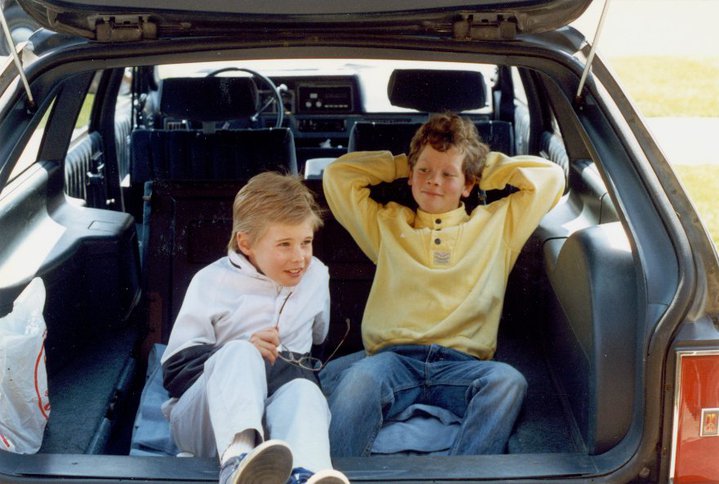
Rear view treat: the seat of choice.

When we came out of the restaurant after dinner, the wagon was gone, but we found the note with a reply, under our wiper:

“This car just won’t die.   190,000 & runs great. Hope you make 300K.”

And here sits Blue today, well past the mark.

With a few makeovers mind you.   We have repainted Blue four times.   Maaco gives us respect, though honestly, the owner there may have succumbed to paint fumes.   On two different occasions we returned after a week to pick up Blue as scheduled, and he couldn’t remember us or the car.

Blue Possum

Varmint duty: airing out after trapping a possum.

But the new paint jobs breathe new life, just like a new suit, new carpet or a new kitchen.   People would stop to stare at Blue.

“What year is that?  How many miles you got on her?”

We never viewed Blue as feminine, but protocols demand the female gender for cars it seems, just like Pat Brady’s Nellie Belle.

Another common comment from admirers:

“We used to have one just like this.  Rode in the back seat.  Does it face backwards?”

You bet it does, kids loved it, but the D.O.T. put an end to that hazard, understandably.  Still, it was fun.

Olds Jerry's

The pitt crew: Don and the team.

But what Blue could do with its backseat and rear window was pack in a 4’x 8′ slab of plywood, thanks to General Motors’ patent on the hatchback window.   You can find the same feature on Cadillac Escalades today.

Unfortunately for Blue, General Motors lost its way, and designed a long series of geriatric, goofy looking Oldsmobiles through the 90s and into the new century.  Sales withered, and April 29, 2004, the last rolled off the line.

Mean time, Blue had become my main ride, and delivered me daily to work and home, racking up the miles.   One day, in 2006, around 229,318 miles, I filled in the new owner questionnaire.   I was 16 years late, but General Motors responded February 9, 2007.   Adam Dickinson, our designated Customer Relationship Specialist congratulated us.   After a stream of compliments, he suggested:

Olds March 2011 copy

15 minutes of fame, and a year’s free oil changes.

“We would be remiss, however, not to suggest that you look closely at our new Cutlass at your local dealership….”  That was three years after the demise of the Olds make.

Denial.

We wonder today if Adam is in a small cube somewhere, still writing optimistic notes to holdouts like me.

In summer 2009, Blue was worried.   The CARS program lurked.   Car Allowance Rebate System, popularly known as Cash For Clunkers, was the federal government effort to compensate GM and others for turning out a decade of lemons.   To the automobile, this was like plague, emerald ash borer and mad cow disease, all rolled into one.

Blue's Worst Fear

Blue’s worst fear: to be stripped at Pick & Pull.

All told, the feds grabbed 671,000 vehicles off the street.  Blue wasn’t one of them.

As a celebration, Blue had his own Facebook page.   It was revealing, listing his favorite movies, shows and songs: Bullitt, Dukes of Hazard, Knight Rider and Deadman’s Curve.

January 2011, the miles continued to climb as Blue enjoyed continuous 100-mile round trip sprints to the office every day.   300,000 loomed ahead on the odometer.   We contacted Jiffylube, which had been Blue’s choice since May of 1991, mile 5991, 20 years earlier.

They sensed a PR opportunity when easy math showed a century of oil changes: 100 visits.

Blue in Hebron

Under the State Champs water tower, Hebron, IL.

Jiffylube’s ad agency jumped on Blue and he had a day’s coverage in suburban Chicagoland’s news, taking interviews from reporters and an FM station in Dubuque.  Best of all, a gift of free oil changes for a year.

Celebrity is emboldening, if also a heavy responsibility.  We bought Blue a new set of tires, with the slim whitewalls to complement his spokes.

The daily commutes were Blue’s opportunity to let the ponies go.  There is a 4-lane strip of highway north of Chicago where we pushed the speedometer over two digits a number of times.  Only for a mile, but long enough to let him smell and feel the brisk air screaming through the rad grill.

Blues new wheels

New tires. Sweet!

Sadly, things change.   With our retirement, the commutes stopped, and not too long after, Blue saw his first signs of slowing down.   Kind of an automotive hardening of the arteries.   Don, the pit crew chief, who has managed Blue like an uncle cautioned us:

Blue at Mars Bar

A ride in the country, Lake Como, WI.

“Yunno, he’s stiff.   You’re not running him hard.   So he gets tired.  He’s gonna stall on ya every once in a while.   Nothing serious, but he really needs a good long drive.   And some Gum-Out.   Use high octane every once and again, just to clear the injectors.”

Then last week, a new wobble.   Driving out for a visit to the hardware, Blue couldn’t make up his mind on which gear he was in.  3rd? 2nd? Drive?  We got him home by slipping into Neutral at every brake and corner, just to keep the revs up.

Blue at 330,000

Blue notches 330,000.

He wouldn’t talk about it.   When we pulled the hood release to check the engine, the wire snapped, locking us out of a closer look inside.   Blue was suffering his pain quietly.

Back to Don again.

“It’s the solenoid in the transmission.   We’ve tried everything, but it’s dead.  He’ll still shift, but you might have to change gears manually.   There’s nothing else we can do.”

At mile 332,879, the automatic Hydra-Matic transmission that was perfected by Oldsmobile in 1939 was out of the race.

Our worst fear is that Blue could end up in the jaws of a car crusher at some junk yard.  It is  unpalatable.   Better to hide under a tarp in a barn.

Blue at Sunset

Sunset, Butler Lake in Libertyville, IL.

So we are hanging onto Blue, and will nudge him past 333,000, maybe with a trip or two to the golf course, or to a grassy park overlooking the tollway, where he can hear and smell the noise and speed of the thousands of cars that whine and hum along the lanes below, unaware of his watchful gaze.

It’ll be a sunny, breezy day.


Standard
childhood, Culture, Sports

For All The Marbles

There was a time when a young boy’s wealth was measured in marbles.   In my hometown, Delhi, Ontario, any 8- to 10-year-old was appointed rank according to how low his pants sagged after a lucky run at the alley pots in our school yard.

IMG_6985

Wealthy beginnings.

We called these beautiful pieces of glass “allies”, and we played on a hard-packed stretch of topsoil just east of the bike racks under a young oak tree.  Alley season started in late April, as soon as the ground dried up from winter, and lasted until school adjourned, end of June.

The alley “pots” peppered a 50-foot square of packed dirt, which looked like a miniature minefield pocked with tiny craters, and not one blade of grass in sight.   The dirt patch was as noisy and busy as any Vegas casino, with players hustling any comer when a pot freed up for a game.   Pint-sized spectators crowded the action like gamblers around a craps table.

The pot was a significant diversion from tradition.   Generally people describe “marbles” as a ring drawn in the dirt or pavement, and a bunch of marbles inside the ring.   Two players would flick marbles at the inner circle, claiming any they knocked out of the ring.  Like dodgeball.

Our game was a more like golf.   The pot was dug into the dirt.   Kids would rotate about ten times on their heel, and form a 4-inch- deep pot that measured about 6 inches across.     Do NOT try this at the golf course.   The pot was the target, and also held the stakes–a heap of 10, 20, 40, maybe a 100 marbles.   Each player would keep one marble out for play.    Stepping about ten feet back from the pot, they dropped their marble, and would alternately inch the marbles towards the pot, usually with their foot.

IMG_6973

Big stakes for the winner of the pot.

The moment of truth occurred when a player felt they could sink one of the marbles into the pot.   Crouching down on one knee, they pushed the marble with a curled forefinger.   Much like golf putting without the fancy shoes.  Or billiards, with no cue.  Or like curling, without the 40-pound rock.

That decisive shot may have been 5 feet away, or perhaps only 12 inches, depending upon the smoothness of the path, the break, and the depth, width and contents of the pot.  If the marble dropped, the player had another turn with the remaining marble.   He might inch that one along, or, take the long shot.   If it sank, he won the pot.   If he missed, then the next turn went back to the other player, who probably would sink it.

With that, fortunes were won and lost every minute with a chorus of cheers and groans around the alley pots.

IMG_7045

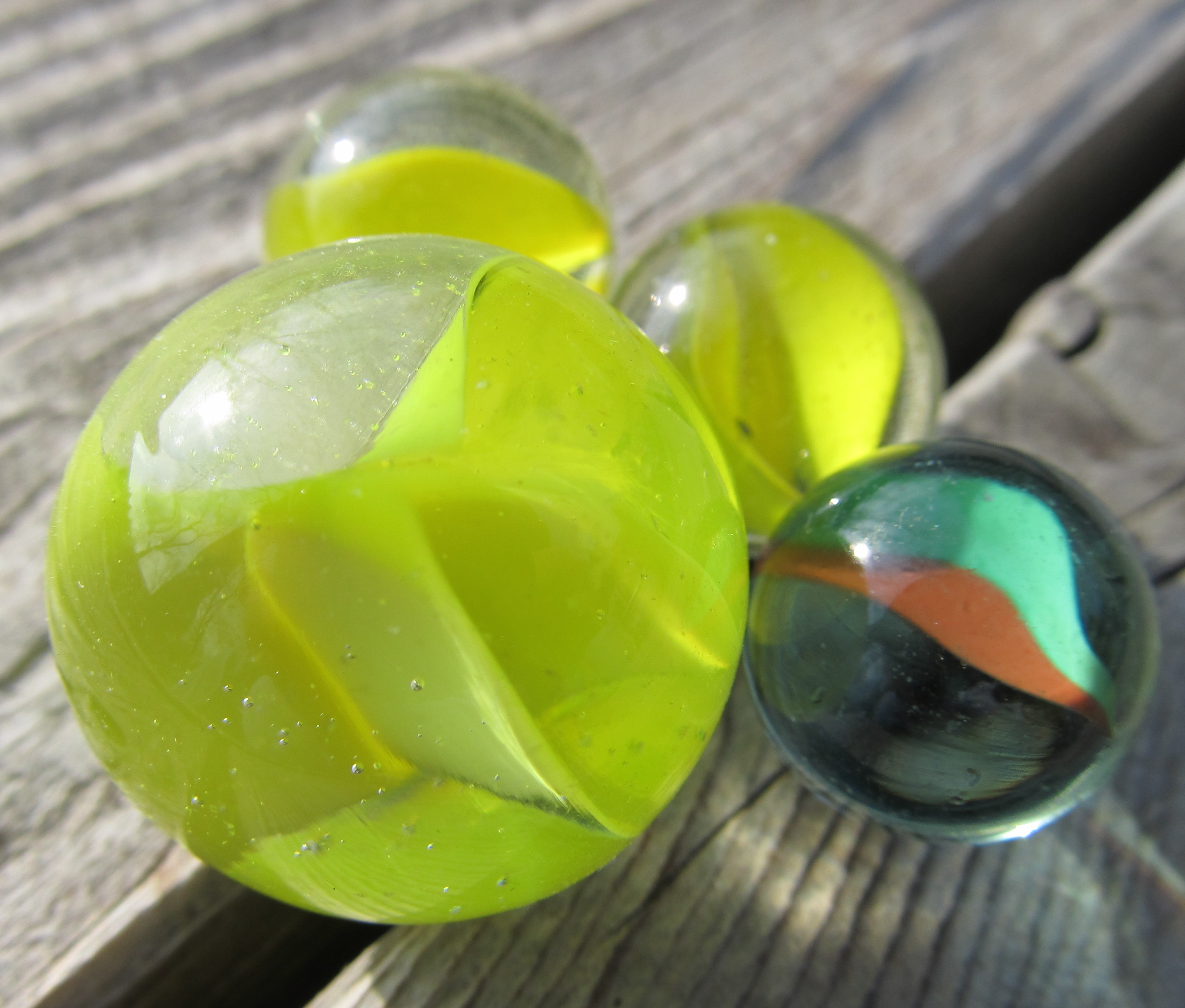
A “starry boulder” with three small friends.

And fortunes they were. The Chainway sold “starries”, 30 for a dime.   The starry was a half inch in diameter, and had a twirly colored pigment frozen into the center of the marble.   If you had the money, you might pick up a bag of starry “boulders”.   These were nearly an inch in diameter and went 6 for a quarter.  Pricey, but in the school yard, they traded around 10:1 against the smaller marble so there was room for arbitrage among the quicker thinking players in the yard.

Possessing a fortune in marbles was risky, too.

According to their job description, grade school teachers are hired to confiscate marbles.  In class, the sound of a vagrant marble clattering among the chair legs on a hardwood floor felt like money falling down a grate.

Aggies were the antiques of marbles.

“Aggies” were the antiques of marbles.

Logging the misdemeanor, the teacher would demand the marble be retrieved and placed in a mason jar on the corner of their desk.   You could buy them back, 3 for a penny, proceeds to the Red Cross.

This was a tension-filled time for big winners, whose loaded pockets would bulge like mumps.   Gingerly sitting down with the grace of a hemmorhoidal sufferer, the trick was to keep the pockets vertical to the fall line, and packed tight.

Kids with zippered cargo pants could plop, heavily laden, into their chair with impunity, but if they didn’t wear belts, they ran the risk of mooning the class which was a major felony.

A super boulder aggie, bigger than a quarter.

A super boulder aggie, bigger than a quarter.

Of all my childhood past times, allies made the deepest imprint.   In 5th and 6th grade, I played with stakes from one to twenty marbles, and had won pots as high as 400.

But I have lost 400 too, which twisted the sharp blade of experience, let me tell you.   So much so, that I cannot pass a marble display in a toy store today without picking up a bag or two.   Now, a marble costs about 10-cents each, a 3,000 % inflationary effect.

Do you know some popular brands of liquor use small marbles in the bottle neck to slow the flow?   I cut them out when the bottle’s empty.  So far, I am not buying liquor just to retrieve the marble.  My wife shakes her head, staring at me– a sorry junkie who can’t kick the habit.

IMG_7043

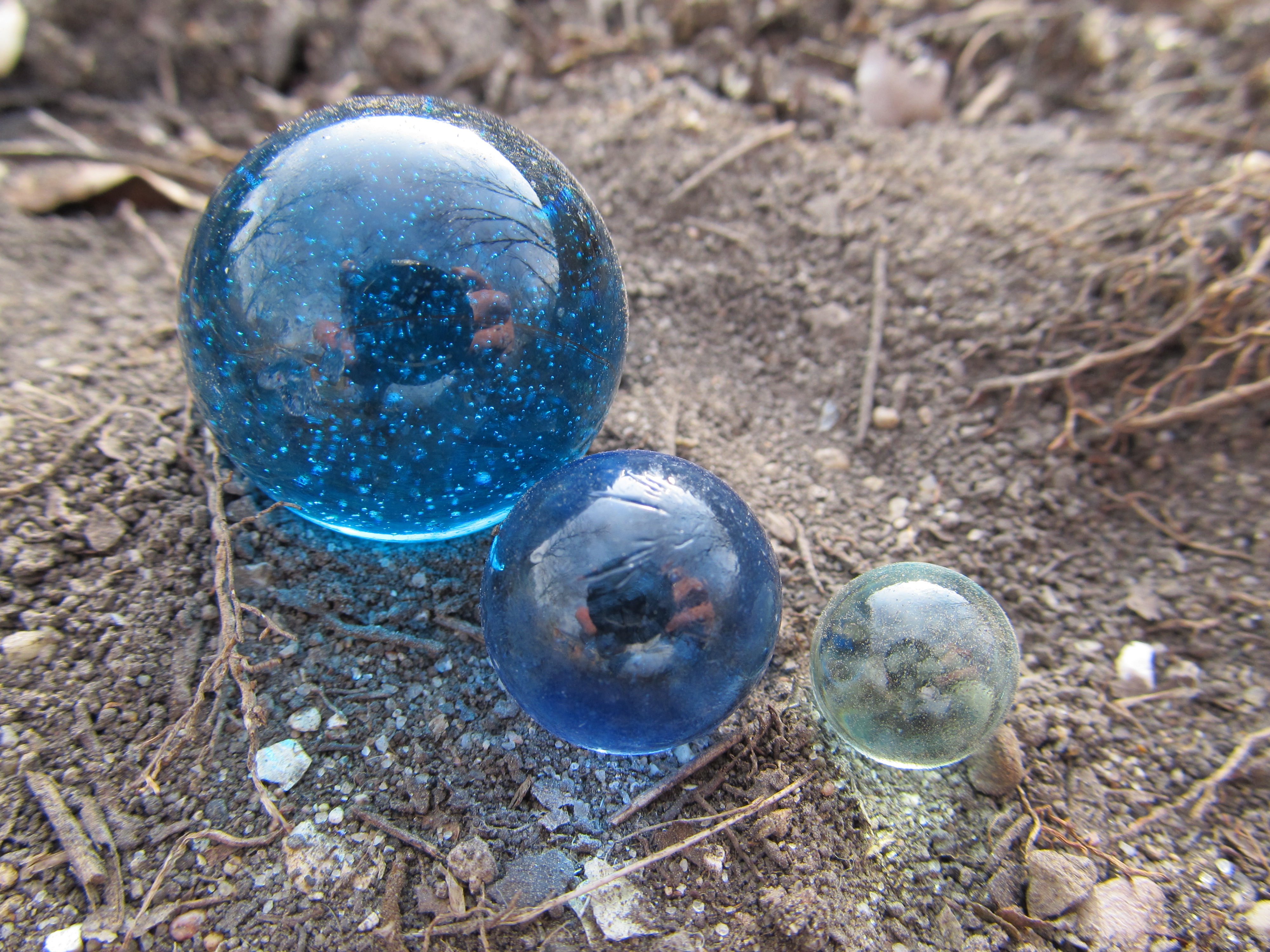
A “purie” boulder and marble. Johnny Walker Double Black provided the tiny one.

I am not sure what to do with my stash: two large Crown Royal bags.   While I want to give them to my grand kids, I have this shameful, miserly greed that won’t let them go.  Remember in “Ghost” when Whoopy Goldberg won’t let go of the $4,000,000 check?  It’s like that.    I am afraid they’ll end up at the bottom of a fish tank.   Or worse, inside a flower pot anchoring a bunch of tulips.  It would be okay if they were displayed in a glass table, maybe.

IMG_6987

The alley bag of choice.

But what I wouldn’t give to take the whole lot of them to a school yard next week and find a buzzing, hard-packed dirt casino, under the shade of an oak, churning with the yell of young risk takers, digging holes for a new game.


Thanks for sticking with me as I try to control this habit of mine.  I just can’t shake it.  If you “like”, say so, and please share or follow!

Marble Count 038

At the end of a long successful day.


Standard