Culture, Government, Media, Politics

A Note To My Canadian Friends

Leading up to the final election results today I have received a pretty consistent flow of commentary through social media and the occasional conversation that suggested perhaps we have all gone nuts in the land of milk and honey.

Since this morning, I have been presented with sound bites of disdain, disgust, and some pithy, intellectual thoughts about the decline and moral decay of America.

The latest was a clipping from the New Yorker “An American Tragedy” with my friend’s comment, “A sad day…”

First of all, let me say, I totally get it.

It is extremely difficult to swallow the language, the rude, boorish nature of the President-elect. But before we blame the winner, we need to ask why such a perceived lout could still mop up the electoral college with such surprise and certainty.

It reminds me of a story the late Art Buchwald told a gathering of we Canadian direct marketers back in the ’80s. This was a luncheon of about 200 business folks at the Boulevard Club alongside Lake Ontario in Toronto.

Buchwald, columnist from the Washington Post, was introduced after lunch to give a few comments. Like a good speaker, he started with a story. Buchwald was about 70 years old at the time and had a dry, gravelly voice that tumbled words out of a mouth you’d swear was filled with marbles.

He was recounting his conversation with the cabbie who drove him downtown from the airport. “I said to the driver, ‘I love coming here. The people are nice. The streets are clean. The architecture is superb. What a wonderful city!’ The driver looked in the rear-view mirror and said, ‘You wouldn’t say that if you lived here.’ ”

The punch line drew lots of laughs predictably.

But you can say the same thing about the view from inside the U.S. today.

By the way, Garden Collective, a Toronto ad agency put together a wonderful 2- minute piece about, “America You Are Already Great“. Watching it on TV, I was speechless, with a lump in my throat, overwhelmed by the kind and complimentary upbeat tone of the message. It was a warm, nice message.

It reflected well on a population which has elected a young, progressive, educated, well spoken, photogenic and popular leader named Trudeau. We Americans can only be jealous, political ideology aside.

But when the verdict is that today was a “sad day” in the United States, let’s be sure why.

Undoubtedly, the election of a person who may personify “bully”, is hard to stomach. I am sure that the nose plug counter at the voting booths cleared its inventory faster than Cubs shirts in one day.

The question is, how many voting Americans picked the winner because they like mysogyny, crudeness, xenophobic language and gratuitous swagger. Not many, I’ll bet.

The reason they held their nose and checked the box is because it has already been a sad day–sad for many years.

Trump won his votes because of the raw facts: only 62% of the U.S. workforce has a job. 45 million Americans are below the poverty level. 43 million Americans live on food stamps.

There are twice as many tax-payer funded civil servants as there are manufacturing employees.   Our enemies disrespect us, and our allies don’t trust us.

We have a $365 billion trade deficit with China, and a $20 trillion national debt, exacerbated by a limitless annual budget deficit.

The economy has poked along at a 2% growth rate annually, for 8 long years.  We are engaged in a middle-east conflict that seems to have no end, with heavy weights like Russia and China picking a piece of the pie.  The icing on the cake: a $12 billion payment to Iran for a nuclear arms deal.

Today there are 61 million immigrants in the USA, myself included, and approximately 25% of those are here illegally, absorbing their share of welfare, medical, educational and social services.

While the numbers may lead to numbness, they add up to a diminution of happy times.  And they have done so for at least 8 years, perhaps longer.  So for a family which is struggling today, to hear the same promises again from the same mouths as the past, the pot finally boiled over.

We all depend upon the media for our news.  And it is the mass media focused on their one dimensional narratives on Obama, Trump and Clinton that have glossed over the very real problems which exist in the U.S. today, leaving you the viewer to wonder how could Americans could elect such an impossible choice for President?

We have been manipulated by pollsters, pundits and reporters who just didn’t see what was happening at street level.  And then in a moment of surprise that only Wile E. Coyote could express, they ran off the cliff.

So I get your disappointment.

I know you are hurt inside that America voted as it did.  But don’t blame it on the electorate.  The numbers are a record– over 120,000,000 made it to the polls, and split the vote like a giant slab cake right down the middle, with just a few crumbs left over on one side.  But hopefully you won’t call out every other American as the stupid one.

More likely, they are holding their breath, like me, and hoping that this sea change, continental shift, tectonic grinding will really change things, and for the better.

In the mean time, thank you for your goodwill and take advantage of a huge dollar exchange advantage: it is a great time for us to visit Canada.

Thanks for sharing!  And don’t stop coming south, we love to see you.


Standard
Culture, Thank You, Thanks

Really, thanks!

matt-writing

A time of civility…

What is it about people today that writing to say “thanks” is too much work?  It seems the least one can do in return for a gift, a dinner, a night out, a sales order, or a visit.   Here is the story of one thank you worth noting.

My frustration is really a hat tip and compliment to NBC’s Today Show host Matt Lauer. You may have seen his visit to the blooming Shinola factory in Detroit.

There, dedicated folks are building a little industry in journals, greeting cards, thank you notes, day planners and personal calendars.

Mr. Lauer’s interest in Shinola is twofold. First he is supporting entrepreneurial growth in one of the toughest and long abandoned districts of Detroit.

detroit-edison-assembly

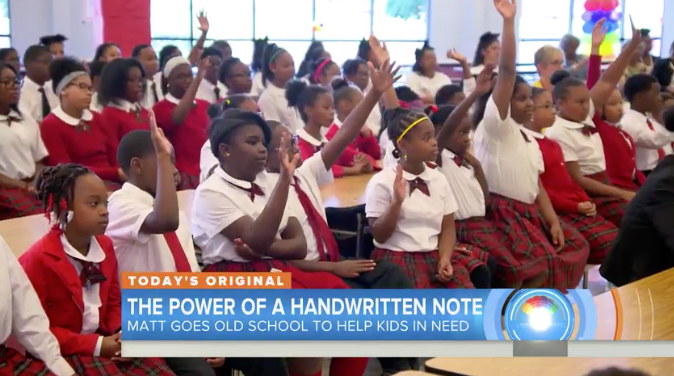
Detroit Edison Academy students

The streets are bordered by broken homes and derelict factory buildings. Homeless denizens still occupy the corners of doorways.

Despite that, there is The Detroit Edison Academy, an elementary school nearby where uniformed children are taking on the challenges of learning and self reliance with optimism.

matt-high-fiving

Matt Lauer cheers on the D-E kids.

Lauer’s gift to the school are the profits derived from Shinola’s sale of his personalized product line.

All part of the comeback process for urban Detroit.

Lauer’s other pursuit is the rebirth of the hand written note.

shianola-watch-production

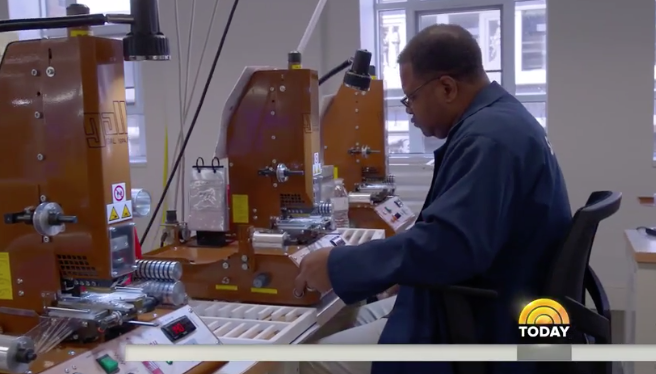
Technician building the Shinola watch

“Everything today is digital. I like to live in an analog world, which takes one back to a time of civility when people took out a piece of paper and a pen to say “thank you.”

matt-lauer-the-shinola-line

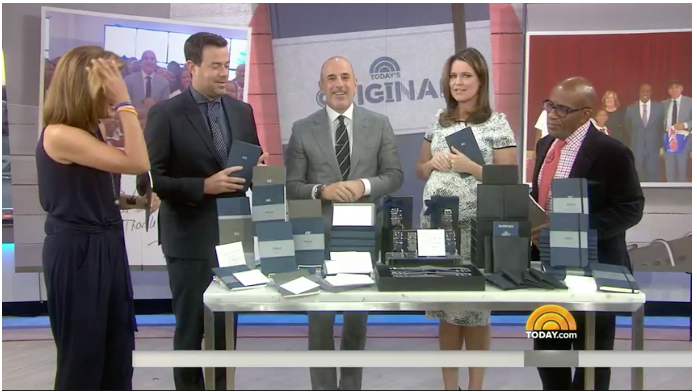
Matt and the Today Show crew viewing his personal line of Shinola journals. Profits go to Detroit Edison Academy.

Shinola’s Detroit product line extends beyond leather and linen covered booklets to precision watches. The combination of the two products appeals to an array of sophisticated and enlightened consumers.

The production lines are the breeding ground for devoted, and motivated workers clad in smocks and dust free head covers.

saying-thanks-to-matt

The D-E students present Matt with their hand written cards of thanks.

Lauer is hooked on the booklets and journals. Clutching one he testifies, “There is the joy of hanging onto something that doesn’t ring, beep, or send you a tone.”

Detroit Edison Academy looks like an oasis in the middle of an urban desert. Its hallways are clean and bright, and teeming with good looking, tidy kids on their way to a better future.

matt-lauer-card

“Let’s never forget the personal touch! Thanks for helping,”

They cheer Matt later for his support, and in a presentation, thank him with a bounty of hand written cards.

Lauer is overcome. “Thank you. This means so much to me. I am one of those believers who still write someone a little note… when was the last time you went to a mail box and found a letter that was addressed to you? Isn’t it a special feeling?


Thanks for sharing!  You can watch this really cool video of Matt’s visit here.

Standard
Culture, Mystery

Shoeless

img_0007

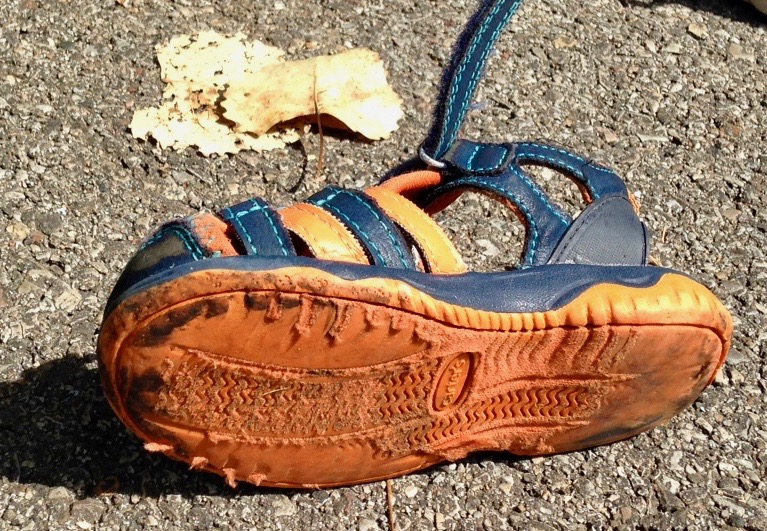
Size 2, left by the roadside.

Late July, as the heat of the summer gets bogged down in humidity from the Gulf, a small child’s shoe appears on the side of the highway by our home.
It resides sole down in the gutter, separated from its partner.

How many times do you see one shoe on the roadside, and wonder how it can be alone? Where is its completing half? You imagine scenarios where the owner opened the door of their car on the roadside to change shoes, pulled off one, and then thinking better of it, closed the door and pulled away half shod.

Miles down the road, or perhaps at the next rest stop, the owner owns up.    They only have one shoe, so dumps the other. Given the choice of using a garbage can or not, they place the shoe on the sidewalk, maybe in the hopes of completing someone else’s broken pair, or more manipulative, to puzzle the casual observer.

Like me.

But back to the blue and orange size 2 sandal. It’s surrounded by gravel and twigs, and passed by approximately 20,000 cars a day.
A half mile up the road, its other half sits in the center lane of the highway.
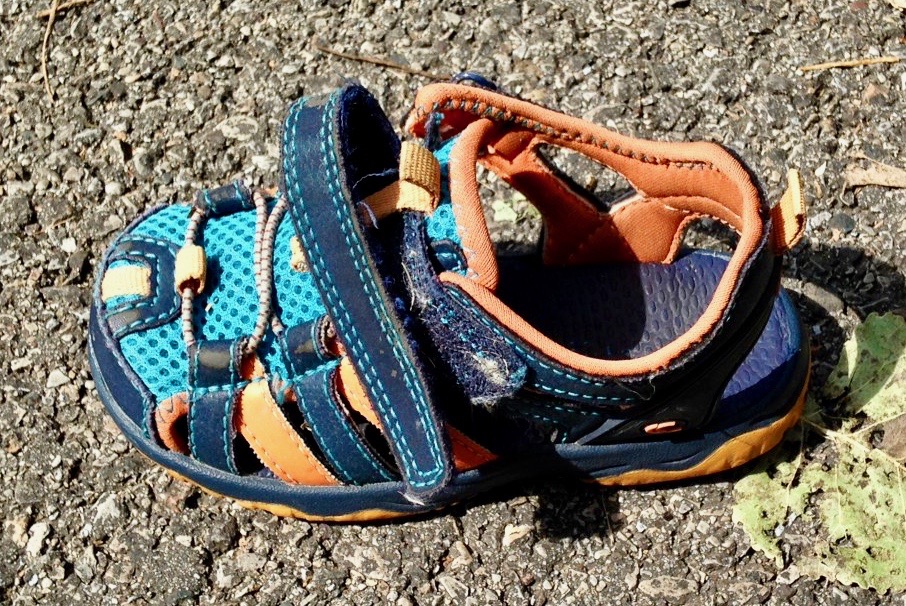
img_0003The story clarifies. This is a pair of children’s summer sandals that departed a speeding car. Northbound, considering the placements.
The most likely explanation is that the shoes never made it beyond the trunk lid, or the roof of the car when the owner’s family left home, or the beach.

I admire their construction: tidy miniaturized engineering, with Velcro for fast escape.

Once in Kauai I had doffed my runners at the beach, and after a dunk in the Pacific walked back to the car barefoot, waiting for the wet sand to fall off my feet. I placed my shoes on top of the car while loading chairs and picnic supplies back into the car. In a moment of moral abandon, I stepped into the driver’s side and decided to drive the one mile trip home, barefoot.
Held up at a bridge along the way, the car behind us honked their horn and pointed to the roof. Doh!!

So it could be that a distracted mom or dad had likewise left the shoes on top of the car, and they blew off along the way.
It’s a tidy explanation.
Another possibility is that the child who was wearing the shoes took them off inside the car, and pitched them out an open window. A little difficult considering the belted seats kids ride in, but still possible.

img_0001

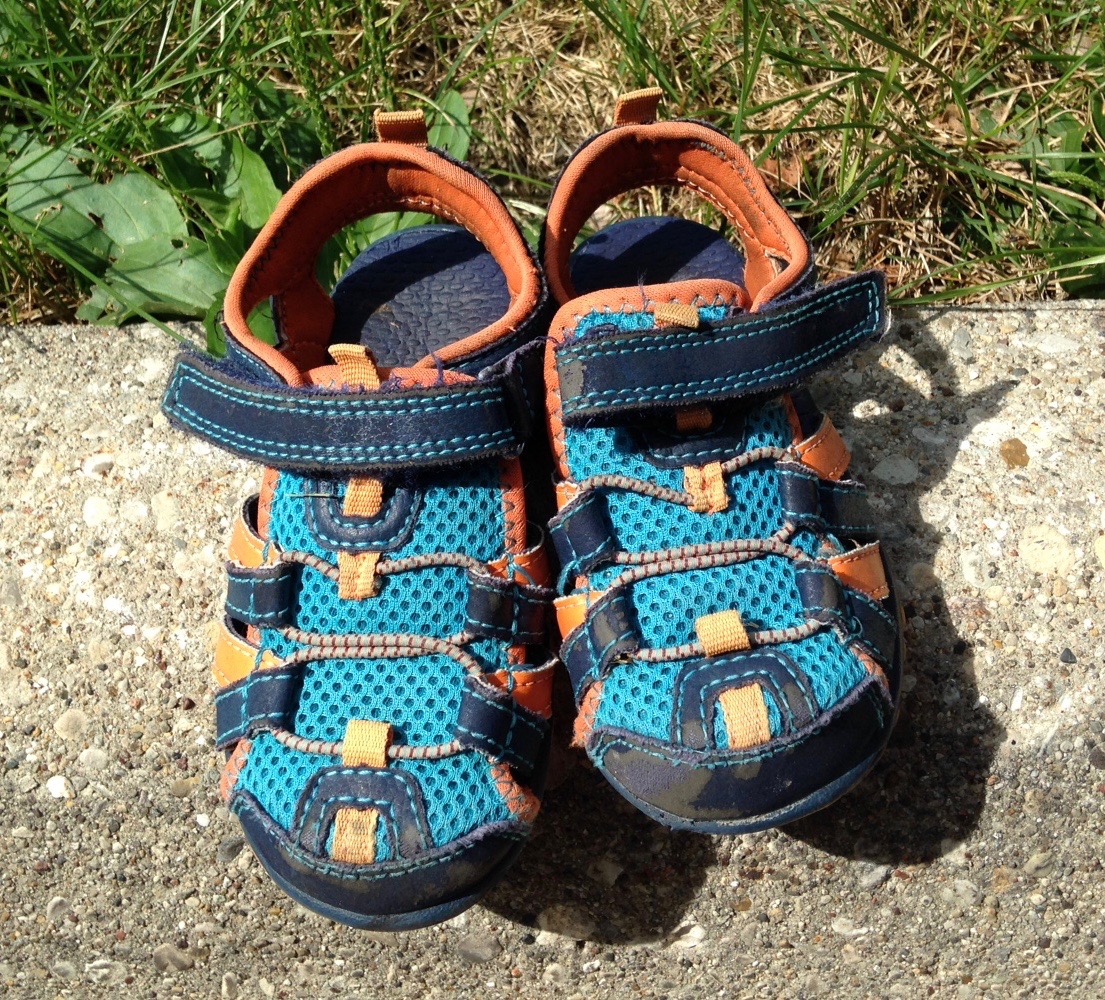
A quite serviceable pair of wheels. Pre-owned.

Then again, it could be that the child’s spiteful sibling removed the shoes and did the deed, in revenge for an earlier insult from the owner. Who knows?

But what remains is the mystery of no recovery.
In our young child-rearing days everything had an accountability for completeness. Count the Jenga before they went back into the can. Check under the couch for errant Lego pieces before packing it away. All the riders in their places on the Fisher Price School bus before it went onto the shelf.

How is it that a mom or dad didn’t wonder about the missing shoes?
Our oldest boy, at the age of 3 had a worn out pair of wing tips that he enjoyed every day. He loved those shoes. If bedtime hadn’t been preceded by a bath, he would have worn those loafers under the covers.

One day we announced that his feet were too big, and he needed new shoes. He absolutely refused to give them up. Stonewalled us, and it was only after I promised that we could keep them that he accepted a new, bigger pair.

He loved those old shoes so much we elected to plant them in the garden. A little fatherly humor: I said, “we’ll just heel them in here, and we’ll grow a shoe tree.”

img_0129

Small, plump little dusty feet once wore these.

Went right over his head.

But the lesson remains, that small children become attached to shoes as keepsakes, and it puzzled me that no parent had come back to retrieve the shoes.
After all, there they were, a half mile apart on the same road. What would it take to stop?
Realistically, it isn’t safe to stop, so perhaps the parent, one of the 20,000 which pass by everyday closed their eyes to the daily reminder that their child’s clothing was lying there in full view, and they were powerless to change it.

August passed by, and just before Labor Day my obsession with the separated pair overwhelmed me. Riding my bike down to shoe #1, I picked it up when there was a pause in traffic.
The shoe was in pretty good shape. Maybe a little worn on the bottom.  Heavy duty blue nylon webbing on a da-glo orange rubber sole. It was tethered by a Velcro tab. At the time I flashed back to long ago, and imagined a tanned, slightly dusty, fat little foot occupying such a sandal.

Next I pedaled back to its mate about three blocks away. That one was resting on the yellow striped line of the middle lane, also in clear view of 20,000 motorists through July and August.
Now I had a pair of child’s sandals. Presentable condition, hardly used.
My thought was to place the two together on the curb. Perhaps then the owner could recognize the gesture of a stranger, and stop to pick them up, joyfully reuniting the shoes with their owner after a two month loss.

img_0127

Cast aside in fun, or forgotten?

Instead of the curb however, I hung them on a nail in our fence. A few yards beyond was a cut out in the road where a car could exit, and stop safely. A quick jog to the fence, and the shoes would be in the car again, the starting point of their summer time escape.

Since Labor Day, by rough estimate, 1,000,000 cars have passed the shoes. No one has stopped to bring them home.
I wonder, daily, why not?

My best hope is that the original trip was unique. That car and its young passengers have never chosen the same route since. My next best guess is that the owner has driven by and weighing the effort of retrieval against the usefulness of a pair of summer sandals in October has resolved to abandon the pair.
My thoughts don’t want to venture a third possibility.

What I have decided is that before the snow flies, I will take down the shoes from their nail, and give them to the local shelter. They will be worn again, hopefully by someone who will cherish them for their comfort and character.  They’ve been on the road.

Thanks for reading and sharing!  This pair of shoes has been on my mind for months.

Standard
direct mail, Marketing

The Roots of Customer Loyalty

Version 5

A 100-year-old brand backed by its owner.

We all have brand imprints that are part of our core. Coke, Kellogg, General Electric, Disney — these are trusted, bedrock brands we’ve known since birth.  The most valuable brands today would be Apple, Google, Facebook–but not necessarily the most trusted, yet.

Then, there are those brands which court obscurity.  Names like Zenith, Woolworths, IGA, Rexall…all in their time were once powerhouses.

haband-252-1

A conventional envelope kit with 50 inserts, weighing in at only 3.2 ounces… a postal bargain.

So how is it that a company called Haband has 5,000,000 customers?

I wondered this puzzle when I received their mailing last week.  Haband is a mailorder merchandiser founded in 1915 by two gentlemen: M. Habernickel and John Anderson.  They sold ties to bankers in Manhattan.

Talk about product selection! Who wears ties today?

haband-262

Clothing and footwear replace the original Haband product line: neck ties for bankers.

From their early beginnings the Haband brand grew to offer general merchandise, mostly, but not limited to, clothing.

Their style choices are not for everyone, and you would be right to suggest that your parents and grand parents would be more likely targets.  Put another way, getting a Haband mailing is like getting an AARP mailing, only much later.

The secret to Haband’s success is the core… the essence of direct mail.  A champion writes a letter to a customer, providing personal assurance about the desirability of a product.

Version 4

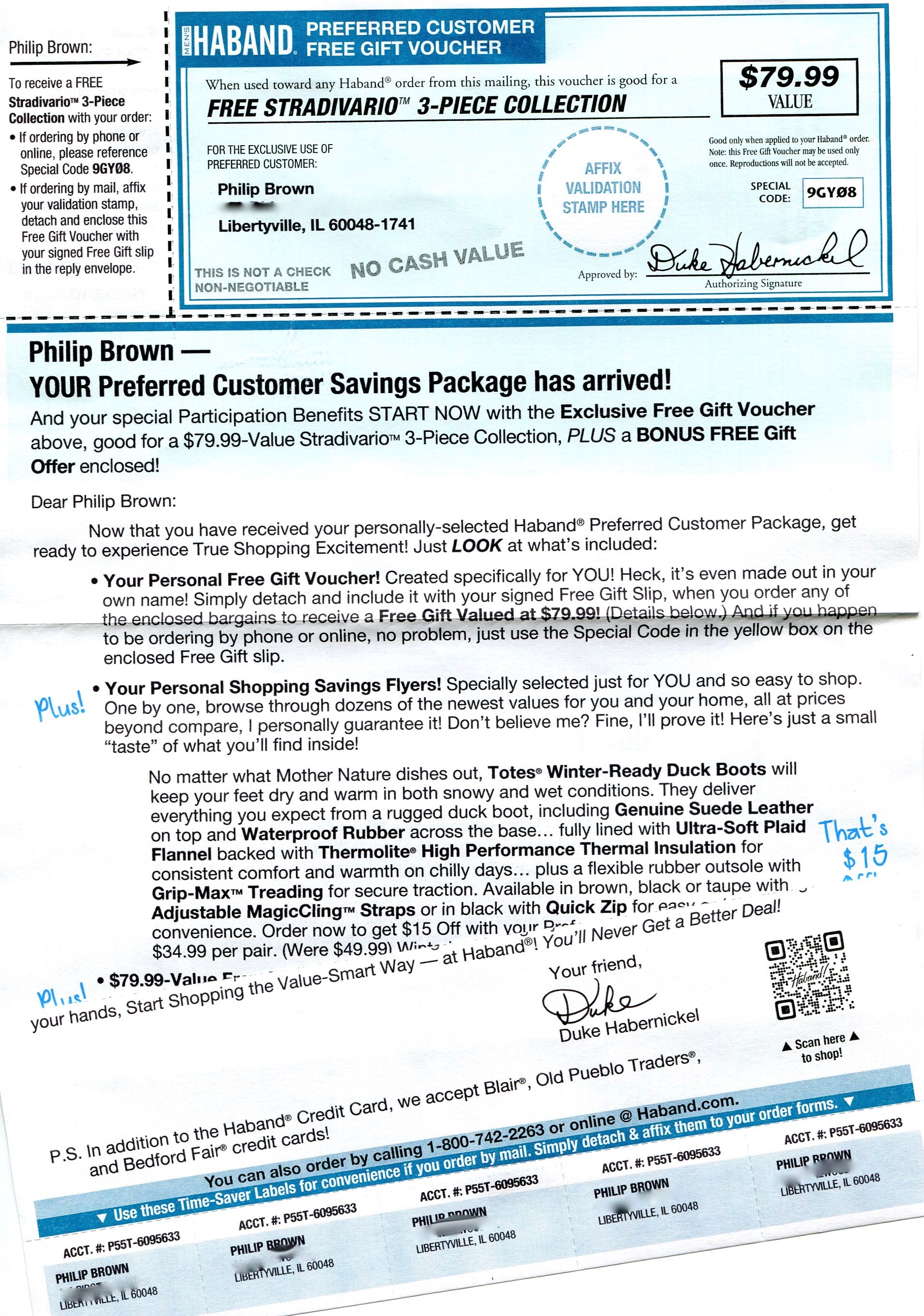
The letter is central to the offer, and in this case, Duke’s guarantee of satisfaction.

Duke Habernickel is, I am guessing, the son or grandson of the fabled company’s co-founder.

The products in question range from duck boots to space heaters, from fleece pants to “ForeverSharp” razors.  The broad selection is what I might have found in my late parents’ closets when we moved them into more modest and permanent surroundings.

haband-258

Free gifts: knife, watch and pen. Suitable for any Haband customer!

But when it comes to direct marketing, what sells, and what doesn’t sell is more than personal taste.  I have learned that my opinion does not count.

This is a platinum rule, maybe even titanium.  Put another way, just because I wouldn’t buy it doesn’t mean that no one else will buy it.

Au contraire!

Haband is successful because it knows its customer very well, and the customer has a reciprocal expectation and trust in Haband.  Thus, Duke Habernickel signs his name to a letter introducing no less than 46 items for purchase, plus another 3 free gift items to sweeten the deal.

The Haband mailing piece is itself unusual in today’s environment.   With so many products you may have expected a catalog.

Instead, it is a low-color, 6 x 10 envelope stuffed with 47 individual sell sheets, plus letter and reply envelope.

haband-264

The kit delivers 47 product sell sheets, from shoes to sharpeners.

The two-sided, 4-color sell sheets each contain the entire deal, embroidered with enthusiastic sell copy, and anchored with individual order form.  They are printed on the lightest coated paper stock available.

While you may question the flimsy medium, Haband gets the 47-piece job done in just under 3.3 ounces, thereby capturing the lowest possible postage rate.  By the square inch, each product has a digest-sized page of display.  Pretty smart.

Duke’s letter is verbose, jumbled, effervescent, and personable.  It is traditional, and lacks the slickness of general agency creative.  The copy is laced with 28 “you’s and your’s” in addition to 8 personal references by name.  More significant however are 7 “me’s, I’s and my’s” illustrating Duke Habernickel’s personal investment in the relationship.

Version 2

It would be a challenge for many marketers to claim being “your friend”, but that’s what counts for Haband customers.

For some, the effect may be unctuous, but if you are a Haband customer, you are Duke’s customer, and comfortable with it.  The personal touch is expected and welcomed.

The roots of customer loyalty are founded in matching customer expectations, tone and manner.  Whoever, and wherever those 5,000,000 buyers may be, they will not be discounted as strangers at Haband.


Thanks for reading! I believe this is the first Haband piece I have ever received.  I must ask serious questions about what demographic group I have now joined.


Standard
Culture, Sports, Wildlife

Paddles Keen And Bright

We have a fleet of canoes.  It was never planned that way, but nevertheless, fate, good fortune and the wish of one man made us canoe mavens.

Freight Canoe Honda

A typical sight along the summer roads of Ontario.

Just last week our son rescued one from the shaky rafters of a rustic, ancient boathouse on a lake in eastern Ontario.

The craft in question is a Chestnut brand Prospector with v-stern. It is a super-wide 16 feet feet long, and has a transom that could host a 3hp outboard if required.

IMG_0011

The Chestnut Prospector known as “Pickle” by our grandchildren.

Our grandchildren call it the Pickle, because it’s green. The Pickle is the last of three canoes which my late father-in-law bestowed upon his three daughters, fulfilling a wish that spanned over half a century.

Chestnut Canoes were an iconic boat company headquartered in Fredericton, New Brunswick.  It went under in 1979, victim of changing tastes.

1982 Canoe421

1983– Mabel’s Tremblay loaded down with our young family.

The class of canoe is cedar-canvas. That is, a cedar rib and plank hull, over which canvas is stretched and bound into place. You will find modern canoes made out of fiber glass, and the truly exotic craft are made from pure cedar strip.  Last summer we lifted a carbon-fiber canoe with two fingers.   It weighed 14 pounds.
In the heyday of cedar-canvas canoes, it was common that most cottages in eastern Canada had a canoe, or were in sight of one off their front dock.

2015 243

Camp was our training ground, and today it commissions at least one war canoe, seen above in their brochure.

Truly a Canadian legacy, the canoe today is still seen on the tops of vacationers’ cars speeding along the highways all summer long. But more often, you will see kayaks.  Hard fiberglass, ultra light, in hues of red and yellow.

When not on the road, or in the water, canoes are habitually found in the rafters of boathouses and garages, nation-wide. Which is where we have two, right now.

The Big Idea

1996 235

1996–Our boys ponder a launch of our Pal Chestnut off the front point of the cottage.

Tom Hamilton is my wife’s Dad, and from the time of his youth he had been an outdoorsman. Very much into camping and fishing, Tom enjoyed no greater release than to glide among the ripples of a quiet northern lake, trolling a lure in search of a hit from a bass or muskie. If he couldn’t experience that first hand, he was intent on passing the thrill along to his daughters.

So they went to camp.

1950 Hamilton702 copy

1950– Tom took his team to camp to build cabins. Here they are arriving in “Tough”, a war canoe.

The YMCA summer camp of our youth was built by service groups, in one of which Tom was a member. After WWII, he spent springs and summers cobbling together cabins, docks and dining hall for generations to enjoy.

The waterfront was well stocked with Chestnut canoes, donated by wealthy benefactors.

The skills regimen at our camp focused on canoeing and out-tripping. The requisites were quite firm for campers to canoe and out-trip.

1989 237

1989– Tom with his grandson and friend paddling the Grand River in his Pal, “Hochelaga”.

IMG_1099

2016– Tom’s Hochelaga now carries three great grandchildren on the Bruce Peninsula.

We graduated from Tenderfoot to Tribesman, Brave, Chieftain, and Chieftain Expert. A fully-fledged canoeist was eligible for out-tripping when they had mastered bow, stern, portage and solo.

The strength test was to hoist a canoe onto one’s shoulders, unassisted, and portage it about a quarter mile. The canoe weighed around 80 pounds, which doesn’t sound like much until you are swinging it over your head in one move.  The ultimate test was to paddle a “Figure 8” without changing sides.

1989 238

The beauty of river canoeing is to enjoy sights unseen from the highway. Grand River, Ontario.

This was the environment Tom treasured, we were raised in, and not surprisingly, it generated tremendous self confidence and pride. The dividend was paddling these sleek, quiet craft on waters through valleys of forest and granite, easily gliding up to wildlife unaware at any bend in the shoreline.

Among Tom’s three daughters, we have 5 cedar-canvas canoes.

2003 245

2001–Mabel’s Tremblay under total rebuild. The red paint bled through an earlier canvas.

When he retired in 1985, Tom searched classified ads, read marina bulletin boards, and probably pestered a few motorists who were transporting a canoe, and eventually acquired three beauties.

They are all in Ontario. Mary’s Chestnut (a Pal model) canoe resides in a bay by her cottage on the Bruce Peninsula.   Bonney’s Langford is beside the Mississippi River in Pakenham, and Jane’s Prospector “Pickle” is just returning from a week on Silent Lake.

Many years before Tom hatched his acquisition plans, I had a well-travelled canoe given to me by a veteran cottager on our lake. Her name was Mabel Stearns. Her canoe was made in eastern Canada, around 1951.   I think it is a Tremblay.

2003 244

2003– Mabel, all spiffed up, trim and pretty.

It looked pretty rough. Coated in layers of chunky blue and green paint, it had dirty brown, peeling varnish coating its ribs and gunwales, and a hole in its bow, attributed to a fast speeding bullet.

Like most older canoes that live outdoors, its decks were crumbling and rotted from years of storage on the ground.

IMG_8482

Bonney’s Langford among the rushes in Pakenham, Ontario.

We were nevertheless thrilled to have the canoe, and that fall we put on a new canvas, reinforced the bow and stern stems, and painted it red. Not a professional job, but sufficient for the time being.

A couple years after that, in 1981, Tom found a red Chestnut Pal looking for a new owner, and convinced me to buy it from a childhood friend of his for $100.  For me, that was considerable, but at the time, a Pal retailed for $800 or more. This canoe was also broken, and I forthwith re-canvassed it, and painted it yellow.

The reconditioned canoes went to our cottage and traded places a couple of times when a more serious attempt was made to give them a worthy overhaul.

IMG_3657

2015– My $100 Pal after a major overhaul, complete with mahogany gunwales.

Ultimately, we sold our cottage, which is a not uncommon phenomenon in Ontario where tax law makes inheritance of family cottages a costly consideration.

While we enjoyed the convenience of the cottage’s stable location, we now appreciate the canoe for its portability to other lakes and rivers.

IMG_6259

2016– Tom takes his place on the Chestnut.

As a result, the Pickle has visited Silent Lake and awaits its next trip, now likely next year.  Mean time it rests dry in storage outside Toronto.

And our $100 Chestnut has been on numerous lakes and rivers before taking up residence behind our house.   Mabel hangs from the garage ceiling, waiting for her next outing.

For me, the pleasure in all of this has been the fulfillment of Tom’s wish, that the canoe stays front and center in our family.

It has done that, and more so.


Thanks for sharing our canoe story!  “Paddles Keen And Bright” is lifted from a Canadian canoeing song, written by Margaret Embers McGee.  The song is sung as a round, a supposed assist for paddlers.

My paddle’s keen and bright, 
Flashing like silver,
Follow the wild goose flight, 
Dip, dip and swing.

Standard
direct mail, Marketing

Walgreens Rolls Up Your Sleeve

Walgreens 227

This may be the best traffic builder ever.

This week we received a notice from Walgreens (at the corner of happy and healthy). It’s only August, but they are now targeting my left arm for a flu shot.

This is the painless inoculation that fends off the swarms of flu virus planned to put me in bed next February.

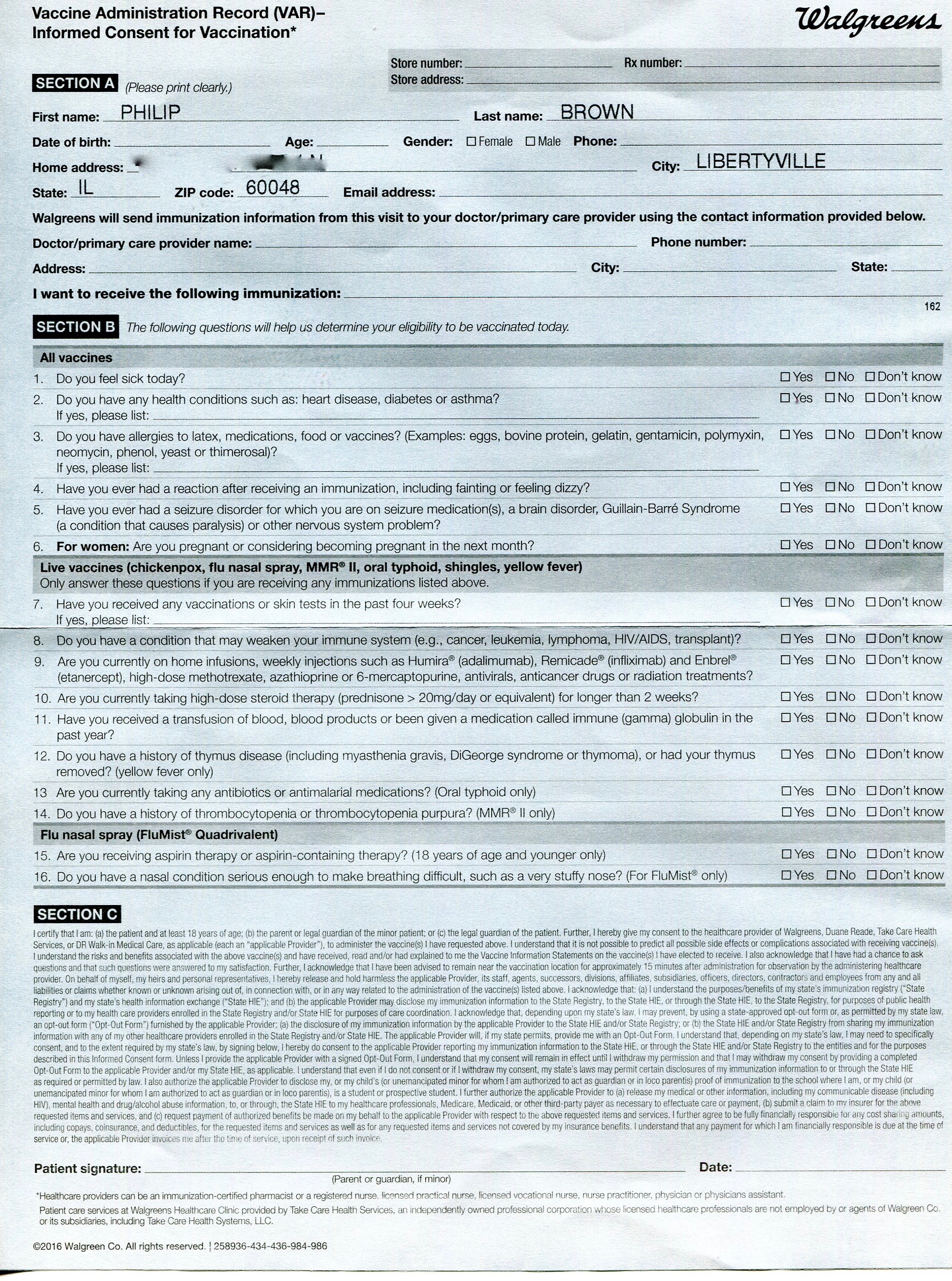
What is not painless, and what Walgreens has figured out, is the paperwork. The mailer includes the consent form that normally we fill out at the scene.

The pocket encloses the nefarious consent form we normally fill out beside the ointments display.

The pocket encloses the nefarious consent form we normally fill out beside the ointments display.

Kudos to the marketer at this famed drug chain who saw the chance to streamline the process, save a few minutes, boost traffic, and promote sales all at the same time.

Truly, the flu shot appointment is drudgery. Who wants to sit behind a curtain in a tiny corner getting stabbed? Who wants to fill out a two-sided form on a clip board, standing beside the first aid display?

Walgreens provides the form, by mail. Bring it in, and –poink– you’re ready for the needle. The only question to answer, “Which arm?”

This annual campaign is one of the easiest to master, and I am surprised more drug chains don’t use it. Selecting a list targeted at seniors is easier than falling asleep in front of the TV.

The creation of the package is simple: envelope and form. In this case, the programmers could have stepped up, and matched our street address to the closest Walgreens store, included its address and a map, but they didn’t.

Walgreens 230 (1)

The consent form is personalized. Walgreens could have included store# and address without much fuss.

They could have also matched our rewards account and popped a little note in the kit to personalize the event, but bedside manners may not be first and foremost in their minds.

Costwise, the investment is 45 cents a piece. With a response rate of 30%, the cost per visit is $1.50 ($0.45/30% = $1.50). Given that most retail traffic builders pull far less response, and usually offer discounts on top of that, this promotion is a winner hands down.

Walgreens gets the flushot revenue from Medicare, plus an in-person visit from a retail customer.

Walgreens 233 copy

Surprisingly, the incentive is buried here: a $2,000,000 donation to the U.N., and an important deadline. Shoulda-woulda-coulda!

Passing The Zig Ziglar Test
This is a moment to validate the Walgreens mailer according to the late sales counsellor Zig Ziglar’s test for sales viability.

He posited, quite astutely, that there were five road blocks to making a sale. The Walgreens promotion knocks down each of these objections:

1. No Need– The target list is to 65-year-olds, prime flu victims
2. No Desire– Walgreens streamlines the paperwork, and further offers a donation to the United Nations Foundation for every inoculation
3. No Money– Virtually free: costs are covered by Medicare and most health insurance
4. No Rush– The offer does have a deadline for eligible donations, but Walgreens could have pushed this harder. See the fine print.
5. No Trust– Hey, this Walgreens–America’s favorite drug store!

Overall, with a few tweaks, a great, timely promotion.

I’ll look for the bottom line next February.

Standard
Culture, Entertainment, Music

Hall, Oates, And A Soundtrack That Won’t Quit

Hall& Oates

The kids in leather, and launched.

We missed Hall & Oates the first time around, but 40 years later they paid us back with a superb performance in Toronto in June.

Years ago, the music of this creative duo crept into our consciousness with Blue Room’s rendition of “Every Time You Go Away” in Planes, Trains and Automobiles.

Little did I fathom at the time that he had covered this wistful piece from one of the truly great composing partnerships of the 70s and 80s.

IMG_1157

The tiny Apple Nano: 1200 songs in a Saltine.

Still unaware of Hall & Oates, I next captured “One On One” on my Apple Nano about 4 years ago.

Buying the Nano was an awakening long overdue.  I was looking for a storage device to hold some music that I was collecting: a couple lost decades of 70s-80s Pop melodies that I had shunned during my Folk and Classic Country years.

One day I was in Best Buy when I asked a helper,

“How many songs can I get on this little Nano?”   It was about the same size as a Saltine cracker, but sturdier.  Its black crystal hinted at deep, magical powers.

She answered, “About 1200.”

I laughed, “I don’t know 1200 songs!”

Four years later we have 957 cuts on the Nano, which include about twelve from our happiest discovery: Hall & Oates.

That evolved when I was given a publicity CD at a Direct Marketing Association trade show.  ULine, a container company–you know, “boxes”— somehow concluded that a free CD of 15 H&O cuts in a ULine-branded sleeve was a good giveaway item to promote itself to mail order companies.

H&O_5571

The Molson Amphitheater on a warm evening by the lake.

Not knowing who Hall & Oates were, I stuffed the CD into a drawer and didn’t retrieve it for a year or so.  One day I popped it into a player, and heard the iconic “Out of Touch” composed by John Oates.

My wife perked up when she heard “Kiss On My List”,

“I love that song!  Who is this?”

“It’s Hall & Oates.  You know them?”

“Nope, but I love this song.  What else is on the CD?”

With that we rolled through their top hits repertoire, and pinched ourselves several times as we knew these songs, but had never connected the composers.

IMG_5567

An enthused Hall & Oates fan arrives early.

The upshot is twofold.   First, we needed to get to a Hall & Oates concert.  Second, we now recognized ULine as a brand of… boxes.  That learning process took about 5 years, but I hope some advertising manager somewhere is having a small vindicating shiver, a frisson, right now, much to their puzzlement.

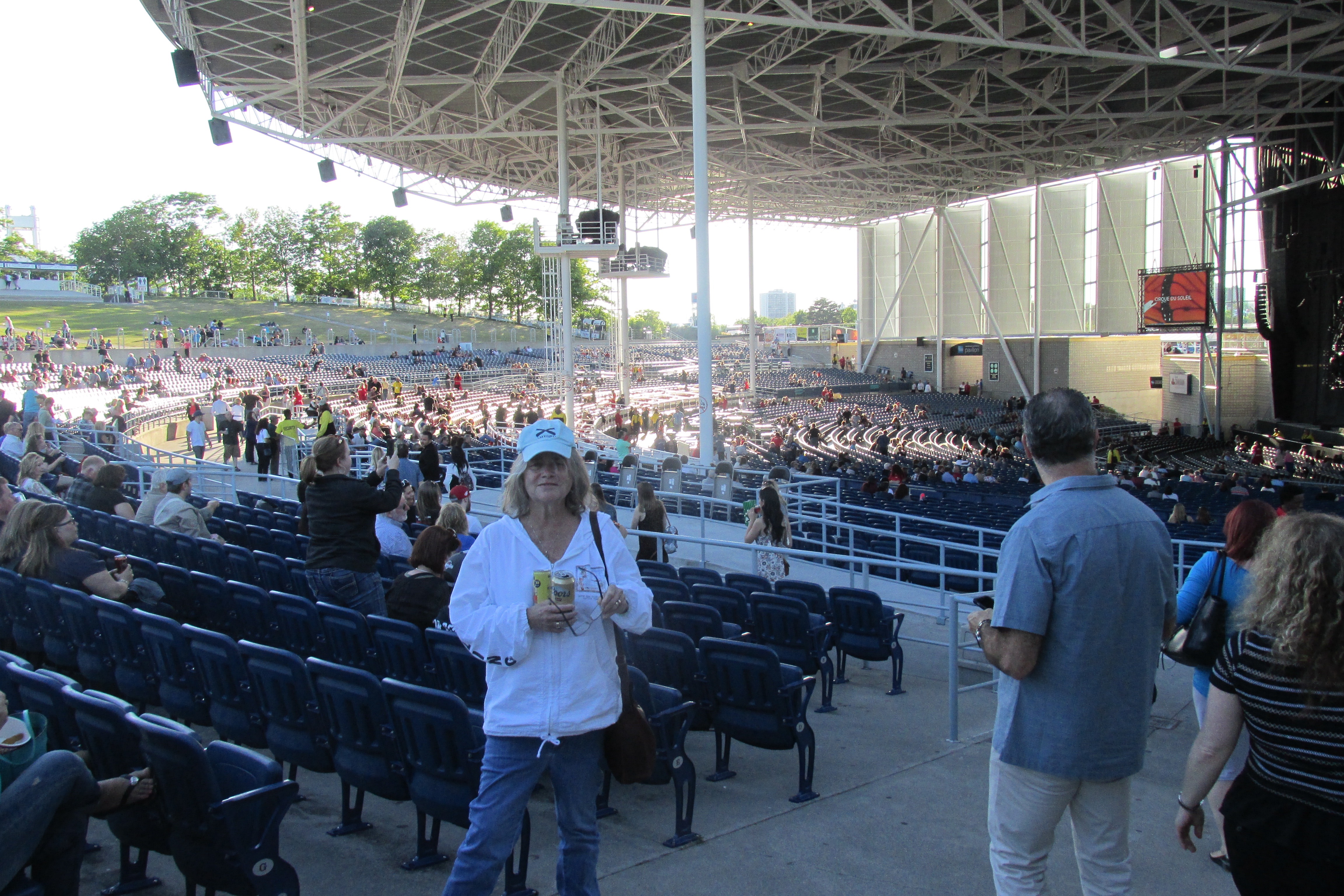
—Which brought us to the Molson Amphitheater on the waterfront of Toronto, looking out on Lake Ontario.

H&O_5580

Daryl Hall lights up on Man Eater.

This open air concert venue seats about 5,000 under the roof, and another 1,500 or so up on the lawn.   On a warm summer evening, with a cooling humid breeze coming off the lake, one can’t find a better place to enjoy a live concert.

There are auditoriums and arenas for McCartney, The Stones and Bruno Mars, but you are one of 60,000 fans holding your ears.  Instead, the Molson Amphitheater is the happiest compromise of a concert crowd and intimacy rolled into one.

The ticket prices are good, and there is no more politely enthused and amicable concert fan than a Canadian.   Every performance we have attended at the Amphitheater evokes a heartfelt thank you from the performers about how welcome, and safe, they feel in Toronto.

Wow!  It must be pretty tough everywhere else.

H&O_5584

Oates is the Yin in this timeless duo.

Our mental image of Hall & Oates is locked in the 70s.  A couple young guys, with hair and rugged good looks.  Up close today, on the jumbotron, it’s 40 years later.  But the genes still hold their ground.

Even better, so does their music.

Predictably, they opened with Maneater, a solid up tempo number that had the audience on its feet in an instant.  What followed was a succession of hits from the 70s: Sarah Smile, She’s Gone, It’s A Laugh, Kiss On My List.

IMG_5636

A friendly Toronto on Lake Ontario

Somewhere half way through their performance Daryl Hall hung up his guitar and went to the keyboard, which was a delight.  The camera focused on his hands pounding these hypnotic chords for 8, 12, 16 bars, typical of their best songs where the lyrics open only after the background music is solidly in place.

Hall’s voice has great range.  It’s remarkably soulful up on the high notes, and he is completely unchained in front of 5,000 fans, delivering melody and passion.  Meanwhile, he works the keyboard with complex chords, lots of 8-fingered flats and sharps, in minor and major…a true believer of “black keys matter”.

IMG_5576

Their music is complex, melodic, and memorable.

John Oates is the journeyman guitarist.  He switches between several during the night, and works up and down the neck effortlessly.   Strutting across the stage he occasionally sides up to Hall, which is the only time you see the physical Yin/Yang of these two: Oates the significant counterbalance to the tall and blonde Hall.

There is a third component to the Hall & Oates sound and that is the roving saxophone of Charles DeChant.  This ponytailed magician nuances every tune with mellow contemplation.   His signature delivery is an extended solo in “I Can’t Go For That, No Can Do” which really stretches the boundaries of contemplation to hard core introspection.  Too long for my taste, but for many, right on.

IMG_5585

The group returns for two ovations. We can’t get enough.

The team comes out for two ovations, after prolonged applause.  They close with Private Eyes and then back again with Rich Girl, which by then has the audience screaming for more.

But no more, they bid good night.

The genius of this pair is their melodic creativity.   It is complex music: hard to dance to I think, but easily remembered, expansive tunes that you can hum  long after the hall goes silent.

Indeed, the tunes play over and over, inside my head.  After walking 9 holes of golf I have re-sung Private Eyes a hundred times without thinking.

Unfortunately, I can also wake up at 3am, and still have the soundtrack bouncing along, varied, hypnotic, and without cease.


Thanks for reading!   If you are an H&O fan, you will find their tour dates here.


Standard
direct mail, Marketing

PCH and The Hard Truth About Pressure Sensitive

Yesterday we bought a sheet of stamps at our post office, and the smiling attendant cautioned me, “Those should only go on envelopes!”

“Sure..like I might put them on the fridge maybe?”

He responded, “Exactly. A lady came in last week complaining she bought set of stamps, and when she couldn’t find them, said they had all ended up on the bathroom mirror.”

Clear evidence of a youngster in the house.

That is the happy truth of stickers. “Pressure sensitive” if you are in the business.   We love to peel them and stick them.

IMG_6043

Stickers!

A few years ago at a “Bring Your Kid To Work” class we took great enjoyment in explaining how direct mail packaging worked. I gave a swarming group of ten-somethings a bunch of fundraising mail.

“Open it up, and look for the stickers, guys!”

While I was fumbling through the kit, I dropped the contents on the floor under the table. Down I went after them. After picking the pieces up, I re-emerged from below to find that every smiling face in the room was covered in address labels and Post-its.

Is there anything more attractive in paper than glue?

PCH 2016-07 205 copy

The shiny poly label attracts the eyes, and the fingers, just to touch…

Just for starters, the direct mail kit that succeeds is the one with the best offer, hands down.  The trick is getting you to see, read and adsorb that offer before the envelope hits the can.  Stickers are the slippery slope to cognition in direct mail.

Publishers Clearinghouse masters the technique, and here’s how they have excelled at the game.

PCH 2016-07 211

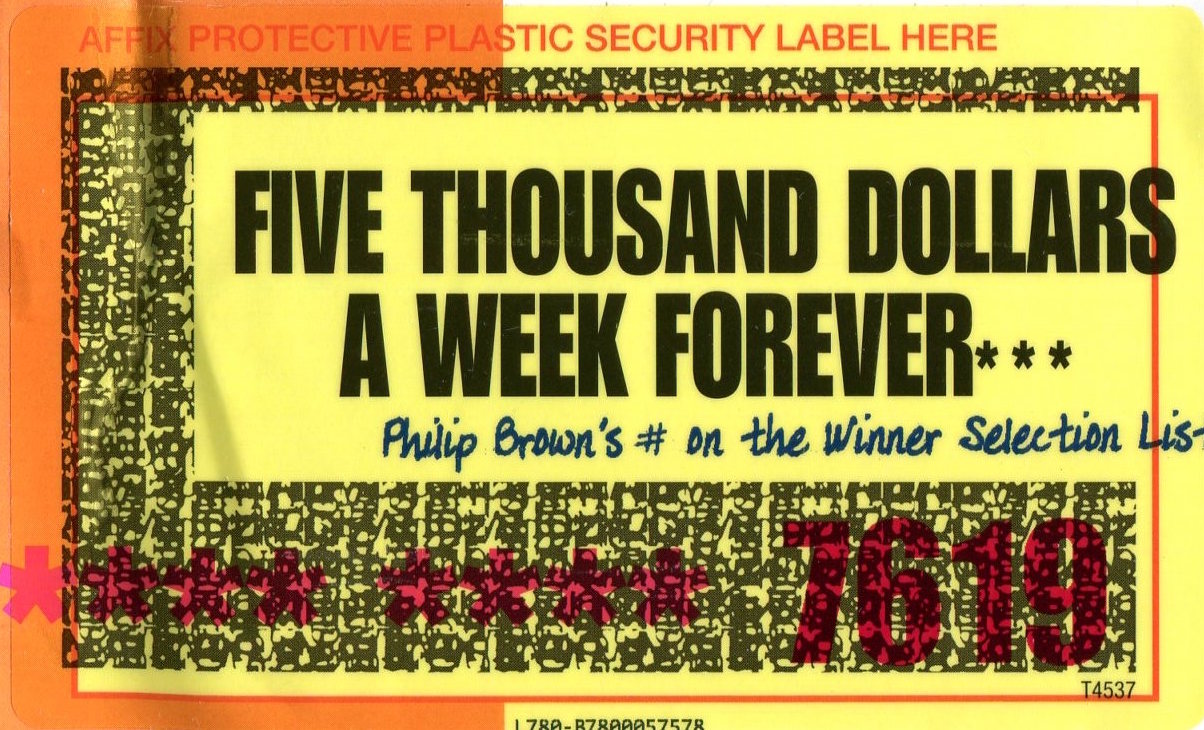
This laminated sheet has two labels which must be peeled and placed on the order form.

Last week we received PCH’s latest deal, a 6 x 10 envelope announcing $5,000 a week for life to a lucky winner.  Can you believe that?

Actually, yes.  A 3% annuity on $6 million will do it, and PCH’s line up of advertisers will support that.

PCH 2016-07 206 copy

A stark wake up call: blunt and unapologetic.

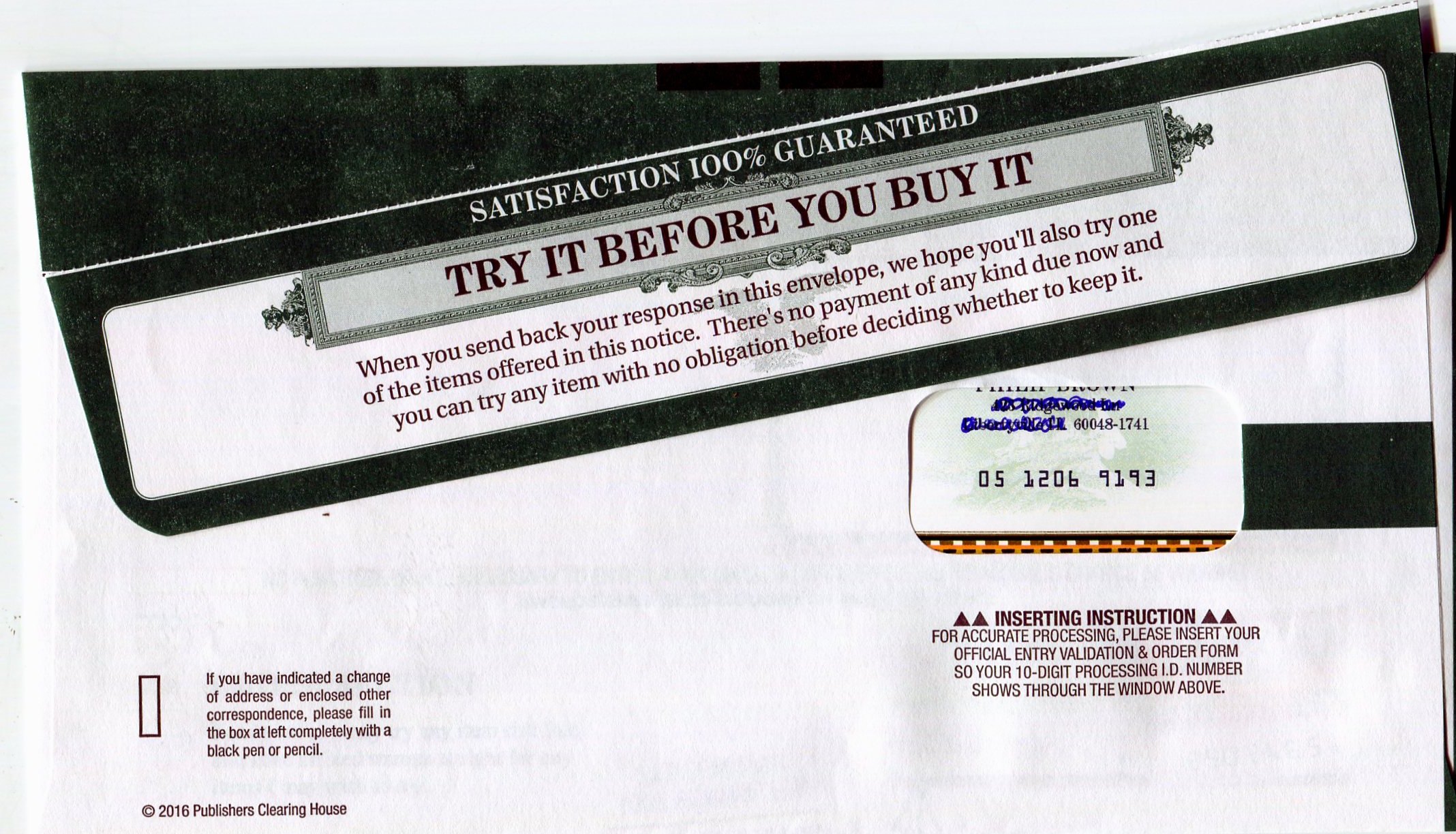
The format lessons of PCH are worthy of attention though.  Their outer envelope sports a permanent, shiny poly label alerting a likely agent at the lettershop where to place it.   The label also alerts me that I am on the winner selection list.

I know, I know, me and 10 million of my demographic peers.  But still, we believe what we want to believe and we hear what we want to hear.

The point is, the label adds zero value to the offer, but its glossiness rivets my greed gene.   So I have to give pause for the $5,000 weekly stipend’s impact to sink in on my heretofore ascetic life.

PCH 2016-07 208

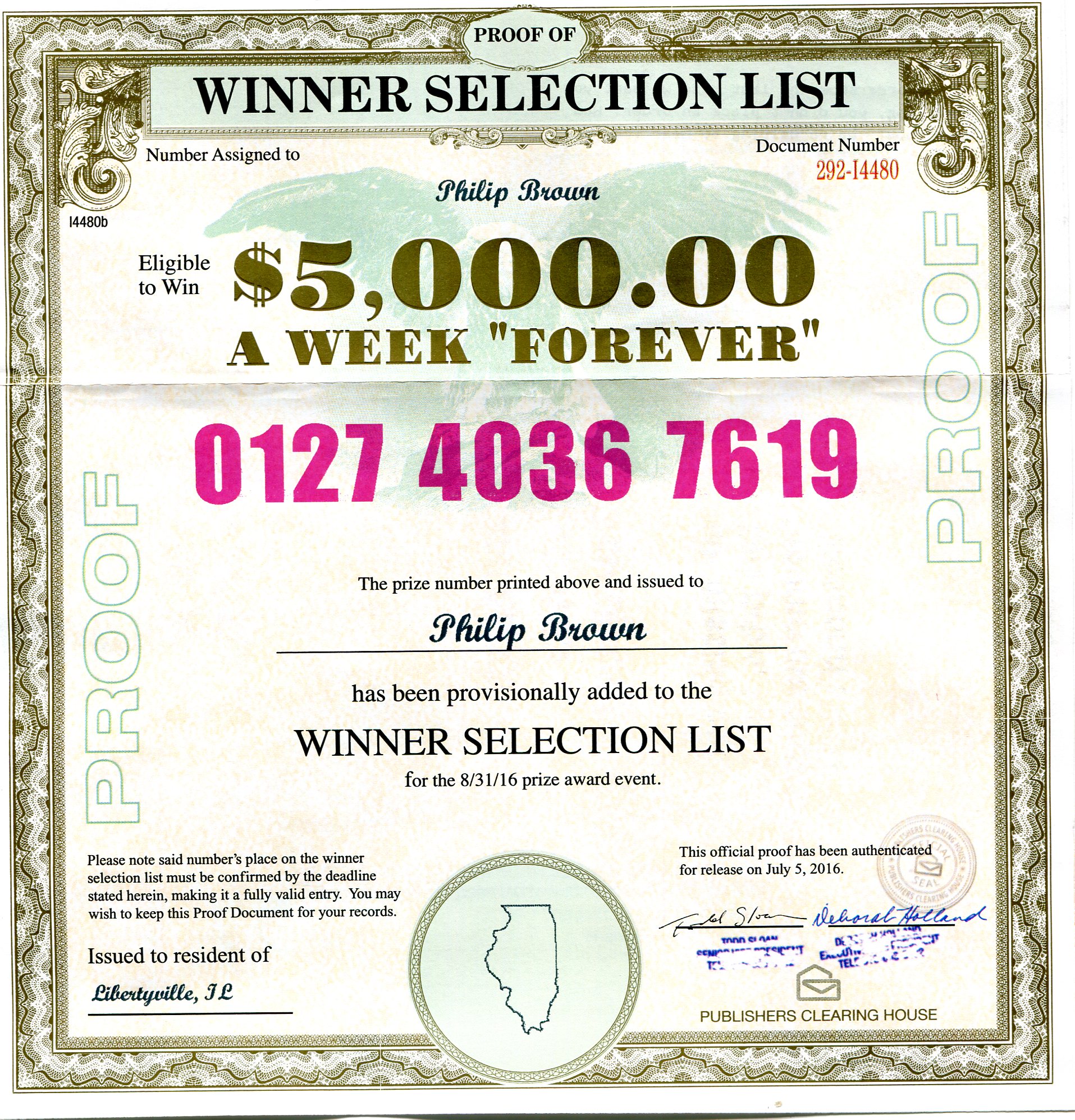
The official document, suitable for framing.

On the back of the envelope is a long forgotten typeface that graced impact printers thirty years ago.  8-pt. type, sans serif, calling me out.  Two phrases bring a momentary, primal galvanic response to my system: “you have ignored” and “your number will be dropped”.

The former kinda sounds like a warning, a scolding.  The latter, sounds bad, like maybe, I am going to be fired.  Yikes!

About now you may be thinking of PCH’s checkered past and all those dubious sweepstakes hypes they thrust on your grandad.  Let it pass.  That PCH came to heel back in the year 2000, and paid their debt to society.   Chastened, they pay homage to the rules.

PCH 2016-07 212

Not as impactful as a biohazard warning label, but reminiscent.

The second point of all that is that the PCH writers know how to wake us up.  Just a couple phrases, and I am motivated.   I open the kit.

Inside is a lot of paper.   Lots of brochures with lots of merchandise, including magazines.   Remember magazines?   Of course you do, and alongside those are some of the most fascinating merchandise items that only last week you saw on cable TV.

PCH 2016-07 213

The meat of the matter: this jumble of brochures is the workhorse in the kit.

Point three: there is an uninformed voice out there that believes neatness and brevity is the soul of direct mail design.  This voice belongs to millennials and general ad agency creatives.   Good direct mail that works leans toward messy, and hodge podge.  That’s why it’s called what it’s called.   But it works.

The key working tools in this kit however are just being revealed amid the clutter: a scratch off game, and even better, a bingo game with stickers.

PCH 2016-07 219

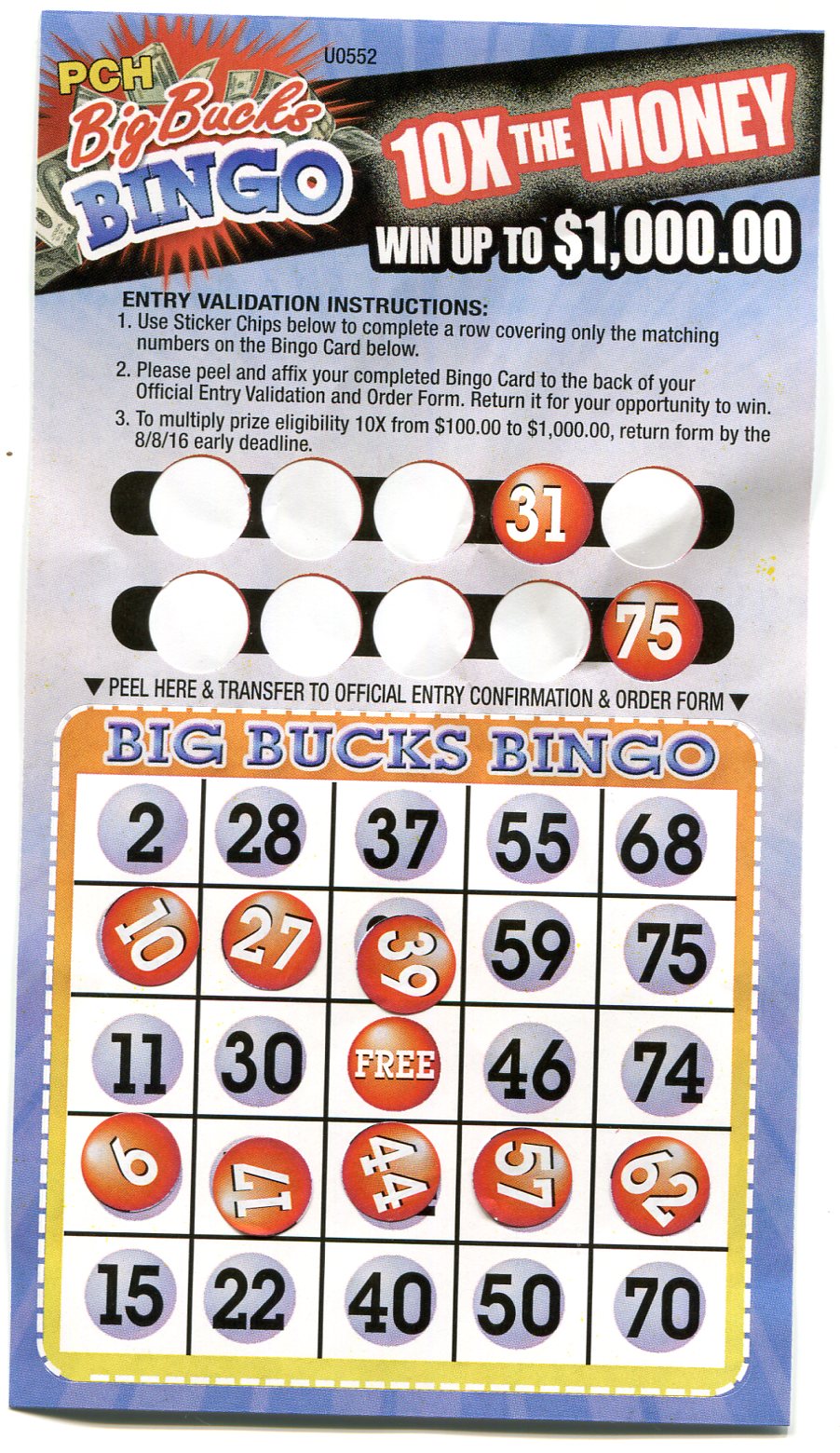
There was no doubt the bingo would be a winner, but the labels beg to be placed, regardless.

Would you be surprised to learn that the scratch off game turns out to work in your favor?  The numbers revealed all match…YES!!   And the bingo card, well, those numbers come together after nine squares are covered.  WOW!!

You wouldn’t be surprised, because you knew they were going to.   So did I but I patiently stuck them all on the card anyway.  Why?  Remember the bathroom mirror story?

Point four:  where the fingers go, the mind follows.   While the skeptic may say we are too mature to play with stickers, PCH knows that under those layers of our supposed adulthood meanders the brain of a K-1 which just couldn’t leave them alone.  That’s the hard and happy truth.

PCH 2016-07 220

The scratch game is a winner. How can we lose?

Digging into the package we retrieve the order form which really looks like the chalk-lined floor of a triple murder.   There are three hash-lined empty boxes waiting for you to supply the appropriate bodies, in this case…..stickers!

These shapes need attention, just like the kid’s patterned quiz, game and color place settings at Boston Pizza.  Digging into the pile of paper I find a laminated piece that includes another label that needs to be popped out and stuck onto the order form.

PCH 2016-07 222

The intuitive order form waiting for stickers, dutifully placed by yours truly.

Having completed two of the three boxes, I now go back to the kit to find two small stickers that I need to complete my form.   Flipping through the kit I see that all of the merchandise can be mine if I tear off the coded stamps, and place them on the form.

I go for the 75-foot pocket hose, and a half pound of Lincoln Wheat Pennies.

Point five: good mail order forms are the picture of good mental ergonomics.   There is a feng shui about form design that must be respected.  They are completely intuitive, much in the same vein as a brand new Mac computer which provides zero instructions.   The PCH form is beautifully designed, almost virginal, waiting for completion. It  avoids the messy hodge podge noted above.

(Incidentally, we buried a Mason jar of pennies out behind the bath house at our cottage years ago.   When we sold the cottage we spent a day feverishly digging holes to retrieve the jar but never found it.)

PCH 2016-07 216

There’s something for everyone. Admit it: the frying pan is a winner, and you want it.

The rest of the kit is a workhorse, selling its wares, notably the non-stick frying pan you can scramble an egg on with a power saw and not leave a scratch.  I should point out that there is also a letter enclosed, signed by a real person.

The sixth point  that you must recognize is that despite the massive publicity and coverage that preceded this package, PCH is not too big to ignore the value of the letter.  You shouldn’t either.   Letters are in our cultural DNA.  We like to read mail, and we like to be saluted by real, living people, and sometimes your letter is what wins a recipient over.

PCH 2016-07 223

The carefully inserted form must display your number. Do NOT mess this up!

After completing the form, the reply envelope awaits, and it too gives the buyer a dexterity test, both with a tear-off flap, as well as a die-cut hole designed to reveal what may be, possibly, remotely, prayerfully, your winning number.   No promises, but it would be foolhardy not to insert your order form in the proper manner.

Finally, the last sticker required brings us back to the beginning.

You will need a stamp.


Thanks for reading!   If you think PCH is wasting its time and money with all the paper, games and labels, take note that they run this promotion frequently.    It works.


Standard
Culture, Entertainment, Music, Thank You

America’s Time Warp – 2

IMG_0863

The marquee at The Packard Music Hall


How We Came To See America

Forty-six years after their first concert, we finally saw America, that classic rock band that formed the soundtrack for many of us in the 70s.

Had it not been for the accidental bump into Bill Worrell, their genius lead guitar, we may have still missed an unforgettable concert, just this week, in historic Warren Ohio.

After meeting Worrell, we followed America’s tour schedule and targeted the closest drive to see them. We bought two seats at the Packard Music Hall for June 15 in Warren, Ohio, an hour outside of Cleveland.   This venue was a small, old, yellow brick auditorium which seemed an unlikely spot for a famous group to appear.  But with some reassurance from the folks at our hotel, we headed into town.

W.D. Packard, builder of the Packard automobile provided for a music hall in his estate.   That building didn’t materialize for some years, but eventually, in 1955 it opened, and became the home of the W.D. Packard Concert Band.   The hall since then has attained renown for its regular hosting of concerts for all tastes.  It is the go-to place for music in Trumbull County.  You would liken it to a small Ryman Auditorium.

IMG_0880

70s– life is good and easy.

Our image of America consists of three young faces with lots of hair.  But neat.  Their album covers telegraph thoughtful rock melody, with some leather and tie-dye.  We weren’t sure what to expect, but given that they graduated from high school in 1969, a quick look in our mirror would set the tone.

Driving down Mahoning Street in Warren, we sense an event about to take off.  Warren is a grand old city, but it has endured some devastating challenges with the collapse of the Ohio steel industry.    Our earlier drive across West Market Street coming into town is heartbreaking and disturbing.  Urban decay in full bloom.

But here, on Mahoning, the cars–all new, all shiny, SUVs and hobby convertibles– signify that money has arrived.   The parking security wave us in like ground control, and we are placed within bumper distance of a classic 80s Corvette.  The crowds are moving to the doors, and after scanning our online tickets, we are admitted to the front room.

Our Crowd Packs In

The Packard only seats 2,500 fans.  So this event will be close, and if not intimate, still friendly, unlike the massive takes at the United Center in Chicago.

IMG_0872

Some happy fans, these sisters and cousins are here to hear their band.

Around us, pony tails, tees, shorts, and sandals abound.  And those are the men.   Beside them are women outfitted in jewelry, dresses, capris and well made up.  This crowd is the picture of the Boomer: under 50, over 70, need not apply.  They are a happy, satisfied bunch who are eagerly looking for a reminder of just how good and innocent those raucous 60s and 70s really were, compared to now.

The Lights Go Down.

The host of the Packard appears and welcomes us all.  He thanks us for being in this hallowed hall, and introduces Brennin Hunt, who opens for America.

brennin-hunt-x-factor

Brennin Hunt, from Oklahoma by way of Nashville

Hunt, aka, Brennin is a smart guitarist/writer who finds a melody and picks it over repeatedly until it is glued into your head.   He has a vocal range that hits Vince Gill highs, and with whom he has co-written songs.

“I have some CDs out front, and I’ll be there to sign ’em for ya.  I’m a nobody so I have time to talk with you too.  Thanks!”

He has fronted for America for only a couple of weeks, but he is the perfect appetizer.  His music is calculated to attract and articulated with a free range across his Martin D-28.   Lots of passion in his tenor voice, he delivers a strong melody.   His best, and most phenomenal delivery is a cover of Michael Jackson’s Billie Jean.   He was brave enough to take on this iconic piece, and he serves it beautifully, acoustic guitar booming out the hypnotic bass line.  Quincy Jones would applaud.

IMG_0875

Brennan and Billy The Kid Worrell render New Kid In Town

Closing his act, Brennin invites our personal hero, Bill Worrell to the stage.  It turns out that Worrell, aka “Billy The Kid” also played guitar for a tribute concert tour  for The Eagles.   To acknowledge that, Brennin and Worrell duet on New Kid In Town.   Worrell’s smiling addition is effortless, and before the crowd can reseat themselves, America romps onto the stage.

IMG_0890

A 70s light show entertains. Easy to set up and take down for the next show in Detroit, tomorrow night.

Dewey Bunnell sports wire frames tucked in beneath neatly combed back silver hair.   He may be seasoned, but he is in good shape, and with a confident, upright pose launches into Tin Man.  He is playing a beautiful black, mother of pearl inlay Taylor acoustic.

To his side, Gerry Beckley is likewise be-spectacled, and strums his six string, tucked under his arm.  Behind them, Worrell plays a third acoustic.  To his right, Ryland Steen, a mere youngster is on drums, and to his right, Rich Campbell nimbly fingers a five string Spector bass.

I mention the band’s gear because the electrified acoustics give a full body of sound.  You think you are listening to an orchestra, but it’s just five guys and a powerful amp.

Just then, I asked myself, why do guys like this keep at it?  This is work, big time.

The crowd is on its feet.   We have been waiting for this sound since 1976.  For a moment, tonight it’s all music and light.

With hardly a pause, the group turns over “You Can Do Magic”, “Don’t Cross The River”, and “Daisy Jane” .   We are enraptured, and a spotlight on the audience would show a sea of pasty, wrinkled faces with wide grins singing back at the band.

The guys perform their hits flawlessly like shooting bottles off a fence rail, one after another.  They introduce Billy The Kid, and he takes off on an instrumental break, one of many in the show.

IMG_0886

America’s classic logo sustains and endures, like the band.

Meanwhile, the back stage screen flashes an encyclopedia of America images.  From album covers to Peyote Indian meetings to Viet Nam gunboats and helicopters.

What is enchanting about this 70s light show, is that it is a 70s light show.  No fireworks.   No pedestals or trapeze work.  No swinging microphone stands and no dance groups.

In all, America played 20 of their tunes.  They were all good, and fresh.

You might expect that like other vintage groups, a back up team of vocalists would deliver the high notes.

Instead, Gerry Beckley hits them, if like climbing out on a drooping limb at the top of a tall tree, he was careful, and plucked the peach he was after, every time.  A fearless display of singing.

The group soaked up several standing ovations, and only then did they turn over “Ventura Highway”.  Beckley fingered that one on his Taylor acoustic and made it look devilishly simple.

In a quiet moment, Bunnell smiles and thanks us for listening, and remarks that they have been performing over 100 concerts a year, for 46 years.

“People ask why?  Well, as long as you keep coming, we’ll keep playing.”

Asked and answered.

IMG_0898

In front of a U.S. gunboat we get “Sandman”.

The band unloads a solid “Sandman”, heavily enhanced by Bill Worrell against a grey tone backdrop of Huey helicopters in flight over Viet Nam.  They goose us up with “Sister Golden Hair”  and then leave the stage.

We cheered them back, and then, like Christmas, they unleashed “A Horse With No Name” which made the evening complete.

Watching this enduring 70s band do its best stuff with cheerful ease awakened some dormant yearnings and memories.   School.  College.  First love.  First job.   Money and independence.

It made me imagine the high times on West Market Street in Warren, when the steel industry was in its heyday, and wealth and the plans for future wealth were effervescent in everyone’s imaginations.   Those days are long gone here, but as the town continues to remake itself, and this music plays on at Packard Hall, they will come back.

That is the joy of America.


Thanks for reading!  Here’s some websites you might value:

America Concert Tour Dates

Brennin Hunt

Bill Worrell

Warren Ohio

Warren Photo Tour


Standard
Culture, Entertainment, Music, Thank You

America’s Time Warp – 1

How We Nearly Missed A Classic Rock Band, Again

I_need_you_-_AmericaAt the time we first were raising kids we managed to survive without a television, stereo, or car radio.  Only occasionally did we hear those magnetic tunes of America by Dewey Bunnell, Gerry Beckley and Dan Peek.   In the background, George Martin produced.

Years later, the kids now have kids of their own, and we have lots of sound equipment.  And a collection of America’s Greatest Hits which are an irreplaceable soundtrack of the 70s, and still captivating today for their lyrics and melodies.

On a flight back from LAX last spring we sat beside a polite young gentleman who stared at his laptop, ears plugged in, for most of the trip.   Coming into O’Hare, we all powered down, and said hello.  A casual, perfunctory conversation followed:

“So, what do you do?” I asked.

“I’m a musician.”

“Really?  In a band?”

“Unhunh.  I play in a classic rock band called America. My name’s Bill Worrell.”

“Oh, cool. Well, nice to meetcha.  We’re Phil and Jane. Safe trip home.”

The plane landed and we all scrambled for our bags, got onto our feet and into the aisle to get off the plane.  The guy walked out ahead of us and disappeared into the crowds at Terminal 3.

“Do you know who that is??” my wife asked, incredulous.

“Uh, Bill somebody.  Nice guy.”

“You twit!!  He’s with America.  You know, the band.  Ventura Highway?  Horse With No Name?  Tin Man?  Sister Golden Hair?  Daisy Jane???”  By now she is dragging her bag ahead of me straining to spot Bill Worrell in the crowd.

We never found him, but the enormity of my density hung over my head the entire ride home in the car.

bill warrell

A Steve Gaglio Photography image of our seat mate, Bill Worrell.

I felt badly.  On the one hand, this kid is looking for fame and recognition, and I crush him with indifference.  On the other hand, he sees me as a wizened old goof probably humming Dion tunes.

I made things up by contacting him on his website and blaming my doziness to jet lag.  He immediately responded, and graciously gave me a pass with a chuckle.  I wrote back adding that anyone who could play the opening riff to Ventura Highway was a hero in my books.

Ever since then we have tracked America, and a few months ago booked tickets to see them last weekend at the Packard Music Hall in Warren, Ohio.  It’s a 450-mile drive but we have the time.

A Wrong Turn, And A Crisis

Warren is southeast of Cleveland.  We approach this historic city from I-8o and a solid line on the map entices us to skip the beltway outside the city to our hotel, and instead, drive through town on West Market Street.

Center of the World

Great expectations, questionable today.

Just off the interstate, our first introduction is to the hamlet, Center of the World.   It is distinguished by a few small roadside stores and the shell of a burnt out, collapsed garage.  We drive on.

Getting closer to Warren on West Market street we drive past closed shops, discount stores, pawn shops and unkempt properties.  We see a couple walking toward the Superpawn Shop, him with bareback in shorts, festooned in tattoos.  She shuffles by his side in tee and flip flops.

Our trip to downtown continues dismally.  The ruin continues with no cease.

“How could they book a gig here?”

“An aggressive agent, I guess.  Wow. What an eye opener.”

Deflated by the west side, we head up to Packard Music Hall to check out the venue, look for safe parking and quick getaways if we need them.

Warren City Hall

Warren’s City Hall, a beautiful building decked out in petunias.

Along the way we see the greatness of Warren.  Founded in 1798, this city has some of the most stunning architecture in its public buildings we have ever seen.  Along the wealthy streets there are some enormous, and beautifully built antebellum homes.  Flowers are everywhere.

The music hall is small.  Which means a cozy concert, and that’s good.  But beyond it is a park with groups of people milling about, not so much picnicking, but lazing about, because there is nothing else to do on a Wednesday afternoon.  The view among the ancient oaks and green lawns is strangely unsettling.

We drive back through the city center amid vacant store and office buildings, out along East Market Street where the real estate improves.

Trumbull_County_Courthouse_2

Trumbull County Court House in downtown Warren is majestic.

But it doesn’t improve enough to lift a feeling of dread about going downtown at night to see America.

By the time we reach our posh hotel in the suburbs we have decided to go home.  I inform the front desk folks, and with that, we elect to have a lunch in the mall, and start the 450-mile return trip, extremely disappointed.

The Turning Point

We sit at the bar of an Outback Steakhouse.  Bar sitting is great when you are splitting a meal.  It also gives license to speak with neighbors.

Lynn is running the bar.  I opened:

“Hi Lynn.   We just got into town, but I made a huge mistake driving in on West Market.  It’s pretty scary.  What happened?”

She paused before answering, maybe wondering if I was worth explaining to.

“Well, we used to have about six steel mills in the area.  They all went out of business in the 80s and it’s been a struggle for many.  All the people and business who supported the economy went away. Welcome to another country.”

With that I started to synchronize the news of Ohio’s past with my sheltered life in Illinois. But concerns persisted.

IMG_0863

Our first look at the concert hall.

“We’re going to the Packard Music Hall to see America.  It looks kinda rundown.  Are we crazy?”

“Oh no.  You’re perfectly safe there.  It’ll be a good show.  The east side is quite different than the west side.”

With that, a lady came up to us from behind.

“Are you going to see America tonight?”

She wore a black and white summer dress.  Bracelets on her tanned arms telegraphed upscale success.  Her 20s-something daughter hung back at their dining table.

“We are going.   It will be great.  You’ll love it.  We are having dinner at Leo’s first, and then drive in.  The Packard is perfect, and the place will be packed.  You’ll feel right at home.”

Her name was Diane, and she unloaded a ton of dining advice, hotels, and sights to see.  Had I asked, she may have admitted to being a real estate sales rep.  Regardless, she was good.

With that, we decided to rebook our hotel room.

More tomorrow, and I tell you how this trek to see America ended up.


Standard