direct mail, Marketing

Pretty Ain’t Pretty Sometimes

Hospital 978

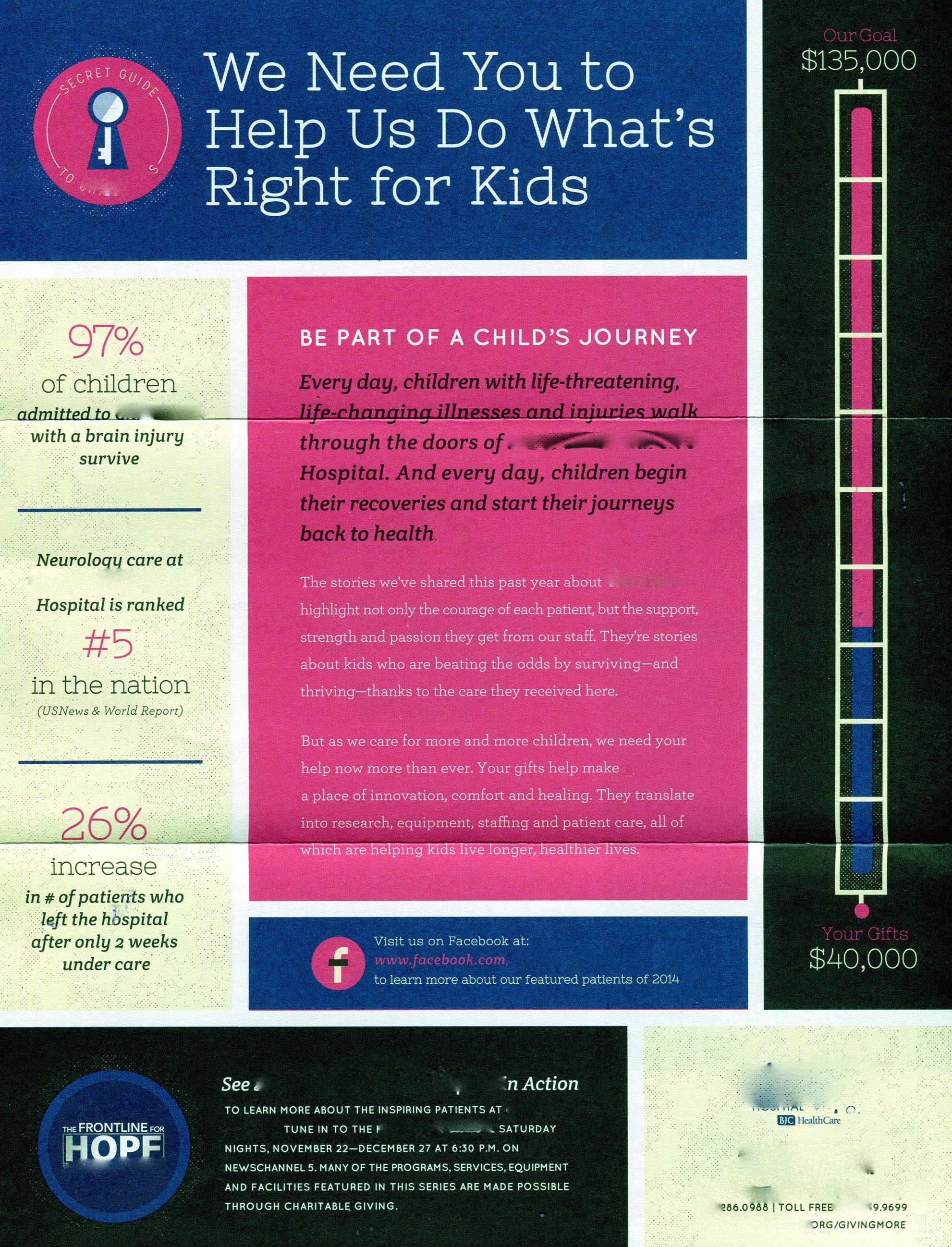
A 2-page high color sell sheet, but no letter!

When you are on the marketing end, you may feel that direct mail, especially fundraisers and business mail, looks pretty vanilla. Maybe even bland.

So the urge is to pretty it up.
Hospital 976

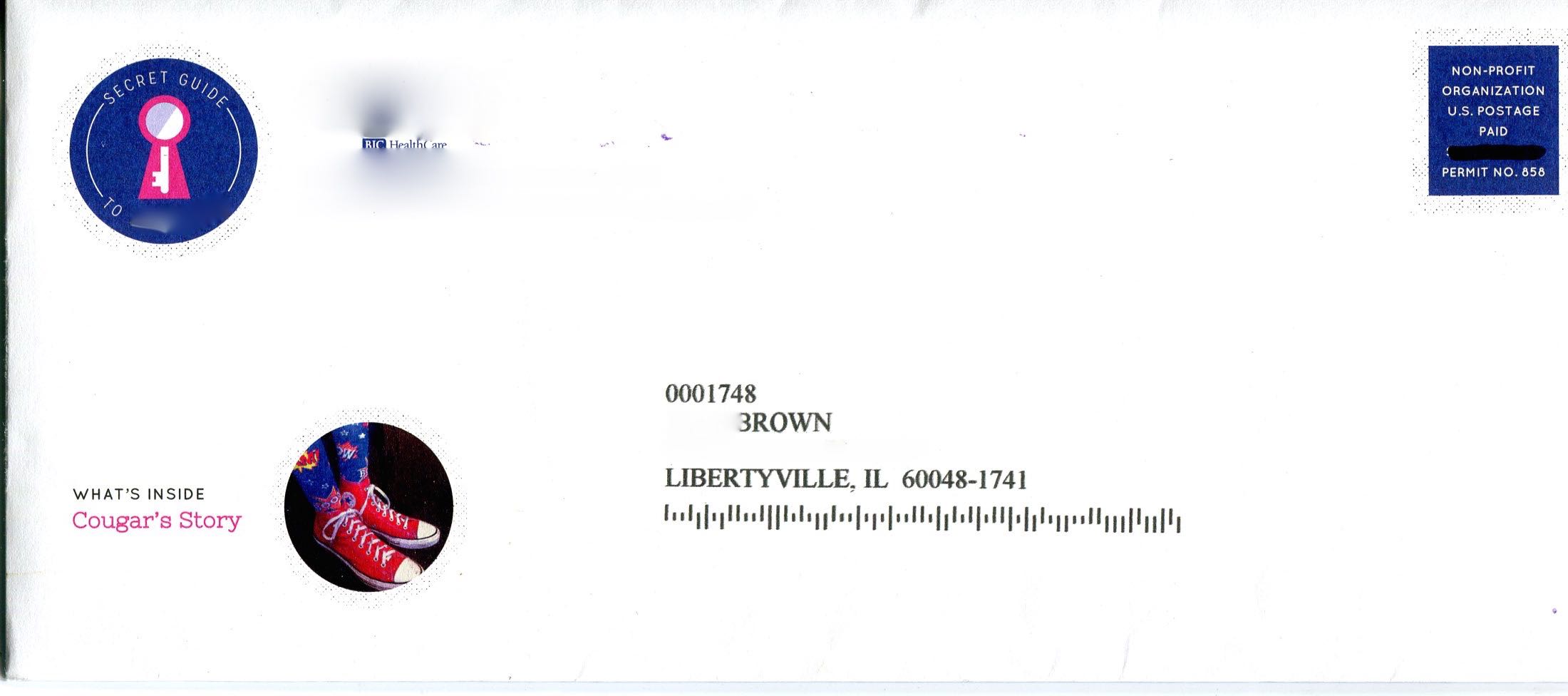
The hospital’s familiar happy logo is disguised here, but this envelope brings no bad news.

That is the case with this fundraising piece for a well known children’s hospital. For its sake, anonymity will prevail. But here is a 7-step rule book on designing fundraising mail.

1. Set the mood for urgent need.
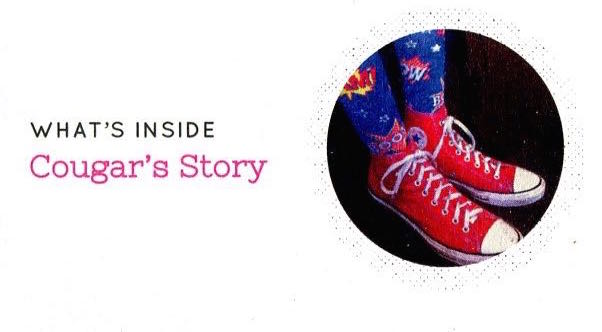
Hospital Sneakers copy

A snappy colorful tease, but is it urgent?

To that end, use color and graphics sparingly, to best create a tone that delivers gravity, not levity.   The envelope for this kit displays a cheery logo (disguised here) for the hospital. Understandably, it wants to convey happiness for its patients.   But that’s not the right strategy for getting financial backing.

The OE features a spunky new pair of pink sneakers teasing the story of a cured patient, whose story is inside.

The “story inside” teaser is good. But the sneakers remind one of a Saturday morning kids TV show.  Pretty, but not important.

2. Follow up with a personal request.

One of the most recognized personal media in existence is the letter. When we open an envelope, we are looking for it. The letter sets the agenda for the potential donor. This is who we are.  Here’s our challenge, and how you can help.

There is a myth that people no longer read letters, and certainly not long ones.  Not true!  If your story is real, and the request is sincere, the letter will be read.

Hospital Cougar copy

A potentially compelling story is delivered in challenging, small white type against a pink background.

Named, titled and signed, the letter provides basic credentials. A person is “at the other end of the mail box”.

This piece has no letter, but rather hangs its success on a two-page high color sell sheet.

3. Demonstrate and prove the wise use of donations to solve the problem.

Convince the donor that money is needed, and that it won’t be wasted.

The hospital has a goal of $135,000. What for? It is not apparent that it is short of funds, or solely supported by charitable donations. Not knowing that, why would a donor be moved to give?

Hospital Circles copy

A logical effort to monetize the services provided. But what are the Circles all about?

To its credit, the hospital does explain what your money will buy. It also presents operating statistics, and some official endorsements.

To put an edge on the numbers, show how many cases were turned away or disadvantaged for lack of funds.

4. Be legible and understandable.

Possibly the most difficult task of a senior donor is to read copy that is too small, and reversed out.   In this case, important “ask copy” and narrative is in 8-point type, white on pink. Pink on black. Blue on white.  Ouch!

Hospital Key copy

The significance of the “Secret Guide” is just that: secret.

This piece also employs some secret code, uninterpretable by the cold prospect.   The use of their “key” logo is un-explained, and a series of icons on the pledge card do not telegraph any meaning to the uninitiated.

5.   Tie the Ask To A Specific Need.

The story in the piece relates to a child’s full recovery after an accident.  The pledge card, and supporting copy don’t connect to the child’s need, or to the next child with a similar accident.

The list of financial values and associated services in the ad piece refer to Circles of Commitment and generous benefactors, but the recognition value of the Circles is not explained.

6.   Urgency.  

Any mailing’s strategy is aimed to get a response immediately.   Hospital $135,000 copyThis fundraising piece needs  some parameters to define the timely need for a donation.   What will happen if they don’t reach $135,000?   When will time run out?

7.   Indispensability.
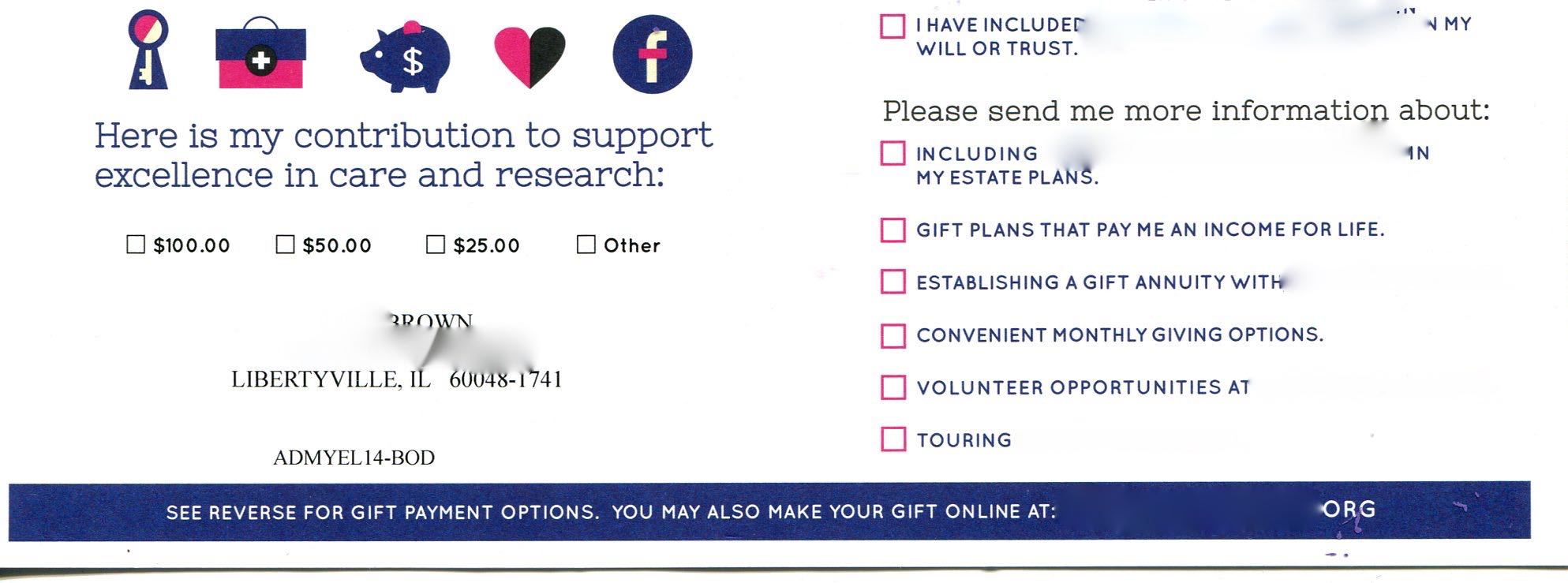
Hospital 980

The mystery of the icons: how do they work?


The best direct mail is impossible to throw out.   It just sits there on the kitchen table, or on the dresser until the responder finally acts.   This piece lacks that important nagging factor.

A gift, a freemium, a stamp, a coin, a sample, a personalized card, a photograph, an address label set, are examples of items that  are hard to ignore.

Unless the donor had already decided to contact the hospital, or the donor’s accountant recommended more charitable giving, there’s no reason to hang onto this piece.

Hospital $500

$50 bucks? We haven’t even met!

Direct mail design is challenging because the mailer gets bored with the “same-old, same-old”.  There is a temptation to jazz up the piece just to be different.   After all, you mail out a few thousand, or a few million, and they all look the same!

Just remember: the recipient only gets one piece, and to that person, the piece is well distinguished, just by its mere arrival.

Thanks for reading!  If your fundraising program is serious, make it look that way.  There’s nothing more serious than asking for money.
Standard
direct mail, Economics, Marketing

AAA Goes Flat Out

AAA 2014-12-02 803

The door opener!

Want to know what stops just about anyone when they open their mailbox?

No, not a boxing glove. Instead, it’s a flat.   No, not a flat tire.   A flat-sized mailing piece.

AAA 2014-12-02 800

The 10 x 12 Flat. Size counts in direct mail.

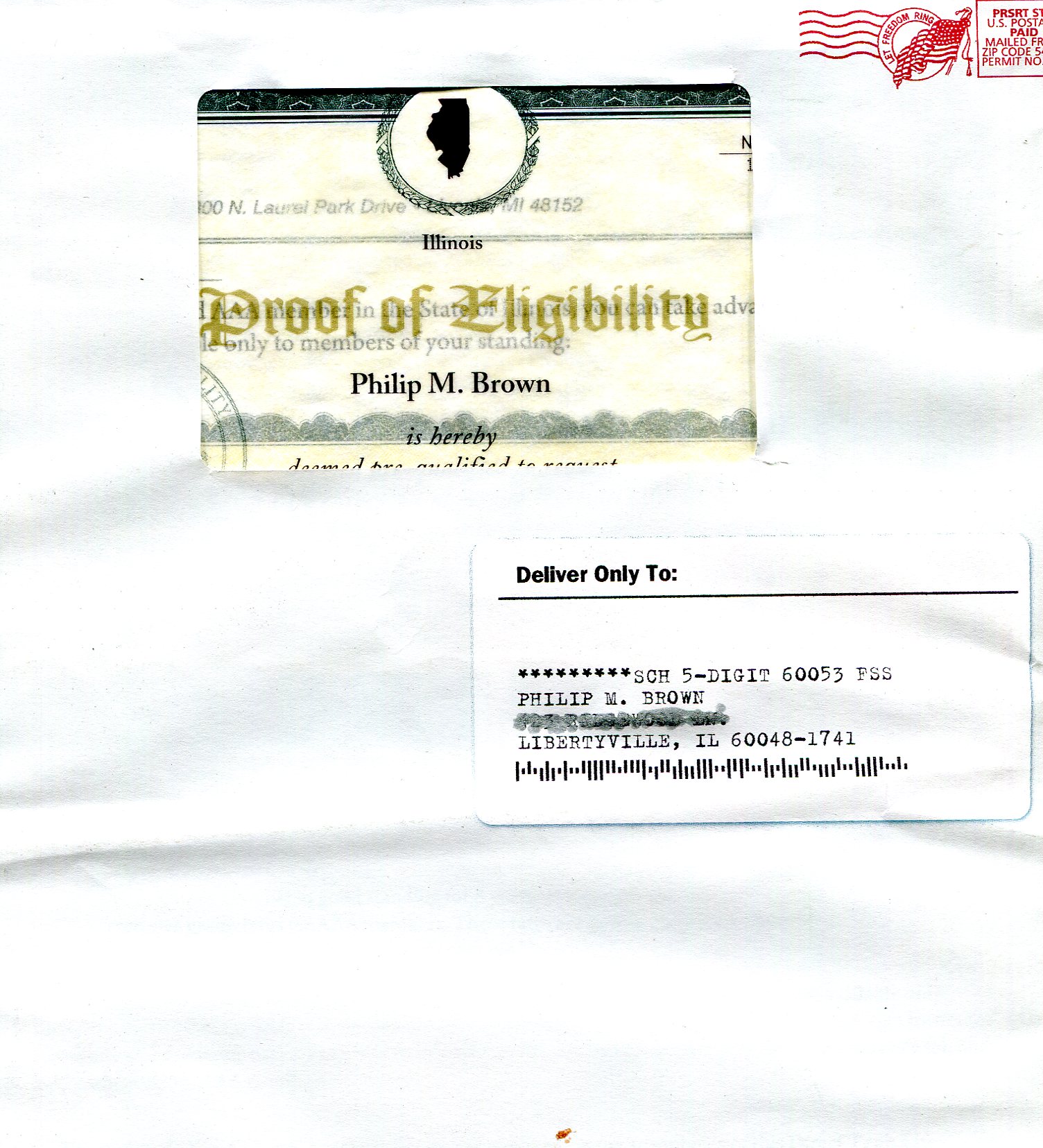
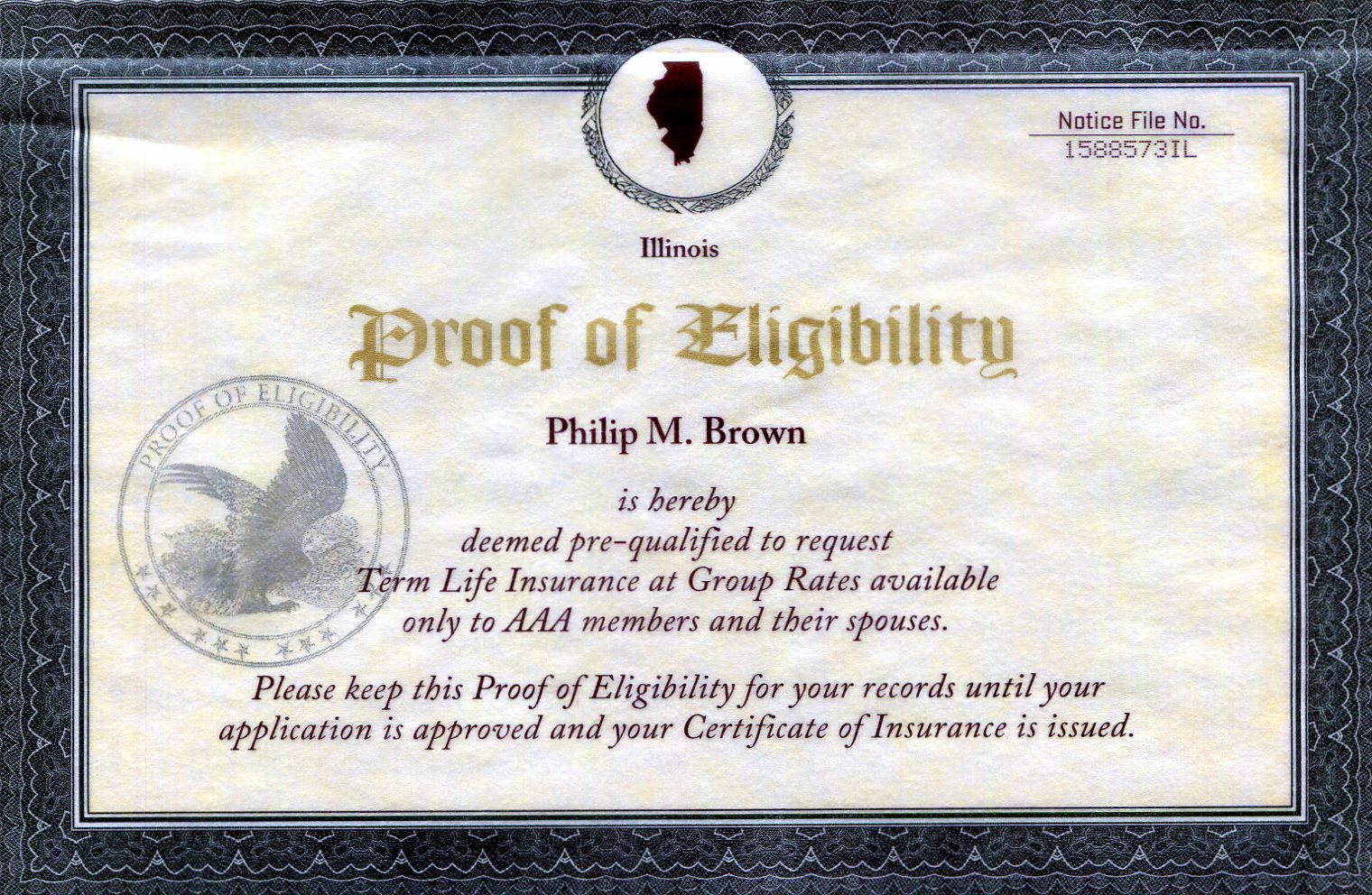
So it is that I opened our mailbox to be confronted by a certificate-sized 10″ x 12″ envelope. Front and center, in portrait orientation, is an open window. As I peak through I see my name, in bold, printed below a 40-point, gothic type proclamation: Proof of Eligibility.  The State of Illinois is symbolically positioned above.

This manifest is shielded behind a thin sheet of parchment. My reaction? Better open this now.

I am not that naiive, I know this is a solicitation. But still, eligible for what?   Nomination? Higher taxes?  Bronzing?

AAA 2014-12-02 Label copy

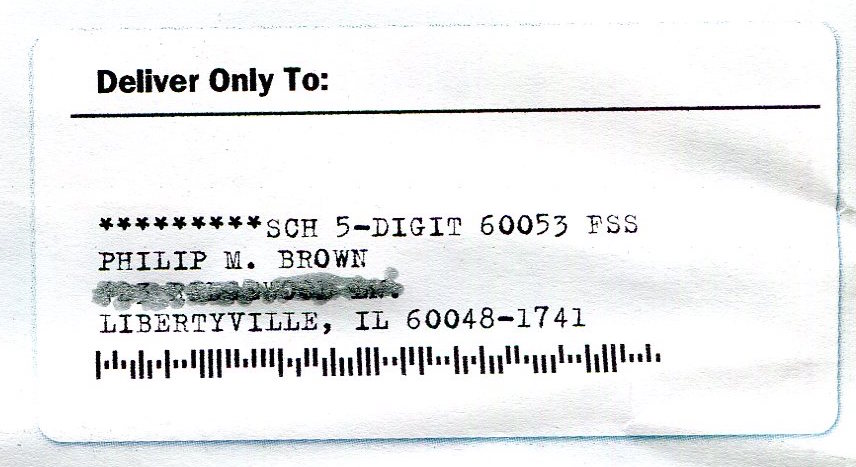
A beautiful label… applied on a slant, with raised shading, is actually printed, not real.

As it turns out, it is the AAA Life Insurance Company, who has decided to give me a second chance to insure my remaining days.  Or until the age of 80, when all bets are off.

These are the same folks who sent along a policy kit a few months back.    That one was a flat too: a “fulfillment package”.   Presuming I am ready to sign up, it is essentially a welcome kit.   Regrettably, and unknown to AAA, I am disqualified from obtaining coverage due to a shady past.   So I deferred.

AAA 2014-12-02 eagle copy

The official seal of eligibility.

The reason I highlight the new kit is to point out the allure and attraction of the envelope.  “Proof of Eligibility” is vague.   But when it is presented so elegantly, it works.   How many of your incoming direct mail summons use parchment?   40-point Gothic?   Not much I am guessing, since the Sheriff of Nottingham died.

The design strategy of this AAA kit is to get opened.   My bet is that better than 90% of the recipients do open it.   It is irresistible.

From there, the internals have to carry the freight.

The big question you should be asking is why spend the extra postage– probably 15 cents– to send an over-sized envelope?

AAA 2014-12-02 802

The letter under the parchment, complete with filigree.

Do the math.   In a standard #10 envelope, the kit, list and assembly would cost about $250/m.   Postage, another $200/m.   Total, $450/m.

Now lay the papers flat, and place them in a big envelope instead.   Let’s say the production is cost neutral, but adding $150/m flat postage has just increased overall cost by 33%.

The bottom line in direct mail: raise your production cost 33%, you must increase response 33% too.

So if the small envelope garnered a 1% response, the flat needs 1.33% to stay in the game.

From personal experience, I know this is achievable, and judging from AAA’s use of flats before, it’s probably not unusual for them either.

AAA 2014-12-02 Eligible copyBy the way, what was I eligible for?  Discounted premiums as an AAA member.


Thanks for reading!   Never pass up the opportunity to go “big” in a mailing piece.   The cost may frighten you, but usually higher response will cover it.

Standard
direct mail, Economics, Media, Politics

Found: The Hidden Miracle in the USPS

Spoiler Alert: This Is A Good Story About Numbers
Every year the media touts the headline that the United States Postal Service lost another few billion dollars. Politicians get huffy. The digerati are quick to call the funeral home.

But in fact, the USPS has accomplished an amazing business coup in its mail delivery management.

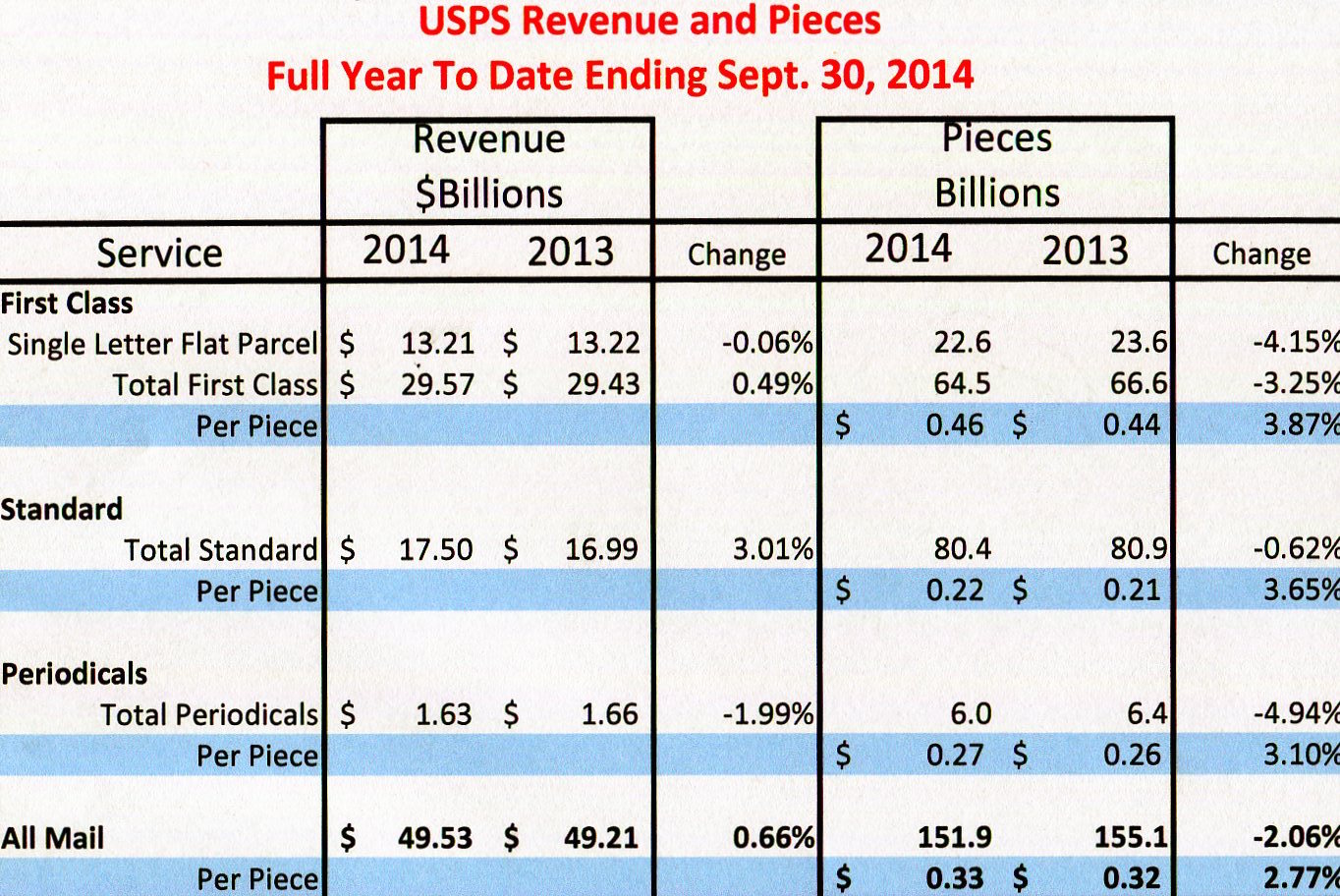
First, look at the current “bad news” available in the latest Revenue, Pieces and Weights report* for USPS full year 2014.   Figure 1 gives some highlights.

Fig.1.  2014 revenues were up 0.66% while volume fell 2.06%

Fig.1. 2014 mail revenues were up 0.66% to $49.53B while mail volume fell 2.06% to 151.9B.

Mail volumes decreased from 2013 to 2014. A 2.06% decrease to 151.9 Billion pieces. “Pieces” include letters, parcels, magazines and flats. The shrinkage may be attributed, if you wish, to a blended increase in price (postage) from 32 cents to 33 cents per piece. A 2.77% increase. But it probably has more to do with society’s use of email.   We would just as soon email Gran a singing birthday gift card as send her a parcel.

Dig deeper and we find that First Class volume shrank 3.25% while actual revenues increased 0.49%.

Postage per piece went up 2 cents, or 3.87%

What we know about mailing economics is that there is no elasticity. When postage goes up, volume goes down.

This is the fundamental truth of direct mailers. They maximize performance through testing list, offer, format and copy. The best performance becomes the economics benchmark. So when Standard Postage goes up 3.65%, we expect some mail to drop out, which it did: 0.62% less.

Amidst The Bad News, A Twinkling of Brilliance

November 14, the USPS presented its preliminary financial results to the Board of Governors. It declared a $5.5 billion loss in income. That made headlines. What was not picked up however, was its mail operations performance. You see, its operations income was $1.4Billion profit.

What that means is that the USPS moved nearly 152 billion pieces across the country to over 140 million addresses, six days a week, and did better than break even. What was the all-in price per piece to the mailer? 33 cents.

2004 Eye Opener

Now lets look at the real miracle of the USPS by comparing 2014 with 2004.

Ten years ago, it delivered 206 billion pieces for $65.87 billion.

Cost back then? 32 cents each.

Not bad! A one-cent increase in 10 years. Despite a 26% decrease in economies of scale, its performance eroded only by a penny.

Surviving The Ravages of Inflation and Restructuring

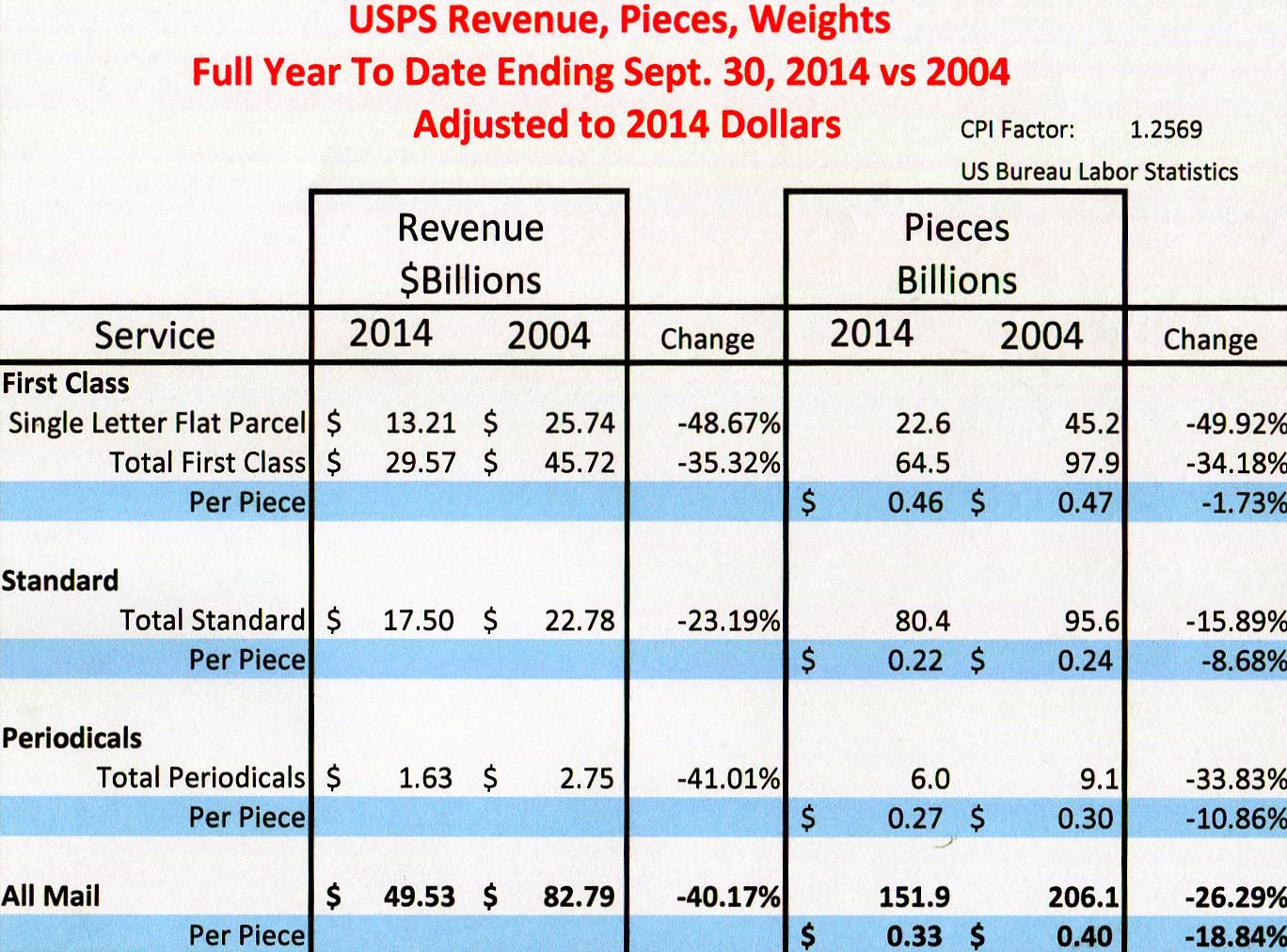
This does not begin to recognize the efficiencies the USPS has managed to achieve in the last ten years however. It disregards the massive cutbacks in volume, and the inexorable devaluation of the dollar. Look at the 2004 figures when they are expressed in 2014 dollars.  See Figure 2.

Using 2014 dollars it cost 40 cents to a mail apiece in 2004, versus 33 cents today.

Fig.2  Using 2014 dollars it cost 40 cents to a mail a piece in 2004, versus 33 cents today.

According to the US Bureau of Labor, we have experienced a 26% increase in prices. In other words, it takes $1.26 today to purchase what $1.00 would buy in 2004.

Applying the CPI to USPS figures then, we find that in 2004, it cost 40 cents to mail a piece, versus 33 cents today.

Standard Mailers would pay 24 cents in 2004 versus 22 cents today. First Class mailers would pay 47 cents, versus 46 cents today.

Magazines: 30 cents then, 27 cents now.

USPS: Economic Movement of Value

This government agency may have its critics.   The oracles may claim that mail is antiquated.   But they can hardly explain how well the post office has learned to distribute real property coast to coast at ridiculously low cost to the consumer.   Email and Internet may be instantaneous, but they both lack the credibility of hard copy delivered under government seal.

It can be said that mail is slow, but it maintains its cache because it is trusted.   We need to acknowledge the effort that the USPS has expended to bring us that service.


*The Revenue Pieces and Weights Report: http://1.usa.gov/1A8wEj1

Standard
Economics

What’s Coming Next

String Ball

Life time savings.

There is a major, seismic shift in assets occurring while you read this.  You are thinking of the $12 Trillion which is pouring into the pockets of Baby Boomers as their hardworking, scrimping and saving parents pass into the great beyond.  But you are off.

In truth, the money is peanuts.  It moves from one bank account to the next, and nobody lifts a finger.

So, it’s not about their money.  It’s really about their stuff.

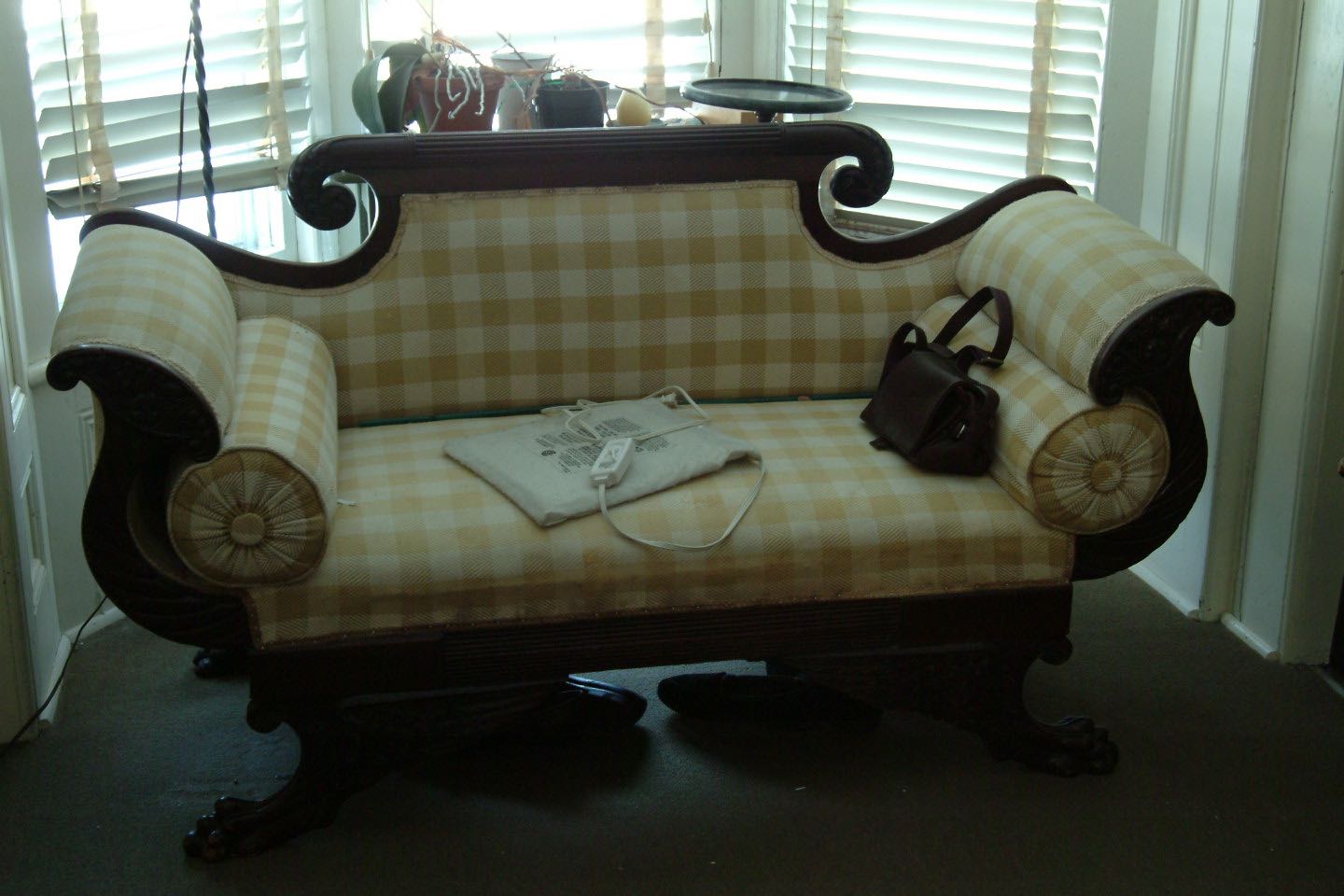
Sofa

This may not fit in with the kids’ Ikea.

There are two legacies which those post-wartime parents are sending along.  They promise profound effect upon us, and to generations still coming.

The first is a treasure of property which they struggled to build and acquire through thick and thin.   Too vast to itemize, but most Boomers will recognize the impact of their parents’ fully executed Last Will.

They are manifested in crowded basements, overflowing garages, leases on storage space, impenetrable walk-in closets, jammed kitchen drawers, and cabinets crammed with silver and china.

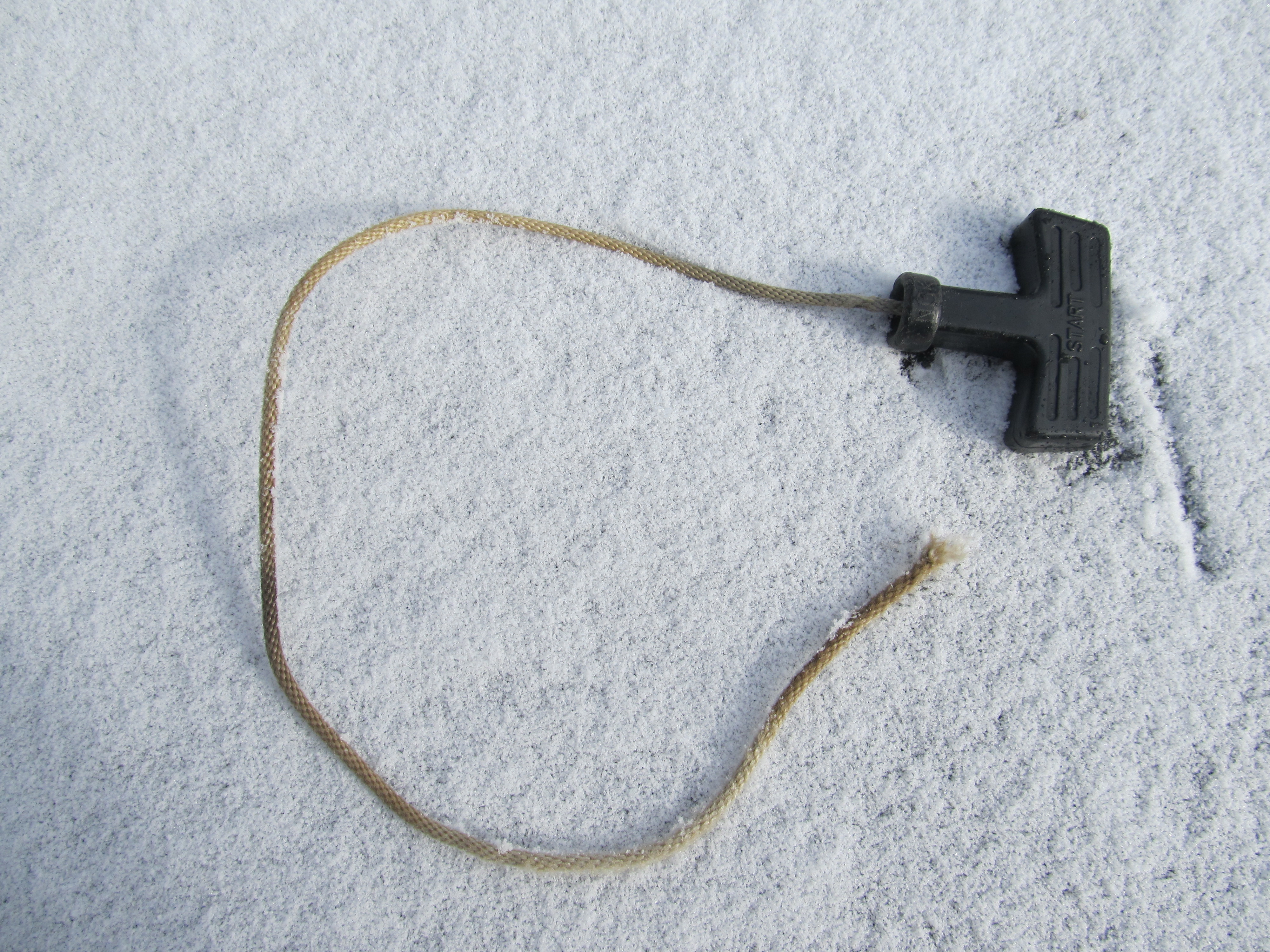
IMG_6466

A perfectly good pull cord, with some help.

The second legacy, even more profound, is a culture of saving.   The Baby Boomer was raised in a household characterized by frugal economy.   Nothing half-used ever got thrown out.   A broken item was in queue for repair, some day.

Again, the inventory of leftovers is virtually infinite.  Its aura a phenomenon.

Christmas Lights

Half of these work very reliably.

And you know it when you see it in the eyes of a Boomer.  That wince of remorse as a half-good string of Christmas lights hits the garbage bin.   Or the guilt attached to an old set of dull drill bits, that holds its place on the workshop bench, right beside a brand new set.

The reality is, while the Boomer is swamped in their folks’ stuff, they still can’t throw it out.   What’s worse, they are adding to it.

For example, a few days ago while driving down Milwaukee Avenue, I spied four baseballs resting in the gutter.   To me, it was like driving by a bank vault with the door wide open.

dumpster-hero-resi

“No, we are keeping the dumpster too.”

As kids, we could only envy the one on our street who had a baseball.   In fact, most of our youth was focused on scavenging for baseballs knocked out of the park, hockey pucks stuffed in snowbanks, broken hockey sticks, errant golf balls found on the road.

In our garage is a 5-gallon bucket full to overflowing with tennis balls, golf balls, lacrosse balls, wiffle balls, softballs…all items I have brought home like trophies from a jog around the park.

So I collect these play things like gold nuggets, feeding an appetite that was spawned a couple of generations ago when people just didn’t have much money.

Back to Milwaukee Avenue.   I pulled over, parked, and scurried across the street and retrieved the balls.   I could not believe my find.   These were in excellent condition, leather covers, no scuffs, and laces still waxed and shiny.   Bonanza!   The motherlode.

Balls

Cornucopia of finds on the jogging trail.

They are now on the shelf beside the bucket, which is full.

The significance of this perpetual foraging will become apparent to the next generation, those GenX-ers and Y-ers, and wet-eared Millennials who will finally have to deal with The Stuff.

Desk

One day, this may be a chicken coop.

You may want to give The Stuff to them, but you can’t.   They are still living with their parents.

My suggestion: this is the time to invest and build.   Look closely at your business prospects in:

1.   Storage space

2.   Trailer rentals

3.   Thrift stores

4.   Auctioneering

5.   Waste management

Golf Tees

Saving for the next round.

Regrettably we haven’t yet found a way to load it all onto a freighter, and sail it to a Third World depot, but that would be the next best opportunity.

Thanks for reading this far. It’s a puzzle I really can’t solve.  

I have to get back to repairing our Monopoly board.


Standard