direct mail, Economics, Marketing, USPS

Geez, Wally, What Are We Gonna Do Now?

Did you ever have a little brother, or sister, look up to you, and ask how to get out of the latest jam some misadventure brought upon them?

We might wonder how the latest USPS postal increase jams up direct marketers. Bottom line, it comes down to cost per response, or indirectly, response rates. There’s a formula you need to apply now, and it’s coming up shortly.

First off, the added cost of postage is somewhere around 2.4% to 3.0%, depending upon postal densities. So if you used to pay as much as 30 cents per piece for a mail drop, effective January 27th you will fork out as much as 30.8 cents. Not insurmountable, but that heavily laden camel is looking nervously for any straw piles nearby.

But what counts in the direct marketing arena is ROI. What does the postal rate do to returns on investment?

Just because postal rates go up, say, 2.7% doesn’t mean your mailing costs go up 2.7%. The total in-the-mail-cost includes creative, art, print, list, letter shop, freight and postage. For the basic #10 kit with letter, flyer, reply form and BRE, you may be paying $450-$600/m. It’s shocking to think that half of that cost is postage, but there it is.

A USPS 2.7% increase adds $8 to a $300 postal bill. But that is $8 added to a total in-mail cost of $450, or an 1.8% increase in total cost.

Your figures will vary from this. If you are mailing simple post cards, the increase in total cost is more significant. If you are mailing expensive, feature-rich, multi-component, highly customized mail, the increase is not as noticeable.

Still, you will experience a hike in cost, and that means you will see an increase in cost per response. That means if you used to have a $450/m cost, and a 2% response, your historical cost per response is $22.50 each, ($450/20=$22.50) Add in an $8/m postal hike, and your cost per response has grown to $22.90. The 40-cent increase doesn’t seem like a deal breaker, but the accountants will point out that your entire business functions on controlling cost.

So what do you do?

Calculate what higher response rate is now needed to mitigate the effect of the postal increase:

(New in-mail cost) divided by (Old in-mail cost) times current response rate.

($458/$450) x 2.00 = 2.0355…..2.036% response.

Where you used to get 20 responses per thousand, you now need 20.36.

So now, we have a target, what do we do?

Go back to the basics: list, offer, format, copy.

Examine your list to remove low propensity response groups, ensure addressing is current, and at the same time consider list increases if higher densities will lower postage. Optimize delivery, too. Are you commingling and co-palletizing mail for maximum cost reductions?

Does your offer optimize pricing?  Do you include an incentive premium?  Is there an incentive with deadline?  What can you add to the offer for free?

Format changes can boost response.  Change your envelope shape and color.  Add in additional pieces: buckslip, lift note, testimonial letter, freemium, sample, cards, labels, personalization, variable graphics. Remember anything up to 3.5 ounces costs the same, so don’t be bashful.

What about your copy?  Is there another theme to test?  A letter change?  New outer envelope copy?

Your opportunities to kick up your response rates never evaporate.  There’s always more to test.  Quantum leaps in response are uncommon, but still, a simple postal increase is cause for finding those drivers that will deliver the increases you need to keep up with the USPS.

Lastly, isn’t it great to have a little brother or sister asking for advice, or better yet, to be one?  Enjoy your holidays with family!

Standard
Government, Legal

Apples, Oranges and The Pits

The Church’s plan: 148 cluster homes on 33 acres. One access point.

Yesterday the Lake County 19th Circuit Courtroom 205 heard closing arguments from the Archdiocese of Chicago vs. the Village of Libertyville, case 17MR0001013.

After 9 full days of throwing paper at each other and the judge, witnesses grilled, the final decision comes down to choosing between safety and due process.
While the weight of the issue is whether the Church can go ahead with its 148 houses on 33 acres, or not, the arguments came down to the definition of “safe”, and a village board’s right to vote its conscience.

The key word is arguments. The parties had different paths of logic.  Like apples and oranges.

The Church first of all defended its development plan on the precedent of the LaSalle/Sinclair Factors, which is a set of Illinois measures used to evaluate zoning changes.

One by one, the Church counsel ticked off their presumed compliance with the factors. Will the development fit the neighborhood, yes. Is the Church losing money as is, yes.  Will the Village make money, yes. Do health, safety and welfare benefits offset any downsides, yes. Is the land unsuitable as currently zoned, yes. Has it been vacant a long time, yes. Does the Village need the homes, yes. Was it in the Village Plan, yes.

Each of the points is debatable, but that wasn’t the pivotal point of the Church’s argument.  Their real bone to pick was the “arbitrary, unreasonable, unjustified and capricious” decision by the village board to vote down the plan because it was unsafe for access and egress.

The Church’s “arbitrary etc” charge is based on two dueling traffic consultants’ reports, spiced with a good measure of Lake County DOT traffic data, computer models, and some established science about traffic weight times, traffic gaps, highway capacity, and mixed up–no, osterized with a lot of math.  Recall Twain’s concern about lies, damned lies, and statistics.

The Village had decided back in 2017 that residents presently have difficulty making left turns in and out of the neighborhood, and the development’s single access would further aggravate the situation, with the certain threat of an accident.  The lack of a traffic signal, and a second access are at the bottom of this scrum, and how they got there is not important today, other than to say that the Church knew of the problem long ago, and should have planned it better when they had the chance.

Northbound on Butterfield during morning commute. Choosing the right gap may be difficult.

But where the Church built its argument was on the “non-credible” village consultant’s findings.  Instead, its own consultant should be the respected source.  To that end, their counsel spent considerable time stressing that all published reports regard the access “adequate” and it was never claimed that they were “unsafe”.  That is solely the village’s determination.

But in fact, when the DOT witness had testified earlier that the access was adequate, she also offered that other people may disagree.

When confronted with the notion that a high traffic area may complicate entry and exit to the development, including those difficult left turns, the Church’s comment was, “We have an arterial highway that has to move traffic fast.  The property is in direct conflict.  But that’s the risk of all development today.”

For the Village, the argument was from a different angle.  While the Church pointed to all of the LaSalle Sinclair factors as the standard,  the Village focused only on one factor: health, safety and welfare.   “Despite the beauty and luxury of homes promised, they pale compared to safety.  The proposed increase in home values won’t compensate for safety and loss of life.”

The judge himself intruded on the closing argument for the Village.   He asked if the safety is any worse at Ridgewood and Lake streets, to which the Village counsel replied that just because those intersections are also difficult, doesn’t justify adding yet another.  When the judge challenged the supposed hardship of drivers waiting for a gap in the traffic, Village counsel observed, citing the Highway Capacity Manual, that while statistics may indicate that the intersection is relatively open for turns, the reality of a long wait in a car to make a left turn may reduce a driver’s tolerance to choose the right gap in the traffic.  The judge countered, “that’s just common sense,” to which the Village replied, “that doesn’t make it any less dangerous.”

There is much give and take between the judge and village counsel about a traffic lights, wait times, gaps in traffic, and there is a moment when it’s suggested that the Village’s position is somewhat hypothetical.  The reply is noteworthy: “Actually, everything here is hypothetical.  The home values are hypothetical.  Home sales are hypothetical.  Nobody knows.  We just have to guess.  The Village decided it was unsafe.”

In his conclusion, village counsel noted that the evidence supported the Village’s legislative determination to be a reasonable, rational decision.  “At peak times, both morning and afternoon there will be an inadequate gap decision made by a driver.  We aren’t going to test it out and see how it goes.  The beauty and luxury homes are not worth it.”

Since the beginning of the trial, the judge has frequently returned to the viability and feasibility of a signal light at the Lake/Butterfield intersection.  It may factor in the nature and specifics of his decision.  He complimented and thanked both attorneys for their preparations and comprehensive presentations of the arguments, and after requesting a 15-page summary of all facts from each, hoped to reach a decision by January 31, 2019.

Standard
direct mail, Fundraising, Marketing, Media, USPS

USPS Cuts To The Chase

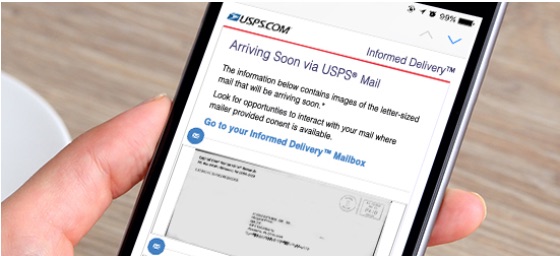
USPS pops you an email of today’s delivery.

140 billion images per year, some right to your smartphone.

Have you noticed what’s arriving in your mailbox these days? For many of us, getting Informed Delivery Service saves us from a trip down an icy driveway.

Over a year ago, we signed up for Informed Delivery, and I told you about it.  It’s like X-Ray vision, or electronic surveillance, though that sounds ominous.

American Girl’s catalog and URL are displayed in your email.

Their catalog arrives the same day.

The email alert provides a URL that takes you directly to their website.

The USPS emails you hours before delivery, sending a set of pictures of today’s mail.

In case you have forgotten, the USPS scans over 140 billion letters a year.

The Heifer letter follows their email.

Each of those scans creates a jpg file.  Because of the Intelligent Mail Bar code on the envelope, it tracks that mail to you.   When you sign up, they take your email address, and voila: you have x-ray vision, kind of.

What is really cool, and smart of the post office, is that they have now introduced a URL hyperlink service for advertisers to catch you at your computer, laptop, mobile phone.  Rather than wait for the hike to the mailbox, you can open the piece on line.

Hammacher is America’s oldest catalog company, and also a memorable tongue twister.

USPS knows a multi channel approach includes direct mail, email and web.

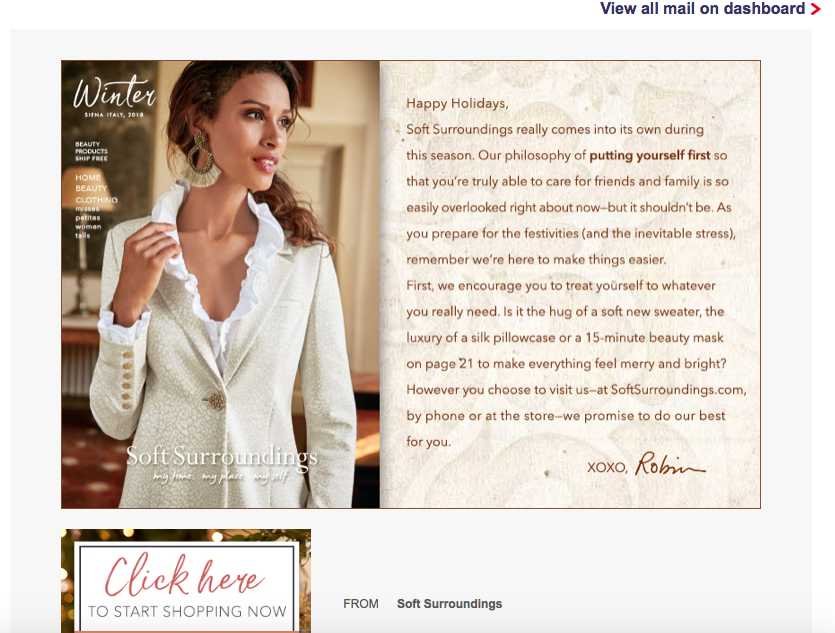
And that’s what people are doing.  Advertisers like Flemings Steakhouse, American Girl, Soft Surroundings, Heifer International, Hammacher Schlemmer are taking advantage of the USPS service to get into your heads, if not your hands, as rapidly as possible.

Soft Surroundings invites you into their catalog.

If you haven’t signed up for Informed Delivery at home, you should.  Not only does it tell you what’s coming, you are also on alert for when something does not arrive, like a paycheck, or a bill.

So: you can just wait for the mail, and pursue your daily rituals of fetching for it, or, cut to the chase, and see it now.


Thanks for reading!  No, I am not a shill for the USPS, but I do believe that it is taking the right steps to be relevant in a changing world.


Standard