Cars, Culture, Economics, Government

Dear President Trump:

Dear President Trump:

I voted for you. I understand your strategy of America first. But your decision to tariff Canadian auto exports to the United States makes no sense.  As you know, the automotive trade between Canada and the United States is virtually balanced. While Canada’s exports of cars to the U.S. may create a U.S. deficit, the United States exports an excess of automotive parts to Canada, balancing the automotive trade between the two countries.

This is clearly stated by the Toronto Dominion Bank’s economics team, January 28, 2025: “Potential Hazards Ahead” by Andrew Foran.

So why tariff Canadian exports of automotive products?

Your position to re-patriate the automotive industry to the United States is supposed to “bring back” jobs lost to overseas countries.  The truth is that in Canada, many of those jobs were created over a hundred years ago, long before you and I were born. Look at these Canadian subsidiaries, and their starting dates in Canada:  

The Ford Motor Company of Canada, founded 1904

General Motors Company of Canada 1918

The Chrysler Corporation of Canada 1925

Kaiser Willys Jeep 1954

American Motors Corporation (Nash & Hudson) 1954

Honda Canada Inc 1986

Toyota Manufacturing Inc 1988

The Big Three were building and shipping cars in Canada for Canadians long before WWII. Four, and five generations of Canadian families have worked in the factories, the shops, accessories and parts businesses feeding these successful companies. It’s in their DNA. They have taken loans to buy cars, mortgages to build homes, grow towns, and slogged to work for their families. The profits were returned to head office.

Sir, why are these companies in Canada? Market opportunity. This expansion wasn’t about finding cheap labor. This was about mining Canadian dollars.

Now you suggest that Canada is “ripping off” the United States by building cars and trucks. I think it’s a fair bet that every automotive trade investment that has been made on Canadian soil in the last seventy-five years has been supported by Canadian loans and a motivated labor force.

These industries existed decades before NAFTA. The 1965 US/Canada Auto Pact designed this relationship, which is balanced, and has been a cornerstone in supplying both countries equally.

I must remind you, Mr. President, that Canada is not just a neighbor. It is our friend and ally. Canadians have pitched in whenever the need arose: Dieppe, Vimy Ridge, Juno Beach, Afghanistan, Iraq, Iranian hostages, emergency 911-housing. Canadian first responders have convoyed to floods and tornados in the US heartland, quakes, hurricanes in the south, and to forest fires in the west.

These tariffs are worse than a slap in the face, they are a stab in the back.

Please explain why this balanced relationship is being burdened by tariffs which will harm citizens on both sides of the border.  Better yet, Mr. President, please stop the tariffs on the automotive trade.

                                                Yours truly,

                                                Phil Brown

                                                Libertyville, IL 

Standard
Culture, Economics, Government, Marketing, Politics

Spin City: “Shop Local”

Last week I shared my frustration and shame at President Trump’s brutish and uncaring treatment of Canada, a treasured friend of the United States. My letter was to the Republican National Committee.

The gist of it was that under the pretense of stopping drugs and illegal immigration, Canada was forced into increasing secure borders, or risk tariffs. After complying to the President’s demand, the subject pivoted. It wasn’t about drugs and borders, it was about a $60 billion trade deficit between our two countries, favoring Canada. I called the pivot a “bait and switch”.

But I have finally settled on the ultimate truth of this pivot, and it’s not what we thought at all.

First, to confirm, a trade deficit exists when two bodies don’t equal each other’s bank accounts. To wit, Canada’s tills received $413B from Americans, and America’s tills received $349B. from Canadians. Canadians would be right in saying, “We need a bigger cash register!”

To put this in perspective, the trade deficit has not been $63B in recent history. In fact, from 2017 to 2020, the deficit has averaged $20B per year. So the latest is a jump.

This deficit phenomenon is not unique.

If I was mayor of a small town, and noticed with some gloom that my local residents all went to the neighboring town to buy groceries, because they were cheaper, or more varied, I would expect the grocer in my town to come banging on my desk, with a grievance. “Nobody shops here. I’m going out of business at this rate!” I would apologize, and hoist signs on every lamp standard, “SHOP LOCAL”. I would also tell the grocer to get smart: “Bring in better stuff, and lower your prices.”

This is logical enough, but it doesn’t necessarily work if the out-of-town grocer has better suppliers.

So placing this on an international scale, the USA is taxing imports, with punishing tariffs paid by American importers.

But here’s the real twist. I finally glommed onto this as I ate my last Dad’s Cookie which was baked in Toronto Canada. While the President has charged that “Canada is ripping us off,” what he was really afraid to admit is, “I am going to punish American consumers for purchasing desirable Canadian product. By collecting a tariff on those imports, U.S. consumers will learn to shop local.”

It would be political suicide to come out and just say that, so instead, this “rip off” language targets Canadians, and all other countries as bad actors. The end game however, is to bring offshore jobs home. And while it may seem that Canadians are the bad guys, they aren’t. We are the bad guys because we like our Dad’s Cookies. The President’s hope is that one day, those cookies will be made here.

You can see this happening now in Canada. With new Canadian tariffs on U.S. goods, Canadians are encouraged to buy Canadian: SHOP LOCAL. To which they are proudly responding.

Mean time, the home-wrecking language and bombastic posturing from the White House has had a toxic effect on the USA’s goodwill account. Who knows how long that major faux pas will take to smooth over?

Standard
Culture, Economics, Government

An Open Letter to Michael Whatley, RNC Chair

Bait and Switch

Dear Chairman Whatley: I am staring at my Sustaining Member card for the Republican National Committee, and I am debating whether to return it to the RNC.

I am dismayed by President Trump’s transparent attempt to fool his electorate into believing he is imposing tariffs on Canadian exports to the USA just to stem the flow of illegal aliens and to stop the production of fentynyl. He revealed his real goal: to balance trade between our two countries.

You well know he announced his tariff plans were contingent upon Canada bearing down on illegal crossings and drug controls. When he was satisfied, the tariffs would go away. Canada responded and is working with US agencies to comply.

Now President Trump is accusing Canadian exporters of “ripping off” the United States over a $68 billion trade deficit. In a $762 billion trade relationship, this is a 9% differential. Never mind he negotiated this trade pact.

The outcome of this capricious and arbitrary action is that we have lost the best friends we could ever have. Canadians are rightfully angry and scalded by this abusive action and language. You will witness that our flag is lowered from Canadian businesses. The national anthem is booed at sports. Provincial governments are canceling contracts with US vendors. American sales people are refused entry to Canadian offices. One wonders how American tourists will ever be welcomed in Canada.

The numbing question over this infamy is whether Americans are even aware, and if so, do they even care? The tariffs have created 40,000,000 enemies without a single shot fired.

I would remind you of an important test for what we say, think and do. It is the operating rule of the Rotary International, here in Evanston, Illinois: The Four Way Test. Is it the truth? Is it fair to all concerned? Will it build goodwill and better friendships? Will it be beneficial to all concerned?

I believe that the President’s treatment of Canada fails this test abysmally.

I am urging you to communicate my anger and disappointment to the President with respect to this ridiculous and deceitful tariff ruling.

Yours truly, Phil Brown, Libertyville, IL USA.

CC: KC Crosbie, CoChair; Kathy Salvi, Illinois State Chair; Dean White, Illinois National Committee Man; Rhonda Belford, Illinois National Committee Woman; Daily Herald, Chicago Tribune.

Standard
Economics, Government, Legal, Marketing

Open Letter to Kwame Raoul

Re: Kroger and Albertsons Merger

Dear A.G. Raoul: I am concerned that the proposed merger of Kroger and Albertsons grocery stores will create a disadvantage for Illinois shoppers. Here, in Lake County, we are fortunate to have two corporate branches: Jewel (Albertsons) and Mariano’s (Kroger). The stores face each other across Milwaukee Avenue, in Libertyville/Vernon Hills. They are connected via a major intersection.

The parking lots are full.

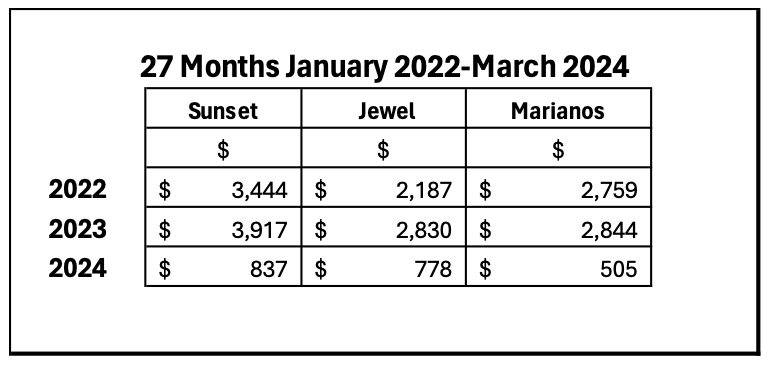
We are long term shoppers at Sunset Foods, Jewel, and Mariano’s . Despite the distance, we visit all three stores regularly to choose from a rich, wide selection. Each store continually makes competitive offers, which we enjoy. We are frequent shopper club members at all three stores, and take full advantage of the timely deals.

Over the past 27 months I have logged the dollars spent at each store.

As you can see, all three stores enjoy our business. If Jewel and Marianos co-exist under a merger, it would not be for long, as they will both get their product through the same purchasing department. So one of these stores will probably close. To me, that eliminates the competitive environment. Indeed, it is likely, with no competition, that prices will rise over time.

I urge you to be firm in fighting this proposed merger. It may be good for business, but it’s no good for shoppers.

Sincerely,

Phil Brown, Libertyville, IL.

Standard
Culture, Economics, Science

Getting Charged Ain’t Easy

The nation is getting its head around all-electric powered cars by 2035. It sparked me -haha- to wonder if electric cars really generate a carbon footprint smaller than gas-driven cars. My research confirmed it: in a “well-to-wheel” comparison, an electric car generates about one-third the level of carbon compared to the gas guzzler. So case closed on that.

But what troubles me is the generally held notion that we will just plug our car into an outlet every night, and be ready to drive by daylight. Where is the electricity coming from? That is a thornier question, and it doesn’t appear to have a satisfactory answer yet.

Here are some numbers worth knowing. 

  1. The US annual consumption of electricity in 2020 was 3,800 Twh. A ‘Twh” is a terrawatt hour. Because I know you really want to get into this, a terawatt is one trillion watts. That’s with 12 zeros.
  2. The US annual production of electricity for the same year was 4,009 Twh. 

Understanding these two numbers, you see we have a margin, say, a surplus of 209 Twh. Just for fun, that’s 209,000,000,000,000 watts.

What is interesting though is that the US also sells and buys electricity during the year, based on peak demands and capacity levels. But net, we imported 47 Twh last year. So we did not actually have enough to go around, based on our own production capacity.

Not having enough is generally a foreign concept in America, but there you have it.

So: will we have enough electricity for the car in our garage come 2035? That troubles me. Here’s why.

In 2016, American automobile mileage was 3.22 trillion miles. We are “trillionaires” for everything, it seems. Assuming that electric cars replace all the gas guzzlers, and that we still drive the same distance, happily guilt-free of carbon fears, will we have enough electricity?

I am not so sure. Tesla’s 2018 Model 3 has a commendable “mileage” rating of 26Kwh. That is, it can drive 100 miles using only 26 kilowatt hours of electricity. This is the best there is, today, beating out the Chev Volt, VW Golf, and BMW i3. By the way, 26Kwh is the equivalent of burning a 40-watt light bulb over your stove for 27 days. Doesn’t seem so bad, really.

But the total mileage of 3.22 trillion divided by Tesla’s 26Kwh/100 miles will require a total of 837Twh of electricity. That’s additional energy over what we use today. And we only have a margin of 200Kwh.

We do get one break. By shutting down the unnecessary gasoline refineries, we will save 47Twh. So our actual new requirement for electrical power is only 790Twh. That’s 790,000,000,000,000 watts.

Meanwhile, the State of California is enduring periodic black outs. Why? Because in the effort to be a good environmental steward, they have been closing their coal and nuclear power generating stations in favor of wind turbines, solar and hydro-electric power, aka, power dams.  Unfortunately, when there is no wind, no sun, and no water, there is no power. Local cynics refer to the disruptions as ‘Green Outs”. 

It turns out that the engineers in public and private sectors have been noodling on this. Some of the more common solutions are wind turbines. Did you know that today there already 67,000 turbines thrumming the winds in America?  And solar panels? There are 2,500 such farms today.  Of 80,000 dams in the country, some 2,400 are hydro-electric power generators.

These solutions generally fall under the heading “renewable energy” sources. In total, renewable energy supplies 20% of all the power generated in the US.

There is another solution which is being developed, and that is the reversible battery charger. It allows for energy to flow both ways from your electric car. You might plug it in for one night last week to charge for six hours, and then you left your car undriven, and cooling in the garage for several days. During that time, if you have a permit, the power company may take electricity back from your car to top up the grid. You would get a credit, and maybe an empty battery, but you would be a good person.

The lack of surplus electrical energy is not top of mind for many right now, but as we approach the next decade, the subject will arise much more frequently. Stay tuned, and as usual, turn out the lights upon leaving.

Thanks for reading and sharing! Will you get an electric car? Will you get the charger too?

Standard
Culture, Economics, Marketing

Along The Amazon: The Real Invasion

The Brown Marmorated Stink Bug: perennial invader.

For the two previous summers, our community has been infiltrated by legions of quietly intrusive stinkbugs.  They seemed to magically appear, just out of the corner of our eyes, posing on a wall or lampshade.  

Amazon Prime van passes the broken shell of a Macy’s store.

Little did we know that these were just the first wave, doing reconnaissance for the main invasion: Amazon. Now, virtually on every street, at every corner, we catch a glimpse of an Amazon delivery truck slipping in and out of view.

Amazon first broke into our consciousness in 1995 with a simple concept: a place to buy books online.  Their ads claimed access to all of the world’s contemporary literature available, and their warehouse was in outer space, “The World’s Biggest Bookstore”.  We might have listened.

Today Amazon is the world’s second largest company, by market capitalization, following Microsoft, and just ahead of Apple.  It has the world’s second largest retail sales volume, following Walmart.  

Barbarians at the gate: Amazon vans use shuttered Macy’s parking lot in Northbrook, IL.

It has up-ended the retail business model.  In 1997 3% of its sales were attributed to third party sellers.  Today, 58% of its sales come from third party.    In response, 2019 saw the closing of 9,300 big brand retail stores in the U.S.  The shift will continue.

The most physical sense of Amazon’s presence is its growing fleet of delivery vans.  In 2019, Fedex and UPS and the United States Postal Service delivered approximately 13.9 billion parcels in the United States.    But on its own, Amazon dropped 2.5 billion pieces at our doors.  According to Morgan Stanley, that will increase to 6.2 billion in the next 3 years.

The Amazon convoy. Dispatched regularly in 10-15 vehicle sorties on Butterfield Road.

I remark on these stats primarily because we watch the daily procession of Amazon trucks that travel Butterfield Highway, between Libertyville and Mundelein. The company has leased space to stage its fleet in an available lot on Technology Way on Libertyville’s west side.   There, independent owners and employees are regularly dispatched in squads of 10-15 vehicles at a time to head south to Allanson Road in Mundelein where they will pick up their allotted parcels for delivery.  The system is efficient, and it is supported by a good road, courtesy of Lake County.

Staging area in west Libertyville.

Just over the Illinois/Wisconsin Line, there is a vast Amazon distribution center off of US Route 94.  It measures several football fields in size, plus parking lot.  Not coincidentally, directly across the highway sits an equally large U-Line facility that makes shipping boxes. One wonders if there is a tunnel.  According to Amazon’s 2018 statements, the company has 230 million square feet of fulfillment space.  Its premises house nearly 650,000 employees.  One might also wonder how many of those people used to work for Sears, Macy’s, Pier One Imports, Abercrombie & Fitch, Office Depot, Victoria’s Secret, The Gap, and Payless Shoes.

This is not a critique of Amazon in any way.  The company’s mission statement is in part to serve a “customer-centric obsession”.  To that end, it has grown from simply books to sales of more than 100 million items.  Its website lists not a few business diversifications, but a vast portfolio of divisions relating to fashion, video streaming, groceries, pharmaceuticals, publishing, music, movies, web services, home automation and home security.

We can mourn the loss of the local store, but we have gravitated toward a business model that for much of our wants and needs, is just plain easy.

I wish I could feel as good about the stink bugs. 


Standard
direct mail, Economics, Marketing, Media, USPS

The Last Post

This is my last post on USPS performance. If you are in the direct marketing or direct mail business, you have seen these before, but unless things stabilize, I don’t want to report, thanks.

The USPS Postal Regulatory Commission has just released the latest Revenues, Pieces and Weights quarterly report. They call it FY Q1/2020.This covers October 1 to December 31, 2019.

Cutting to the chase, I highlight these numbers:
1. First Class revenues are off $161 million, down 2.3% just for the quarter. This was supposed to be the Christmas, Thanksgiving, Halloween and holiday greetings season.
2. Direct Mail or “Marketing Mail” as they have renamed it, down $252 million, or off 5.4% during what was traditionally a good season.
3. Direct mail volume for the quarter was off 1.7 billion pieces…down 7.9%. Hello??
4. Periodical mail continues its slide, revenues off 7.7%, volumes off 7.4%
5. Competitive Packages and Parcel mail, revenues up $137 million, or 2.1%, but quantities down 68 million pieces, off 4.0%.

I suppose I am naiively conservative, but I really expected for this past quarter to shine, and I have been rudely shaken to grasp what everyone else has been saying for years.

On an annual basis, the numbers are no more encouraging. I have created the chart below, converting the USPS fiscal year reports to normal business calendar years: January to December.

Compared to 2018, here are a few highlights about 2019 volumes:
1. First Class revenues off 2.2%; pieces off 3.4%
2. Direct mail revenues off 3.7%; pieces off 5.6%
3. Packages and Parcels revenues up 3.5%; pieces down 2.8%

Clearly, email, chat, web, and social media has displaced the need to use the mail. The only beneficiary in this trend is the package delivery business, which the USPS has carefully cultivated, though the decline in pieces is still a concern.

If there is any bright spot in this numbers soup, it might be that the direct marketers who mail to live know what they are doing; that it’s the small local businesses which used to mail have opted for web and social media instead.

We’ll see, but unless they do, this is my last post on the USPS.

Thanks for reading and sharing.  If you are in the DM business, and have an alternative observation to make, I would love to hear it!

Standard
direct mail, Economics, Government, Media, USPS

USPS: A Six-Month Stagger Into 2019

What can you say about a cursory glance at the most recent USPS Revenues Pieces and Weights report other than “CURSES!!” ?

What else can one say? They raised their rates around 2.5% last January, and six months later, revenues, pieces and weights are down.

SPOILER ALERT: This is all about numbers, which mean little, unless you are thinking about money.

You can see the details for yourself, but a cautionary word: the official RPW report above covers 9 months, from October 1 to June 30.   I have extracted the numbers below to cover from January to June, 2019.


In First Class Mail, which is all about bills, statements, cards and letters to mom and the folks, volume was off 3.2%– 904,000,000 pieces less than 2018.

Marketing Mail– direct mail was off 4.9%, — down 1,839,000,000 pieces from a year ago. Even more disturbing, the weight of those direct mail pieces also shrank about 2% from 1.49 ounces in 2018 to 1.46 ounces in 2019.

Leavened economics: 4 for $8.00 or 1 for $3.50?

The lesson here is that when you raise prices, despite your dominant position in the marketplace, people will buy less. We experienced a similar phenomenon at our favorite bakery when they raised the price of a cinnamon bun from $2.00 to $3.50. We used to buy 4, for $8. Now we buy one. Who’s happy?

The only bright light in the USPS tunnel to perdition is the package volume. Thanks to Internet orders, parcel shipments are still growing revenues, up 3.6%, though pieces and weights are off 1.7% and 3.3% respectively.

For wholly different reasons, magazine volume is also continuing its slide. Pieces are off 7.7% to 2,345,000,000 total delivered to as many as 159 million addresses in each of the past 6 months. If these magazines are all monthlies, there are approximately 391 million subscriptions in effect. About 2.4 for every household in America. While that may seem like plenty, just 5 years ago, the USPS delivered just over 3 billion periodicals, honoring approximately 502 million contracts, or 3.2 for every household.  But face it: if it wasn’t for the waiting rooms outside doctors’ offices, lube shops and office lobbies, the count would be less.

None of these figures should surprise you.  We all know the effect of the Internet on hard copy, paper, ink, and postal delivery.  Still, it is distressing to see a vital communications channel slowly price itself into a retreat, fulfilling a prophecy of irrelevance.

USS Ronald Reagan, a meager 110,000 tons.

But it’s not irrelevant.  Total mail volume in the fiscal year 2018 was 146 billion pieces.  That weighed 12.3 million tons. For those of you who are counting, that’s 108 USS Ronald Reagan aircraft carriers, soaking wet.

I have said it several times before, that the USPS, as an independent government agency has lots to be proud of, starting with its relatively minuscule cost to the US taxpayer.  Its 2017-2018 annual report showed an operating loss of $3.9 billion.  Sounds like a lot!  It’s 0.095% of the total U.S budget.   Less than one tenth of a percent.

The reality is, the USPS is still the bargain of all the media choices: it’s part of our lives, 6 days a week, with door-to-door pick-up and delivery, costing the taxpayer household about $23 per year, plus stamps.  Beat that, Amazon Prime.

Standard
direct mail, Economics, Marketing, USPS

Geez, Wally, What Are We Gonna Do Now?

Did you ever have a little brother, or sister, look up to you, and ask how to get out of the latest jam some misadventure brought upon them?

We might wonder how the latest USPS postal increase jams up direct marketers. Bottom line, it comes down to cost per response, or indirectly, response rates. There’s a formula you need to apply now, and it’s coming up shortly.

First off, the added cost of postage is somewhere around 2.4% to 3.0%, depending upon postal densities. So if you used to pay as much as 30 cents per piece for a mail drop, effective January 27th you will fork out as much as 30.8 cents. Not insurmountable, but that heavily laden camel is looking nervously for any straw piles nearby.

But what counts in the direct marketing arena is ROI. What does the postal rate do to returns on investment?

Just because postal rates go up, say, 2.7% doesn’t mean your mailing costs go up 2.7%. The total in-the-mail-cost includes creative, art, print, list, letter shop, freight and postage. For the basic #10 kit with letter, flyer, reply form and BRE, you may be paying $450-$600/m. It’s shocking to think that half of that cost is postage, but there it is.

A USPS 2.7% increase adds $8 to a $300 postal bill. But that is $8 added to a total in-mail cost of $450, or an 1.8% increase in total cost.

Your figures will vary from this. If you are mailing simple post cards, the increase in total cost is more significant. If you are mailing expensive, feature-rich, multi-component, highly customized mail, the increase is not as noticeable.

Still, you will experience a hike in cost, and that means you will see an increase in cost per response. That means if you used to have a $450/m cost, and a 2% response, your historical cost per response is $22.50 each, ($450/20=$22.50) Add in an $8/m postal hike, and your cost per response has grown to $22.90. The 40-cent increase doesn’t seem like a deal breaker, but the accountants will point out that your entire business functions on controlling cost.

So what do you do?

Calculate what higher response rate is now needed to mitigate the effect of the postal increase:

(New in-mail cost) divided by (Old in-mail cost) times current response rate.

($458/$450) x 2.00 = 2.0355…..2.036% response.

Where you used to get 20 responses per thousand, you now need 20.36.

So now, we have a target, what do we do?

Go back to the basics: list, offer, format, copy.

Examine your list to remove low propensity response groups, ensure addressing is current, and at the same time consider list increases if higher densities will lower postage. Optimize delivery, too. Are you commingling and co-palletizing mail for maximum cost reductions?

Does your offer optimize pricing?  Do you include an incentive premium?  Is there an incentive with deadline?  What can you add to the offer for free?

Format changes can boost response.  Change your envelope shape and color.  Add in additional pieces: buckslip, lift note, testimonial letter, freemium, sample, cards, labels, personalization, variable graphics. Remember anything up to 3.5 ounces costs the same, so don’t be bashful.

What about your copy?  Is there another theme to test?  A letter change?  New outer envelope copy?

Your opportunities to kick up your response rates never evaporate.  There’s always more to test.  Quantum leaps in response are uncommon, but still, a simple postal increase is cause for finding those drivers that will deliver the increases you need to keep up with the USPS.

Lastly, isn’t it great to have a little brother or sister asking for advice, or better yet, to be one?  Enjoy your holidays with family!

Standard
Culture, direct mail, Economics, Government, Marketing, USPS

USPS: Hidden Good Fortunes

Every quarter the USPS publishes their Revenues, Pieces and Weights Report. For the numerical savants out there, this is a feast of numbers beyond one sitting, for sure.

But the big story is, the USPS continues to perform in a stellar fashion, despite the ravaging onset of online displacement of hard copy as we know it.

If you think the post office is in trouble? Have another think.

Q3 YTD Results–9 Months Only
~The bad news– and what is publicly perceived, First Class revenues have fallen from $22.7 billion in 2013 to $19.9 in 2018. (off $2.7B or -12%).

~In the same 5 years, Magazines and Periodicals dropped from $1.3 billion to $984 million. (off $276M or -22%)

These two categories accounted for a $3 billion shortfall in revenue.

~Direct Mail, which includes catalogs, has ceded $294 million over the past 5 years. (off -2%) to $12.5 billion in the first three quarters of fiscal 2018.

Now for the good news.

In 2018, competitive Parcel and Package delivery has grown from $9.8 billion in 2013 to $16.9 billion. That’s a $7.1 billion growth, or 73%!

So we can certainly see how internet and digital media have blasted the legacy paper and ink communications business to smithereens.

What we did not see however was that online commerce has grown so rapidly that the USPS has found its newest niche: order delivery.

Year to date, 9 months, FY 2018, the USPS has delivered 4.2 billion pieces. Compare that to 2.3 billion, 5 years ago.

The USPS has another interesting report available, entitled Public Cost and Revenue Analysis, Fiscal Year 2017.

I like this report because it tells you how well it covers its costs of operation.  For instance, First Class Mail has a cost coverage of 210%.  Basically, its revenues are double its costs.

Direct Mail cost coverage is 153%.  Magazines and Periodicals, only 69%.  But the Package and Parcel delivery business, in the competitive markets, cost coverage is 155%.

Overall revenues for 9 months are $53.8 billion, up 5% from $51.2B 5 years ago.

These numbers indicate the ebb and flow of the door-to-door, pick-up-and-delivery business, and how the USPS is responding to America’s choices in communications.  True, the numbers do not account for front office costs, and legacy benefit and pension challenges, where there is a different story to tell.

But for making their daily appointed rounds, no one does it better than the USPS.


Thanks for reading!  If you would like to see these reports for yourself, have at it!

Click here: Fiscal year 2018 Q3 Revenues Pieces and Weights

and here: Public Cost and Revenue Analysis 2017

Standard