Culture, direct mail, Fundraising, Marketing

It’s All In The Bag

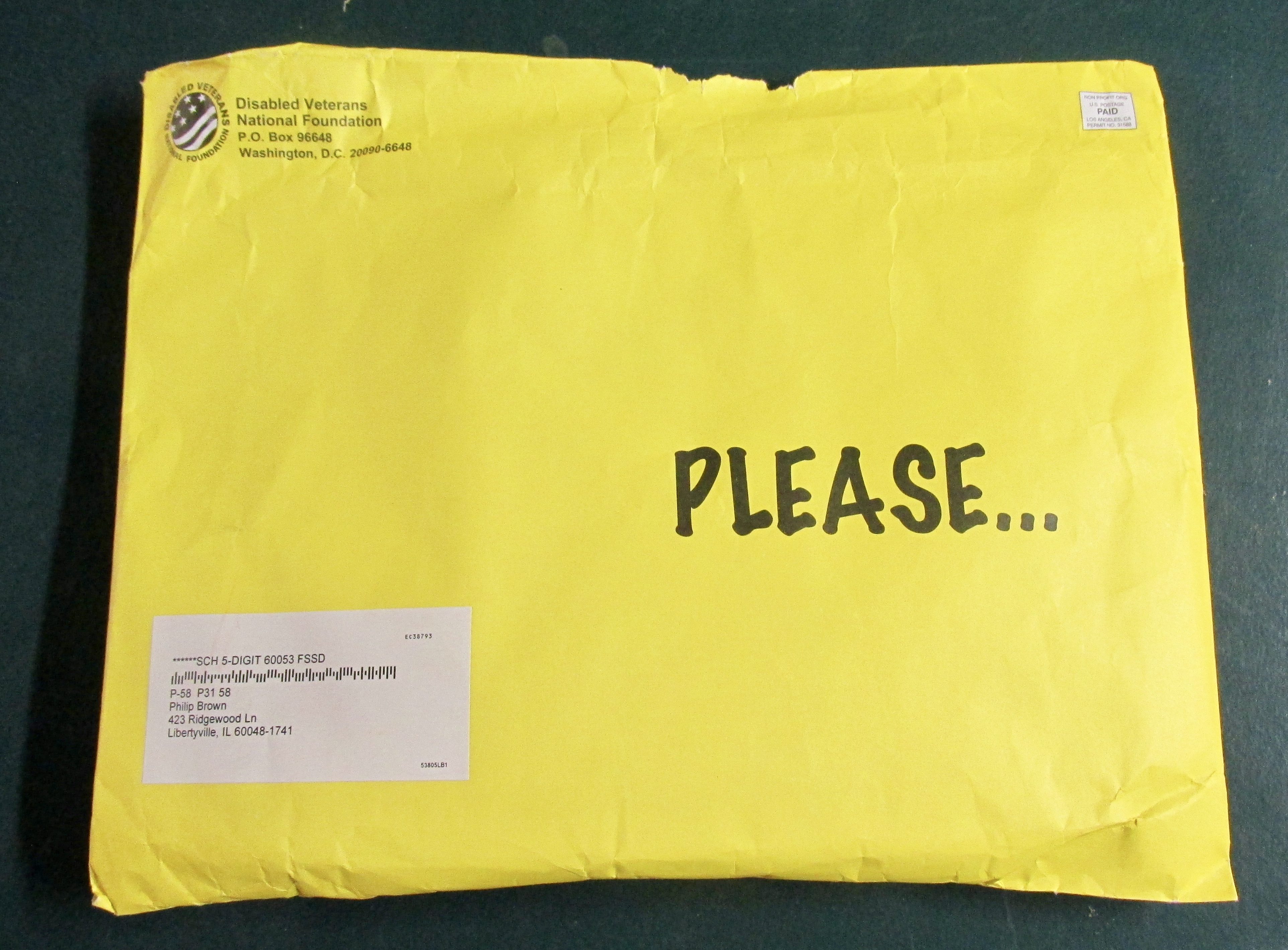
A max-sized lumpy day-glo envelope from Disabled Veterans National Foundation

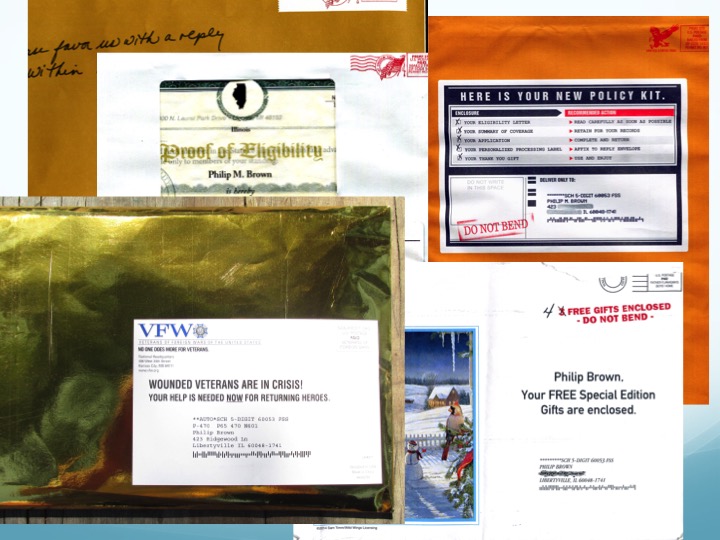
October comes around, and the non profits are making their first of several strong pitches for another discretionary dollar donation. I find my mailbox full, and refreshingly, with some new twists.

Kudos to the team at St. Joseph’s Indian School who have brought in some new creative to overlay their basic control kit.

St Joe’s gift vouchers go full color.

The Dream Catcher is the most unique gift of all.

As always, the Dream Catcher is a unique keeper. I have several, which make their way to the grandchildren. But the kits also deliver more colorful coupons. We’ll see if they repeat…or does the sterile, sober-looking appeal still trump happy colors?

As yet, St Joseph’s is not twigging to my male gender: I am getting stunningly beautiful foil labels with flowers and butterflies. I can’t use these, not even on my golf clubs.

The Post-It Note goes pointy for more attention.

Another St. Joseph first for me: a pointy Post-It note. It’s a little different, and catches my eye.

Certificates, suitable for framing deliver a message.

Plus, I have received a colorful, feather-imaged gold foil, embossed certificate of appreciation, on laid stock, no less!   Veterans of Foreign Wars sent me a similar recognition.

These certificates really are quite classy, as ‘thank you’s go. I am not going to frame them, but that doesn’t mean that someone somewhere else won’t frame theirs.

VFW targets the CD-player crowd with Christmas carols.

VFW also sent along a CD of Christmas carols! This may seem early to you, but actually is just in the nick of time: our new car no longer has a CD drive, but hey, it’s the thought that counts. I do have a cassette player in the basement, a.k.a., Santa’s Workshop.

Father Flanagan’s Boystown has sent me a Puzzles and Brainteasers booklet. You know, I mean to give it to the kids, but in an idle moment, I look at them too.

Beautifully designed gift bags are the pride of several organizations.

In an additional kit I was also treated to a colorful paper gift bag. These items show up across several charities, and I suspect there is a traveling paper bag sales rep who is shipping bunches of orders back to a printing plant in Shenzhen China.

The tote bag is a premium-with-donation offer from VFW.

Veterans of Foreign Wars has kicked the bag up a notch. They offer a full-sized  tote as a premium with donation.
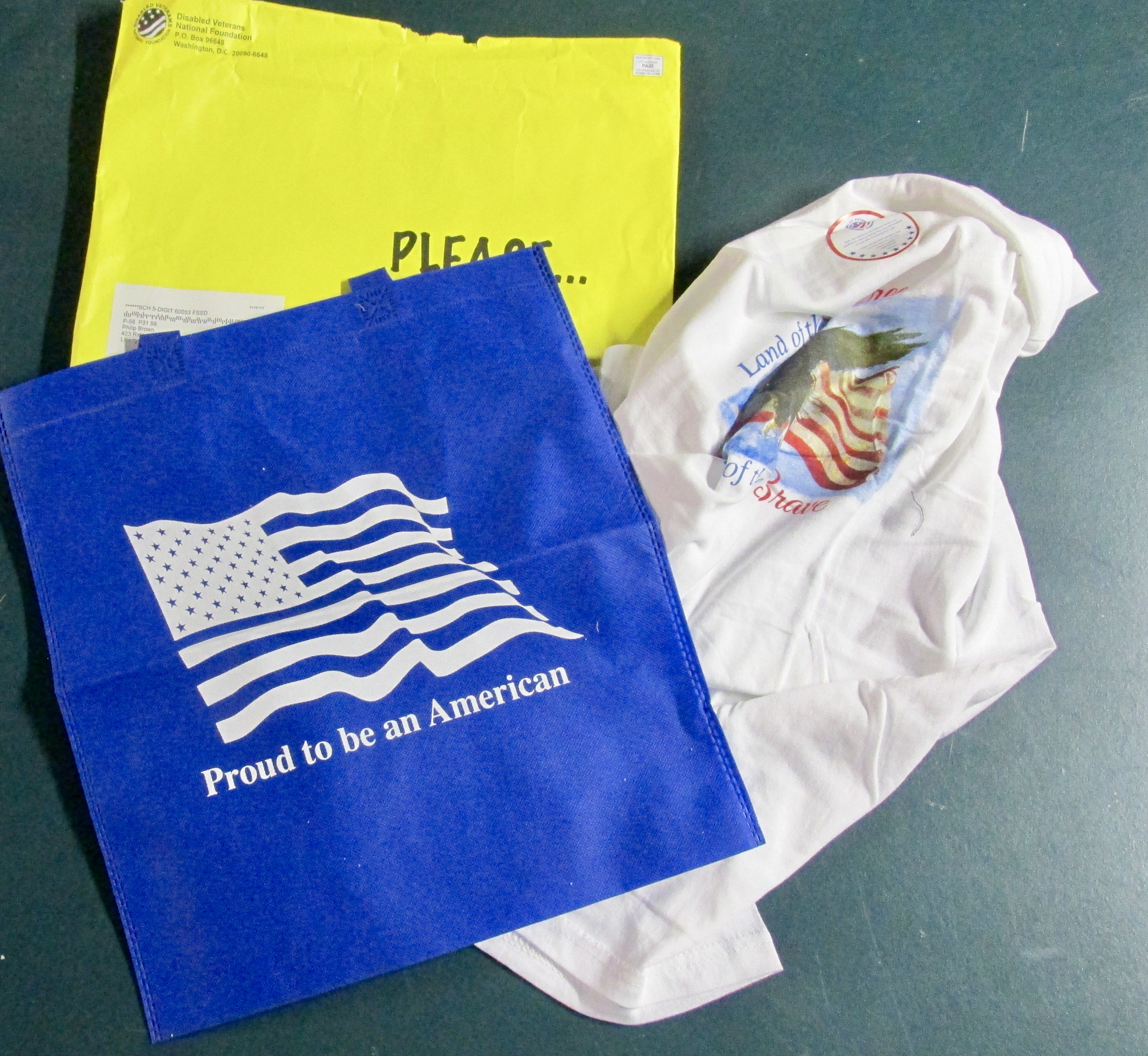
DVNF throws in the bag and a T-shirt with their request for donation.

At the top of the pile however is Disabled Veterans National Foundation (not to be confused with Disabled American Veterans) which sent the whole bag, and a T-shirt, in a day-glo yellow max-sized envelope.

I am now thinking that there are regular flights for printing sales personnel from U.S. to Shenzhen.

St. Joseph’s vinyl totes are small, but classy.

Truly, the most impressive were printed plastic vinyl tote bags courtesy of St. Joseph’s, that aside from their modest size, sported quality designs.

Lateral Thinking

There is an artful expansion of thinking on applying postage stamps to the reply envelope.   Pasting real postage on a reply envelope is a riveting issue.   Donors shudder to waste the stamps, and I am sure the charity’s accountants aren’t thrilled about giving away postage.

But here’s the thing–you may remember in my book Many Happy Returns, the story of the fundraiser who coaxed the donor to please supply their own stamps. The reply envelope said, “Your stamp will save us money.”  In a manner of speaking, it did. Average dollar gifts rose 6%, but response rate dropped 15%. Go figure!

DAV fronts all of the postage on the reply envelope..50 cents worth.

Anyway, the pioneer in applying the full 49-cents (or so) postage was DAV. They primed the pump, and happily cashed our flood of checks. We Baby Boomer donors can’t see a stamp go to waste.

But now, there are some diversions in the path.

VFW fronts only 5 cents, but appearances count in their favor.

VFW provides 5, one-cent stamps to the postage paid BRE, and the USPS will charge the rest. The modest nickel cost looks like a lot of stamps–but it’s not 50 cents’ worth.  This effectively cuts VFW’s in-the-mail costs by $450 per thousand, while still appearing to offer the more expensive stamps.
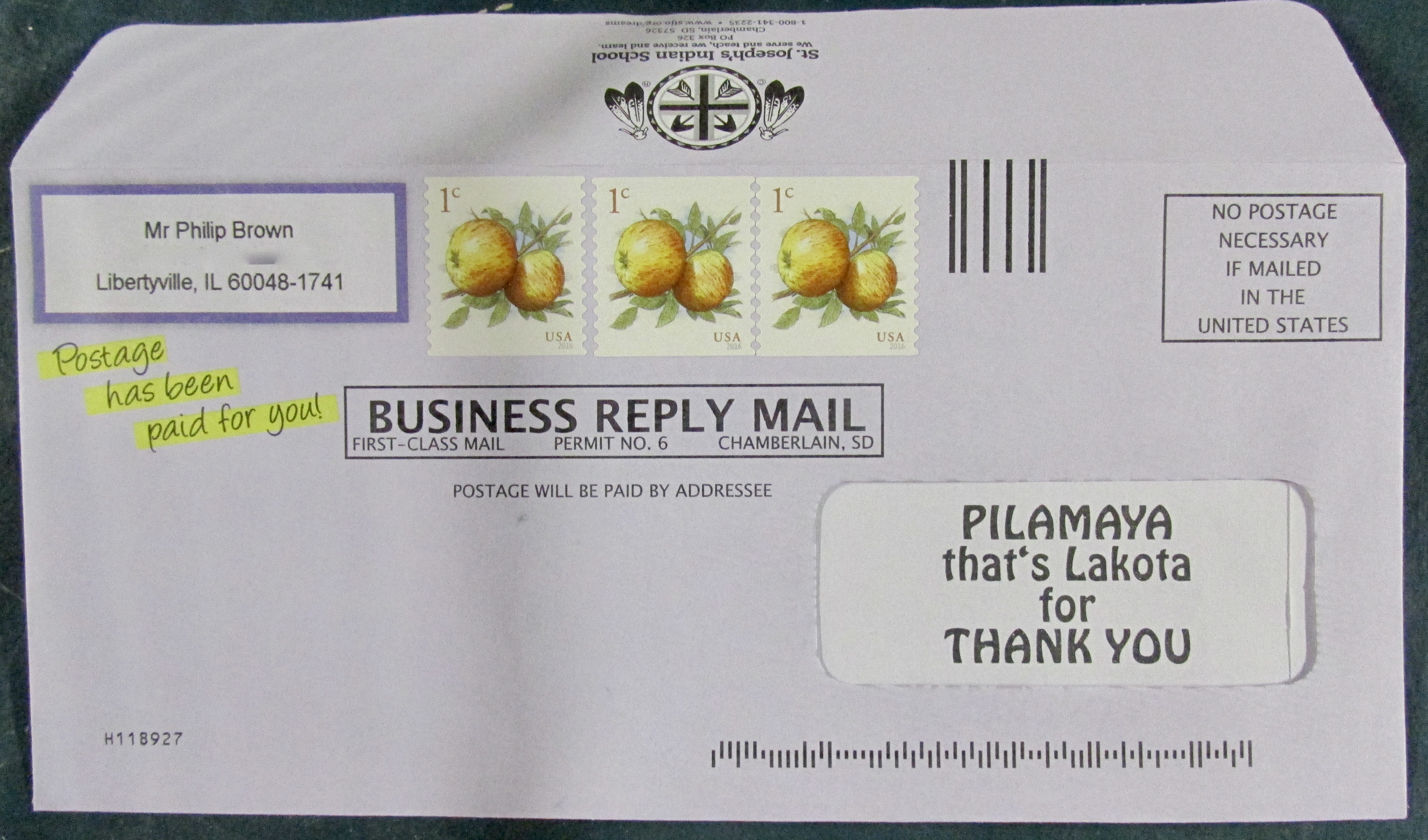
St Joes includes a faux return address label with 3-cents postage.

St. Joseph’s sharpens their pencil a little more, and only provides 3 one-cent stamps, but adorns their BRE with a faux return address label in my name.  How can I throw this out?

Boystown decorates their BRE with zero-value greeting stamps, but they look great, regardless.

Not to be outdone, Father Flanagan applies 4 Greeting Stamps of no value whatsoever to their BRE, but they look great!

Who can deny the effort?

To date we have 46 greeting cards in inventory. Production quality is high.

Throughout all of the recent spate of mailings I have received, greeting cards still predominate. I counted 46, all high production quality, and which are now stored in one of those pretty paper gift bags.

We have a bucket of pens, but St Joe’s are the classiest.

As well, I have been issued with numerous writing pens…lots of them, and some very tastefully designed, courtesy of St. Joseph.

And speaking of writing, I have a mountain of note pads, some die-cut, none of which can be discarded.

A pencil case for the pens. A lunch box may be next.

They get used.  And when not, where do they go?  Into a pen and pencil bag, supplied by St. Joseph’s!  Wow, what’s next…a lunchbox?

There is an ongoing debate, stirred up by loyal donors about the exorbitant expense taken in these mailing pieces.  How can a charitable organization spend this much, and then ask for more money?

The fact is, the gift strategy works.  Especially if the gifts are exclusive and high quality.  When they are accompanied by personal, expressive letters, the efforts are rewarded by donors who are sitting on, or searching, for the summit of Maslow’s pyramid: self actualization.

Thanks for reading, and sharing.  If you wish to check on these charitable organizations, you can visit Charity Navigator, or the organization’s websites to see their financial disclosures and especially their direct mail fundraising performance.


Standard
Culture, direct mail, Economics, Government, Marketing, USPS

USPS: Hidden Good Fortunes

Every quarter the USPS publishes their Revenues, Pieces and Weights Report. For the numerical savants out there, this is a feast of numbers beyond one sitting, for sure.

But the big story is, the USPS continues to perform in a stellar fashion, despite the ravaging onset of online displacement of hard copy as we know it.

If you think the post office is in trouble? Have another think.

Q3 YTD Results–9 Months Only
~The bad news– and what is publicly perceived, First Class revenues have fallen from $22.7 billion in 2013 to $19.9 in 2018. (off $2.7B or -12%).

~In the same 5 years, Magazines and Periodicals dropped from $1.3 billion to $984 million. (off $276M or -22%)

These two categories accounted for a $3 billion shortfall in revenue.

~Direct Mail, which includes catalogs, has ceded $294 million over the past 5 years. (off -2%) to $12.5 billion in the first three quarters of fiscal 2018.

Now for the good news.

In 2018, competitive Parcel and Package delivery has grown from $9.8 billion in 2013 to $16.9 billion. That’s a $7.1 billion growth, or 73%!

So we can certainly see how internet and digital media have blasted the legacy paper and ink communications business to smithereens.

What we did not see however was that online commerce has grown so rapidly that the USPS has found its newest niche: order delivery.

Year to date, 9 months, FY 2018, the USPS has delivered 4.2 billion pieces. Compare that to 2.3 billion, 5 years ago.

The USPS has another interesting report available, entitled Public Cost and Revenue Analysis, Fiscal Year 2017.

I like this report because it tells you how well it covers its costs of operation.  For instance, First Class Mail has a cost coverage of 210%.  Basically, its revenues are double its costs.

Direct Mail cost coverage is 153%.  Magazines and Periodicals, only 69%.  But the Package and Parcel delivery business, in the competitive markets, cost coverage is 155%.

Overall revenues for 9 months are $53.8 billion, up 5% from $51.2B 5 years ago.

These numbers indicate the ebb and flow of the door-to-door, pick-up-and-delivery business, and how the USPS is responding to America’s choices in communications.  True, the numbers do not account for front office costs, and legacy benefit and pension challenges, where there is a different story to tell.

But for making their daily appointed rounds, no one does it better than the USPS.


Thanks for reading!  If you would like to see these reports for yourself, have at it!

Click here: Fiscal year 2018 Q3 Revenues Pieces and Weights

and here: Public Cost and Revenue Analysis 2017

Standard
direct mail, Marketing, USPS

Direct Mail Design: This Never Gets Old

Did you know that the USPS Office of the Inspector General performs a customer satisfaction survey every year? News to me, but why not?

The results are available for viewing below.

But the stunning and head-spinning discovery about direct mail design is worth noting. In the study’s own words, verbatim:

“In FY 2016, it sent out more than 5.7 million survey invitations in the form of a two-sided postcard that invites customers to take the survey online or by phone. These invitations resulted in approximately 71,000 completed surveys, a 1% response rate.

“In order to increase response rates, the Postal Service tested two other survey invitations. An oversized postcard did not make a significant difference, but a sealed envelope with an invitation on letterhead had a 7% response rate.

“Consequently, the Postal Service adopted the sealed envelope for all invitations for FY 2018.”

A 600% increase in response!

There are two big rules of direct mail design:

1. It takes A Letter.
2. Put it in an envelope.

As for the survey, it is itself a pot-boiler and you can “self-administer” online, or participate by phone. If you are the social scientist, you know that a 50% response rate is the minimum acceptable for self-administered surveys, because who knows that the respondents don’t drop off, or conversely, have an axe to grind, or perversely, come from Chicago and complete several forms.

All results can be read here, but first and foremost, remember the two rules above.

Glad the Inspector has come on board!

Standard
Culture, direct mail, Marketing

Feel-Felt-Found

A Tough Customer?

Have you ever found yourself searching for the right way to win over a person who resists an idea?  You know you are right, but you don’t need to pound the table to prove it.  I recalled this tactic from years ago in the infancy of my sales career.  It works.

I decided to include Feel-Felt-Found in my book Many Happy Returns, which is all about writing and designing good direct mail.  Feel-felt-found is an excellent tool for a testimonial, and even an opening statement.   It can be a third party insert to disarm the most resistant buyers of their reservations.

‘Feel-felt-found’ is a logical progression that brings a reader around to a positive point of view. The seller is identifying with the potential buyer: “Look, I know how you feel…” and continues to list the potential negatives of the offer. This concession aligns the buyer and seller on the same side of the issue.

Continuing, “I felt the same way myself…” describes the suspicions and reservations in some detail. And then turns the tables, “But here is what I found…” and concludes by cashing the objections for a happy discovery that it’s a good deal after all.

He delivers perfectly.

Tom Selleck, best known for his convincing portrayal of the gruff, conservative, New York Police Commissioner on CBS “Bluebloods”, delivers a perfect ‘feel-felt-found’ for American Advisors Group which markets reverse mortgages for seniors.

He sticks close to script:

“I know what you’re thinking. I thought what you thought. Some things are just too good to be true. Just like you, I thought that reverse mortgages had to have some kinda catch –just a way for banks to get your house…right?
Well then I did some homework and I found out that it’s not any of that – it’s not another way for the bank to get your house and it’s also not too good to be true!

The script continues to explain the financing procedures and the benefits. Selleck concludes:

“I know what you were thinking – I did too. I felt the same way. But I checked it out and I found out a lot more. It’s pretty simple, a reverse mortgage from AAG can give you the retirement stability you’re looking for. Maybe you want to check it out.”

The script goes on to offer a free brochure and video for interested viewers.

‘Feel-felt-found’ is a powerful sales tool and delivered in the voice of a satisfied customer, or a company employee, makes a great testimonial for the reader to re-assess an offer.

I hope you liked this.  I have never used this blog for promotion, but in this case, I felt compelled.  It’s part of a life story, so I included it.  There’s plenty more for direct marketers who are on a quest for success.  You will find uniquely helpful clues in Many Happy Returns–Rules, Reckonings and Tales Told From The Mailbox.  It’s available now!

Standard
direct mail, Fundraising, Marketing

Beans, Trees, Socks, Calculators: All Into The Funnel

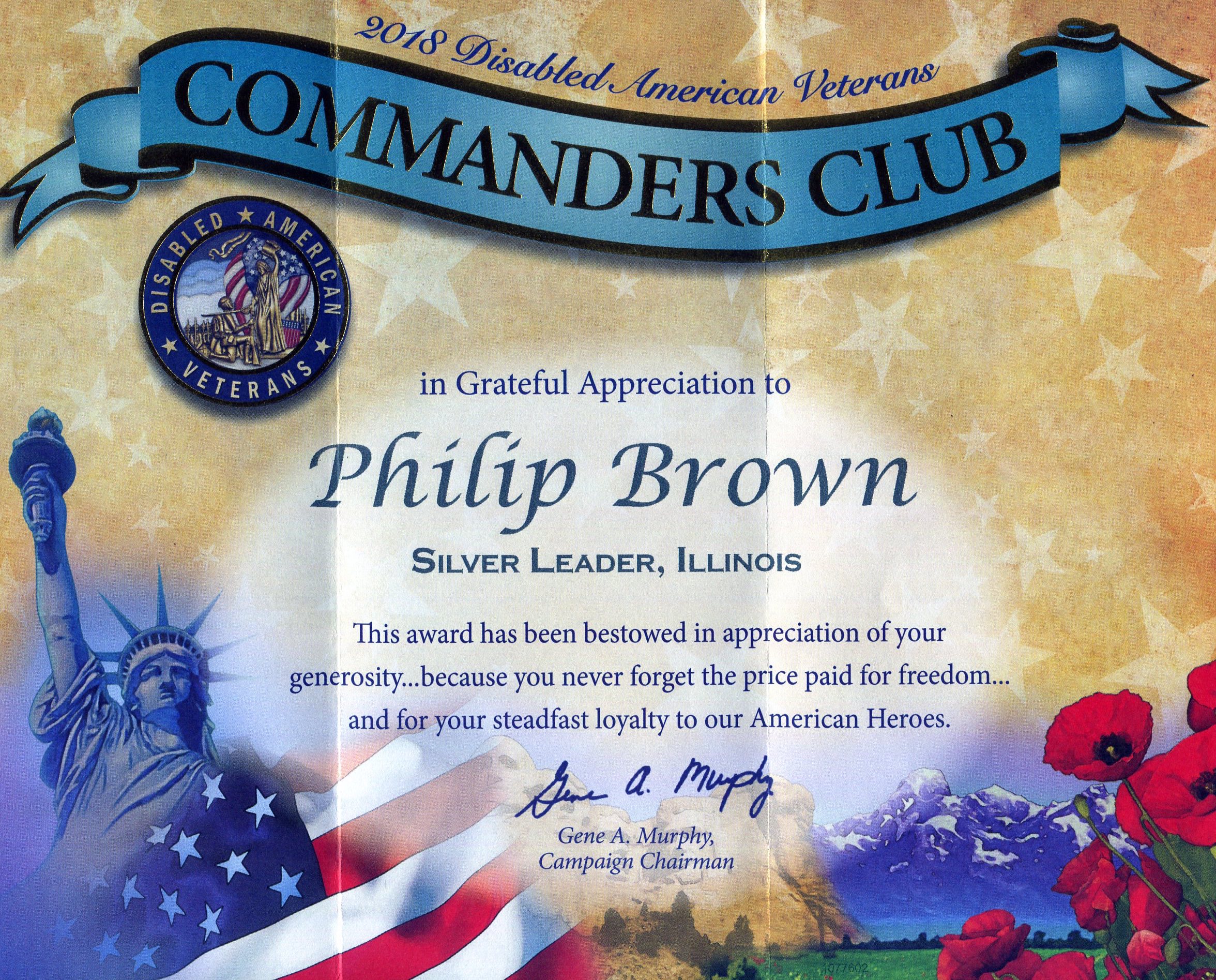
DAV has granted me membership to the Commanders Club.

The fundamental logic of customer acquisition mail is like starting my snowblower this morning. Gas up, pull out the choke, prime the cylinder and yank the cord. After a moment’s belch of smoke, I can turn off the choke, and the machine settles into a nice, steady RPM.

In direct mail, the sales funnel is a similar process: first overwhelm your prospect, at some expense, then convert them to a repeat with a follow up, and then funnel them into a steady revenue stream.

So I have kept track of my personal response funnel with a few regulars.

Arbor Day will reforest my yard, many times over.

Arbor Day
They are looking for a conversion. Last time I wrote, I reported to you that I had giddily responded to their acquisition piece, ordering 10 spruce trees, and 2 lilacs, with the hope of getting a year’s supply of coffee beans. Well, the coffee beans got me, but I didn’t get them. However, I did get a follow-up mailing, profusely thanking me for the spruce and lilac order. In this mailing they furnish a colorful mail order tree catalog, a newsletter, member card and a free red maple tree with my order.
The tree is 3-4 feet high.
I haven’t the heart to explain I have 17 trees on the lot now. I am still wondering where to put the spruces and lilacs.

Paralyzed Vets sees me bagging my groceries at attention.

Paralyzed Veterans of America
This should be a win back. I haven’t responded to them in the last few years, so they are gracing me with a patriotic tote bag. Actually, they have forgotten who I am, or was, and are introducing themselves. This is a gap in their database. The tote is enclosed, shrink-wrapped.

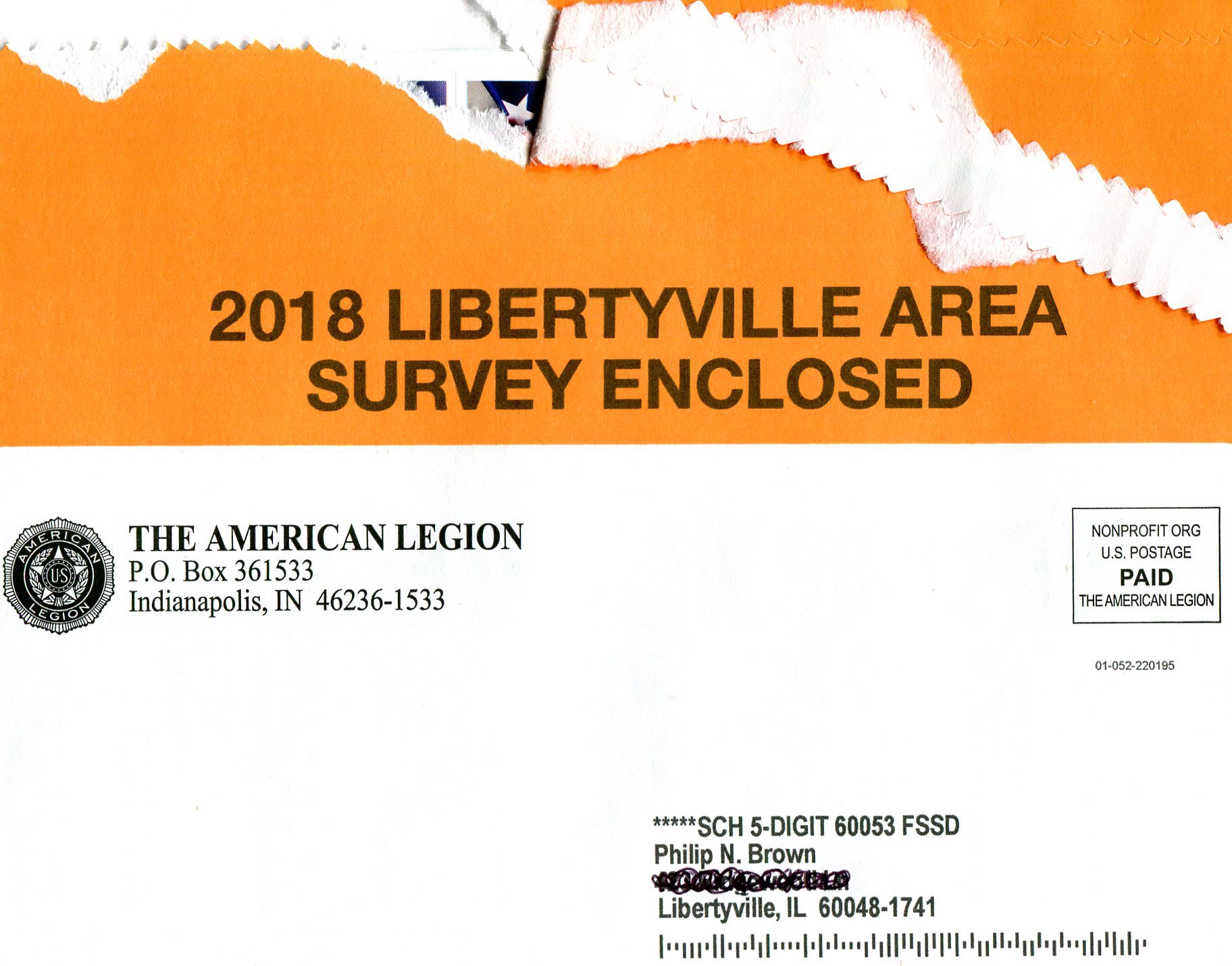
American Legion’s zip strip. A lesson here: it tears best when with, not across the grain of the paper envelope.

American Legion
This is a win back, delivered as a questionnaire. It comes in a large orange flat, 10″ x 13″, opens with a ‘zip strip’ and presents a set of rhetorical opinion questions which are, as designed, hard to say ‘no’ to. I haven’t given to the Legion in a couple of years. The labels they offer as a freemium unfortunately misspell my name.

A modest, business-like presentation from the VFW. The solar calculator works to 7 decimal places.

Veterans of Foreign Wars
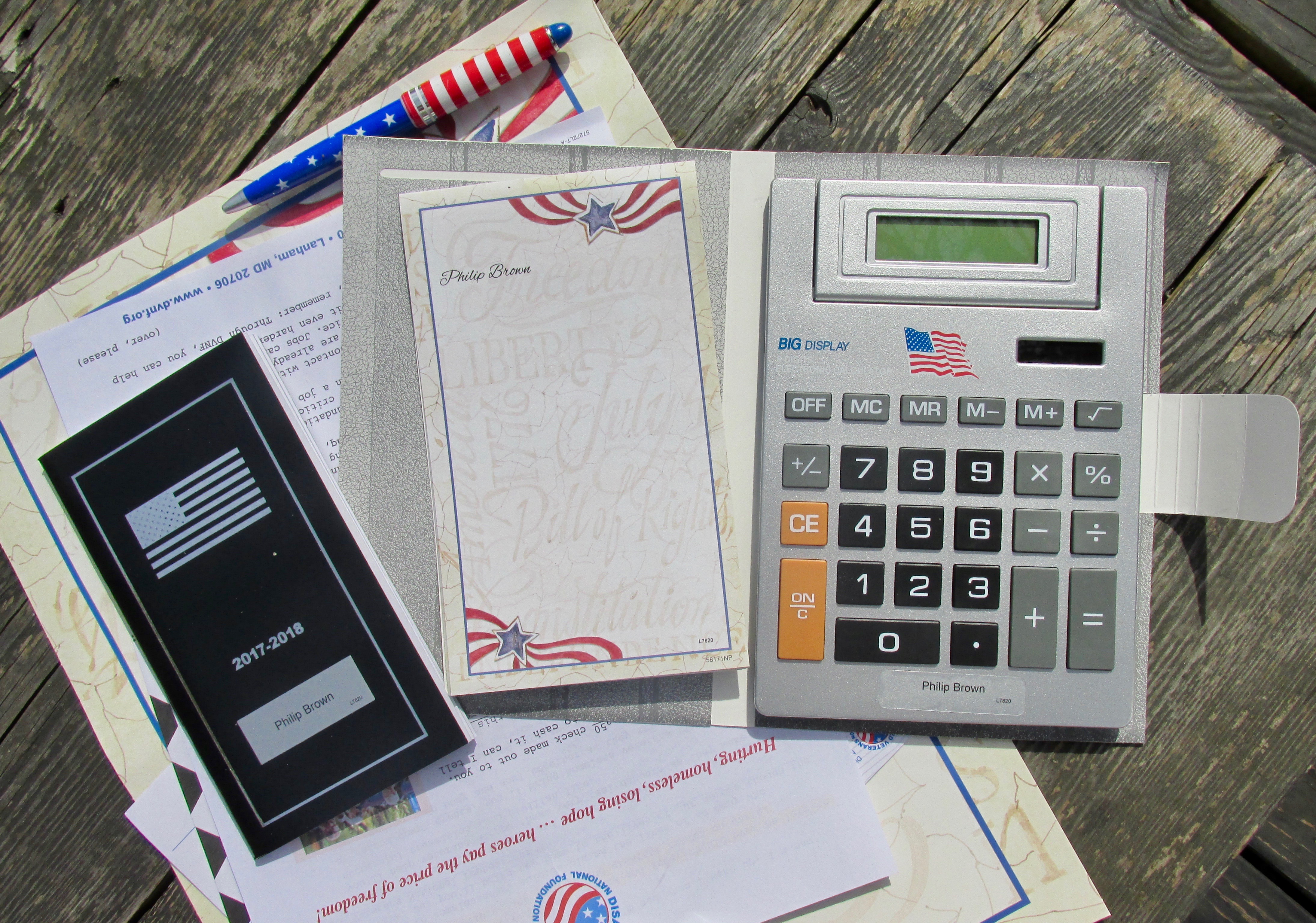
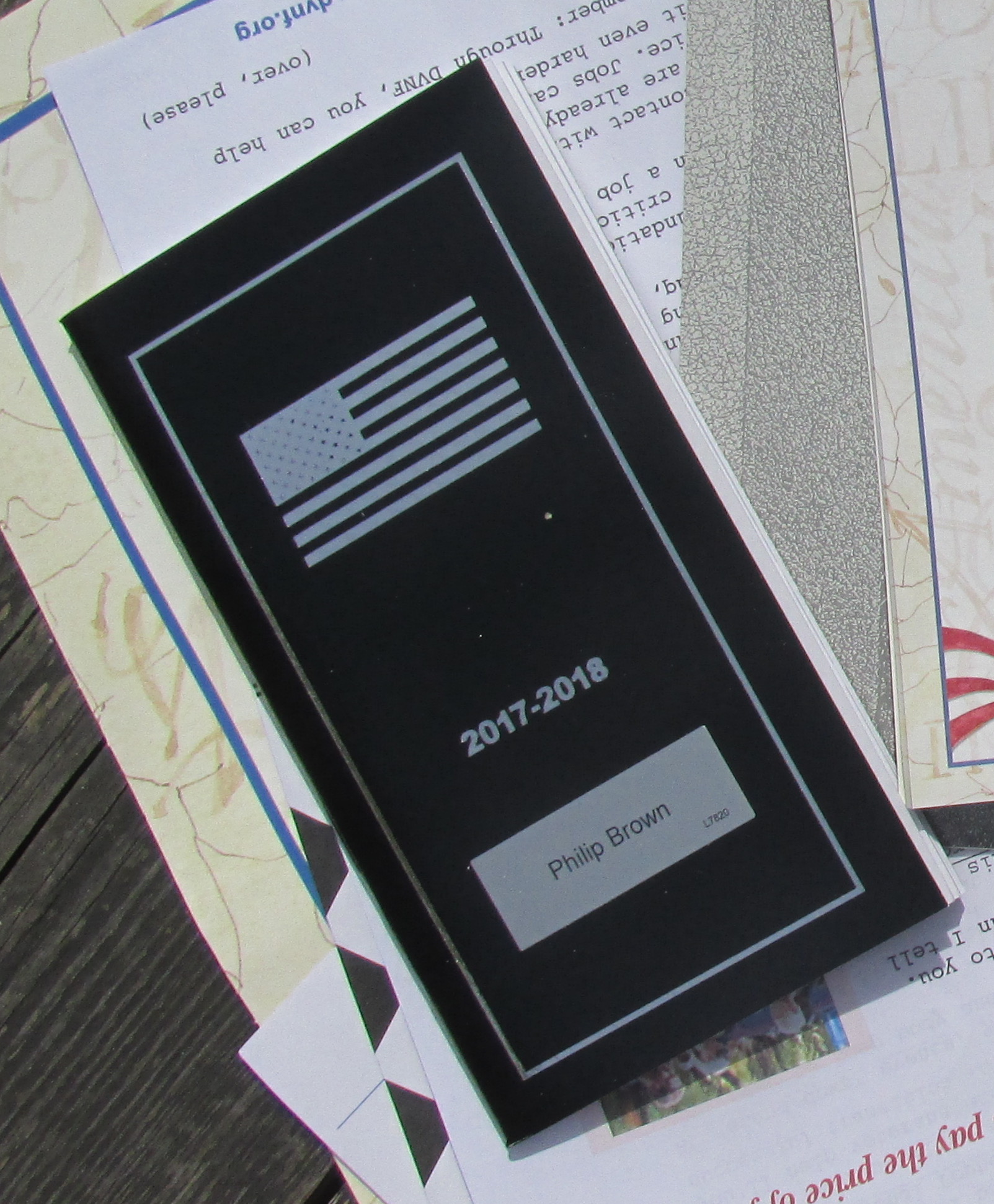
This is a conversion kit, and I am flattered that they have already made me a Gold Circle member. I don’t think I quite deserve that. However, they do, and have sent me a 12″ x 14-1/2″ flat containing a monogrammed desktop calculator, pen and notepad. The calculator works, and my traditional test is ‘PI‘, 22/7 = 3.1428571 which goes to the 7th decimal place. With PI, that’s far enough. They optimistically ask our mailman to deliver to our front door. Good luck with that!

DVNA equips my office with everything but a lawyer.

Disabled Veterans National Foundation
This 12″ x 14-1/2″ faux kraft flat is like a postal trunk sale. It is an acquisition piece. Inside I get the motherlode: a pocket calculator in its own wallet–goes to the 7th decimal place– two pens, a monogrammed 15 month calendar, with silver-edged pages, three greeting cards and envelopes, and a check made out to me drawn on the Bank of America for $2.50. I am verklempt.

DAV’s renewal kit bespeaks lower cost. They have me now.

Disabled American Veterans
This is a renewal notice to the DAV’s Commanders Club. A kraft #9 stuffed with a member card, a small note pad, some tastefully designed stickers, a prayer card, and a certificate stating I am an Illinois Silver member. The preferred ‘ask’ is $50. This kit is confidently on cruise control.

Father Flanagan’s “Acknowledgement”: I envision Spencer Tracy suggesting I try a little harder.

Father Flanagan’s Boys Home “Boystown”
This 8-1/2″ x 12″ kit is as thick as a breadboard. It is not an acquisition piece, because I am a repeat donor, so I put it up to their attempts to get a bigger gift from me, like $60. They send along a wall calendar of the cosiest Sam Trimm bird paintings I have ever witnessed, plus a 30-page puzzle book–21 games, answers on the back page–, a pocket calendar, a one-page, at-a-glance calendar, a 16-page daily planner, a Certificate of Acknowledgement–which I don’t want to over analyze, but I think it really means ‘you can do better’– a second 2018 calendar, with a personalized street sign, two sheets of address stickers, and of course, a letter displaying some gift certificates worth $60 that I should fund.

My Aunt Betty would have liked these.

Father Flanagan..Again
I did not respond quickly enough to the kit above, so Father Flanagan sent me a 6 x 9 reminder stuffed with blank greeting cards. I should point out to the folks at Boystown that these cards are pretty close to what my sadly belated great aunt would have mailed upon occasion, rest her soul. They have hearts, flowers, birds, and butterflies. Again, I should not over-think this, but it’s possible Father F believes I am my aunt.

Lakota designed hosiery. We all need socks.

St Joseph’s Indian School
I have difficulty thinking I am not a “renewal” with these folks. But darn it, they are still working me up with a shiny, red-foiled, hard sell on a ‘triple-up’ mailing. An anonymous benefactor will triple my gift. They would like $25 which will balloon to $75. While this is reminiscent of the stock market, up until last Monday, I am even more impressed by the very snazzy pair of socks which they have included for me. Many may have lost their shirt on the Dow Jones this week, but by golly, I have my socks.

I have to return to snow blowing.  My feet are warm.

Thanks for reading!  If you are interested in these organizations, especially their financial efficiency and clarity, you can check them out at Charity Navigator, Give.org or at their website:

Arbor Day, The American Legion, Disabled American Veterans, Veterans of Foreign wars, Disabled Veterans National Foundation, Father Flanagan’s, St. Joseph’s Indian School.

Standard
Culture, direct mail, Environment, Government, Marketing

Don’t Leave The Lights On

Got a light?

Just a few days ago we received a handy tool from ComEd, our power supplier. We have a light bulb guide.

ComEd’s 3 steps to lighting your home.

What seems like 10 years back, somebody governmental decided unilaterally that we should do away with those high-energy-consuming incandescent bulbs which we have been using since Edison. No longer would we squint in the warm glow of a 60-watt bulb while reading the newspaper.

This was because someone, probably in Shanghai Xiangshan, thought we were better off screwing mini-helical fluorescent bulbs into our light sockets. Touted as energy-saving devices, the ‘cool light’ replacements would use less electricity, and last 5 times longer. Incandescents all but left the market, unless you looked in an old variety store off a back road.

So we were prodded into changing out all the old bulbs.

The bright idea: mercury infused fluorescence!

Once all the houses in America were transitioned over to the helix models, then the mercury sleuths woke up, and said we could not dispose of the bulbs. Because after all, they do burn out eventually, and to my disappointment, faster than claimed. But who’s going to China to file a complaint?

Terrific!

So now the incandescents have returned, like swallows to Capistrano.

From watts to lumens. At the speed of light.

But at the same time, another Edison protege has risen, to suggest disposing again of all incandescents in favor of LED bulbs.  The light-emitting-diode bulbs are very efficient indeed.  Not only do they use less power, but they are also blindingly brilliant.

ComEd has taken the initiative in nudging the switch along by mailing us a helpful little card.  On one side, it converts incandescent strengths to LED, which is like shrinking a bagel to a Cheerio.

It goes from watts… remember him? ..to lumens, which is like from energy consumed to instead, brightness delivered.

A Canadian bookmark for the 1970s, still in use today.

But before I go any further, I just want you to consider a similar transition from ancient Canadian history.  Back in 1973 the federal government, of course, decided to change from Imperial measure…remember the Queen?… to metric.   This was purportedly to rationalize and expand Canadian exports to the non-U.S. metric world of commerce.

I think the real reason was to hoodwink the car-owning public.  We shifted gas prices from 45 cents a gallon to 15 cents a liter overnight– without a shred of understanding.  To further bamboozle the public, the government then commanded that car fuel efficiency should shift from mpg, miles per gallon to… kilometers per liter?….no wait for it,  liters per 100 kilometers!

What the heck is that?

Lenticular: lighting your home, as Kelvin would like it.

Not un-coincidentally, while this huge shell game was in process, the Feds decided to start a government-owned company called Petrocan to sell us gas for our cars!  They bought up all the Sunoco stations, changed the signs, and raised the prices like great Caesar’s ghost.  We didn’t have a clue.

So back to ComEd, which so far is not a government entity.

Lord Kelvin

The other side of the ComEd lightbulb card is a lenticular lens which shows you what your home will look like using LED lighting.  It’s pretty clever, and a great device for direct mailers to use.  When you wiggle the card, it changes the brightness of the living room pictured on the card.

You have three exposures: DAYLIGHT, SOFT LIGHT and BRIGHT WHITE.  Below each setting a number tells you what the bulb’s color temperature is, in…Kelvin?…remember him?

Of course you do.  Water freezes at 32′ Fahrenheit, or 0′ Celsius, or 273Kelvin.

Anyway, we now have a card to buy the right bulbs, defined by lumens and Kelvins.

The only remaining question, how many civil servants does it take to change a light bulb?


Thanks for reading!  Please illuminate your friends by sharing!

Standard
direct mail, Government, Marketing, Media, Thank You, USPS

Their Appointed Rounds

The United States Postal Service closed out their fiscal year September 30.  Never mind that the rest of the world goes by the annual calendar; the USPS wanted to beat the Christmas rush.

All in, the giant continues to perform well, within the confines of its quasi-government walls.  I wish the rest of the Federal government departments spent as much time looking after their own performance and expenses as does the USPS.

But from the latest Revenues Pieces And Weights report, here are a few glimmers of surprise and excitement.

  1.  It is a $69.6 billion dollar enterprise.  In the Fortune 500 list, it hovers around #37, bigger than Target, and smaller than Procter & Gamble, both good neighbors.  Like both of these companies, the USPS is an indicator of the USA’s pulse rate, though we will admit that it has slipped a bit.
  2. In 2017, the USPS revenues fell $1.8 billion.  We know why.  The Web, social media, email have all disenfranchised much of the USPS core business: first class mail and standard mail.
  3. First class mail continues to fall, $1.9 billion.  Compared to last year, it delivered 2.5 billion fewer pieces of mail, a drop of 4.1%.  Why? Because we receive our invoices, checks and statements electronically.  We pay electronically too.
  4. Standard Mail, now called Marketing Mail, dropped 2.6 billion pieces, about 3.2%.  Why?  Last year was a mail-infused election year.  It was distinguished by huge volumes of mail, from you know who, despite his predilection for Twitter.
  5. Overall, in its market dominant categories, that is, where it holds monopoly rights, revenues fell just over $4.0 billion.
  6. In the open competitive markets, ie., parcels and packages, revenues were UP over $2.2 billion, a 12.5% increase.  Wow! Who knew?

The Web Taketh, And It Giveth

Here’s what I find impressive about the USPS.  Despite the constant nagging of the digital futurists who want to write the Obit for the post office, it continues to hold its own.  In an environment where Internet media are running rampant, the USPS has found a broad new niche: parcel delivery, a $20 billion business.  If anyone should be worried, it will be the brick and mortar retail stores. Ask Sears.  Ask Toys R Us.  Ask Amazon.

American consumers have taken to the Web in all respects, but at day’s end, they need physical product delivery, and the USPS has risen to serving that need.  After all, they were coming by our house anyway.  Their two main competitors are UPS and Fedex, the latter using the postal carrier to make the “last mile” delivery.

Neither Rain, Nor Snow, Nor Gloom of Night…

Postal carriers are the only American entity which visit 157,000,000 addresses every day.  They delivered, all in, 149 billion items in 2017.  They lifted 24 billion pounds, or 12 million tons, of physical product: mail, checks, magazines, parcels and yes, live bees and plants. The USPS has over 500,000 career employees and another 140,000 part-timers.  While this may seem like a wildly aggressive employer, I put it to you that the postal employee actually delivers, a claim many can’t make for other government institutions.

So hats off to the USPS.  It continues to fight the currents, and with astonishingly little help from its political friends, it far surpasses its governmental cousins.

Thanks for reading! If you would like to take a look at the USPS 10-K for 2017, click here!

Standard
direct mail, Marketing, USPS

Finally Closing The Mail Gap

Out of town, or at the office, consumers can check their mailbox.

The USPS may be experiencing the continuing shrinkage in mail volumes, especially after the election season spike of 2016. But despite the trend to digital, the folks at L’Enfant Plaza, DC 20590 have come up with a winning service, “Informed Delivery”.

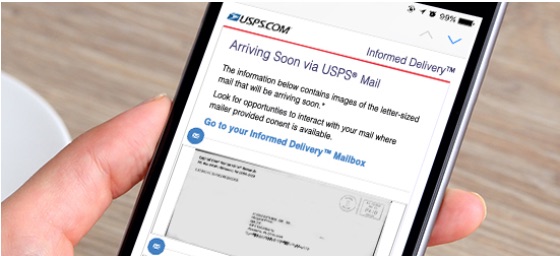
Householders and businesses can receive emails daily reporting what letters have been mailed to them.

You may have thought that Facebook or Instagram are the leading purveyors of new photography– the daily delivery of selfies, restaurant plates, goofy pets and family outings. In fact, it’s the USPS.  It takes approximately 411,000,000 new pictures every day.

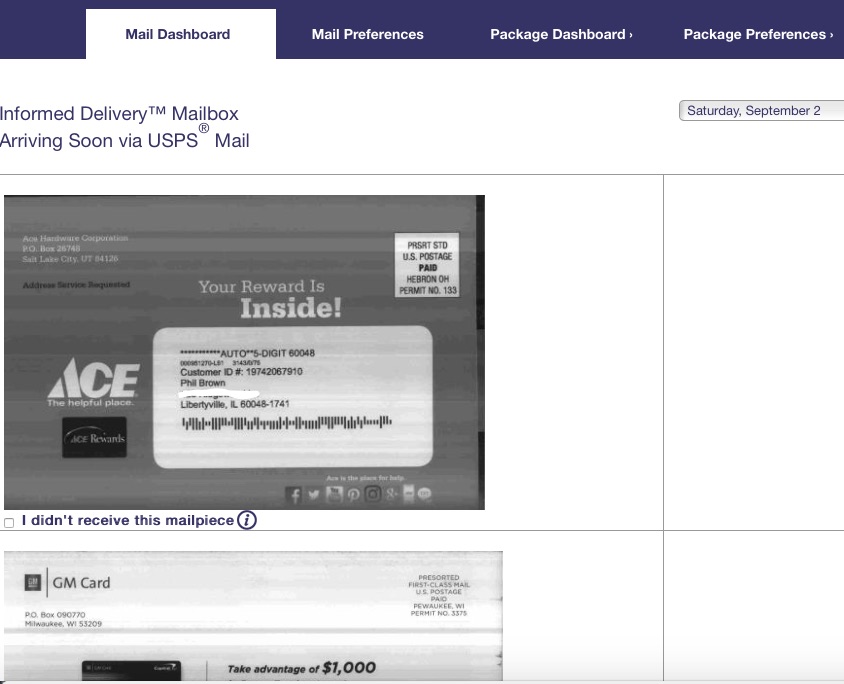
The images are emailed, and also displayed on the user’s web portal.

The automated sorting process for letters relies on instantaneous scanning of a bar code, or a ZIP code. In 2016, Americans dropped 150 billion pieces into the USPS mail stream, and the sortation machinery looked at every one of those pieces and took a quick picture of the bar code or ZIP.

Until recently, those images were probably trashed a nano-second later. But then someone, a marketer, an engineer, a postal clerk, thought, “Hey, we took a picture, let’s post it!” Pardon the pun.

Automation machinery scans the incoming letter-sized mail.

Thus, the invention of Informed Delivery.

Every day, we at our household, receive an email from the USPS advising us of letter-sized mail making its way to us. The email includes an individual JPG of each piece, in black and white.

Now, you may feel that this is a weak attempt, a grasping at straws by a struggling old school business attempting to fight the digital tides. To me, it is enlightened genius. In a move that is worthy of a jiu jitsu artist’s praise, the USPS is using the power of digital to elevate its analog medium.

Every day a USPS email sends a photo album of coming mail.

Christmas Comes Early
For people at home, Informed Delivery may eliminate the excitement and anticipation of walking to the mailbox. ‘Kind of like peeking at your Christmas presents under the tree a few days before the event. Still, the service lets you know that a letter, check or invoice you are waiting for is definitely on the way. It also allows you to look at your mailbox, or mail-on-hold while you are out of town. ‘Kind of like scanning your voice mail–and you know you do that.

Many Happy Returns
Direct marketers will love Informed Delivery. Rather than waiting for the physical replies to show up from their latest mailing, they can see the reply envelopes as soon as the consumer drops it back in the mail. Admittedly, marketers can get digital reports now of bar coded reply mail, but Informed Delivery shows which replies, as there may be many outgoing mailings occurring simultaneously.

The USPS harnesses a digital app…who knew??

A Stronger Pitch
Every marketer considers the orchestration of messaging. We want to integrate email, social media and direct mail to complement a retail sales event. Informed Delivery alerts consumers by email of a coming promotion. The front of the envelope is the ideal canvas for the first tease of the event.

Intelligence At HQ
It should be pointed out, that if I have a dashboard of my incoming mail, so does the USPS. While you may worry that the USPS knows what I get by mail, I don’t. But if postal reform ever does get passed, the USPS may be able to offer user privileges to recipients based on the volumes of mail received. After all, if you do receive a lot of mail, you are a likely advocate of mail delivery, and to the USPS, that’s a high-five.

Kudos to the USPS on this latest innovation.  My bet is that as it takes hold, it will be leveraged, much to the benefit of one of America’s oldest and revered institutions.

Thanks for reading and sharing! If you want to see the Informed Delivery package, click on this!

(All pictures shamelessly taken from the USPS email and my personal portal.)

Standard
direct mail, Economics, Fundraising, Marketing, USPS

The Mysterious Cost To Raise A Dollar

The tiny silver disc leapt from the shelf.

The convolution of three events today raised my antenna that there is a superior organizing force out there that is directing our path as we hurtle through space.

As I was cleaning off our bookshelf, a small battery dropped to the desk. These are the tiny nickel-cadmium dots that we find in cameras and calculators. Not the larger lithium incendiary bombs that we have in our laptops and hover boards.

The calculator that failed to light up.

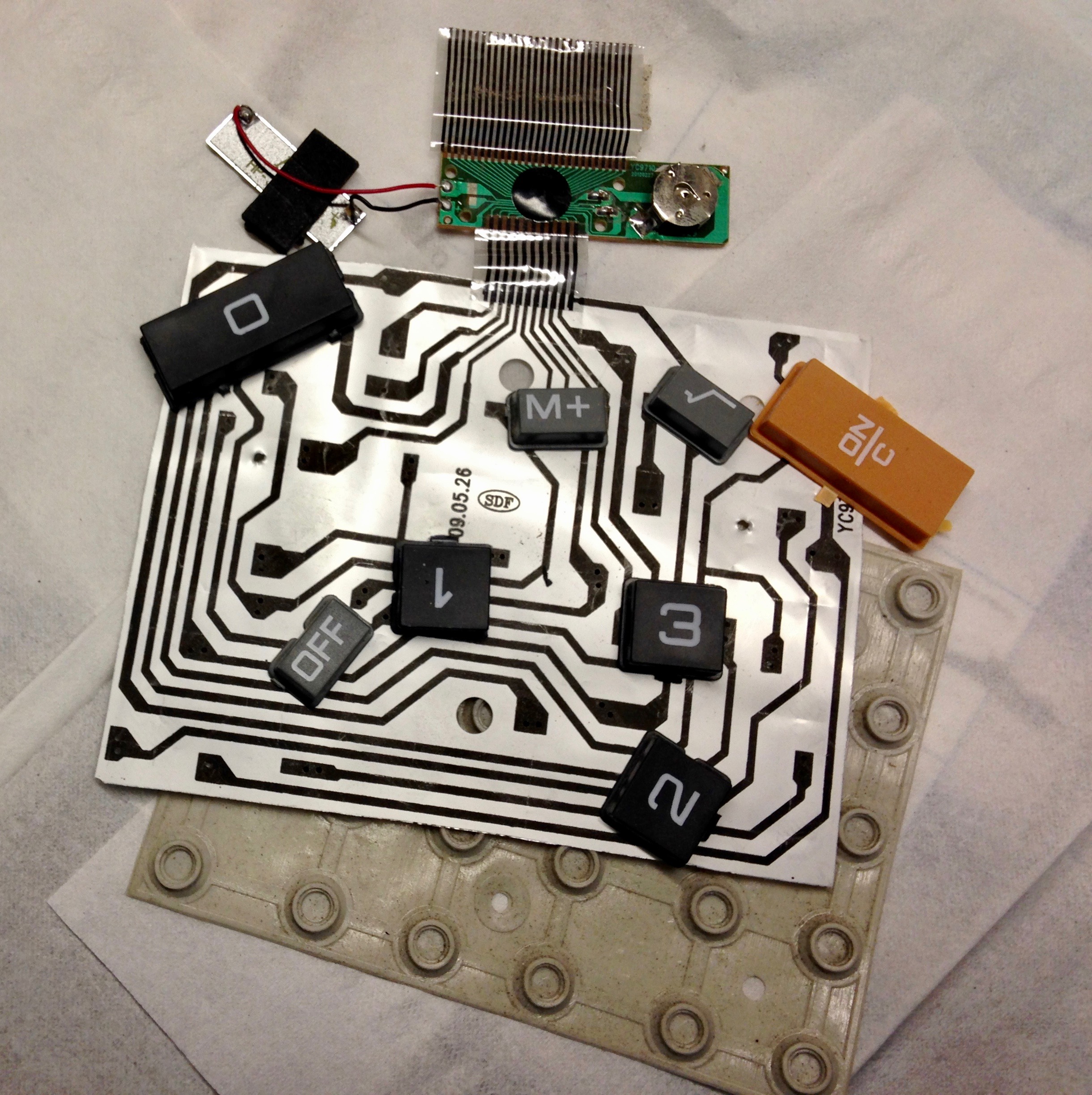
The battery was all that was left of a calculator I tried to resuscitate a few months ago. When the machine didn’t light up, I undid about 9 tiny screws to retrieve the battery.  As I popped off the back, the entire calculator sprung into a hundred pieces of keys, buttons and circuit board.  Incalculable.   I saved the battery to take into the hardware store for a replacement, just in case the calculator could be reassembled.

The next thing that happened was while emptying out the washing machine, we discovered that I had left my Moleskine diary in my shirt pocket. We retrieved the diary cover, very soggy, and found the rest of its contents spread like a million flakes of oatmeal over all our clothes. So much for keeping notes on paper.

A misadventure, attempting to extract the battery for replacement.

As the morning progressed, Lonny the mailman came by, and stuffed our mailbox with lots of missives from people we don’t know, but asking for money. The largest piece in the delivery was a giant, lumpy, shiny, pebbled envelope from Disabled Veterans National Foundation.

The DVNF package was an exceptional “Flat”: 12″ x 15″.   So huge that all the other mail was folded in with it.

In direct mail, size counts.  So I opened it immediately to find, mirabile dictu––another calculator!  And—- another diary!  Wow.  I am completed.

The Mystery of Fundraising By Mail

After admitting that the USPS may be a supernatural force, most would ponder the imponderable: how does DVNF get away with sending out calculators, books and notepads, and expect to earn any money for their cause?

A “max flat” the 12 x 15 kit is shiny, pebbled and lumpy. It was folded to fit the mailbox.

That, dear reader, is one of the great mysteries of direct mail fundraising, and one that I will unravel for you now.  All you need to know is what the package really costs, response rate and average dollar gift amount.

To calculate the cost, I first took the kit down to the USPS post office for an official weighing.   Ranjit asked with a jaded smile on his face, “Why?  Do you intend to sue them?”

“No.  I want to calculate their postage, and how much this whole thing cost in the mail.”

Ranjit replied, “It’s non-profit, but don’t kid yourself, they are making money.”

I pulled out the new calculator and said, “Look at this!  That’s gotta cost a buck anyway…”

Ranjit smirked, “Nope.  Twenty cents.  About $2 dollars a pound. It’s from China.”  We weighed it: 3.3 ounces.  “That works out to 40 cents, ” I figured.  Ranjit countered, “OK so maybe $1 dollar a pound, that’s 20 cents.”

A new pocket diary, calculator, memo pad and pen, all personalized.

I stared at him as I pondered that number.  At the same time Ranjit extended his arm across the counter to flash a beautiful bejeweled wristwatch, sparkling in buttons, numbers, dials, and a bright yellow face.  “How much do you think this cost?”  He smiled.

“Uh, I don’t know.  Ten bucks?  A nickel?   79 cents?”

“Close.  It cost me $2 dollars.  Made in China. I bought 5 for $10 bucks, each a different color, for every day at work.”

Smitten with this new-found knowledge of international commerce, I bid him a good day and took my 20-cent calculator back to the car.

The whole mail kit, which included the calculator, the notebook, DVNF pen and some letters and envelopes weighed 9.1 ounces.  According to the USPS, this Flat was part of a 3-digit automation scheme, so I estimate the non-profit postage was about $0.59 a piece.

This pocket diary replaced the soggy Moleskine in a nick of time.

The envelope was made in China, as was the notebook.  Without asking, one can only guess that the components all assembled, shipping included, must have cost around $2 dollars.  Add another 50 cents for the 5-way match on name (envelope, calculator, notebook, donor form and notepad) and you have a kit that surely cost over $3 dollars to put in the mail.

And Now, Using The New Calculator:

That’s $3,000/m for you printers out there keeping score.

The donor form offers a $2.50 check as a tempting diversion. But they want $15-$25. Go figure.

When most mail kits ring in around $0.35 cents each, $3 dollars is a hefty challenge.   In their calculations DVNF finds a breakeven point by dividing the total cost of the kit by the average gift amount.   Looking at their donor card, they suggest a gift of $15-$25.  Taking the lower end, their breakeven response is $3/$15 = 20% response.  At the higher end, 12% response.

12% – 20% response is a steep hill.   This particular charity is known for its high fundraising costs.  According to Charity Navigator their fundraising efficiency is $0.71.  That means for every dollar raised, they spent 71 cents.

For this package, that translates to $3/.71 = $4.23 raised for every piece mailed.

If their average gift is $15, then their response rate would be $4.23/$15 = 28.2%.

And at $25, the response is 16.9%.

There’s no way to be certain, and DVNF is unlikely to share their response results.  But the package itself is a donor acquisition kit.  That is, a high pressure sales pitch to get a new donor.   If indeed it did generate a 28.2% response rate, with a gift of $15, the cost per new donor is:  ($4.23-$3.00)/28.2% = $4.36, which is pretty darn good, if not downright incredible.

It also follows that every new donor will be repeatedly contacted for further donations, which over time, leads to a real surplus, destined for program expenses that support the disabled veterans.


Thanks for grinding through these numbers with me!  Please note that Disabled Veterans National Foundation should not be confused with Disabled American Veterans.


Standard
Culture, direct mail, Marketing

USPS: It’s Worth The Weight

Flipping through old photo albums is a fearsome task. We used to look better. The forces of gravity and time didn’t seem so obvious.

The post office isn’t immune from these effects either, but it is still eye-opening to see how direct mail has aged with some elegance.

Direct mail dropped 22% in the past ten years, but First Class dropped even more: 37%.

I took a moment to compare 2016 USPS results against 2006. If you are a USPS employee, a printer, or a person who lives by the mailbox, read on.  By the way, I converted these to a normal calendar year.

We all associate the USPS with letter mail: invoices, statements, and personal mail. This past year, the USPS delivered 62 billion First Class letters. Ten years ago– 98 billion letters…a 37% drop in personal mail.

On the other hand, direct mail only dropped 23 billion pieces, or 22%.

But here is where direct marketers have managed to carve out a path to serve some 150 million homes and businesses with advertising every day.

Direct mailers have managed to make a respectable living with the USPS by slimming down. While the rest of the world has acknowledged that our bodies are bigger than in the past, direct mail has successfully dropped a few sizes.

To wit: in 2006, the average piece of direct mail weighed 1.86 ounces.  By last year, that had slipped 15% to 1.55 ounces.

Direct Mail has slimmed down in the past decade.

This may not seem like a big deal, but it reveals a lot about the reading public.  Direct mail designers have essentially cut down on paper and ink.

Envelopes are smaller, and contain fewer pieces.  In fact, Flats, which are larger than 6-1/8″ by 11-1/2″, dropped a staggering 51% in the last 10 years, down from 13 billion pieces to 6.3 billion.

The landfill protesters and tree huggers have to be thrilled.  But despite their glee, most direct mail is entirely recyclable, and much of it is made from post consumer waste paper anyway.

The super-sized Flat, large enough to hold a placemat is fading.

The rapid weight loss has provided a financial dividend for the USPS.  In 2006, the revenue per ounce was $0.107.  Ten years later it is $0.139, which is 12 points better than the rate of inflation.

The irony of the slimmed-down direct mail piece is that the USPS charges the same postage for a 1-ounce letter as it does for 3-1/2 ounces.  This would be the same as your favorite airline designing all the seats for a 300-pound row mate.  You know that is not the case, but the USPS is much more generous.

Given that allowance, it would make sense for direct mail designers to plump up their product.  Postage is the highest proportion of the in-mail cost, yet it is not leveraged.  Instead, parsimonious design has cut out the frills and treats that used to adorn productive direct mail.

My trips to the mailbox are disappointing.  It’s all two-dimensional post cards.

New age designers have lost the urge to embellish the kit, forsaking the 3.5 ounce opportunity to “load it up” like these.

What you don’t see anymore are great works of art that pleased and intrigued the reader.

The stuffed envelopes have been flattened.  The labels and stickers are gone.  The samples are gone.  The origami is muted.  Member cards, scrapped.  The shiny foils no longer announce a prize.  The extra letters and testimonials are removed.  The textures are smooth and sterile.  Reply envelopes?  Naah….go to the website.  Brochure?  Website.   Buck slip?  Phifff–what’s a buck slip??

So direct mail has entered its age of demur elegance: slim, sleek and stylistically boring, but somehow pleasing to the agency head who doesn’t absorb sentences longer than a gnat’s breath.

An experienced designer once told me, “you will make more money by adding to a kit than you will by taking away.”  What would he think today?

But let’s give the contemporary designer their kudos.  They have won the war on weight, but they have lost their way on  beauty and bucks.


Thanks for reading!  Please share with your direct mail associates.   Just like people who have rediscovered the beauty of vinyl records, there will be a time when “gangbuster” direct mail will return. 

Standard