Marketing, Media, Politics, Sports

We’ll Never Hear About Those Balls

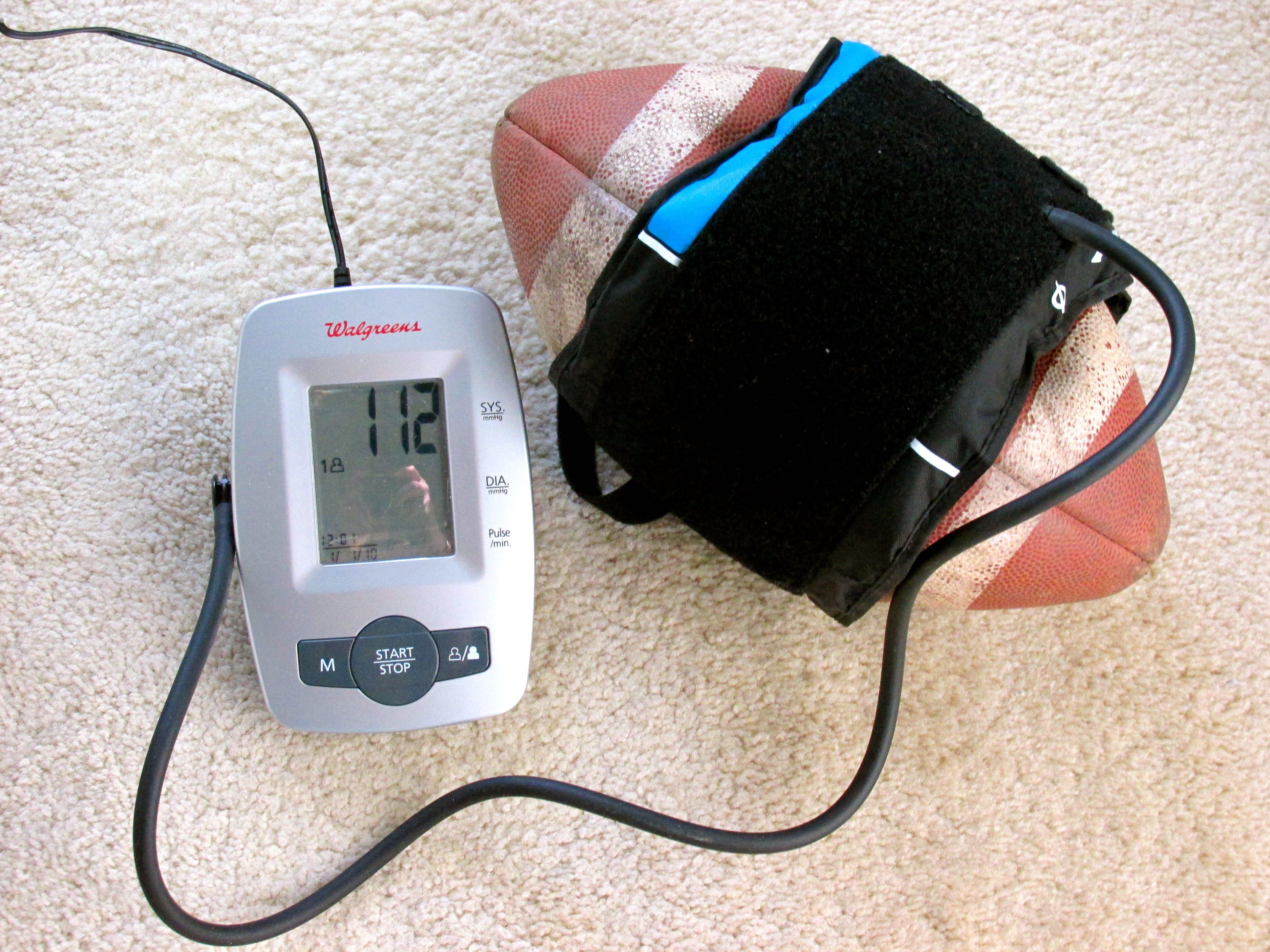
Ball Pressure

Hypertense?

January 18, 2015 the Indianapolis Colts had their hats handed to them by the over-ripe New England Patriots. Moments later the incredible tale of the deflated game balls levitated the media for two weeks until the Super Bowl eve.

Sherlock1

“Quickly Roger! The game is afoot!”

By then, suspicions were suspended long enough for the NFL to crown Tom Brady, dispense Rings, get Bill  Belichick a new hoody, rush Roger Goodell back to his limo, hustle Katy Perry and her Sharks back into her bus, pack Lenny Cravitz into his box, and to astutely hire Ted Wells, locker room attorney, to chase down every possible lead to get to the bottom of this horrifyingly regrettable schmozzle, and effectively bring a calm rational end to the controversy that has rocked the very foundations of the NFL.

In other words, kill it.

Mr. Wells however has been diligent, and we have been able to get an inside look at his case book.  Dates are omitted, but you can follow the subject line pretty well:

Iron Ball

Volume X Temperature = Pressure

~ Pigskin or Naugahyde? ….  Steer hide!   Who knew?

~ Cage free steers… more relaxed?

~ Check laces.  Proper bow?

~ Left handed or right handed balls?


~ “Let it Go”… Roger singing this…why?

~ Bratwurst steamer in locker room.  Why?

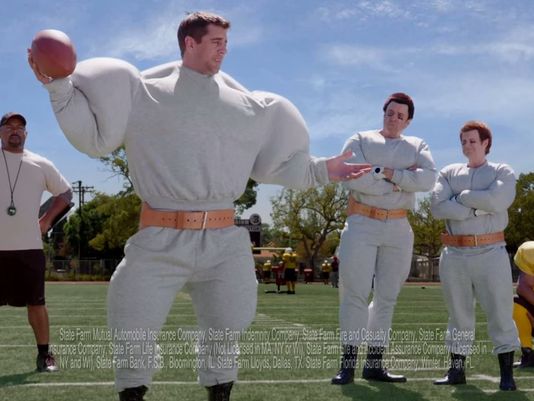
Aaron Rodgers

“I had trouble getting these in so I bled them off a bit…”

~ BP station in Glendale.  Check pumps.

~ Gluten free steers… more relaxed?

~ State Farm “Pump You Up” commercial.  Code?   What’s with Aaron Rodgers?

~ Belichick… Ideal Gas Law??  Physics degree??

~ Mythbusters test lab– put in call 

~ Mental state of footballs?

~ Presidential PAC for Roger.   Too much?

Mythbuster Lab

“Yunno what we need to try next?”

~ Get plane tickets, sunscreen

~ Set up out-of-office voice mail

~ Empty shredder

   The report may come out soon, but it will be as light as the victimized footballs.   The next time we hear about the infamous footballs will be on Cold Case, or on Discovery Channel’s expose on Stonehenge.  Stay tuned!


Standard
Media, Politics, Sports

Complicated Is Right

blue_bloods_cbs_dinner_a_l

Will Estes and Tom Selleck tackle a dilemma.

Our favorite TV police commissioner is Frank Reagan (Tom Selleck, Blue Bloods, CBS) who presents at least one pithy moral judgement at the Reagan family dinner table on Sundays.   Lately, he said: “Doing the right thing may be hard, but it’s not complicated.”

So it probably was hard, and not complicated for NBC to say ‘anchors away’ to Brian Williams, who will go without work or pay for 6 months.

As a loyal fan of the NBC News show, I will miss Mr. Williams, but at the same time, the quick action of his management will save his reputation for another day.   (It begs the question, when he returns in August, will he have a weathered tan, beard and shaggy hair, shod in Birkenstocks?)

This week the American audience had another cold shower when the International Little League stripped the Jackie Robinson West baseball team of their 2014 U.S. Championship title.

The flames haven’t quite burnt out in this issue, as a legal suit is now underway against the League contesting the decision.   But there might be kudos for the individual or group who made the vacating decision.   We’ll wait to see.

In these two instances however, one must respect the gumption of the decision makers, to essentially throw away the enormous investment of public goodwill and the positive momentum directed at both Williams and the Little Leaguers during their respective arcs.

The Jackie Robinson West team, reputedly disadvantaged Chicago south siders, practiced and played their way to the top of the heap, a great story.   Brian Williams, hardly disadvantaged, but still trusted and loved as America’s #1 rated news anchor… could he just be a celebrity entertainer after all?

These are huge disappointments.   But due to some tough decisions, the integrity of the Little League, and of the NBC News can be preserved.   There won’t be any nagging thoughts and “yeah-buts” in the future.

Which raises another troubling question: what about those deflated footballs?

Is it possible that the NFL will escape the painful compression point of making a decision some day?   Does the investigation, effectively in place since January 22, continue long enough that the public loses interest as MLB Spring Training hovers on the horizon?

It must be tough in NFL headquarters, especially when the public saw one of the best games ever, with impossible catches, Tom Brady with his 4th Super Bowl ring, Katy Perry and her sharks, and the incomprehensible Lenny Kravitz dazzling us at half time.

Against that euphoric background, and pumped up with countless $4.5 million ad spots, it will be very, very hard for the NFL to stick a pin in the balloon if the investigation turns up any factual details of malfeasance.

In the mean time, we’ll coast through to the next Super Bowl, but always with a nagging thought, a “yeah-but” on our conscience.

Which brings me back to another observation that Frank Reagan tells his family a week later at the table: “Doing the right thing is easy.   Deciding  what is right is hard.”


Just my point of view obviously, but tell me if you have another perspective I didn’t consider.  Thanks for reading!

Standard
direct mail, Economics, Media, Politics

Found: The Hidden Miracle in the USPS

Spoiler Alert: This Is A Good Story About Numbers
Every year the media touts the headline that the United States Postal Service lost another few billion dollars. Politicians get huffy. The digerati are quick to call the funeral home.

But in fact, the USPS has accomplished an amazing business coup in its mail delivery management.

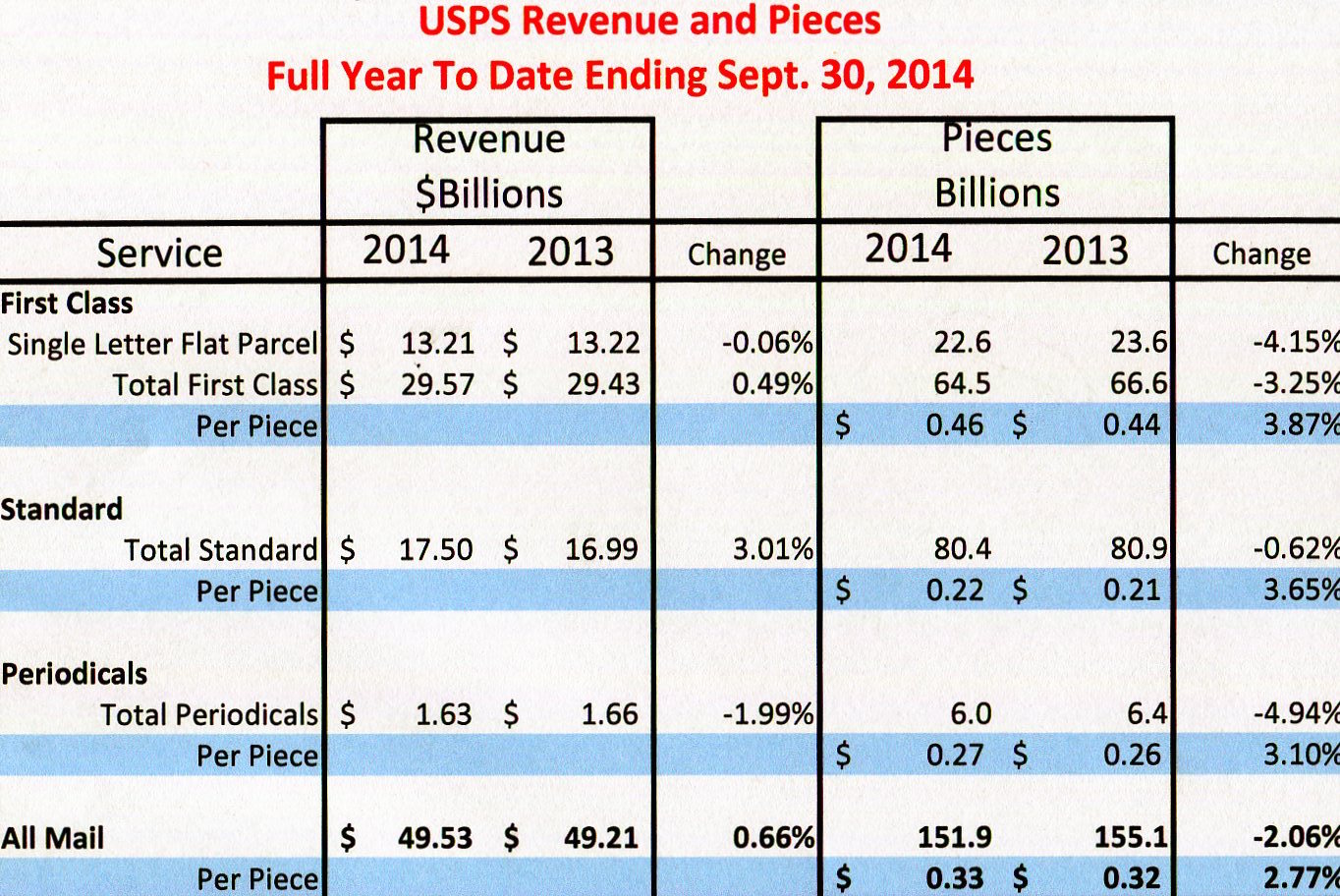
First, look at the current “bad news” available in the latest Revenue, Pieces and Weights report* for USPS full year 2014.   Figure 1 gives some highlights.
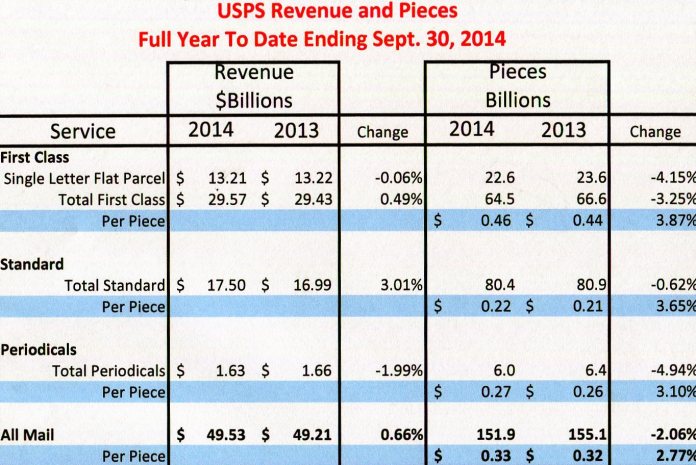
Fig.1.  2014 revenues were up 0.66% while volume fell 2.06%

Fig.1. 2014 mail revenues were up 0.66% to $49.53B while mail volume fell 2.06% to 151.9B.

Mail volumes decreased from 2013 to 2014. A 2.06% decrease to 151.9 Billion pieces. “Pieces” include letters, parcels, magazines and flats. The shrinkage may be attributed, if you wish, to a blended increase in price (postage) from 32 cents to 33 cents per piece. A 2.77% increase. But it probably has more to do with society’s use of email.   We would just as soon email Gran a singing birthday gift card as send her a parcel.

Dig deeper and we find that First Class volume shrank 3.25% while actual revenues increased 0.49%.

Postage per piece went up 2 cents, or 3.87%

What we know about mailing economics is that there is no elasticity. When postage goes up, volume goes down.

This is the fundamental truth of direct mailers. They maximize performance through testing list, offer, format and copy. The best performance becomes the economics benchmark. So when Standard Postage goes up 3.65%, we expect some mail to drop out, which it did: 0.62% less.

Amidst The Bad News, A Twinkling of Brilliance

November 14, the USPS presented its preliminary financial results to the Board of Governors. It declared a $5.5 billion loss in income. That made headlines. What was not picked up however, was its mail operations performance. You see, its operations income was $1.4Billion profit.

What that means is that the USPS moved nearly 152 billion pieces across the country to over 140 million addresses, six days a week, and did better than break even. What was the all-in price per piece to the mailer? 33 cents.

2004 Eye Opener

Now lets look at the real miracle of the USPS by comparing 2014 with 2004.

Ten years ago, it delivered 206 billion pieces for $65.87 billion.

Cost back then? 32 cents each.

Not bad! A one-cent increase in 10 years. Despite a 26% decrease in economies of scale, its performance eroded only by a penny.

Surviving The Ravages of Inflation and Restructuring

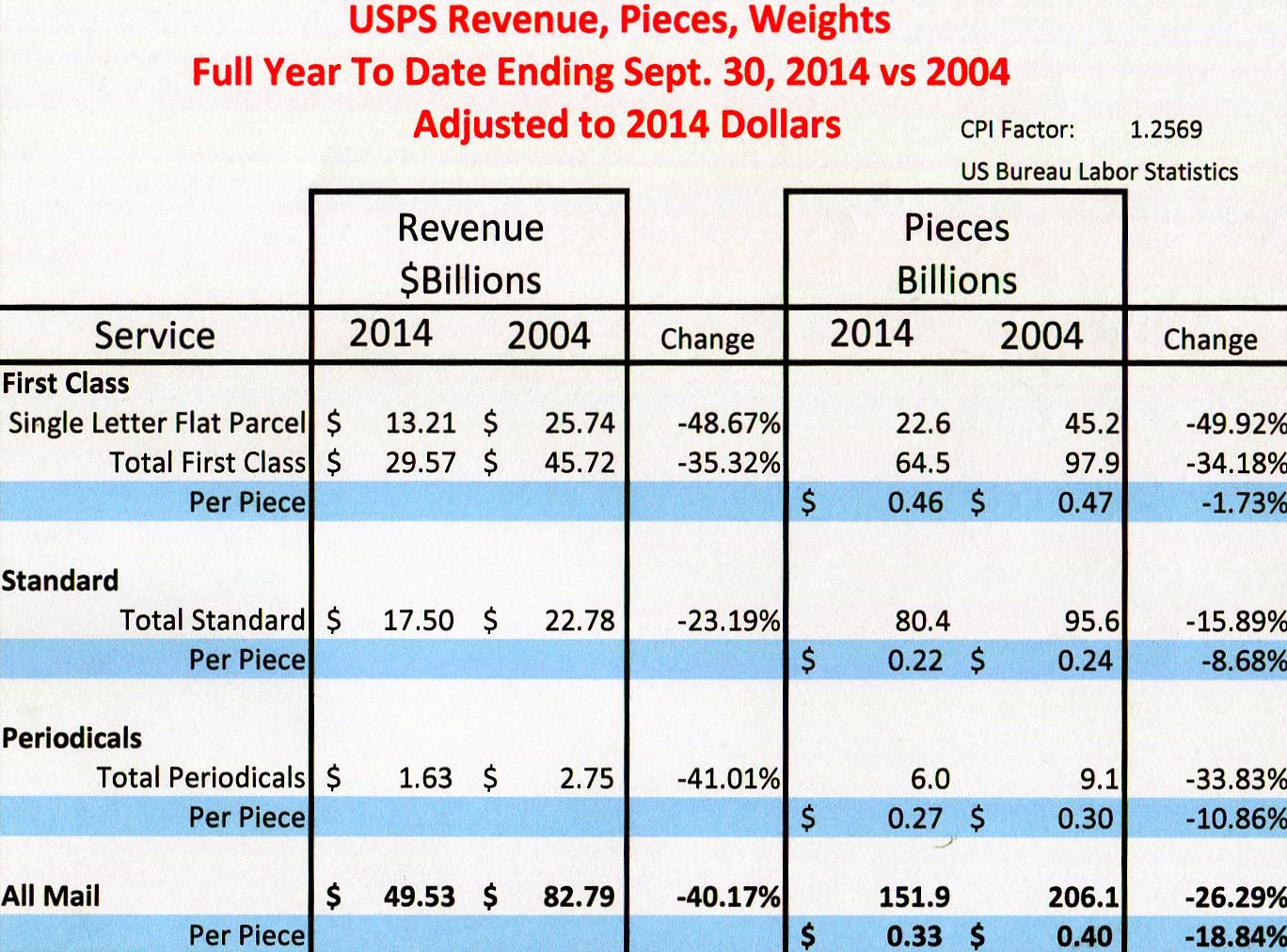
This does not begin to recognize the efficiencies the USPS has managed to achieve in the last ten years however. It disregards the massive cutbacks in volume, and the inexorable devaluation of the dollar. Look at the 2004 figures when they are expressed in 2014 dollars.  See Figure 2.

Using 2014 dollars it cost 40 cents to a mail apiece in 2004, versus 33 cents today.

Fig.2  Using 2014 dollars it cost 40 cents to a mail a piece in 2004, versus 33 cents today.

According to the US Bureau of Labor, we have experienced a 26% increase in prices. In other words, it takes $1.26 today to purchase what $1.00 would buy in 2004.

Applying the CPI to USPS figures then, we find that in 2004, it cost 40 cents to mail a piece, versus 33 cents today.

Standard Mailers would pay 24 cents in 2004 versus 22 cents today. First Class mailers would pay 47 cents, versus 46 cents today.

Magazines: 30 cents then, 27 cents now.

USPS: Economic Movement of Value

This government agency may have its critics.   The oracles may claim that mail is antiquated.   But they can hardly explain how well the post office has learned to distribute real property coast to coast at ridiculously low cost to the consumer.   Email and Internet may be instantaneous, but they both lack the credibility of hard copy delivered under government seal.

It can be said that mail is slow, but it maintains its cache because it is trusted.   We need to acknowledge the effort that the USPS has expended to bring us that service.


*The Revenue Pieces and Weights Report: http://1.usa.gov/1A8wEj1

Standard
direct mail, Marketing, Politics

Fall Seat Sale: The Check’s In the Mail

RNC  558

A dollar a seat… get ’em while they’re hot!

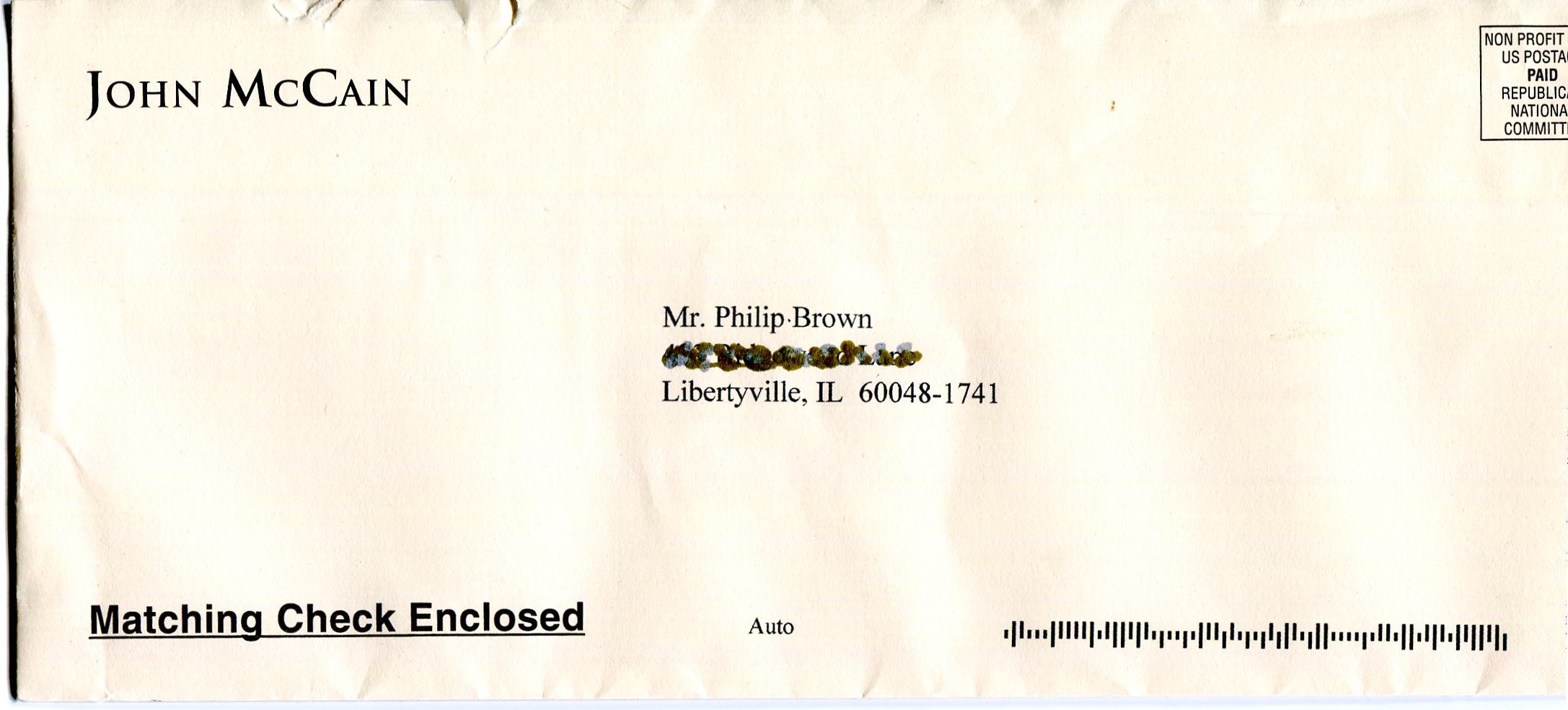
My walk to the mailbox today was rewarded with a letter from John McCain’s desk.

It was especially exciting to get his letter, because he enclosed a personal check!   Usually this works the other way around.

Anyway, I opened his letter to find a check for $36 bucks.  Unfortunately, or fortunately, depending upon your political stripe, it was made out to the Republican National Committee.

This is a very crafty gambit.

RNC  561 copy 2

Is it really the desk writing?  I wonder.

Seldom do we receive checks, and this one, measuring a modest 6″ x 2-3/4″ looks like the real thing.

What I liked about the approach of this fundraiser was the rationale.   The U.S. Senate has 36 seats up for grabs in the mid-term election, and McCain is donating a dollar for each seat.

I know, I know.  It should be more, but hey, have you seen his suits?

Sartorial comments aside, the dollar-a-seat strategy is a door opener for the tight-fisted, like me.   He is asking me to match his donation.

But I am puzzled. The RNC goes on to say it requires only $8,000,000 in the next ten days.  This seems like chicken feed compared to the dollars normally needed to buy an election.   I hope they know what they are doing.

RNC  557

The envelope needs to be opened, just to see the check!

In any event, they are counting on 222,222 folks like me, at $36 each, to respond.   At a 2% response rate, they must be asking over 11 million people.

I will leave the financial logistics to the back room guys.

I would point out, however, that after wresting $36 from my cold, thrifty mitts, John could have at least coughed up an additional 49-cents for the stamp on the return envelope.

A stamp! A stamp! The Senate for want of a stamp!

A stamp! A stamp! The Senate for want of a stamp!

You see, the face value of a stamp may seem like a lot to the RNC, but in this case, each one is worth $36 dollars.

Don’t forget to vote!

Standard