direct mail, Economics, Marketing, Thank You

Ten Reasons You Should Thank The USPS

Teddy StampWe are all cheesed that the USPS is looking for a 1.97% increase in postal rates.  But before we run to our social media to complain, let’s open the envelope.  What are we getting?

1.   Door-to-door, pick-up and delivery.   Not only does a real person come to your home to deliver mail, but they are charged to pick it up, too.   Beats driving downtown.   And they do this 6 days a week.
2.   Equal representation.   The USPS is probably the only government institution which situates an office based on population density, rather than political handouts.  For sure, it’s the only federal presence in your community that isn’t there to administer laws and levy taxes.

3.   Legal authority.   A USPS postmark is an official seal, and when your letter is in the system, it’s a completed act.

4.   Jobs.   The USPS employs over 600,000 people.   It’s also the network that directly supports another 1.3 million people who use the mail to make a living, according to the Direct Marketing Association.

5.   The Grid.   There are 142,000,000 delivery addresses in the United States which are visited daily by the mail person.   The USPS grid is like a vast capillary system that beats nationwide, touching the most distant extremity.

6.   Innovation.  Maybe hard to believe, in the face of digital networks, but the USPS has refined and streamlined delivery to the point that it is cheaper to mail a letter today than it was 10 years ago.

7.   Protection.   Your mail is protected by federal law.   The space inside your mailbox is federal property.  The blue boxes situated across your community are safety deposit boxes, in effect.   Drop your mail, and it’s secure in the system.

8.   Culture.   What other government body continually picks new designs to celebrate on the face of a stamp?   Rock stars, writers, artists, scientists, athletes, discoverers… and they are BIG stamps too!

9.   Resilience. Despite a whirlwind of communications technology advances, the USPS still has cache, delivering nearly 500 million pieces a day.   When was the last time you saw a public phone booth?

10.   Fiscal control.   Yes, it has a $5 billion budget deficit.   Works out to $8,333 per employee.   The federal government has a $483 billion budget deficit.   $112,013 per federal employee.   In the bigger scheme of things, go figure.

Nobody likes price increases, but it is a sure thing that the USPS has done leagues more work to control costs than any of its government cousins.  In light of its value, can you really complain?

By the way, the price of a first class stamp remains at 49-cents after the hike.   Good anywhere in the nation.  Buy a bunch, they’ll last forever.

Standard
Marketing, Media, Music

Oh-Oh-Oh-Oh-Ugh.

There is a disturbing movement sweeping the air waves.   You may have just heard it in the background one day, the cheerful, melodic moan of a faceless, happy chorus singing “oh-oh-oh-oh-oh”.

I missed the first occurrence: Philip Phillips delivering his blockbuster “Home”

with a long, triumphant chorus of “oh’s”.   But I did catch it when American Family Insurance adopted his tune, sung by what seemed the entire Morman Tabernacle Choir to drill the melody into my insurance-saturated brain.

Fine.   Phillips and AFI hit it off.

But now the oh-ohs are a virus, spreading across the music stage, and frankly, few performers get it right.  Nevertheless, they include their attempt at oh-oh, because the recording studio asked for it.

MacCauley Culkin

” ‘Oh’– a catchy phrase, with infinite potential.”

Or it could be that the writers’ union has gone on strike.  No more chorus lyrics!

And if it’s selling music, it must be selling burgers, phones and cars, too.  Just ask McDonalds, T-Mobil and Nissan.  They all have their own oh-oh theme right now.

Atlanta Chop

“Oh, oh, oh, oh, oh, oh–once again, with feeling!”

Looking for the source of this mono-syllabic drone, one could guess that it was the Atlanta Braves fan club that mass marketed oh-oh with their jubilant “Tomahawk Chop” song.

Any pitcher-batter contest was unnervingly accompanied by the 6-tone refrain, delivered by 40,000 spectators motioning like one-armed bandits in a therapy session.

meowmix

“Just the sound of it makes one salivate.”

Still, it could also be a tip of the hat to the feline chorus that gave us the MeowMix anthem.  This little ditty has soothed and inspired us for over 30 years.  Let’s hum a few bars.

benhur1

“On the downbeat, gents!”

Digging deeper into the past, it could be the hearty and beloved   rowing songs that floated up from below the salty decks of huge Roman galleys charging toward some hapless fishing dinghy in the ancient Mediterranean.  “All together now, lads!  Oh-oh-oh……. crunch.”

Slaves Pyramids

“Now I know what they meant by ‘chorus line’!”

Still, oh-oh’s roots could hark back even earlier to the carefree days of the Egyptians, toiling together, sliding 20-ton obelisks across films of hot bull fat with the help of a team of 200 melodious Ethiopians, in full harness.

“Now that is a Sphinx!  Let’s give a hearty rendition of Oh!”

My hunch is that oh-oh will eventually go away, when the human ear finally grows flaps, or the alphabet is re-written, eliminating “o”.

Mean time, I am playing nothing but Bobby Ridell and Beach Boys.  They were into “oo”.

Thanks for reading along!  Feel free to comment.

I hope you don’t have trouble sleeping as oh-oh runs around in your head all night!  


Standard
direct mail, Economics, Marketing

How You Make Personalization Pay Off

Boystown CALENDAR HANGER

A 24-page color calendar, replete with country roads, cabins, barns, flowers and birds…lots of birds.

Personalizing a mail piece comes with expense. You are about to see the motherlode.

Gracing the letter with the reader’s name is one thing, but it’s quite another to match that to the envelope. For the fully committed direct marketer, there are personalization payoffs, and Father Flanagan’s Boystown shows us how.

Boystown Envelope

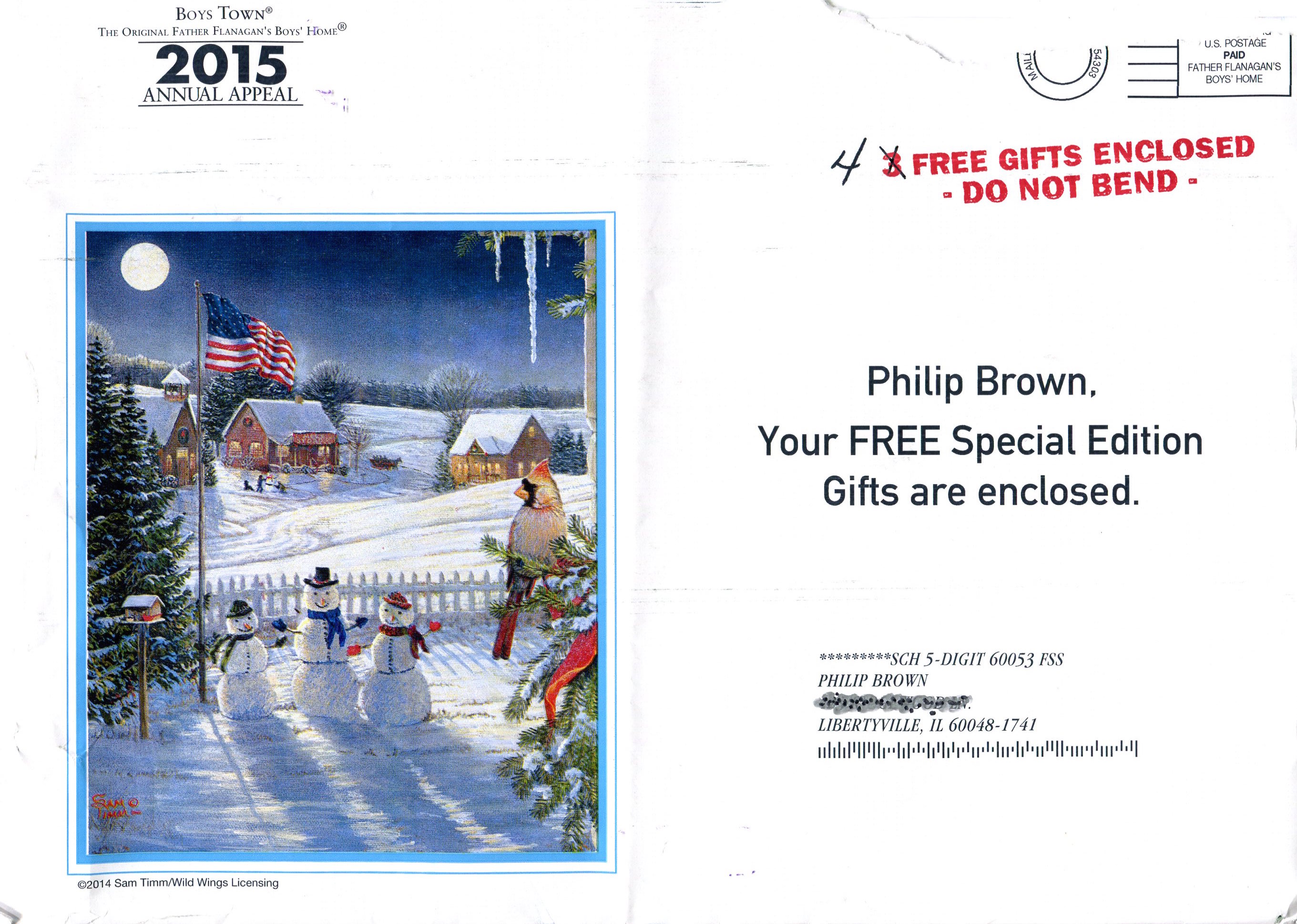
An outer envelope promising lots, and delivering, too.

BoystownBooklet Bird Jan

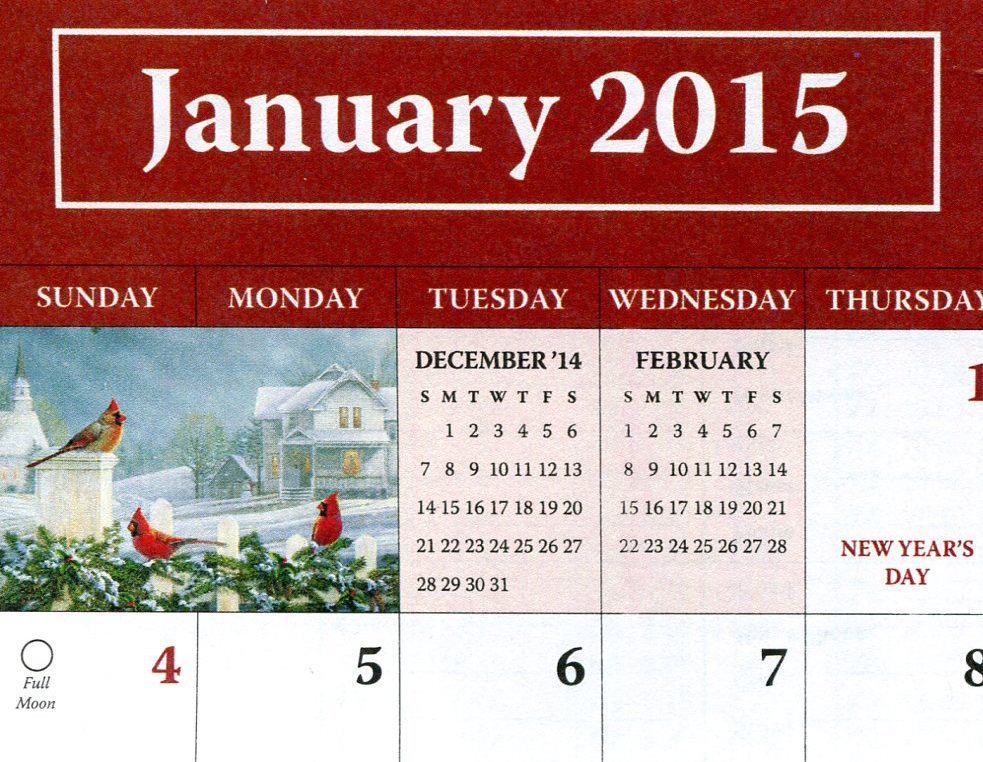
January.. from the 36-pager booklet, with more birds…growing in numbers.

Just before Christmas we received a 9 x 12 envelope from Boystown announcing their 2015 appeal. The donor acquisition kit weighs about a third of a pound, which is huge. The outer envelope calls out, by name, that FREE Special Edition Gifts are enclosed.

“Free Gifts” is right. They send three calendars: a 24-page hanger for the wall, a 36-page purse calendar booklet, and an 8-1/4 x 10-3/4 calendar card.

Boystown    color labels

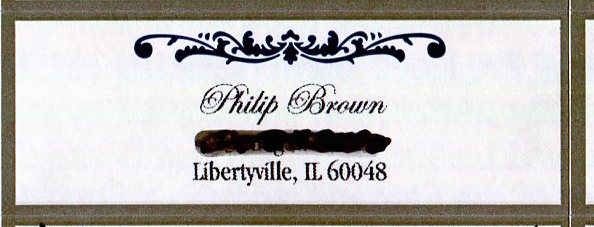
The color label sheet. High quality and keepable.

The whole collection is covered in Sam Timm nostalgia art: winter ponds, chimneyed log cabins, old trucks, old boats, old canoes and birds…. enough birds to awaken Alfred Hitchcock one last time.

Boystown    028VGF Calendar

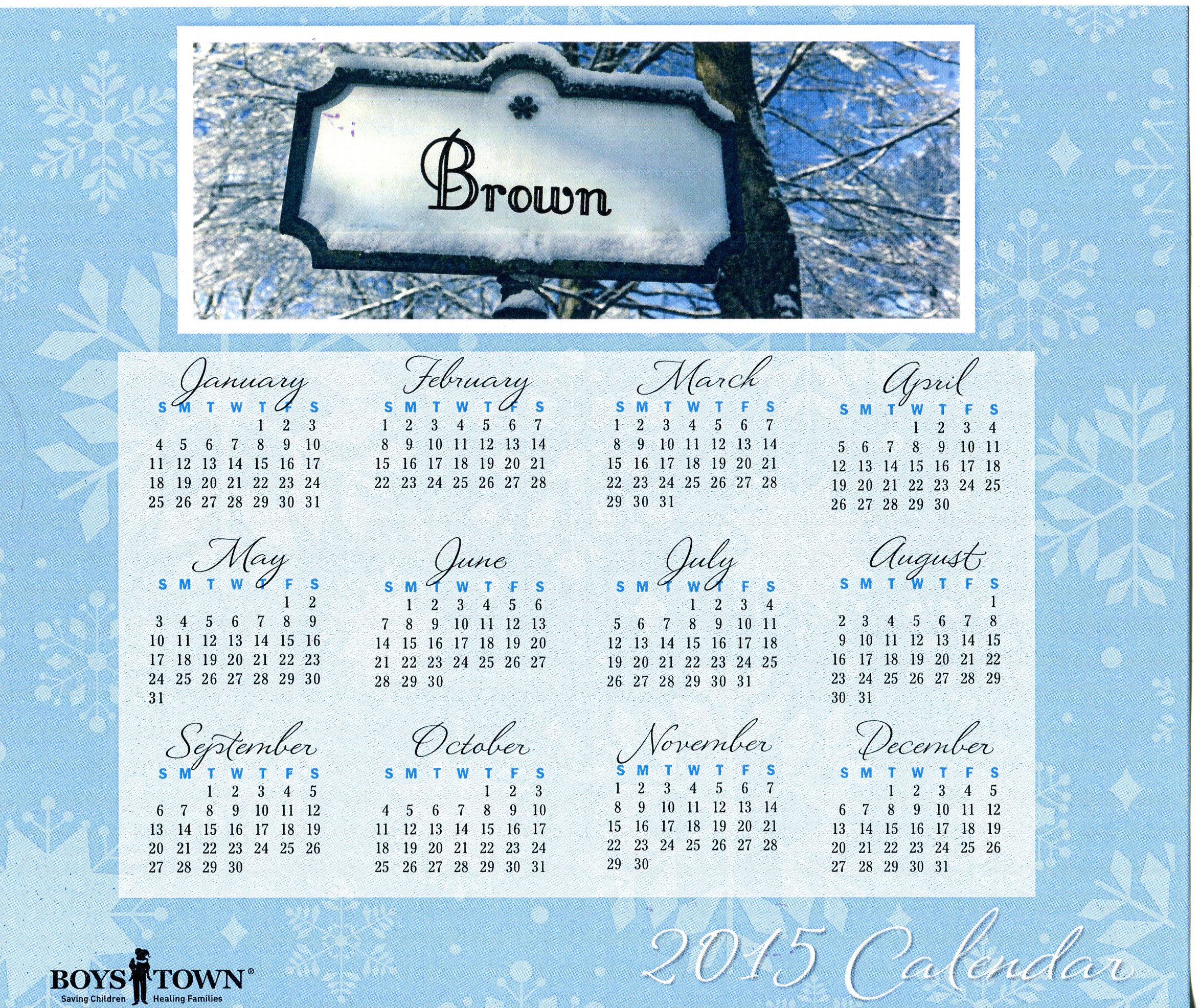
Another calendar, this one with a stylized street sign.

But the overwhelming effect comes from the personalization. Father Flanagan has managed to personalize 8 pieces in this whopper kit: the envelope, the letter, the reply form, the reply envelope, two sets of very nice address labels, a certificate and a calendar card.

Boystown  Certificate

It’s only an acknowledgement, but hey, it’s framable.

Over the top maybe?

Boystown Johnson Box

A Johnson Box, personalized and tinted, captures the gist.

Not really. Remember, good direct mail is designed to be indispensable.   It is extremely difficult to throw out a kit when your name is woven into its making so admirably.   The proof: this is a control package, or very similar to past controls. So it is working.

What’s the math that supports this?

The kit itself probably cost around $1.80. Postage for a 6-ounce Flat at non profit rates is actually a bargain, add another 30-cents. Total cost in the mail, probably $2.25 after adding list and processing.  This is a guess, only, having not spoken directly with Boystown.

Boystown Gift Certificate

Individualized gift certificates, one of three.

Now, the hard part: getting paid. Assume the average gift is $15. To break even, we need a 15.0% response. ($2.25 divided by $15.00 = 15.0%)

And the really hard part: they probably won’t get 15.0% response.   More likely, they might achieve 8-10%.   Let’s say 10%.  So given that, every response came at a cost of $22.50 ($2.25 divided by 10% = $22.50).

Boystown Donor Closeup

A strategic gift choice, Goldilocks-style. Let’s go for $15.00!

Is a new donor worth $22.50?   The answer is, “yes”!

By Father Flanagan’s 2012 financial report, they derived nearly $5 for every dollar spent in fundraising.  A very acceptable payback according to industry standards.  By the numbers above, the new donor will continue to give over time, well in excess of $113.00.

Boystown B&W Close Up revised

A set of stylish B&W labels in case I don’t want to give away the birds.

BoystownBangtail Reply

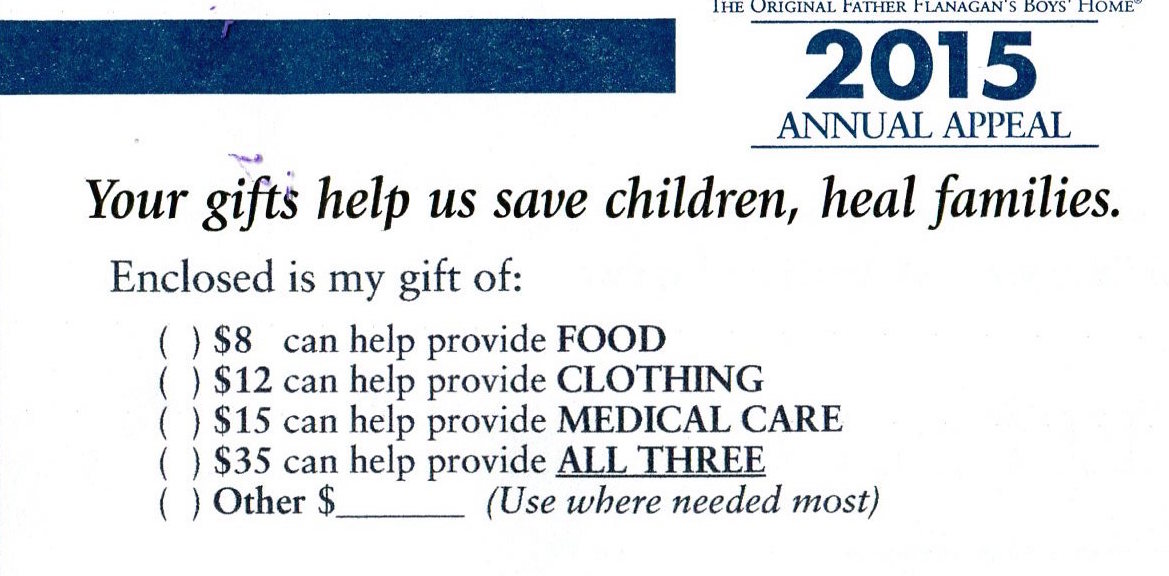
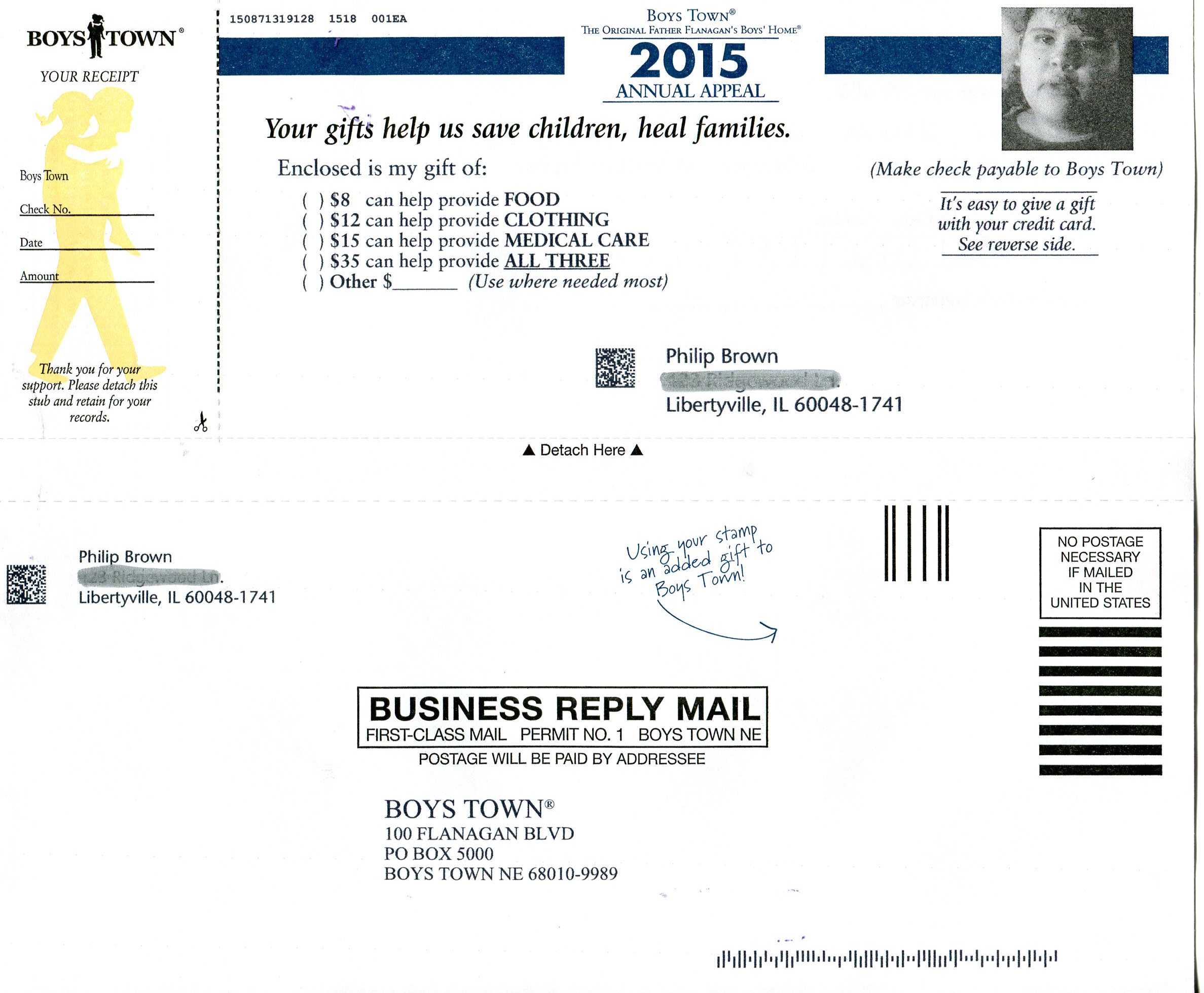
Personalized donor form and reply envelope. Note the QR code for tracking!

Again, this analysis is my perspective only, but a donor will continue to give to a worthy cause, especially one as well branded as Boystown.   And not only will they give today, but some will most assuredly make bequests after passing to keep the institution providing its valuable service.

So personalization plays a big part in winning support, and the savvy marketers at Boystown have done their jobs well in making it pay for their cause.

Thanks for hanging in to read all those numbers!   FYI, Boystown provided nearly $192 million in services in 2012, and in 2013, served 122,000 children and families across America.

Standard
direct mail, Marketing

Pretty Ain’t Pretty Sometimes

Hospital 978

A 2-page high color sell sheet, but no letter!

When you are on the marketing end, you may feel that direct mail, especially fundraisers and business mail, looks pretty vanilla. Maybe even bland.

So the urge is to pretty it up.

Hospital 976

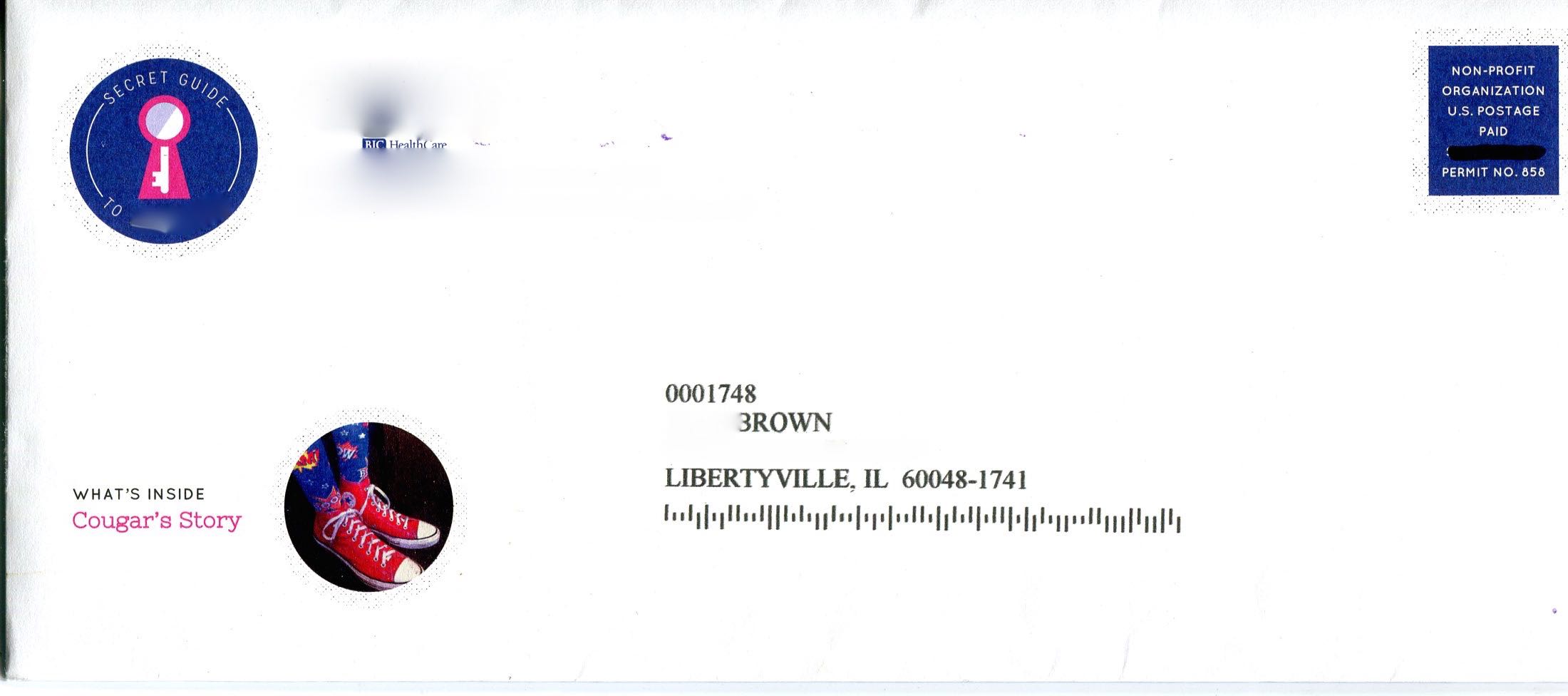
The hospital’s familiar happy logo is disguised here, but this envelope brings no bad news.

That is the case with this fundraising piece for a well known children’s hospital. For its sake, anonymity will prevail. But here is a 7-step rule book on designing fundraising mail.

1. Set the mood for urgent need.

Hospital Sneakers copy

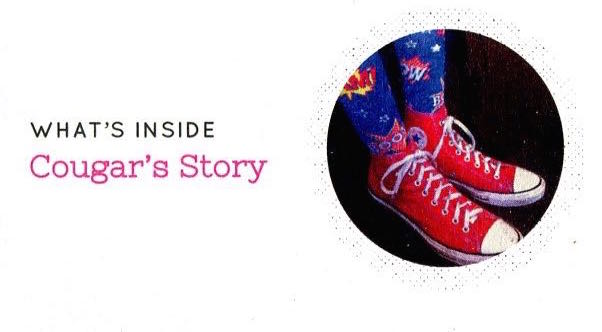
A snappy colorful tease, but is it urgent?

To that end, use color and graphics sparingly, to best create a tone that delivers gravity, not levity.   The envelope for this kit displays a cheery logo (disguised here) for the hospital. Understandably, it wants to convey happiness for its patients.   But that’s not the right strategy for getting financial backing.

The OE features a spunky new pair of pink sneakers teasing the story of a cured patient, whose story is inside.

The “story inside” teaser is good. But the sneakers remind one of a Saturday morning kids TV show.  Pretty, but not important.

2. Follow up with a personal request.

One of the most recognized personal media in existence is the letter. When we open an envelope, we are looking for it. The letter sets the agenda for the potential donor. This is who we are.  Here’s our challenge, and how you can help.

There is a myth that people no longer read letters, and certainly not long ones.  Not true!  If your story is real, and the request is sincere, the letter will be read.

Hospital Cougar copy

A potentially compelling story is delivered in challenging, small white type against a pink background.

Named, titled and signed, the letter provides basic credentials. A person is “at the other end of the mail box”.

This piece has no letter, but rather hangs its success on a two-page high color sell sheet.

3. Demonstrate and prove the wise use of donations to solve the problem.

Convince the donor that money is needed, and that it won’t be wasted.

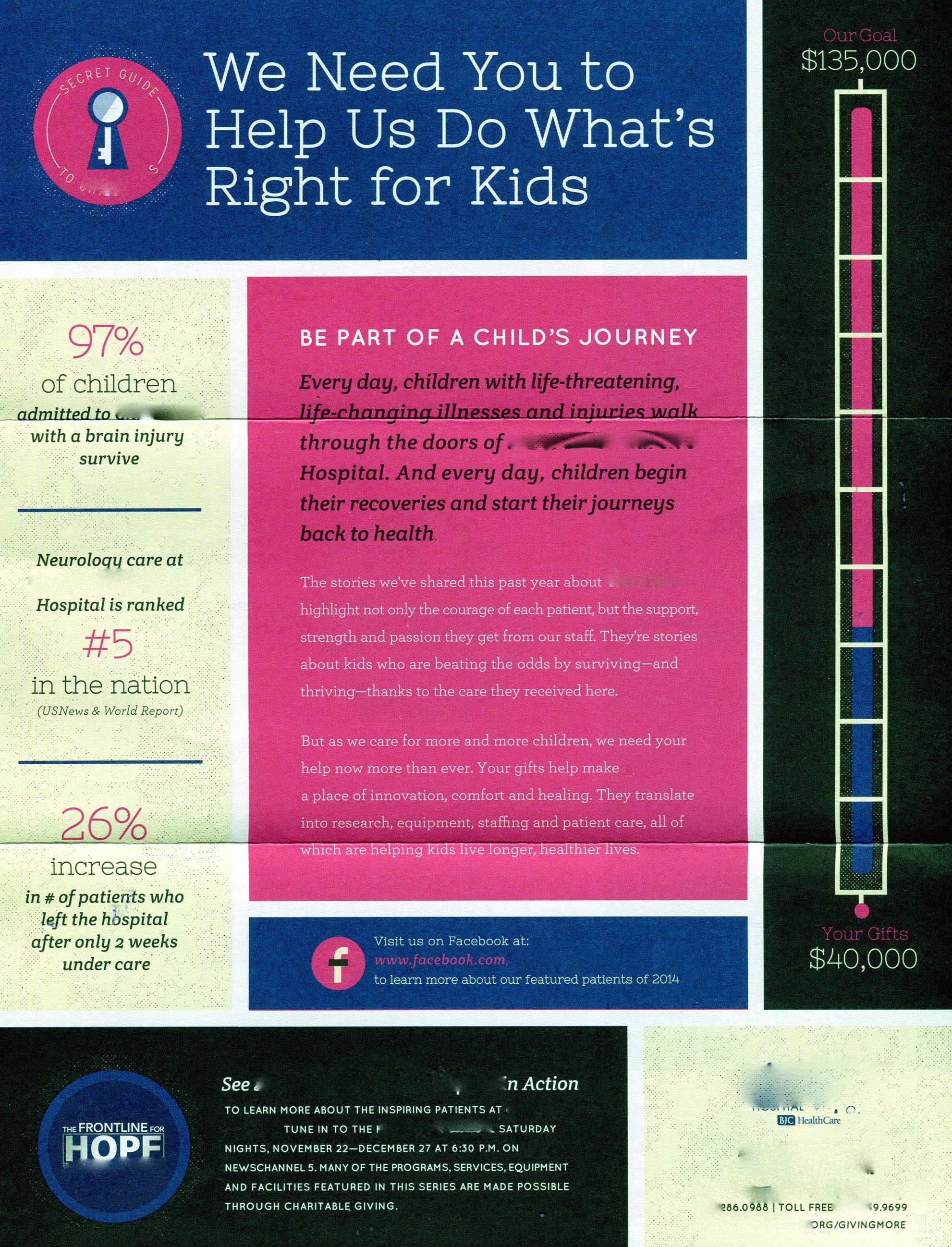
The hospital has a goal of $135,000. What for? It is not apparent that it is short of funds, or solely supported by charitable donations. Not knowing that, why would a donor be moved to give?

Hospital Circles copy

A logical effort to monetize the services provided. But what are the Circles all about?

To its credit, the hospital does explain what your money will buy. It also presents operating statistics, and some official endorsements.

To put an edge on the numbers, show how many cases were turned away or disadvantaged for lack of funds.

4. Be legible and understandable.

Possibly the most difficult task of a senior donor is to read copy that is too small, and reversed out.   In this case, important “ask copy” and narrative is in 8-point type, white on pink. Pink on black. Blue on white.  Ouch!

Hospital Key copy

The significance of the “Secret Guide” is just that: secret.

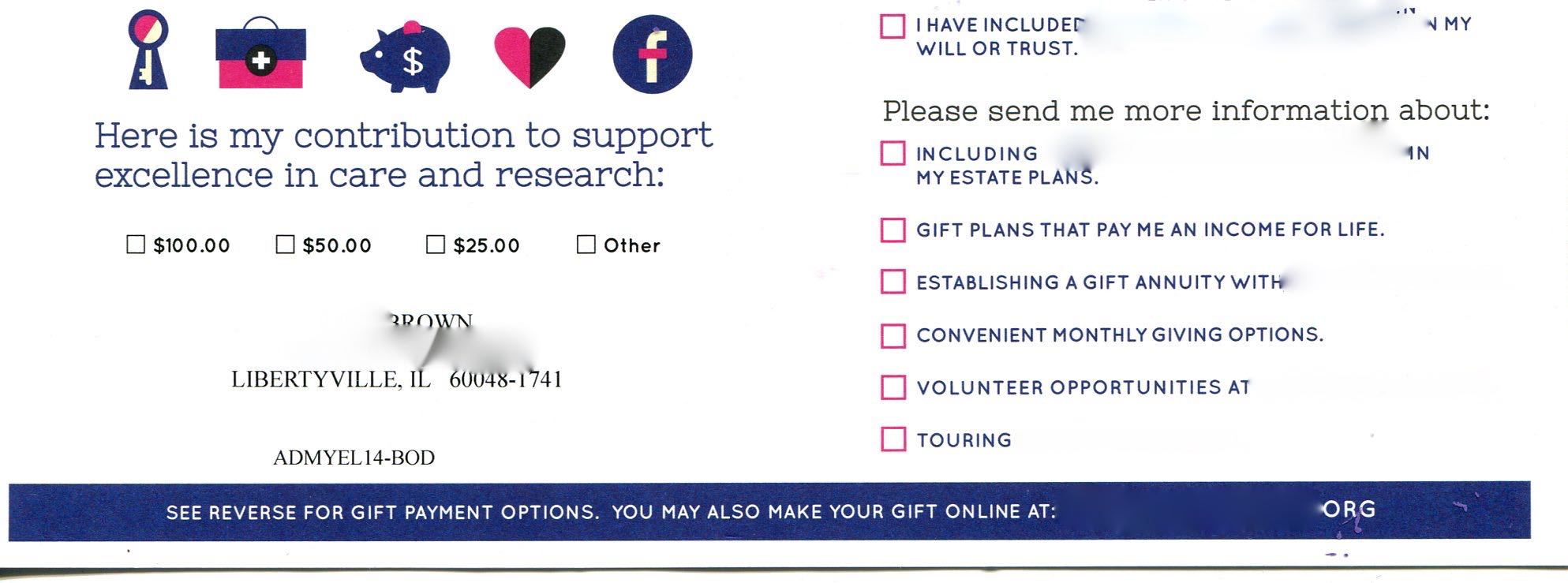
This piece also employs some secret code, uninterpretable by the cold prospect.   The use of their “key” logo is un-explained, and a series of icons on the pledge card do not telegraph any meaning to the uninitiated.

5.   Tie the Ask To A Specific Need.

The story in the piece relates to a child’s full recovery after an accident.  The pledge card, and supporting copy don’t connect to the child’s need, or to the next child with a similar accident.

The list of financial values and associated services in the ad piece refer to Circles of Commitment and generous benefactors, but the recognition value of the Circles is not explained.

6.   Urgency.  

Any mailing’s strategy is aimed to get a response immediately.   Hospital $135,000 copyThis fundraising piece needs  some parameters to define the timely need for a donation.   What will happen if they don’t reach $135,000?   When will time run out?

7.   Indispensability.

Hospital 980

The mystery of the icons: how do they work?


The best direct mail is impossible to throw out.   It just sits there on the kitchen table, or on the dresser until the responder finally acts.   This piece lacks that important nagging factor.

A gift, a freemium, a stamp, a coin, a sample, a personalized card, a photograph, an address label set, are examples of items that  are hard to ignore.

Unless the donor had already decided to contact the hospital, or the donor’s accountant recommended more charitable giving, there’s no reason to hang onto this piece.

Hospital $500

$50 bucks? We haven’t even met!

Direct mail design is challenging because the mailer gets bored with the “same-old, same-old”.  There is a temptation to jazz up the piece just to be different.   After all, you mail out a few thousand, or a few million, and they all look the same!

Just remember: the recipient only gets one piece, and to that person, the piece is well distinguished, just by its mere arrival.

Thanks for reading!  If your fundraising program is serious, make it look that way.  There’s nothing more serious than asking for money.

Standard
direct mail, Economics, Marketing

AAA Goes Flat Out

AAA 2014-12-02 803

The door opener!

Want to know what stops just about anyone when they open their mailbox?

No, not a boxing glove. Instead, it’s a flat.   No, not a flat tire.   A flat-sized mailing piece.

AAA 2014-12-02 800

The 10 x 12 Flat. Size counts in direct mail.

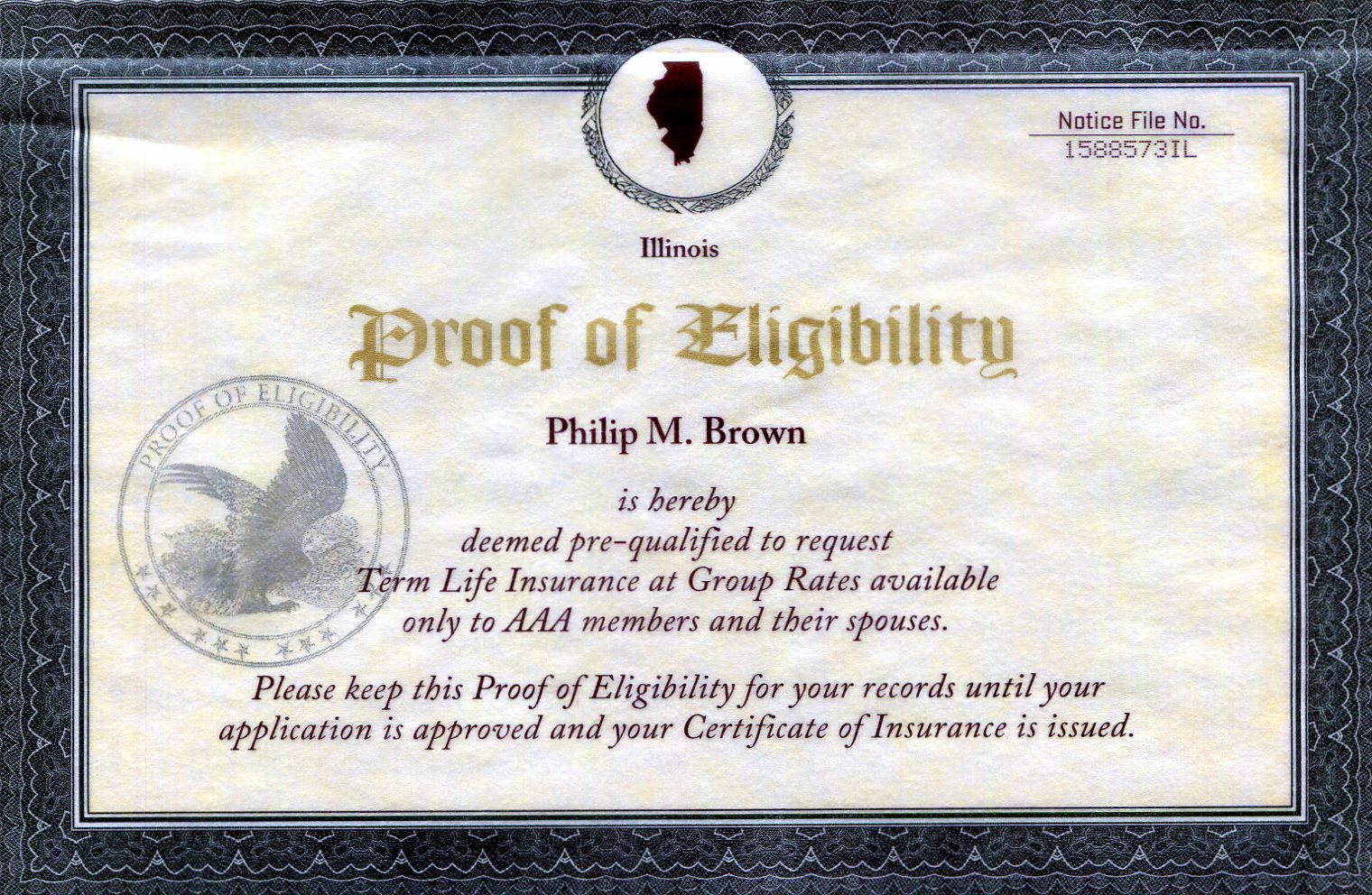
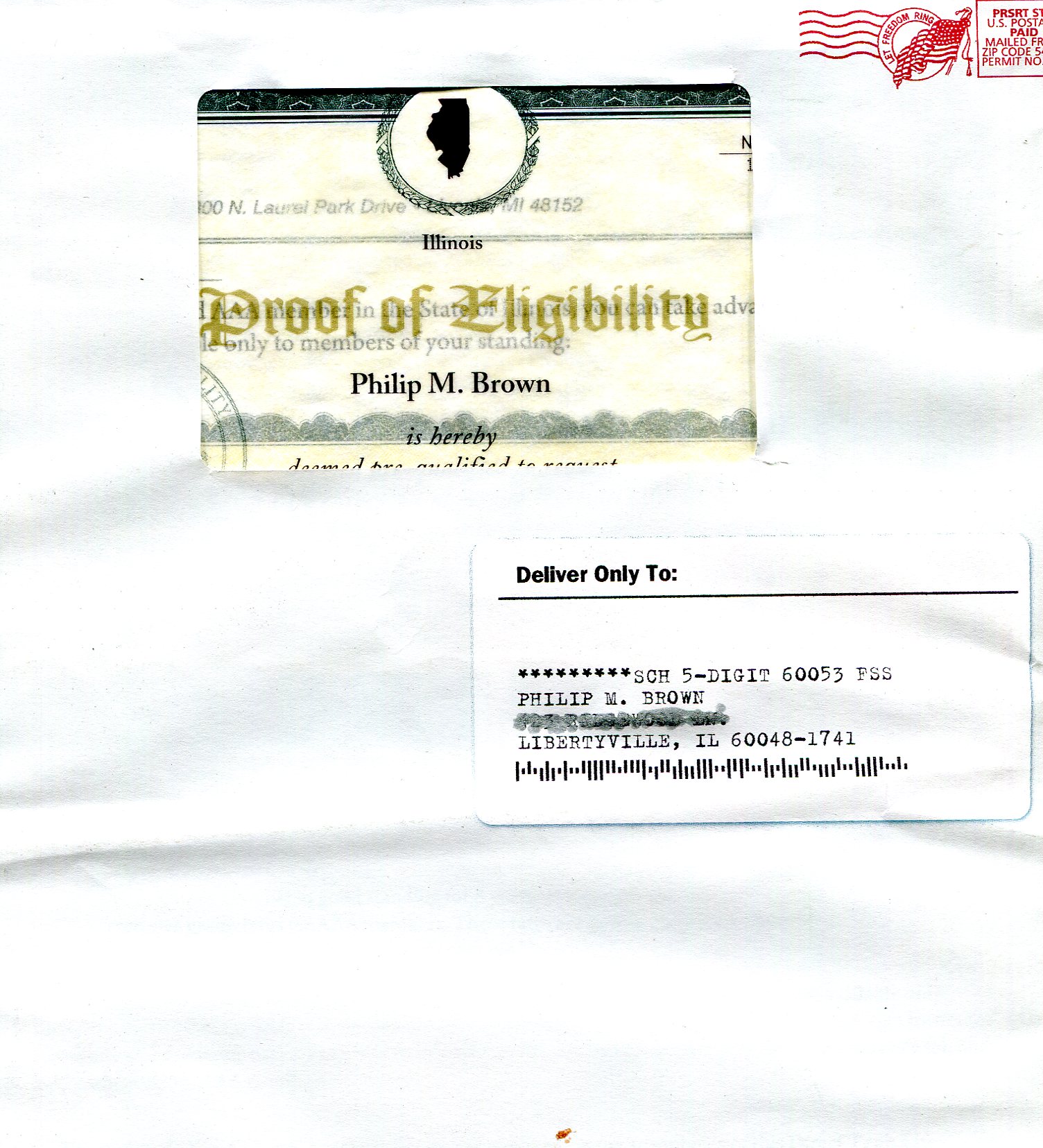
So it is that I opened our mailbox to be confronted by a certificate-sized 10″ x 12″ envelope. Front and center, in portrait orientation, is an open window. As I peak through I see my name, in bold, printed below a 40-point, gothic type proclamation: Proof of Eligibility.  The State of Illinois is symbolically positioned above.

This manifest is shielded behind a thin sheet of parchment. My reaction? Better open this now.

I am not that naiive, I know this is a solicitation. But still, eligible for what?   Nomination? Higher taxes?  Bronzing?

AAA 2014-12-02 Label copy

A beautiful label… applied on a slant, with raised shading, is actually printed, not real.

As it turns out, it is the AAA Life Insurance Company, who has decided to give me a second chance to insure my remaining days.  Or until the age of 80, when all bets are off.

These are the same folks who sent along a policy kit a few months back.    That one was a flat too: a “fulfillment package”.   Presuming I am ready to sign up, it is essentially a welcome kit.   Regrettably, and unknown to AAA, I am disqualified from obtaining coverage due to a shady past.   So I deferred.

AAA 2014-12-02 eagle copy

The official seal of eligibility.

The reason I highlight the new kit is to point out the allure and attraction of the envelope.  “Proof of Eligibility” is vague.   But when it is presented so elegantly, it works.   How many of your incoming direct mail summons use parchment?   40-point Gothic?   Not much I am guessing, since the Sheriff of Nottingham died.

The design strategy of this AAA kit is to get opened.   My bet is that better than 90% of the recipients do open it.   It is irresistible.

From there, the internals have to carry the freight.

The big question you should be asking is why spend the extra postage– probably 15 cents– to send an over-sized envelope?

AAA 2014-12-02 802

The letter under the parchment, complete with filigree.

Do the math.   In a standard #10 envelope, the kit, list and assembly would cost about $250/m.   Postage, another $200/m.   Total, $450/m.

Now lay the papers flat, and place them in a big envelope instead.   Let’s say the production is cost neutral, but adding $150/m flat postage has just increased overall cost by 33%.

The bottom line in direct mail: raise your production cost 33%, you must increase response 33% too.

So if the small envelope garnered a 1% response, the flat needs 1.33% to stay in the game.

From personal experience, I know this is achievable, and judging from AAA’s use of flats before, it’s probably not unusual for them either.

AAA 2014-12-02 Eligible copyBy the way, what was I eligible for?  Discounted premiums as an AAA member.


Thanks for reading!   Never pass up the opportunity to go “big” in a mailing piece.   The cost may frighten you, but usually higher response will cover it.

Standard
direct mail, Economics, Media, Politics

Found: The Hidden Miracle in the USPS

Spoiler Alert: This Is A Good Story About Numbers
Every year the media touts the headline that the United States Postal Service lost another few billion dollars. Politicians get huffy. The digerati are quick to call the funeral home.

But in fact, the USPS has accomplished an amazing business coup in its mail delivery management.

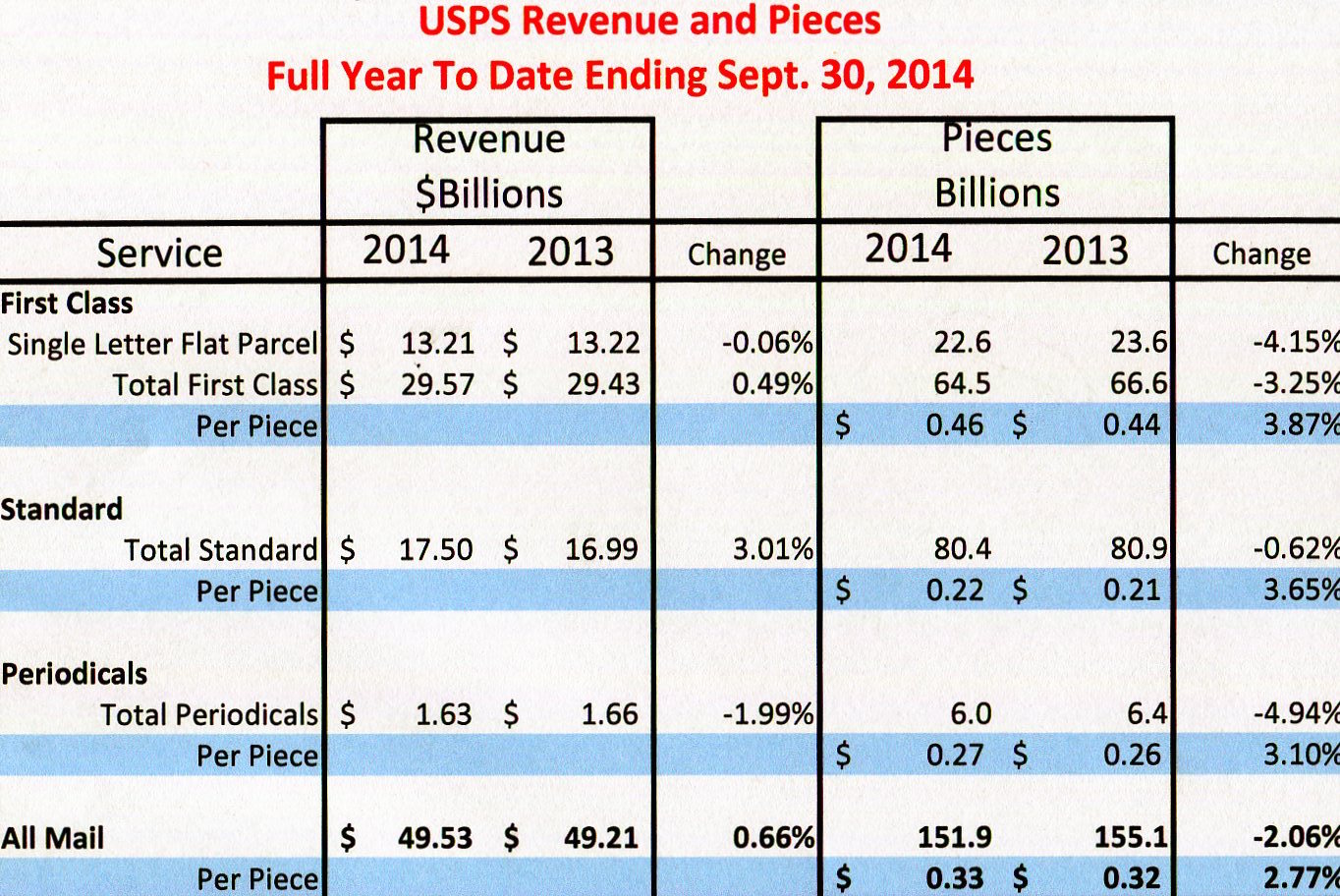
First, look at the current “bad news” available in the latest Revenue, Pieces and Weights report* for USPS full year 2014.   Figure 1 gives some highlights.

Fig.1.  2014 revenues were up 0.66% while volume fell 2.06%

Fig.1. 2014 mail revenues were up 0.66% to $49.53B while mail volume fell 2.06% to 151.9B.

Mail volumes decreased from 2013 to 2014. A 2.06% decrease to 151.9 Billion pieces. “Pieces” include letters, parcels, magazines and flats. The shrinkage may be attributed, if you wish, to a blended increase in price (postage) from 32 cents to 33 cents per piece. A 2.77% increase. But it probably has more to do with society’s use of email.   We would just as soon email Gran a singing birthday gift card as send her a parcel.

Dig deeper and we find that First Class volume shrank 3.25% while actual revenues increased 0.49%.

Postage per piece went up 2 cents, or 3.87%

What we know about mailing economics is that there is no elasticity. When postage goes up, volume goes down.

This is the fundamental truth of direct mailers. They maximize performance through testing list, offer, format and copy. The best performance becomes the economics benchmark. So when Standard Postage goes up 3.65%, we expect some mail to drop out, which it did: 0.62% less.

Amidst The Bad News, A Twinkling of Brilliance

November 14, the USPS presented its preliminary financial results to the Board of Governors. It declared a $5.5 billion loss in income. That made headlines. What was not picked up however, was its mail operations performance. You see, its operations income was $1.4Billion profit.

What that means is that the USPS moved nearly 152 billion pieces across the country to over 140 million addresses, six days a week, and did better than break even. What was the all-in price per piece to the mailer? 33 cents.

2004 Eye Opener

Now lets look at the real miracle of the USPS by comparing 2014 with 2004.

Ten years ago, it delivered 206 billion pieces for $65.87 billion.

Cost back then? 32 cents each.

Not bad! A one-cent increase in 10 years. Despite a 26% decrease in economies of scale, its performance eroded only by a penny.

Surviving The Ravages of Inflation and Restructuring

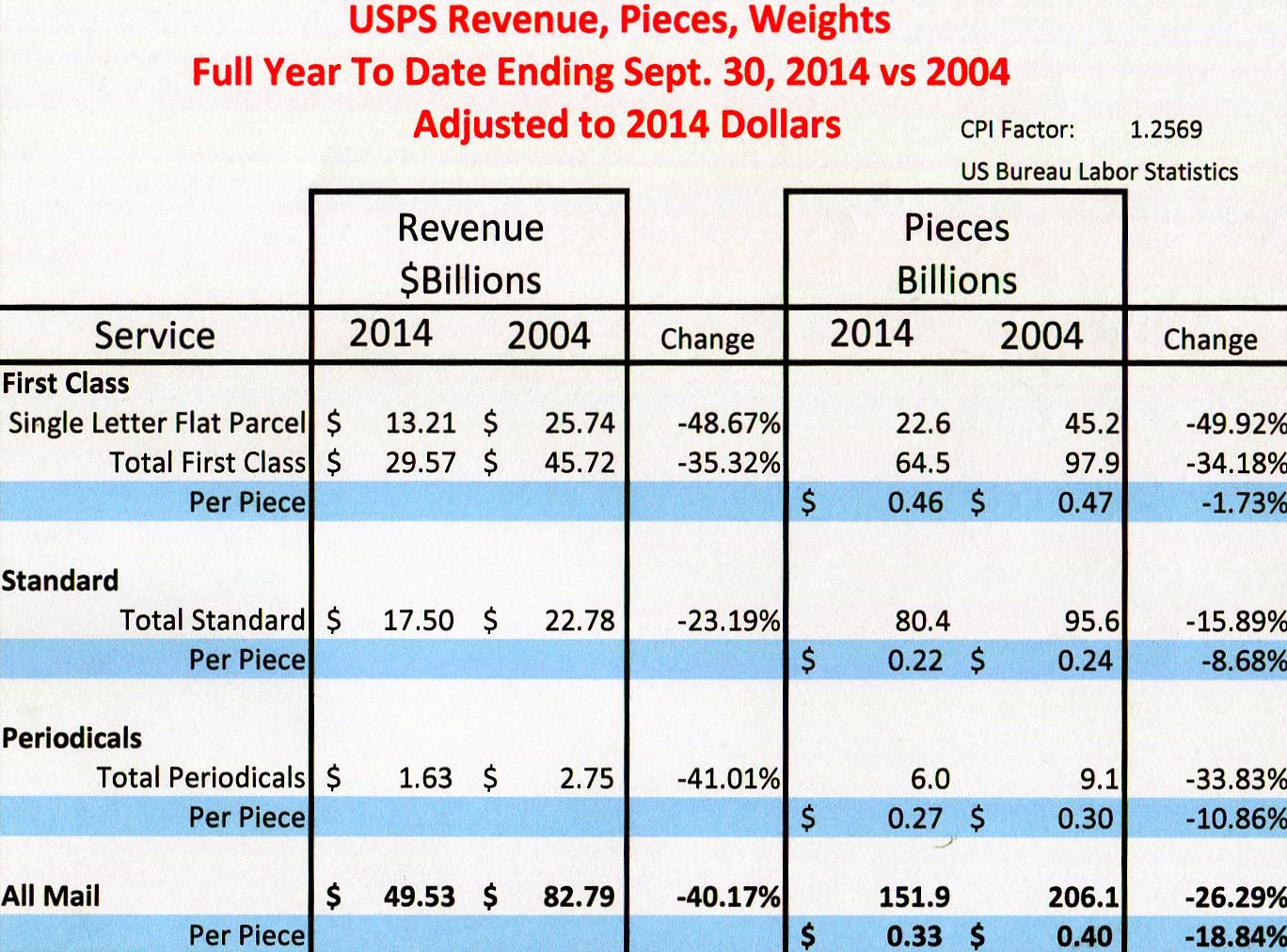
This does not begin to recognize the efficiencies the USPS has managed to achieve in the last ten years however. It disregards the massive cutbacks in volume, and the inexorable devaluation of the dollar. Look at the 2004 figures when they are expressed in 2014 dollars.  See Figure 2.

Using 2014 dollars it cost 40 cents to a mail apiece in 2004, versus 33 cents today.

Fig.2  Using 2014 dollars it cost 40 cents to a mail a piece in 2004, versus 33 cents today.

According to the US Bureau of Labor, we have experienced a 26% increase in prices. In other words, it takes $1.26 today to purchase what $1.00 would buy in 2004.

Applying the CPI to USPS figures then, we find that in 2004, it cost 40 cents to mail a piece, versus 33 cents today.

Standard Mailers would pay 24 cents in 2004 versus 22 cents today. First Class mailers would pay 47 cents, versus 46 cents today.

Magazines: 30 cents then, 27 cents now.

USPS: Economic Movement of Value

This government agency may have its critics.   The oracles may claim that mail is antiquated.   But they can hardly explain how well the post office has learned to distribute real property coast to coast at ridiculously low cost to the consumer.   Email and Internet may be instantaneous, but they both lack the credibility of hard copy delivered under government seal.

It can be said that mail is slow, but it maintains its cache because it is trusted.   We need to acknowledge the effort that the USPS has expended to bring us that service.


*The Revenue Pieces and Weights Report: http://1.usa.gov/1A8wEj1

Standard
Economics

What’s Coming Next

String Ball

Life time savings.

There is a major, seismic shift in assets occurring while you read this.  You are thinking of the $12 Trillion which is pouring into the pockets of Baby Boomers as their hardworking, scrimping and saving parents pass into the great beyond.  But you are off.

In truth, the money is peanuts.  It moves from one bank account to the next, and nobody lifts a finger.

So, it’s not about their money.  It’s really about their stuff.

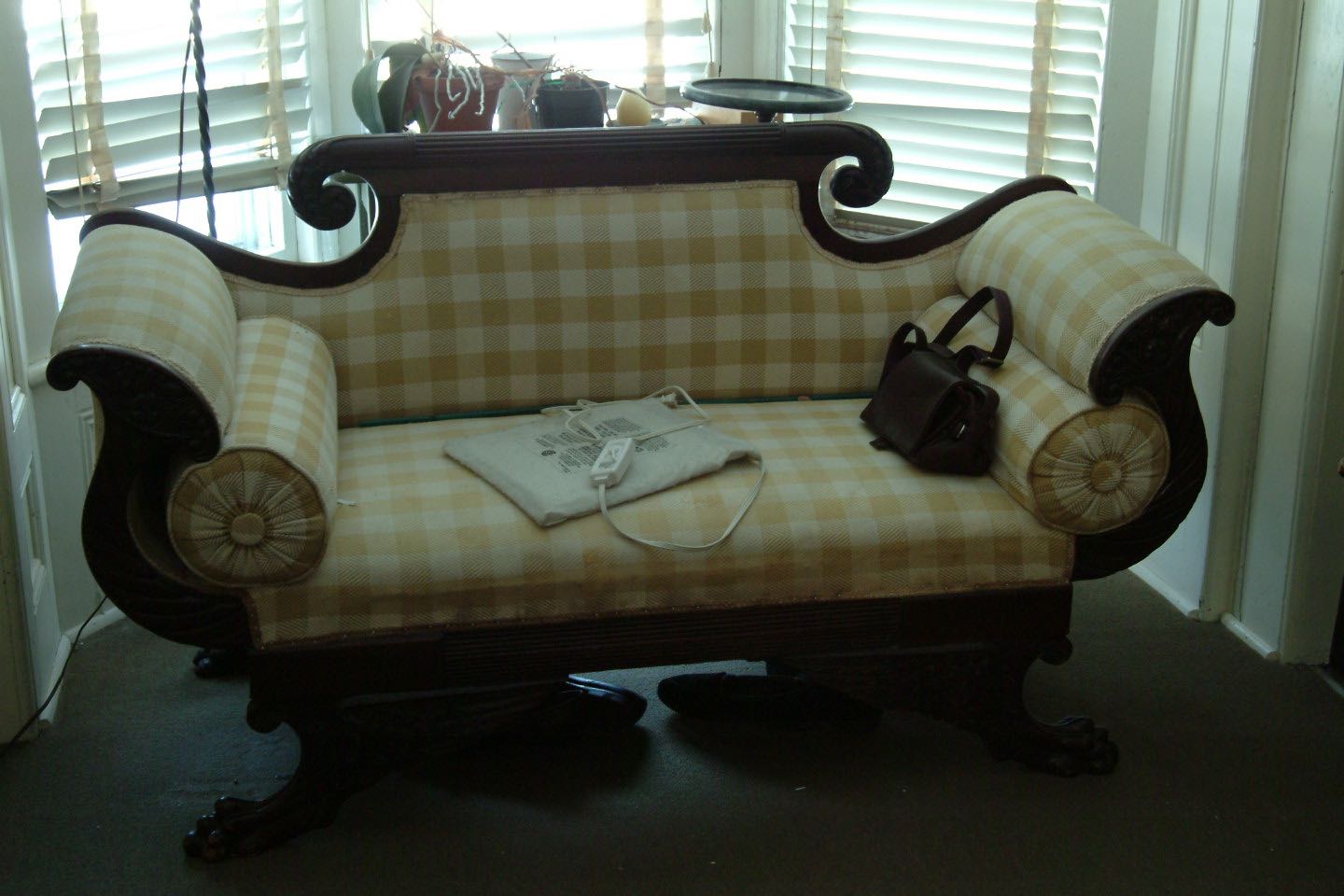
Sofa

This may not fit in with the kids’ Ikea.

There are two legacies which those post-wartime parents are sending along.  They promise profound effect upon us, and to generations still coming.

The first is a treasure of property which they struggled to build and acquire through thick and thin.   Too vast to itemize, but most Boomers will recognize the impact of their parents’ fully executed Last Will.

They are manifested in crowded basements, overflowing garages, leases on storage space, impenetrable walk-in closets, jammed kitchen drawers, and cabinets crammed with silver and china.

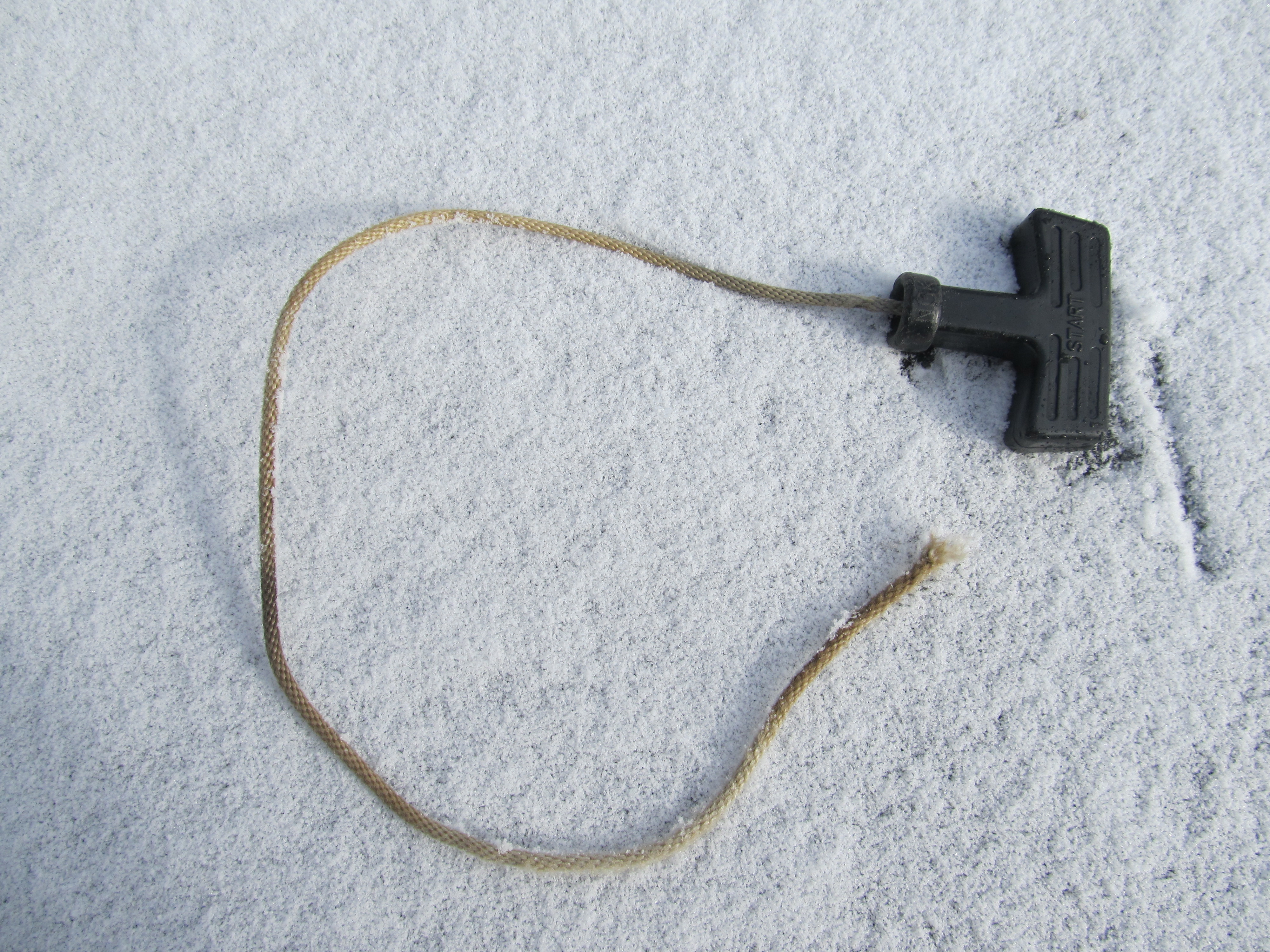
IMG_6466

A perfectly good pull cord, with some help.

The second legacy, even more profound, is a culture of saving.   The Baby Boomer was raised in a household characterized by frugal economy.   Nothing half-used ever got thrown out.   A broken item was in queue for repair, some day.

Again, the inventory of leftovers is virtually infinite.  Its aura a phenomenon.

Christmas Lights

Half of these work very reliably.

And you know it when you see it in the eyes of a Boomer.  That wince of remorse as a half-good string of Christmas lights hits the garbage bin.   Or the guilt attached to an old set of dull drill bits, that holds its place on the workshop bench, right beside a brand new set.

The reality is, while the Boomer is swamped in their folks’ stuff, they still can’t throw it out.   What’s worse, they are adding to it.

For example, a few days ago while driving down Milwaukee Avenue, I spied four baseballs resting in the gutter.   To me, it was like driving by a bank vault with the door wide open.

dumpster-hero-resi

“No, we are keeping the dumpster too.”

As kids, we could only envy the one on our street who had a baseball.   In fact, most of our youth was focused on scavenging for baseballs knocked out of the park, hockey pucks stuffed in snowbanks, broken hockey sticks, errant golf balls found on the road.

In our garage is a 5-gallon bucket full to overflowing with tennis balls, golf balls, lacrosse balls, wiffle balls, softballs…all items I have brought home like trophies from a jog around the park.

So I collect these play things like gold nuggets, feeding an appetite that was spawned a couple of generations ago when people just didn’t have much money.

Back to Milwaukee Avenue.   I pulled over, parked, and scurried across the street and retrieved the balls.   I could not believe my find.   These were in excellent condition, leather covers, no scuffs, and laces still waxed and shiny.   Bonanza!   The motherlode.

Balls

Cornucopia of finds on the jogging trail.

They are now on the shelf beside the bucket, which is full.

The significance of this perpetual foraging will become apparent to the next generation, those GenX-ers and Y-ers, and wet-eared Millennials who will finally have to deal with The Stuff.

Desk

One day, this may be a chicken coop.

You may want to give The Stuff to them, but you can’t.   They are still living with their parents.

My suggestion: this is the time to invest and build.   Look closely at your business prospects in:

1.   Storage space

2.   Trailer rentals

3.   Thrift stores

4.   Auctioneering

5.   Waste management

Golf Tees

Saving for the next round.

Regrettably we haven’t yet found a way to load it all onto a freighter, and sail it to a Third World depot, but that would be the next best opportunity.

Thanks for reading this far. It’s a puzzle I really can’t solve.  

I have to get back to repairing our Monopoly board.


Standard
Marketing

Good Fences Make Good Customers

Tele Switchboard-OperatorsThis is how some empowered employees saved the day for AT&T.

Once admitted, it becomes easier to say I am a traditionalist.  As a result, I can explain and defend my choice of AT&T for our long distance carrier way back in 1990.

After all, what can be more solid a foundation than  American Telephone & Telegraph, even today?

It was with a sense of comfort too, that we chose Illinois Bell as our local service provider.  Again, “The Bell” is as American as it gets, though there are worthy claims that Alexander Graham Bell invented the phone in Brantford, Ontario, just a few miles from my home town.

Over time we were whip-sawed back and forth between Ameritech, Cingular, SBC Communications and Comcast Cable, but at the end of the day it was AT&T that ran the table.

Today we have two land lines, two cell phones, cable and Internet courtesy of AT&T.  It is no surprise that they send us separate bills for each service, because when you add them all up, we are a primo account.

And despite the onslaught of Comcast who pursued us for years, we have stayed with AT&T.

Why? Three reasons, straight from Customer Goodwill 101.

First, AT&T brazenly gave us a $300 new account cash bonus, plus a monthly discount of about $50 for three months.

We shamelessly accepted.   And then endured a three-hour visit from a techie in sanitary shoes who puttered around our house and basement drilling holes and tapping keyboards.  He flashed a TV remote in front of us, and wished us good luck.

We are still trying to figure out the remote, but never mind.

Second, the modem died once, and after some tense withdrawal pangs, exacerbated by a frustrating phone diagnosis, a techie “snuck out” to our house under the pretense of doing a new install, and gave us a new modem.

“Don’t tell anyone I did this.  We are really supposed to handle only new customers during the sales contest.”   He fixed our problem, very much against the rules, I think.

Third, with the authorization of the Village, AT&T announced they were installing a new VRAM unit at the back corner of our lot.   Armed with an “easement”, they came to take our tiny little green cable post away and replace it with a small nuclear reactor the size of a Uhaul trailer.

“It’s for Internet Mr. Brown.   WiFi.    We gotta put it here.  We got approval from Village Hall.”   He stared at our flower bed.  “You want we should move your Mums over there maybe?”

Stunned, I asked, “You can just come here and do that?”

Waving a sheaf of papers, the contractor confirmed it, but then he went on.

“Actually, we’re gonna fix this up nice.   We need about 30 square feet for the pad.  We’ll put a nice cedar fence around it, and then some new dogwood and forsythia in front of that.”

“Unhunh.”

“There’s more actually.”  The contractor eyed the shaky stockade fence across the back of our lot.  “We’re gonna hook the fence up to yours.  But while we’re at it, why don’t we just give you a new fence, too?”

“Really?  You’ll do that?”

“Why not?  You’re a good customer.”

Bingo!

True to their word, the new box went in, the new fence went up, and the bushes flowered the coming spring.

In return, we still pay egregious amounts of money on three separate bills.   Once a week I mow around their humming VRAM, faithfully and carefully so as not to upset whatever it is doing in there.

And, we still scratch our heads about the remote.


Thanks for reading this through to the end!  You know, a good customer can be hard to find, but another good customer can be even harder.  Train your employees to keep the ones you have.

Standard
Marketing, Thank You

What Makes Your Brand Stick

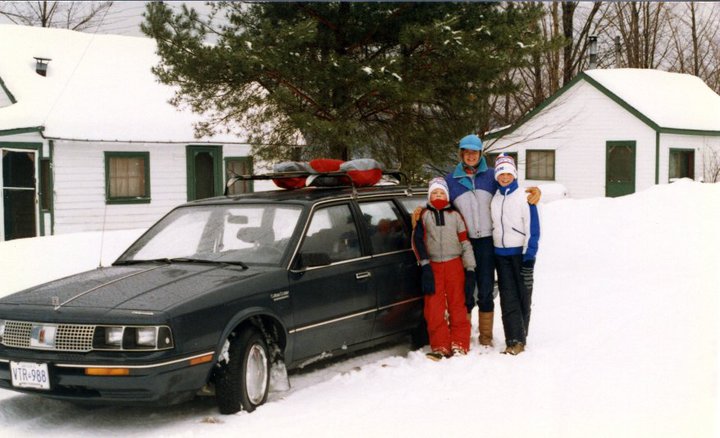
1950 Chevy 990 copy

Our 1950 Chevy: ready to roll.

Some imprints last forever. Your first bank account. Your first cola. My parents’ car was a strong imprint for me. We had GM cars since the dawn of life it seemed. So my compass was frozen on GM: Chevy, Buick, Oldsmobile, even the Vega!

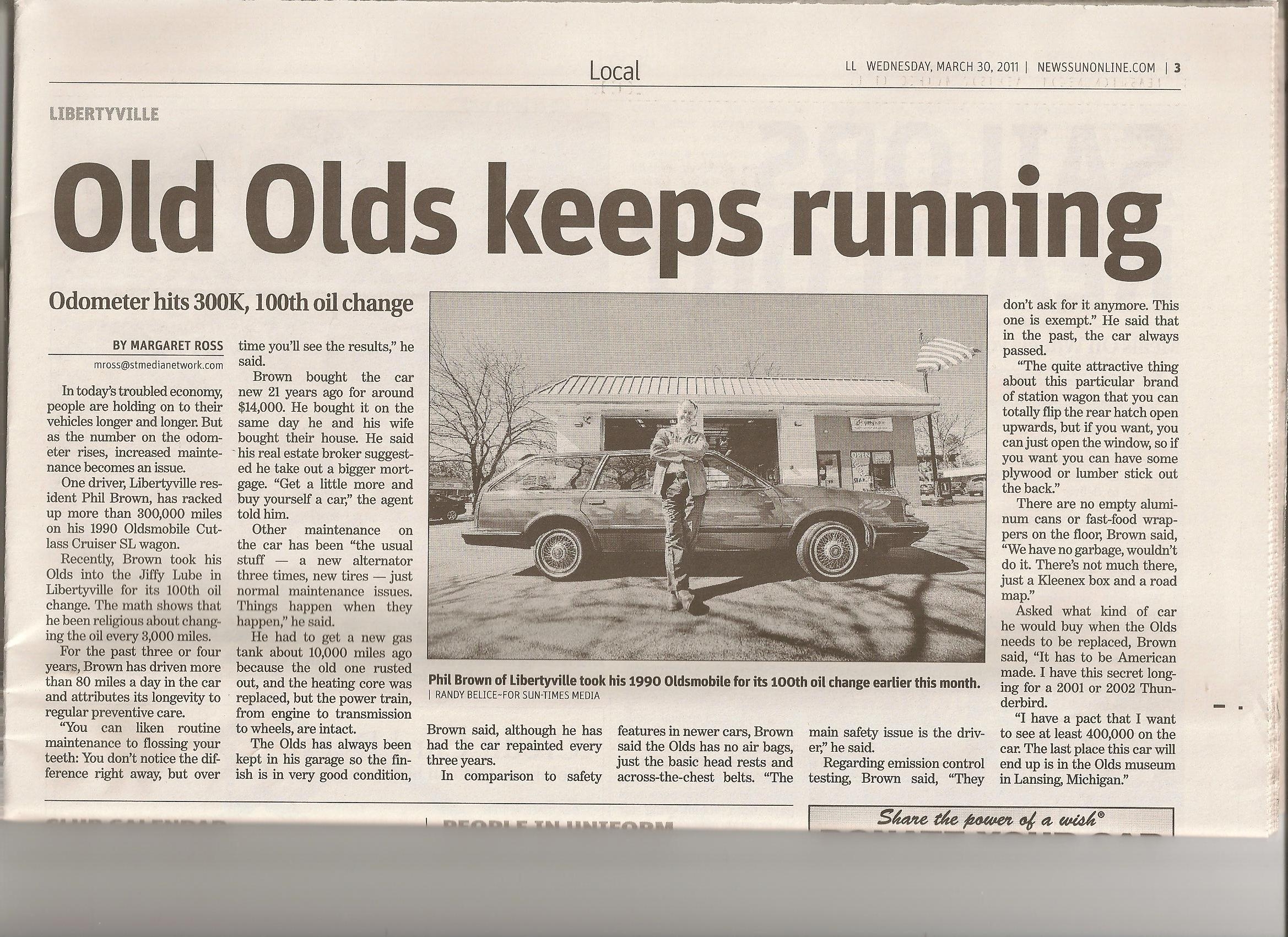
Old Olds

The 1986 Olds Cutlass Cruiser Wagon.

Our first big car in my family of four was an Olds Ciera wagon: the Cutlass Cruiser. We bought it 1986, and loved it so much, we bought another, just like it, in 1990.

Recalling the day, I walked in to our local Cadillac Olds dealer, pointed out our car to the sales rep, and said, “Just give me another, like that one.”

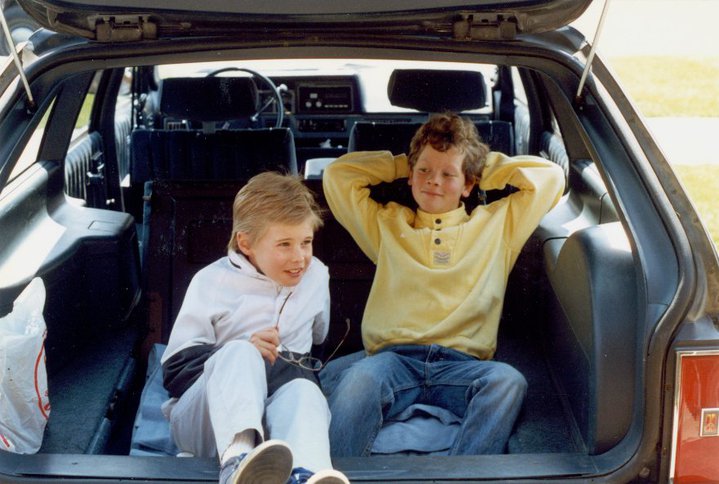
Within the day, I drove a new Cutlass Cruiser off the lot. Pretty much the same color, had the same cool rear-facing third bench seat the kids loved. The only upgrades: Electronic Fuel Injection had replaced the carburetor, and air conditioning and FM radio.

Olds Back Seat

People still ask if there’s a rear-facing seat today.

I kept the hand crank windows just in case we drove off a bridge into water and couldn’t get the doors opened.

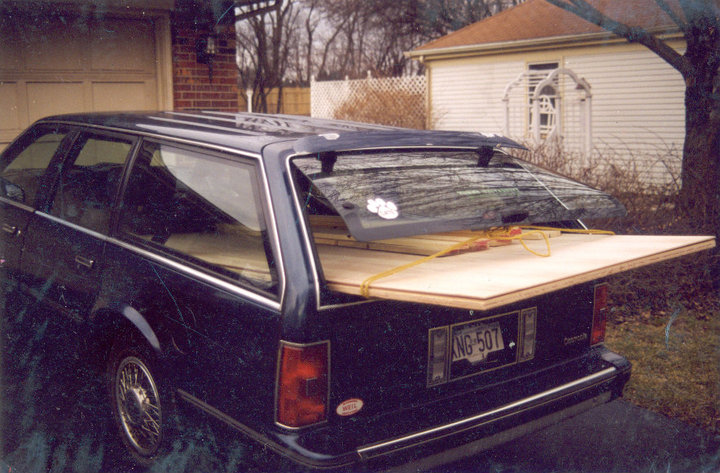
When people asked why I liked the Cruiser so much, I had a bunch of responses, but always described how I could get a 4×8′ sheet of plywood in the back window without opening the rear door.

So the day came along when I decided to get a new wagon, and I returned to the dealer, walked in, pointed out my Olds to the sales rep, and I said, “Just give me another, like that one.”

The guy looked at me like I had just wandered in from the woods.

“You’re kidding, right? No wagons here. Not anywhere.” A bit of a smirk, “Oh wait, maybe you can get a Volvo, or a Saturn.”

I was stunned. I had been in the woods, asleep for at least 7 years during which time “station wagons” had been driven (haha) to extinction by GM.

“How about a Hummer?”

I walked out in a daze.

Olds Plywood

One of GM’s innovations: the hatch window.

Knowing I couldn’t let the Cruiser go, I chose instead to get it painted. I could live with it if at least it looked new.

Olds Cutlass 97-99

The last Cutlass in 1999. A low-fat ghost of prior greatness.

In 2007, I wrote GM a note about my car, filling in the owner’s survey.   I was 17 years late.

They wrote back: “It was especially interesting to hear your Oldsmobile has traveled 229,318 miles…”   I was pleased to get the response, and also from a real person.  I read on, “we would be remiss, however, not to suggest that you look closely at our new Cutlass at your local dealership..”

Alas, unbeknownst to GM, the last Cutlass had rolled off the line in 1999.

You can listen to the humming of the wheels...

It went for miles and miles…

Fast forward, the Cruiser became my commute car, and I tacked on the miles.

Incredibly, it never ground to a halt.  With the occasional makeover on wheels, alternators, batteries, brakes, suspension and mufflers, the Olds just kept on rolling.

How?  By regular, faithful tune-ups.

Olds March 2011 copy

Jiffy Lube gives me and my Olds a pat on the back.

Every 3,000 miles I drove in to JiffyLube and let them soothe the Olds’ jangled commuted nerves.  That’s where they knew my name, too.  Pretty cool!

Lo and behold, in March 2011, I notched 300,000 miles.

Jiffy Lube (Shell Corp) blessed me with a year’s free oil changes, and a PR push that got me radio interviews and some pub in the local news.

Olds New

A 2014 testimonial to a brand that won’t quit.

Is there a lesson here?  Several.  First off, stick with the one who brought you to the dance.   I still drive my Olds wagon. And I hold a torch for General Motors.  Who knows, the Cutlass may return.

Second, seek out faithful, loyal customers and celebrate them.  I always take my cars to Jiffy Lube.

Third, never smirk at a potential sales inquiry.  I have never purchased another car from the dealer who said, “no” in so few words.

That is the view from the rear-facing seat.

Standard
Marketing

Customer Service: Loyal Forever

PeerlessOne simple act of thoughtfulness committed me to ACE Hardware forever.

Sunday morning, nearly 25 years ago, I discovered our kitchen faucet dripping uncontrollably into the dark spaces below our sink.

Ever notice how they bury all those pipes in tight dark spaces? If you are 2 feet tall, you have infinite opportunity as a plumber.

The ACE Hardware in our town was one of our happiest discoveries while moving to our new home. It was where I found that most plumbing solutions were assembled and designed for do-it-yourselfers like me.

Fully confident that I could replace the faucet, I walked into the store and with a foggy image of what I needed, armed with drawings and measurements, I bought stuff.

I had help. The plumbing guy there picked it all out for me.

At home, I took a break for lunch, and afterwards spread all the new parts across the floor, preparing to install a brand new faucet, with all the fixings.

One of the basic life rules that I adopted at early age is: “You will need to go back to the hardware store at least once.”

Indeed, after turning off the water, and undoing some foundational pipes, I realized I had measured badly. So packing up the merchandise, I returned to the store, and the plumbing guy set me straight with new stuff.

The afternoon slipped by as I puttered with the pipes, and rings and washers and bushings and other pieces I had never seen before in my life.

The truth is, we had a cold Sunday dinner as the water was still turned off, and I had encountered additional under-the-sink challenges which had telescoped my supposedly quick DIY job into a kind of major plumbing overhaul.

The kitchen floor was cluttered with wrenches and pipes and fittings lined up like the landing craft on D-Day.

A second life rule is: ” ‘At least once’ means ‘probably more like two or three times’ .”

As it turned out, I returned to the store 15 minutes before closing time, desperate to get my pipe problems resolved. The plumbing guy was there, packing up his stuff, thermos on the counter, ready to go.

He walked towards me as I held a plastic bag with the parts, the manufacturer’s instructions, and a look of defeat on my face.

“Whaddyagot?”

I explained how some part wouldn’t work, how water oozed out, and how I was now the source of my family’s extreme disappointment.

With that, he emptied the bag onto the floor of the store. Next he arranged every piece in sequence according to the manufacturer.

“Yunno, the instructions don’t always account for little details.   Let’s add a couple of these.” He added an additional set of washers.

Satisfied, he watched as I drew the configuration onto my notes, and smiled.

“OK, that’s going to work. Count on it.”

He gathered up all the plastic and bars and steel fittings, put them back into the bag, and walked me to the door as the counter staff was heading for the light switch.

Back home, I was greeted by the family, who looked like relatives called to the hospital, waiting for the surgeon’s bad news.

Again on my knees in the kitchen, I assembled the pipes and clinched the last into place. Down in the basement, I turned the water back on.

Then upstairs to the sink where I flipped on the brand new sparkling faucet, and rejoiced with the steady clear stream of water. Under the sink: dry as a bone.

The lesson from all of this was that DIY is challenging, but also very satisfying when it works. More important, ACE’s plumbing guy had stuck by me, and saw the job through.

As a result, I have been a raving fan, ever since.

Standard