direct mail, Marketing, USPS

Finally Closing The Mail Gap

Out of town, or at the office, consumers can check their mailbox.

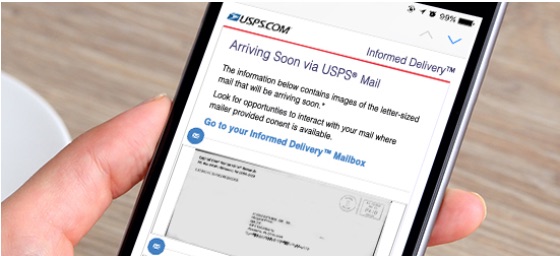
The USPS may be experiencing the continuing shrinkage in mail volumes, especially after the election season spike of 2016. But despite the trend to digital, the folks at L’Enfant Plaza, DC 20590 have come up with a winning service, “Informed Delivery”.

Householders and businesses can receive emails daily reporting what letters have been mailed to them.

You may have thought that Facebook or Instagram are the leading purveyors of new photography– the daily delivery of selfies, restaurant plates, goofy pets and family outings. In fact, it’s the USPS.  It takes approximately 411,000,000 new pictures every day.

The images are emailed, and also displayed on the user’s web portal.

The automated sorting process for letters relies on instantaneous scanning of a bar code, or a ZIP code. In 2016, Americans dropped 150 billion pieces into the USPS mail stream, and the sortation machinery looked at every one of those pieces and took a quick picture of the bar code or ZIP.

Until recently, those images were probably trashed a nano-second later. But then someone, a marketer, an engineer, a postal clerk, thought, “Hey, we took a picture, let’s post it!” Pardon the pun.

Automation machinery scans the incoming letter-sized mail.

Thus, the invention of Informed Delivery.

Every day, we at our household, receive an email from the USPS advising us of letter-sized mail making its way to us. The email includes an individual JPG of each piece, in black and white.

Now, you may feel that this is a weak attempt, a grasping at straws by a struggling old school business attempting to fight the digital tides. To me, it is enlightened genius. In a move that is worthy of a jiu jitsu artist’s praise, the USPS is using the power of digital to elevate its analog medium.

Every day a USPS email sends a photo album of coming mail.

Christmas Comes Early
For people at home, Informed Delivery may eliminate the excitement and anticipation of walking to the mailbox. ‘Kind of like peeking at your Christmas presents under the tree a few days before the event. Still, the service lets you know that a letter, check or invoice you are waiting for is definitely on the way. It also allows you to look at your mailbox, or mail-on-hold while you are out of town. ‘Kind of like scanning your voice mail–and you know you do that.

Many Happy Returns
Direct marketers will love Informed Delivery. Rather than waiting for the physical replies to show up from their latest mailing, they can see the reply envelopes as soon as the consumer drops it back in the mail. Admittedly, marketers can get digital reports now of bar coded reply mail, but Informed Delivery shows which replies, as there may be many outgoing mailings occurring simultaneously.

The USPS harnesses a digital app…who knew??

A Stronger Pitch
Every marketer considers the orchestration of messaging. We want to integrate email, social media and direct mail to complement a retail sales event. Informed Delivery alerts consumers by email of a coming promotion. The front of the envelope is the ideal canvas for the first tease of the event.

Intelligence At HQ
It should be pointed out, that if I have a dashboard of my incoming mail, so does the USPS. While you may worry that the USPS knows what I get by mail, I don’t. But if postal reform ever does get passed, the USPS may be able to offer user privileges to recipients based on the volumes of mail received. After all, if you do receive a lot of mail, you are a likely advocate of mail delivery, and to the USPS, that’s a high-five.

Kudos to the USPS on this latest innovation.  My bet is that as it takes hold, it will be leveraged, much to the benefit of one of America’s oldest and revered institutions.

Thanks for reading and sharing! If you want to see the Informed Delivery package, click on this!

(All pictures shamelessly taken from the USPS email and my personal portal.)

Standard
Sports

Knuckling Down

The Canadian Open finished at Glen Abbey Golf Course in Oakville yesterday, and the scoring amazed me for the strokes under par.  After 72 holes played, the leader board showed the winner, Jhonattan Vegas at 21 under par.  Put another way, for 288 recommended strokes, he only needed 267 to win $1,000,000 dollars.

21 under par is a pretty astounding number in the PGA Tour.  But it reminded me that I have played at Glen Abbey, many, many years ago, and I recall that I finished just the front 9 with a 57, or 21 strokes over par.  I have not been back.

Since then, my golf game has not improved.   Despite lessons, innumerable outings, new clubs, golf magazine subscriptions, disciplined score keeping, fastidious handicap calculations  (28.6), spiffy shirts, and an unbridled optimism, I still come up with a couple extra strokes per hole, delivering a consistent 108, +/- 5 strokes.  36 over par any given day.

The reason this occurs is obvious to me now.   After years of recording and analyzing  scores, yardage, accuracy, putts and penalties, my game is consistent.  First, short drives.  Second, wide drives.   Once in the rough, always in the rough.   If most holes require 2 strokes to hit the green, I will usually take three and maybe four.

Next, sorrowful putts.  Regulation calls for two.   My putts will usually be two, but I can make a three, even a four happen so easily that the gallery of geese standing nearby shake their heads in dismay.

I have reconciled and accepted my numbing under-performance.  And like a professional, I have studied it and dissected every misstep, and have now come up with a new way to measure and find success.

The Knucklehead Count

It’s not the lackluster shots that dampen my game.  Sometimes I get away with some brilliant shots which compensate.  What ruins my game is the knucklehead shot.

A knucklehead shot is a bizarre, inept moment of inattention enhanced by extraordinary clumsiness.  Knucklehead putts that are marred by a scuffed green or a bouncing putter.  Knucklehead approach shots are skulled wedge shots that rocket with malice waist-high  over the green and, nearly hitting a startled partner, end up in a bunker.  A knucklehead bunker shot is hit so fat that the ball barely rolls up three feet to rest under the lip.  A knucklehead fairway shot usually involves a 5-wood grinding the ball deep into the  turf before skittering 12 feet to a stop.

Knuckleheads generally can be validated by quickly taking a second ball, and repeating the stroke with consummate perfection.  In other words, lacking my inattention and clumsiness, the prior shot could have been brilliant.  Unfortunately, but to its credit, the game of golf requires physical and intellectual honesty, so the knucklehead counts, and the beautiful do-over doesn’t.

I break out scores on my card to show putts, fairway, yardage, accuracy and penalty strokes.   But the most important score is the knucklehead count.

Why?

Because I have accepted my game.  The only thing that changes is the knucklehead count.  When I finish up, I can look at my score, and have this quiet moment of calculation:  “I shot a 108.  But take away 9 knuckleheads and I could have had a 99.  Wow!

When people asked me how my game was, I used to respond, “Pretty good! I found three balls and only lost two!”  Now I measure success, and surprisingly, happiness, by low knucklehead counts.

It’s a great game, even for the knuckleheads.


Thanks for reading!  Please share with your earnest golfing friends who are still looking for that perfect game.


Standard
direct mail, Economics, Fundraising, Marketing, USPS

The Mysterious Cost To Raise A Dollar

The tiny silver disc leapt from the shelf.

The convolution of three events today raised my antenna that there is a superior organizing force out there that is directing our path as we hurtle through space.

As I was cleaning off our bookshelf, a small battery dropped to the desk. These are the tiny nickel-cadmium dots that we find in cameras and calculators. Not the larger lithium incendiary bombs that we have in our laptops and hover boards.

The calculator that failed to light up.

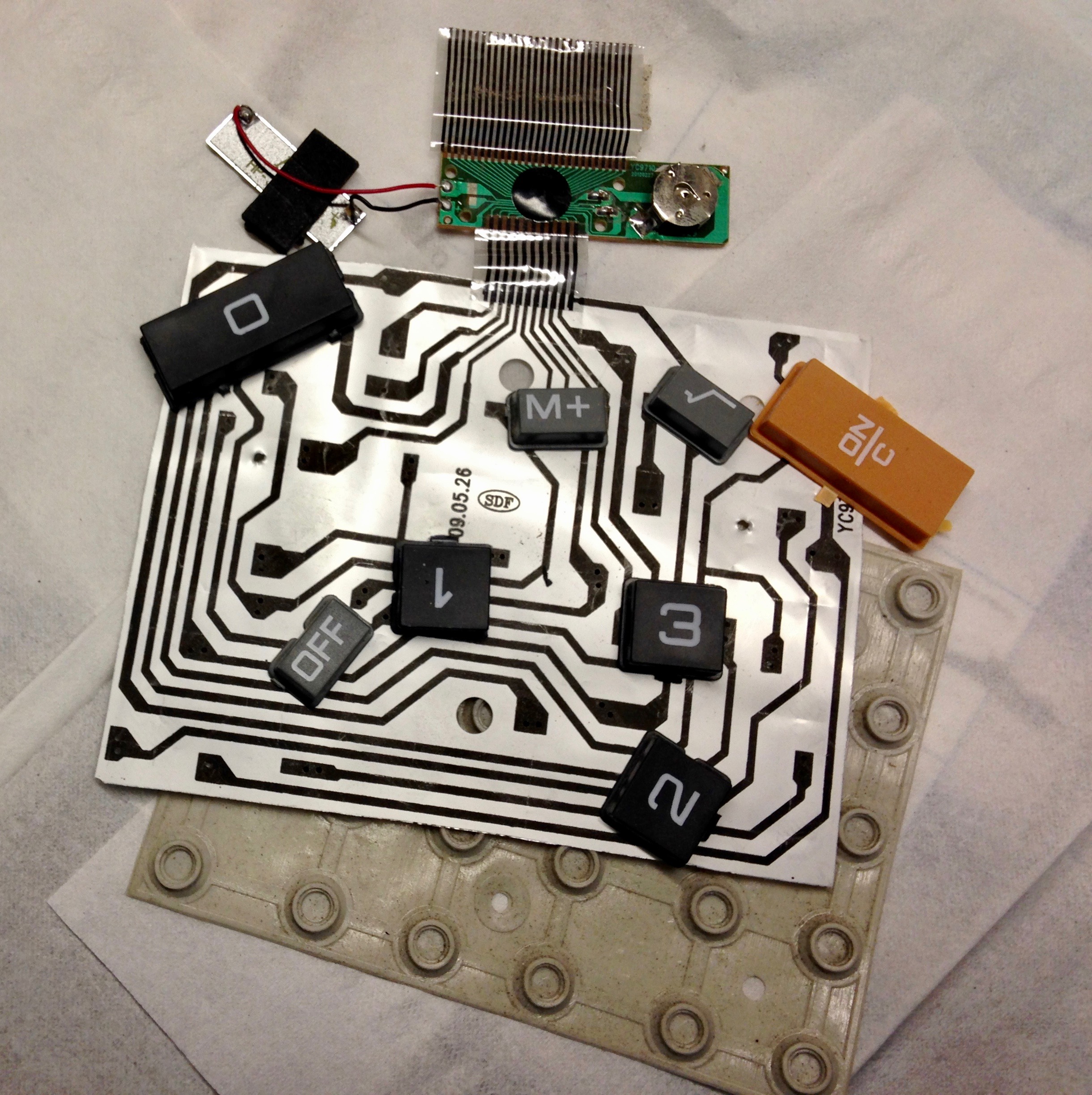
The battery was all that was left of a calculator I tried to resuscitate a few months ago. When the machine didn’t light up, I undid about 9 tiny screws to retrieve the battery.  As I popped off the back, the entire calculator sprung into a hundred pieces of keys, buttons and circuit board.  Incalculable.   I saved the battery to take into the hardware store for a replacement, just in case the calculator could be reassembled.

The next thing that happened was while emptying out the washing machine, we discovered that I had left my Moleskine diary in my shirt pocket. We retrieved the diary cover, very soggy, and found the rest of its contents spread like a million flakes of oatmeal over all our clothes. So much for keeping notes on paper.

A misadventure, attempting to extract the battery for replacement.

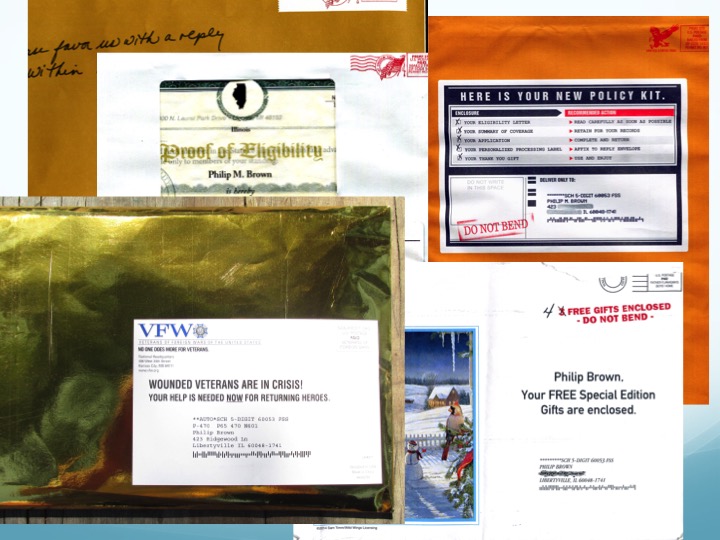
As the morning progressed, Lonny the mailman came by, and stuffed our mailbox with lots of missives from people we don’t know, but asking for money. The largest piece in the delivery was a giant, lumpy, shiny, pebbled envelope from Disabled Veterans National Foundation.

The DVNF package was an exceptional “Flat”: 12″ x 15″.   So huge that all the other mail was folded in with it.

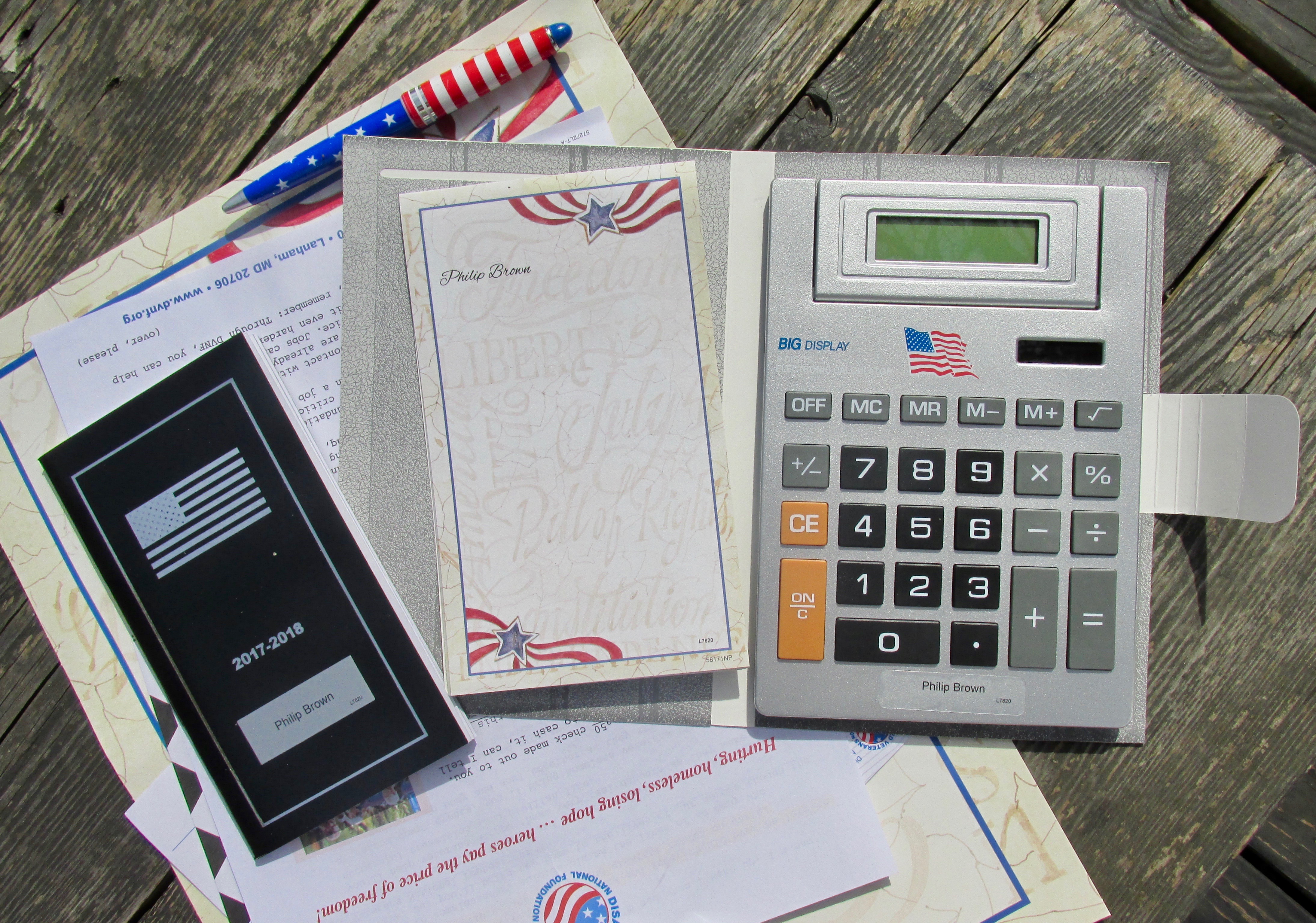
In direct mail, size counts.  So I opened it immediately to find, mirabile dictu––another calculator!  And—- another diary!  Wow.  I am completed.

The Mystery of Fundraising By Mail

After admitting that the USPS may be a supernatural force, most would ponder the imponderable: how does DVNF get away with sending out calculators, books and notepads, and expect to earn any money for their cause?

A “max flat” the 12 x 15 kit is shiny, pebbled and lumpy. It was folded to fit the mailbox.

That, dear reader, is one of the great mysteries of direct mail fundraising, and one that I will unravel for you now.  All you need to know is what the package really costs, response rate and average dollar gift amount.

To calculate the cost, I first took the kit down to the USPS post office for an official weighing.   Ranjit asked with a jaded smile on his face, “Why?  Do you intend to sue them?”

“No.  I want to calculate their postage, and how much this whole thing cost in the mail.”

Ranjit replied, “It’s non-profit, but don’t kid yourself, they are making money.”

I pulled out the new calculator and said, “Look at this!  That’s gotta cost a buck anyway…”

Ranjit smirked, “Nope.  Twenty cents.  About $2 dollars a pound. It’s from China.”  We weighed it: 3.3 ounces.  “That works out to 40 cents, ” I figured.  Ranjit countered, “OK so maybe $1 dollar a pound, that’s 20 cents.”

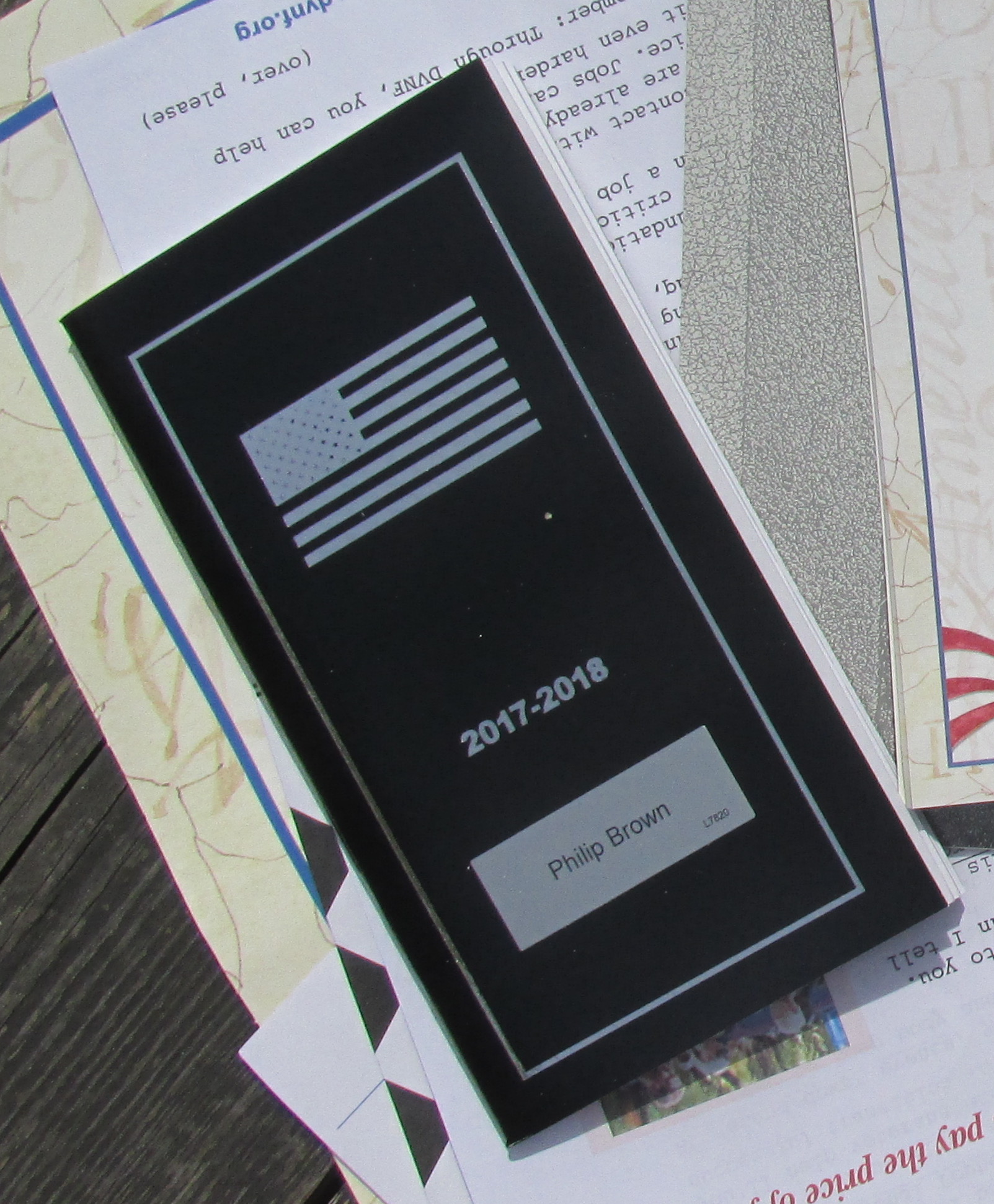
A new pocket diary, calculator, memo pad and pen, all personalized.

I stared at him as I pondered that number.  At the same time Ranjit extended his arm across the counter to flash a beautiful bejeweled wristwatch, sparkling in buttons, numbers, dials, and a bright yellow face.  “How much do you think this cost?”  He smiled.

“Uh, I don’t know.  Ten bucks?  A nickel?   79 cents?”

“Close.  It cost me $2 dollars.  Made in China. I bought 5 for $10 bucks, each a different color, for every day at work.”

Smitten with this new-found knowledge of international commerce, I bid him a good day and took my 20-cent calculator back to the car.

The whole mail kit, which included the calculator, the notebook, DVNF pen and some letters and envelopes weighed 9.1 ounces.  According to the USPS, this Flat was part of a 3-digit automation scheme, so I estimate the non-profit postage was about $0.59 a piece.

This pocket diary replaced the soggy Moleskine in a nick of time.

The envelope was made in China, as was the notebook.  Without asking, one can only guess that the components all assembled, shipping included, must have cost around $2 dollars.  Add another 50 cents for the 5-way match on name (envelope, calculator, notebook, donor form and notepad) and you have a kit that surely cost over $3 dollars to put in the mail.

And Now, Using The New Calculator:

That’s $3,000/m for you printers out there keeping score.

The donor form offers a $2.50 check as a tempting diversion. But they want $15-$25. Go figure.

When most mail kits ring in around $0.35 cents each, $3 dollars is a hefty challenge.   In their calculations DVNF finds a breakeven point by dividing the total cost of the kit by the average gift amount.   Looking at their donor card, they suggest a gift of $15-$25.  Taking the lower end, their breakeven response is $3/$15 = 20% response.  At the higher end, 12% response.

12% – 20% response is a steep hill.   This particular charity is known for its high fundraising costs.  According to Charity Navigator their fundraising efficiency is $0.71.  That means for every dollar raised, they spent 71 cents.

For this package, that translates to $3/.71 = $4.23 raised for every piece mailed.

If their average gift is $15, then their response rate would be $4.23/$15 = 28.2%.

And at $25, the response is 16.9%.

There’s no way to be certain, and DVNF is unlikely to share their response results.  But the package itself is a donor acquisition kit.  That is, a high pressure sales pitch to get a new donor.   If indeed it did generate a 28.2% response rate, with a gift of $15, the cost per new donor is:  ($4.23-$3.00)/28.2% = $4.36, which is pretty darn good, if not downright incredible.

It also follows that every new donor will be repeatedly contacted for further donations, which over time, leads to a real surplus, destined for program expenses that support the disabled veterans.


Thanks for grinding through these numbers with me!  Please note that Disabled Veterans National Foundation should not be confused with Disabled American Veterans.


Standard
Culture, direct mail, Marketing

USPS: It’s Worth The Weight

Flipping through old photo albums is a fearsome task. We used to look better. The forces of gravity and time didn’t seem so obvious.

The post office isn’t immune from these effects either, but it is still eye-opening to see how direct mail has aged with some elegance.

Direct mail dropped 22% in the past ten years, but First Class dropped even more: 37%.

I took a moment to compare 2016 USPS results against 2006. If you are a USPS employee, a printer, or a person who lives by the mailbox, read on.  By the way, I converted these to a normal calendar year.

We all associate the USPS with letter mail: invoices, statements, and personal mail. This past year, the USPS delivered 62 billion First Class letters. Ten years ago– 98 billion letters…a 37% drop in personal mail.

On the other hand, direct mail only dropped 23 billion pieces, or 22%.

But here is where direct marketers have managed to carve out a path to serve some 150 million homes and businesses with advertising every day.

Direct mailers have managed to make a respectable living with the USPS by slimming down. While the rest of the world has acknowledged that our bodies are bigger than in the past, direct mail has successfully dropped a few sizes.

To wit: in 2006, the average piece of direct mail weighed 1.86 ounces.  By last year, that had slipped 15% to 1.55 ounces.

Direct Mail has slimmed down in the past decade.

This may not seem like a big deal, but it reveals a lot about the reading public.  Direct mail designers have essentially cut down on paper and ink.

Envelopes are smaller, and contain fewer pieces.  In fact, Flats, which are larger than 6-1/8″ by 11-1/2″, dropped a staggering 51% in the last 10 years, down from 13 billion pieces to 6.3 billion.

The landfill protesters and tree huggers have to be thrilled.  But despite their glee, most direct mail is entirely recyclable, and much of it is made from post consumer waste paper anyway.

The super-sized Flat, large enough to hold a placemat is fading.

The rapid weight loss has provided a financial dividend for the USPS.  In 2006, the revenue per ounce was $0.107.  Ten years later it is $0.139, which is 12 points better than the rate of inflation.

The irony of the slimmed-down direct mail piece is that the USPS charges the same postage for a 1-ounce letter as it does for 3-1/2 ounces.  This would be the same as your favorite airline designing all the seats for a 300-pound row mate.  You know that is not the case, but the USPS is much more generous.

Given that allowance, it would make sense for direct mail designers to plump up their product.  Postage is the highest proportion of the in-mail cost, yet it is not leveraged.  Instead, parsimonious design has cut out the frills and treats that used to adorn productive direct mail.

My trips to the mailbox are disappointing.  It’s all two-dimensional post cards.

New age designers have lost the urge to embellish the kit, forsaking the 3.5 ounce opportunity to “load it up” like these.

What you don’t see anymore are great works of art that pleased and intrigued the reader.

The stuffed envelopes have been flattened.  The labels and stickers are gone.  The samples are gone.  The origami is muted.  Member cards, scrapped.  The shiny foils no longer announce a prize.  The extra letters and testimonials are removed.  The textures are smooth and sterile.  Reply envelopes?  Naah….go to the website.  Brochure?  Website.   Buck slip?  Phifff–what’s a buck slip??

So direct mail has entered its age of demur elegance: slim, sleek and stylistically boring, but somehow pleasing to the agency head who doesn’t absorb sentences longer than a gnat’s breath.

An experienced designer once told me, “you will make more money by adding to a kit than you will by taking away.”  What would he think today?

But let’s give the contemporary designer their kudos.  They have won the war on weight, but they have lost their way on  beauty and bucks.


Thanks for reading!  Please share with your direct mail associates.   Just like people who have rediscovered the beauty of vinyl records, there will be a time when “gangbuster” direct mail will return. 

Standard
Culture, Government, Politics

How Do You Like Your Eggs?

We don’t, as a social strategy, plan ahead to get involved in every thing that is beyond our comfort zone. We just want to live our lives. In local politics, that can be hazardous.

Once, a young couple were the parents of an infant boy, who from his first appearance in the world, never uttered a sound. Not a peep.  They worried over his silence as he grew into a young scamp. He had friends at school and played with the others, but without a murmur from his lips.

A long progression of doctor visits in those early years were fruitless. Specialists shook their heads, and told his despondent parents, “We don’t know what ails him, we are sorry.”

One morning, as his mother stood beside him at the kitchen table, he picked up his knife, and cracked his customary 5-minute egg. The yoke splashed out of its shell and onto the plate.

All at once, he exploded, “What the…?? What is this??”

Shaking his dripping fingers at the plate, staring at his mother, he spat out, “I can’t eat this! Look at the yoke! It’s all runny and gooey. The egg’s cold, and the toast is all soggy…yikes.. this is..this is… yucky, Mom!!”

His mother, at first shocked, stepped back, and then hugging her son, she beamed and looked up to the ceiling, and cried, “It’s a miracle! You can speak! Thank merciful heavens!”

Then she looked tearfully at her boy, and sobbed, “It’s wonderful! I am so overjoyed with happiness! What happened to you??”

The kid looks up, shrugs and says, “Well, up until now everything’s been okay.”

This may be a hyperbolic analogy of our times, but it certainly illustrates our typical lifestyle: as long as everything’s okay, leave it alone.

The continued public dialogue over the troubling, denuded 40-acre parcel of land that sits within our view is a good example of how we can be divested of our comfort zone.  And perhaps just in a nick of time.

After living for 27 years within the forest shadows of the sunsets over the property, we woke up one day to find the woods gone, and loggers carting away the trees in wood chip containers.  With the blessing of our village government, too.  Only then did I realize I should have spoken up earlier.

Regardless of my regrets, I now pay much more attention to those events that happen outside my daily environment, and in the process, extend my comfort zone to include them.

I suspect it is like that for many of us.


Thanks for reading!  I hope you too are mindful of how things pass us by without much ado, and how they often present themselves later in startling poses.  Thanks for sharing! 

Standard
Culture, Government, Politics, Thank You

Small Town Choices

img_4363

The bridge in the park at Butler Lake. Early freeze.

You know you live in a small town when people drop by without calling first.

Tuesday morning a smiling lady appeared at our door presenting a mardi gras King Cake. She explained it was thanks for speaking up at our town hall meeting.

A couple days before that we found a handwritten note in our mailbox from a gentleman a couple blocks away wishing for good luck.

This morning another note came the same way, saying thanks.

fullsizeoutput_3865

148 “lock and leave” homes for those just passing through.

The cause of these overt gestures is the disturbing proposal to plop 148 homes on 15 acres of a 40-acre parcel of recently cleared land at the edge of our pretty little town.

We call it a Village, which is kind of habit in these parts, but it’s a real town, not a little collection of thatched roof cottages with small people running around in leggings and buckled shoes.  Over 20,000 people live here.

Anyway, because of the collective rejection of the idea, we formed a group of residents in the Village to make our case for stopping the development.

I won’t bore you with the politics.

What I do want you to appreciate though is the essential goodwill of the people who live here, and who love our little town.

img_0986

Lunch in the park, on a sunny Friday.

We moved here 27 years ago.  It was a corporate move, and we had the benefit of shopping around the far north suburbs of Chicagoland.  Our first obligation was interviewing three school principals, each who presented their school’s achievements.   One school had computers in every room, which was pretty special in 1990.  Carpeted hallways.    Another school was brand new, and shiny.

2014-06-13_14-12-45_734

School’s out and the midway comes to town.

The third, was older, but in the center of our little town, bordered by a ball field, festooned with flags, and shaded by ancient maples and oaks.  As the vice principal marched me around the classrooms, the students all smiled and helloed.  It was a very warm May morning, and as we marched through the heat of the second floor, I offered, “Guess there’s no air conditioning?”  He bounced back, “Nope.  Isn’t it great?”  Rugged, smiling enthusiasm.

img_1266

Canopied streets and open space set the tone.

I have for years thereafter said that moving here was the best decision we ever made.  On the July 4th weekend when the moving trucks pulled away from our new home, two of the neighbors’ kids brought over a plate of cookies to welcome us.

A couple of years ago, after a car demolished half of our house, a lady from blocks away appeared at our door one day with a gift card from Panera’s.  She said, “I just wanted you to have this, and hope that you are okay.”  A complete stranger, but not really, in the greater sense.

img_3966

One very dog-friendly town, these two await their family in the Homecoming Parade.

For sure, the schools are great.  Top-tier nationwide, the high school is launch pad for our next generation of leaders.  The junior schools are our pride and joy.

But beyond that, our little town is a hive of busy optimism, set on a picturesque palette of heritage buildings, generous parks, a network of lakes, streams and wetlands, and threaded with neat roads and lanes through open, treed neighborhoods.

img_1172

Two young parade watchers celebrate the downtown alley.

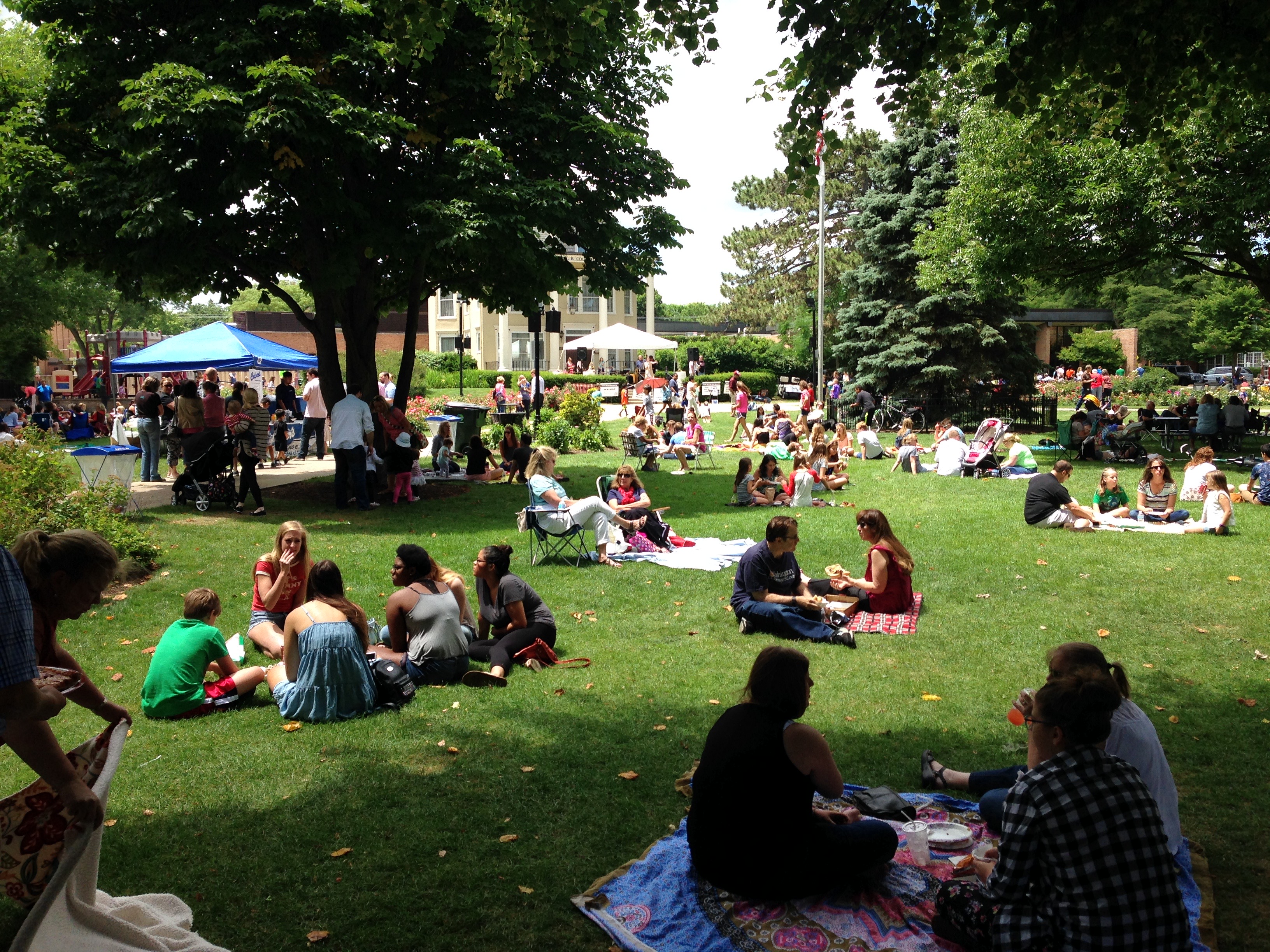
In the summer the town square is thronged with picnickers and market vendors.  In the days leading up to Christmas, Santa is taking last minute orders, and come the end of school, there’s a pretty spectacular fairground set up with horrendously noisy and garish rides.  A great venue for kids to escape for a while as summer approaches.

Even though there are 5-lane roads quartering the Village, its geography exudes community: a oneness of safety, children, exceptional schools, careful planning, well-being and promise.

I mentioned the goodwill of the folks who live here.  Many came to the town hall meeting last week and in front of a couple hundred neighbors, gave passionate testimony in defense of their small town.

img_1183

The village’s architecture is preserved and treasured.

One lady made a simple statement, but with profound meaning.  Before her, the discussion had recalled the past,  and how developers had walked away from our village to build their shopping mall in a neighboring community.  Another developer took its plans for a millionaire’s subdivision complete with golf course to another neighboring village.

Clutching the mike with both hands, she said, “We chose this village to live in because of its character.   We didn’t lose the shopping mall.  We didn’t lose the golf community.  We simply chose not to develop, and not to have them.  They aren’t what our Village is about.”

The debate on whether the 148 dwellings will materialize will continue.  They are described as low maintenance, “lock and leave” buildings for the travel and retirement set.

In the mean time, we’ll still be here, and the front door is open.


Thanks for reading!  I hope you will share this with your friends who also treasure the small town.


Standard
Marketing, Sports

The Deal: With Six You Get Egg Roll

img_6345

In spring, a young man’s fancy turns to…testing.

It’s a sure sign that Spring is on the way. The March issue of Golf magazine arrived, and after the most dismal stretch of dull weather in recent memory, the green pastoral images of fairways and beach-like bunkers beckon irresistibly.

But among those pages floats another stimulant. Golf blew in 4 different subscription order cards. These 4 x 5-1/2 reply cards exemplify the art of mail-order merchandising.

One would ask, why do we need any cards? I am already a subscriber!

Golf Tees

 It’s all in the numbers.

True, for the longest time I used to let my subscriptions expire so that I could re-up and get the free gift. In the past our home was filled with calculators, phones, binoculars, hats, world maps and globes… all manner of stuff with somebody else’s logo on them. Not only did we like the goo-gaws, but it was fun to get them in the mail.

But Golf’s four order cards demonstrate the great science of offer testing. And there is practical beauty in that:  when you understand what excites the buyer’s brain, you make more money.

Analysis

Each of the cards has exactly the same deal. One, two or three years for hefty discounted pricing off of newsstand. With each, the same gift premium is offered: a “Golf Distance Finder”.

I couldn’t use the distance finder. It would be perennially set at “Too Far” with only occasional gauging at “Fat Chance”.

Anyway, the cards are all different.  The result of long, worried debates in Golf’s conference room about how to best wring a dollar out of a new sub, there are four gradations.  Each effort targets a different dark corner of the golfer’s bunkered mind.

Card One: It’s blue, with giant GOLF titling.  In simple fashion it provides the basic deal with a mention of the discounts off newsstand price.

For the unassuming habit-driven: "yep, sure, whatever."

For the unassuming and habit-driven: “yep, sure, whatever.”

A small un-captioned picture of the gift is featured with, “yours free”. This card is the control sample, and wins or loses on brand loyalty.  Ideally suited for the unassuming, doubtless, committed player.

Card Two: It’s grey, with a smaller GOLF title, same deals but highlights “Your Price $16.00”. Understanding that some may not know what the gift is, “FREE Distance Finder” is inserted below the picture.

"The distance between me and the cup, and between me and Jupiter is negligible."

“I may never hit the green, but I can see Jupiter.”

This card is for the cash-strapped grinder who is figuring one year is just long enough to suspend the inevitable realization: golf is just a good walk in the wilds ruined. Or they figure $16 bucks is the right price for a telescope.

Card Three: It’s powder blue and screams to the wealthy and permanently, irrevocably, hopelessly optimistic, driven player: “Tomorrow will be a better day and the BEST DEAL! is a 3-year commitment.”

"This will be my year. Well, maybe, then again, sometime in my lifetime."

“This will be my year. Well, maybe, then again, sometime in my lifetime.”

The distance finder is featured, but it’s the 83% discount that grabs.

Card Four: This is the gutsy guarantee card. “Lower Scores. Lower Price.” is for the duffer who has journeyed through four painful levels of acceptance and will now  admit they couldn’t hit a basketball with a broom in a closet.

"This year I will not tear up my score cards."

“This year I will not tear up my score cards.”

They figure literature, technology and a little learnin’ might be the answer. If that still turns out to be a whiff, then they are ready to go for the money refund.

Results

At the end of the test, which could go on longer than the season, the Golf sales department will look at the results for each card, which got the most orders,  which deal worked best for each card, which got the most email addresses, and which got the most money up front.

This is not a double eagle fantasy for statisticians.  Rather, the results of this inexpensive test will predict which offer is worth rolling out in other media with the promise of the highest return on investment.

While solo direct mail may be proud of a $20 cost to get a new subscriber, the numbers may dictate that direct mail is still stronger than web display ads, email or simple on-page advertising.   Knowing which deal is strongest can shave a few pennies off acquisition cost.

Long ago, we used to puzzle over the best offer: “buy one get one free” vs. “two for the price of one” vs. “50% off”.

It isn’t easy, but you can test.

Thanks for reading!   Direct marketing tests are a way of life, and you never know when a new angle won’t build your margins unexpectedly.  I swing at the ball with the same giddy optimism.

Standard
Culture, Environment, Government, Politics

Trouble In The Back Forty: How We Got To Here

January’s public hearing on the 40-acre development up on Butterfield attracted a sometimes reasoned but also fiery rejection to the idea. The authorities went away ruffled and straightening their ties. The public filed out, quietly fuming, and baffled.

Bafflement prevailed because the question was asked how we ever came to this point: a 148-unit, high density housing development on the site of a recent clear-cut of over 2,000 60-year-old trees. The flames came from a few who castigated the developers and planners alike for taking advantage of the Village rules and a complacent, uninformed and trusting public.

So what happened?

The ground started to move in 2009 when the Archdiocese of Chicago signaled to the Village that they wanted to develop 97 acres of open land at the east end of St.Mary’s Lake. The Village looked at its Comprehensive Plan map and noted the parcel was drawn and zoned as Institutional Building, (IB).

Every smart village government has a Plan. This blueprint provides guidance to control against undesirable development. Our Plan had reserved the 97 acres for church buildings.

The Church however saw housing: affordable housing for Libertyville’s younger families. In a deftly cadenced move that any professional card shark would have applauded, the Church suggested to only develop the northern section, about 33 acres nearest Butterfield Road. South of that, another 7 acres of woods would be “untouched” and the bottom 57 acres would be left institutional. They asked that the 33 acres be redrawn as Residential.

Following two meetings and a lot of questions about Planned Development housing, traffic volumes, safety, isolation, tree preservation, housing affordability, open space and the wisdom of an unscheduled, redrawing of the Plan to suit the Church, they voted.   The Plan Commission went 5/2 in favor, April 2010.  The Village Trustees gave it a green light too.   33 acres were redrawn on the Plan map as Residential, and 7 acres left as Institutional.

However, the entire 97 acres are still today zoned Institutional Building.  While the Plan gives guidance, it’s the zoning which is law.

Only years later did the Church find a developer who would be happy to buy the land if they could build nearly 200 homes on the 33 acres, and take the 7 acres of woods south of the development site as well.

The developer quickly began to design the site, and eventually reduced the residential count to 148 single family dwellings, 3 & 4 bedrooms,  2,000-2,900 square foot, two-story units on tiny, fenced lots.  The designs didn’t comply with residential zone codes, but because they are a Planned Development, they got a pass.

Meanwhile the soft sell on the development commenced as multiple sets of beautiful drawings were dropped off at the Plan Commission office, with the Village Trustees, the engineering and public works departments, as well as the police, fire and the many other committees who need to vet the process.

Unfortunately, the public didn’t get wind of the proposal until a registered letter was sent to a few souls who lived within 250 feet of the site, net of any roads.  A public hearing in September hosted a small crowd of residents who, scratching their heads, asked what the heck was going on.

Even then, the public didn’t fully understand what was about to happen.

The Church, now very much on a roll, authorized the developer to get Village permission to remove 2,500 trees on the property.   After considerable expense and due diligence, the Village Trustees approved the logging on October 10.  By Thanksgiving, the trees were gone, authorized with a site development permit.

Yet no approval had come from the Village to re-zone, let alone develop the site.

The next Plan Commission meeting was postponed until January 9.  With time to study the proposal, it became clear to many that the development was off color.

Many emotional, esthetic issues entangle this debate, but high above them is the reality of traffic congestion, child safety, school crowding and Butler Lake pollution.

In addition to these challenges, the developer is attempting to sell very expensive homes to buyers who will have tenuous and dangerous access to and from their neighborhood.   The stark reality is that there is no convenient way to turn into the site, and nightmarish opportunities to exit.  A deal killer for the rational homeowner.

The Church has been suspected perhaps of disconnecting the site from Libertyville if we kibosh the deal.  Rumors run rampant that the land will host high rises, fast food stores and muffler shops if we were to lose the land to the neighboring village.

The probability of that happening is remote because none of the developer’s challenges go away.    In fact they are compounded by very expensive infrastructure needs and delays statuted in Illinois law.

So we now find the issue coming to a head with a February 27 vote:

  1. To re-draw the Plan map to include the 7 wooded acres as Residential;
  2. To re-zone all 40 acres from Institutional to Residential;
  3. To get a plat of the subdivision;
  4. To grant a special use permit to build a Planned Development;
  5. To develop a concept for the Planned Development.

The Village Trustees painted themselves into a corner back in 2010, but have had to wait 7 years for the floor to dry.  Whether they can find a solution to the conundrum is a toss-up.

Rest assured that the public is now paying attention.

Standard
Culture, Environment, Government, Politics

Warning, Sign Ahead

img_7562

The sign, like fine print, hints at bad news.

In Libertyville we are looking up every few moments to see what else has happened.

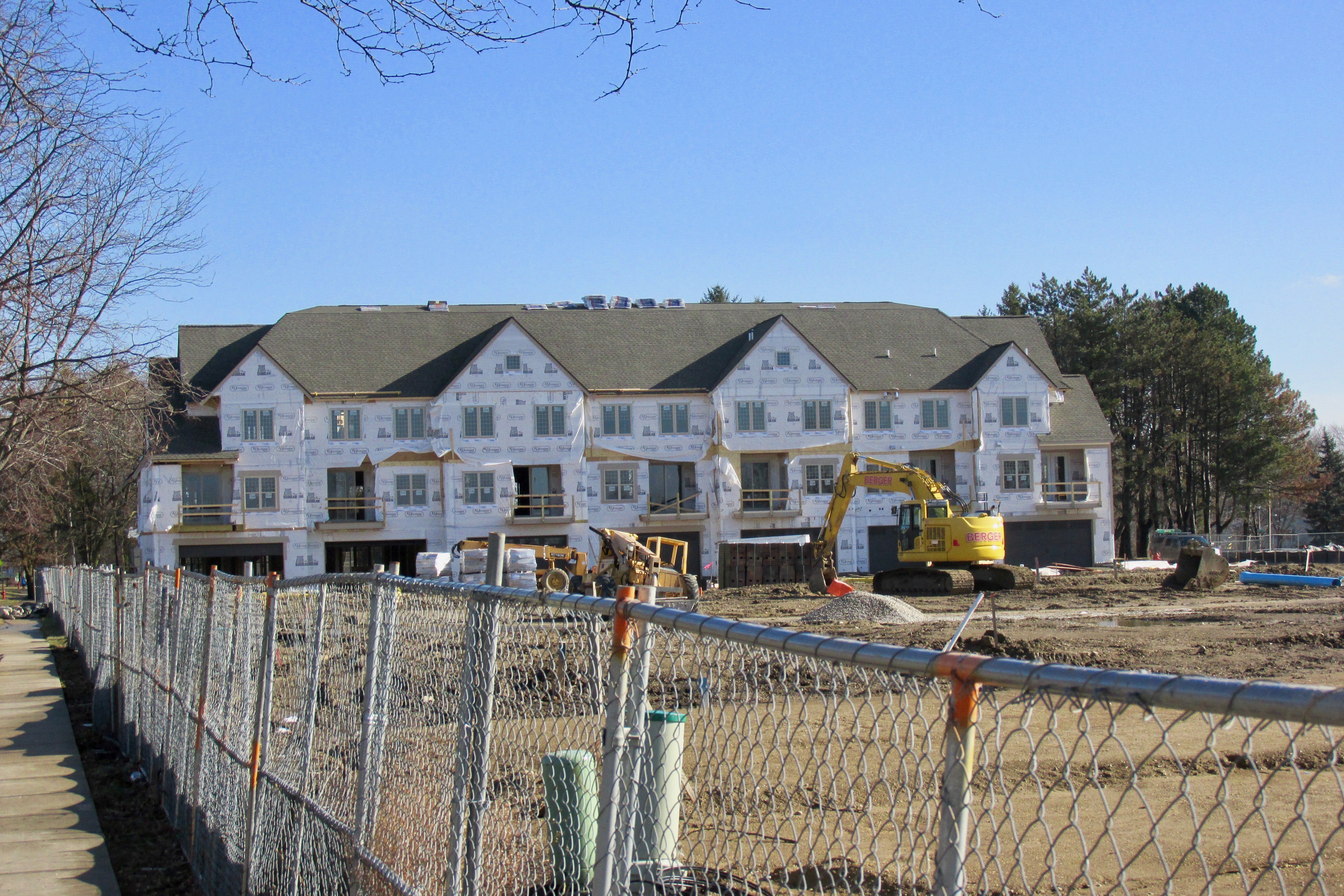
Last summer, without much ado, a sign was posted on an old playing field on the north side.    A little time later, a huge scraping of topsoil appeared, mounded like a two-story pyramid of dark chocolate.  It was soon iced with a frosty mantle of green weeds.   Five condo buildings are soon to follow.

img_7551

The new view from the treetops, sort of.

On the west side, a sign went up announcing a hearing about a corn field bordered by a tangled, but mature stand of 60-year-old trees. By October, the trees had come down. The plan calls for 148 homes.

Further south, another sign announced a hearing for a modest development of 19 houses over a small parcel of land and wetland.

Meanwhile there is a sign in front of the train station.   It’s the site for a multi-residential complex that will make rail commuting an adventure in the future. Some 150 units will be in place to hear that lonesome whistle blow, as some 46 trains roll by every day.

img_7555

Winchester: one up, and four to go.

All of these signs are caused by the popularity of a Village which has every reason to be proud. Founded in 1882, it was a remote outpost for Chicago travelers heading to Milwaukee.

Today it is a thriving, pretty town of 20,000 souls in the country, home to the #1 school district in Illinois, and #2 nationwide. It has a bustling main street that sees 23,000 cars daily, but still offers free two-hour parking on both sides, to visit the big-windowed, filigreed stores selling everything from $30,000 motor cycles to $10 hair cuts.

img_0986

Lunch in the park, in front of the Cook home.

In the Village Center,  residents lounge in a treed park hosting a vibrant, manicured rose garden, summer band concerts, lunches on the lawn, Thursday market and the view of a picturesque antiquity, the city father’s mansion now restored as a public museum.  Hungry for knowledge? The library is right there.  Just plain hungry? The Village lists over 70 restaurants and bars.

We are at the center of a giant societal magnet: everyone wants to live here.  And that is the challenge.  How do you keep that small town feel that brought you here 5, 25, or 75 years ago?

16114544_10210235586460173_5889575746604854179_n

Another housing plan, neatly drafted.

Fortunately, we have considerable oversight.  The Village has a Plan which is the blueprint for planned growth.  It has a commission that executes the Plan, and that includes sub commissions that monitor appearance and zone codes.  Hardly a tree goes down or a roof goes up that doesn’t get a committee say-so first.

Still, none of these measures and controls work if we, the residents, don’t read those pesky little signs.  Like fine print, they often signal bad news.

fullsizeoutput_3aa7

School Street an urban success: asking for over $1,000,000.

The trouble is, the signs keep popping up, like Village-sponsored graffiti, and our only choice is to pay attention.  Which can be a full time job.

The Village Hall posts a schedule of committee meetings.  There is at least one meeting every night, virtually all year.  If one is diligent, the meetings could be met, except that the school boards have their monthly meetings too, so it’s difficult.

station-square

Downtown: the Metra station gets a makeover.

Meanwhile, the developers move in, longstanding property holders look to reap their reward, and the borders of our Village are eroded and pushed, like impacted molars, causing pain with every new sign.

We can’t stop progress.  But we need to trust our Planners and Trustees to watch out for us.  In return, we do need to show up when those signs pop up.

As the saying goes, “if you don’t go to the meeting, the meeting doesn’t go your way.”

The next Public Hearing for the Butterfield proposal is February 27th, at the high school, 7pm.

Thanks for reading!  If you want to keep informed by the Village of new meeting agendas, click here.

Please share!

Standard
Culture, Environment, Government, Politics, Wildlife

If A Tree Falls In The Forest

fullsizeoutput_3666

The woods that colored our view.

This past October has been a searing lesson in keeping one’s antenna up. The teachable moment was the watching of a highly efficient logging crew cut down a thousand or more trees from the lot across the road.

The clear cut was requested by the church which owns the land, and it was approved by the village after due inspection.

You see, where we live we have a village administration which has pretty strong rules about keeping up appearances. You can’t just cut down a tree unless it’s sick, damaged, or dangerous, and if so, you need a permit first.   I used to think too much government is a rein on individual freedom, but this set of rules is a good one.

img_0089

This old gentleman looks forward to a questionable future.

It turns out that the church is in the mood for selling the land for development. The challenge was to make the parcel more attractive, and to that end, counseled with its lawyers to build a case for removing a wilderness of 60-year-old trees.

The trees in question were part of an abandoned tree nursery. Fifty-five  years ago, they were planted 10 feet apart, and do you know what happened? The owners gave up the business, and Mother Nature took over.

In fitting out her arboreal family, she attracted a host of wildlife, from deer, coyote and other furry creatures, complemented by boisterous flocks of birds who populated the tree tops with a chatter of music all day.

fullsizeoutput_3664

20,000 motorists enjoyed this view every day.

Meanwhile, the trees matured to their full 5-story height, and spawned a wilderness of jungle under the canopy.

img_6908

Not a winner: this tag identifies a tree that didn’t make the cut, ironically.

The critters loved it; the church not so much.

Then about a year ago, a developer sniffed out a golden opportunity to build a settlement of new homes on the property, and before long, a deal was made. The developer became the authorized agent for the church to get the trees removed.

fullsizeoutput_3545

Every summer and fall a corn grower leased the land for this harvest.

The new agent petitioned the village government, pointing out the church’s liability if, God forbid, a tree might fall down and clobber a hiker foraging in the woods for morels. It hadn’t happened in 50-plus years, so odds were likely that the jig would soon be up.

With detailed, supporting testimony from professional arborists hired by the developer, and then double-checked by the village’s own arborists, and ultimately inspected by the mayor, the village gave the okay to axe the forest.

Each offending tree was tagged, and given a C.V. page in a three-ring binder. 2,500 candidates were put on the rolls, and 38 were deemed salvageable.

The news finally broke when the local reporter headlined an article on the pending clear cut. Then, and only then, did the public wake up.

fullsizeoutput_3713

The loggers, like good executioners, did their job swiftly, and well.

But sadly, too late!

fullsizeoutput_36ed

A 57-year-old bleeds a story for the arborist.

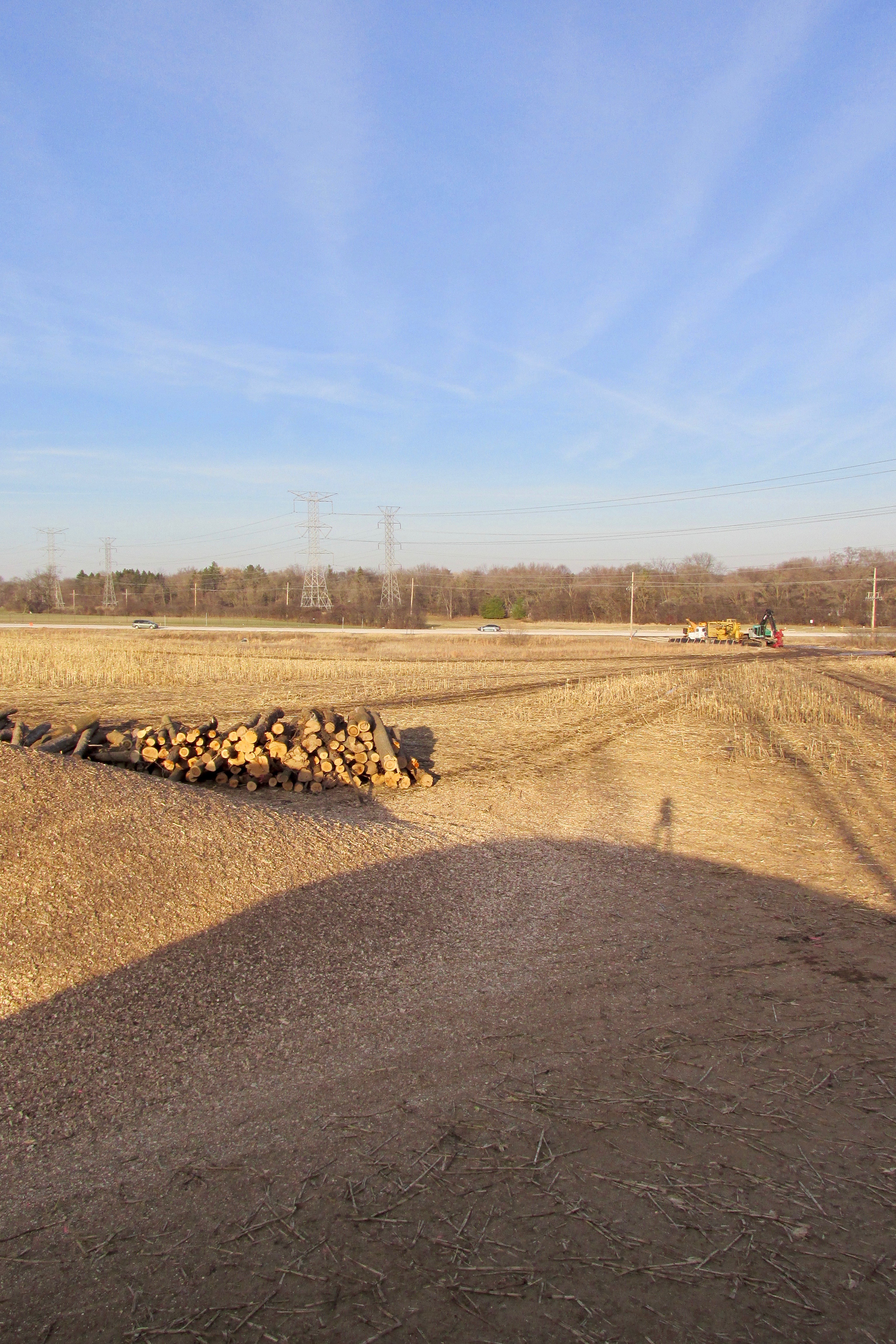
In November the heavy machinery came in, and in a matter of a few days, decimated the woods which had pleased passers by for decades. Today, there is a giant mountain of chipped wood on the lot, over 20 feet high, and enough to fill the village swimming pool three times over.

fullsizeoutput_36eb

Three winners. 38 trees survive the cut.

I mentioned passers by.   Approximately 20,000 motorists pass the woods every day. Year after year the woods have been the backdrop to the driver’s view on a seasonal corn crop that has graced the parcel forever, accented by a colorful palette of leaves each fall.

One day it’s there, the next, it’s gone.

Driving north today we see a sodden battlefield of tree stumps, roots and tangled branches, exposing fresh, grainy wood under torn bark and up-ended logs.  A water tower overlooks the scene, never before visible from the road.  Behind that, the once sheltered golf course now presents a naked 20-foot-high wire fence used to catch wild golf balls.

fullsizeoutput_3836

The new view. Passers by witness the harvest, and drive on, chastened.

As we drive by, our eyes are drawn to the carnage, and then we avert our gaze in disgust.  The sight is sickening.

One wonders if the village will have the gumption to direct the church to clean up the stubble and make it pleasant, minimally, just to keep up appearances.

Though the word “development” is attached to every discussion about the deforestation, we are assured by the village that the decision to remove the trees is not connected to any housing proposal.

fullsizeoutput_3843

This row of trees is no longer a threat to the hiker.

The questionable proposal to crowd up to 147 houses on the parcel of land is nebulous.  Despite the best drawn plans, it has earned no approvals for re-zoning, plats or building.

In the face of the public’s nausea over the decisions to date, the development may never appear, or perhaps hover in limbo indefinitely.

fullsizeoutput_383d

2500 trees, reformatted.

Meanwhile, the steam and fumes of fermenting wood chips fill the air with a bitter tannic scent that drifts across our neighborhood.

The lesson we have learned from this smoldering string of events is that despite our best wishes, bad things happen if we don’t pay attention.   To that end, there is an aggressive interest among the population to watch what’s going on down at village hall.


While all the time, we grieve, and get on with it.


Thanks for reading! Please take a moment to share this with your friends. 

Standard