direct mail, Economics, Marketing

USPS: The Report Nobody Sees

The USPS has published its quarterly Revenues, Pieces and Weights report (RPW) and some trends for both optimists and pessimists will start you thinking.  First off, understand that the post office doesn’t observe the normal calendar year, so the numbers shown here are normalized to January-December.

Revenues for the year, up 3.3% Slide1
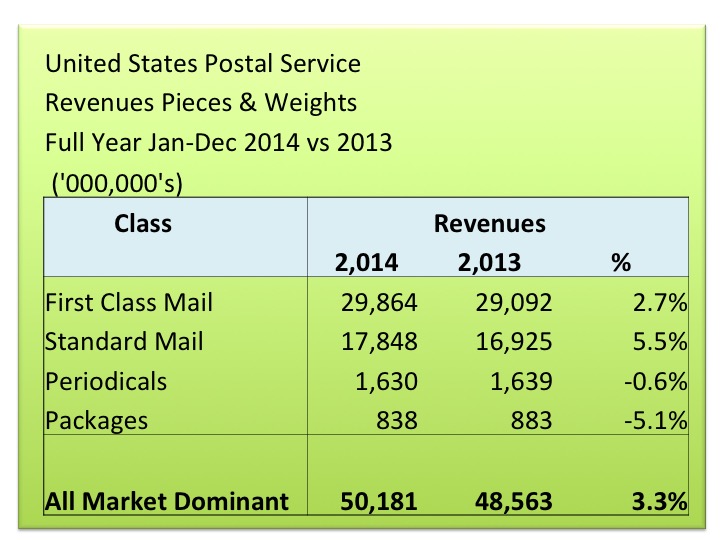
First Class Mail, which includes all the bank statements and financial releases, plus personal letters and cards saw a 2.7% increase in revenues.   Pretty good, considering that the class took a 5% increase in price.

Standard Mail which is entirely promotional and non profit mail boomed 5.5%.   If nothing else, this is an indicator that the market was ready to invest in Direct Mail.

Periodicals revenues were flat, indicating the continued effect of online access to reading material.   Parcels were down as a result of a drop in media and library mail.

Pieces down, virtually flat -0.7% Slide3

The big win for the USPS was its ability to bag an increase in pricing without a significant drop in pieces.   In 2014 the post office delivered 152 billion pieces of mail, magazines and parcels, down a billion… but what’s a billion?   Fundamentally, piece count is the physical evidence: choosing to mail hard copy versus an alternative, such as email.

Drilling in to the numbers, Standard Mail grew a billion pieces, or 1.7%.   As can be expected, First Class dipped 1.5 billion.   Interesting, in Q4, which includes Christmas, volumes were up in all FCM categories except for single cards and letters.   Despite our best hopes, the Christmas season didn’t materialize on the kitchen tables of America as stacks of holiday greetings mail.

The most worrisome segment of the pieces category is Periodicals, which illustrate the rapid decline of magazine mail, the real victim of web communications today.  Periodicals dropped 4.7%.

Tonnage down 3.2%

Slide4While pieces are down slightly, the total weight hauled took a big dip: 500 million pounds or 250,000 tons.  For the record, the USS H.W. Bush Super Carrier weighs 100,000 tons.  Can you imagine losing 2-1/2 aircraft carriers in the mail?

But to the point, while mailers only backed off mailing pieces by 0.7%, they were much more careful to lower the weight of each package.   So the USPS still walked as many routes as last year, but their trucks didn’t use as much gas.
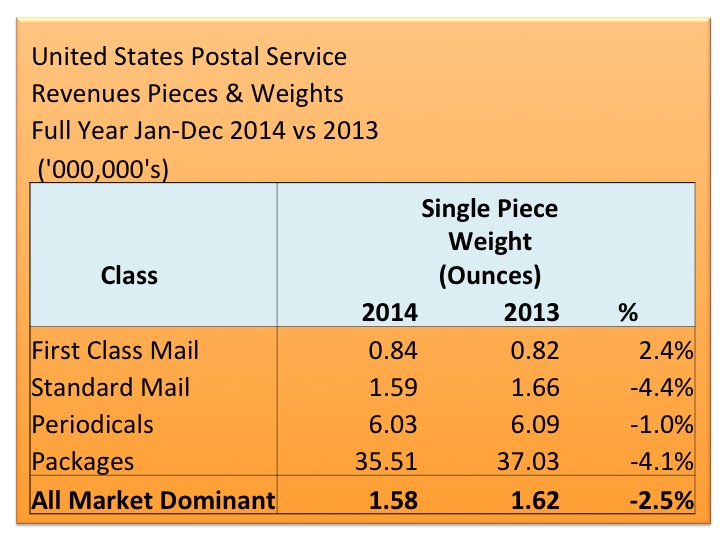
Slide5The drill down shows that Standard Mailers lowered their kit weights by 4.4% to 1.59 ounces on average.   Given that the postage is the same for up to 3-plus ounces, it is likely that printing costs drove down the weights.   That, and fewer Flat-sized kits.

Periodicals dropped 1%, which translates to fewer page counts, and less advertising.  Parcels and packages were down to 2-1/4 pounds.

Only First Class mailers upped their weights.

The Cost of A Stamp Up 4.1%

Slide6First Class postage took a real price increase of 5%, and watched its volumes decline 2.2%.

Standard Mailers took a 4.2% increase and grew their volumes 1.2%.   This is a clear indication that Direct Mail is enjoying the effect of its financial results in the market place.

Only Packages saw a price decrease, which spelled a slight increase in volume.

What’s Next?

We’ll see how the postage increase affects volumes and revenues after April, 2015.   Mean time, it’s a safe bet that Direct Mail is headed in the right direction, and may ultimately be the driving force in USPS revenue stability going forward.

Kudos to the USPS navigating its way through these changing times.   If you would like to see the RPWs they are available here…  http://about.usps.com/who-we-are/financials/welcome.htm

If you have a question, comment or observation about this report, let me know!


Standard
direct mail, Economics, Marketing, Thank You

Ten Reasons You Should Thank The USPS

Teddy StampWe are all cheesed that the USPS is looking for a 1.97% increase in postal rates.  But before we run to our social media to complain, let’s open the envelope.  What are we getting?

1.   Door-to-door, pick-up and delivery.   Not only does a real person come to your home to deliver mail, but they are charged to pick it up, too.   Beats driving downtown.   And they do this 6 days a week.

2.   Equal representation.   The USPS is probably the only government institution which situates an office based on population density, rather than political handouts.  For sure, it’s the only federal presence in your community that isn’t there to administer laws and levy taxes.

3.   Legal authority.   A USPS postmark is an official seal, and when your letter is in the system, it’s a completed act.

4.   Jobs.   The USPS employs over 600,000 people.   It’s also the network that directly supports another 1.3 million people who use the mail to make a living, according to the Direct Marketing Association.

5.   The Grid.   There are 142,000,000 delivery addresses in the United States which are visited daily by the mail person.   The USPS grid is like a vast capillary system that beats nationwide, touching the most distant extremity.

6.   Innovation.  Maybe hard to believe, in the face of digital networks, but the USPS has refined and streamlined delivery to the point that it is cheaper to mail a letter today than it was 10 years ago.

7.   Protection.   Your mail is protected by federal law.   The space inside your mailbox is federal property.  The blue boxes situated across your community are safety deposit boxes, in effect.   Drop your mail, and it’s secure in the system.

8.   Culture.   What other government body continually picks new designs to celebrate on the face of a stamp?   Rock stars, writers, artists, scientists, athletes, discoverers… and they are BIG stamps too!

9.   Resilience. Despite a whirlwind of communications technology advances, the USPS still has cache, delivering nearly 500 million pieces a day.   When was the last time you saw a public phone booth?

10.   Fiscal control.   Yes, it has a $5 billion budget deficit.   Works out to $8,333 per employee.   The federal government has a $483 billion budget deficit.   $112,013 per federal employee.   In the bigger scheme of things, go figure.

Nobody likes price increases, but it is a sure thing that the USPS has done leagues more work to control costs than any of its government cousins.  In light of its value, can you really complain?

By the way, the price of a first class stamp remains at 49-cents after the hike.   Good anywhere in the nation.  Buy a bunch, they’ll last forever.

Standard
direct mail, Economics, Marketing

How You Make Personalization Pay Off

Boystown CALENDAR HANGER

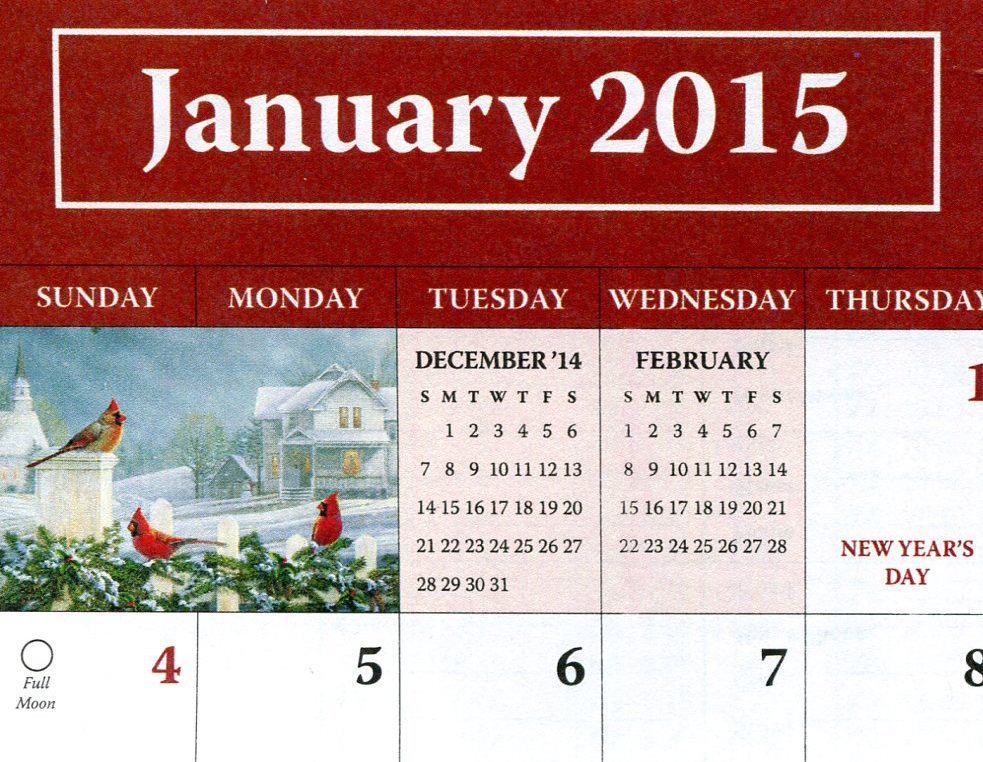
A 24-page color calendar, replete with country roads, cabins, barns, flowers and birds…lots of birds.

Personalizing a mail piece comes with expense. You are about to see the motherlode.

Gracing the letter with the reader’s name is one thing, but it’s quite another to match that to the envelope. For the fully committed direct marketer, there are personalization payoffs, and Father Flanagan’s Boystown shows us how.

Boystown Envelope

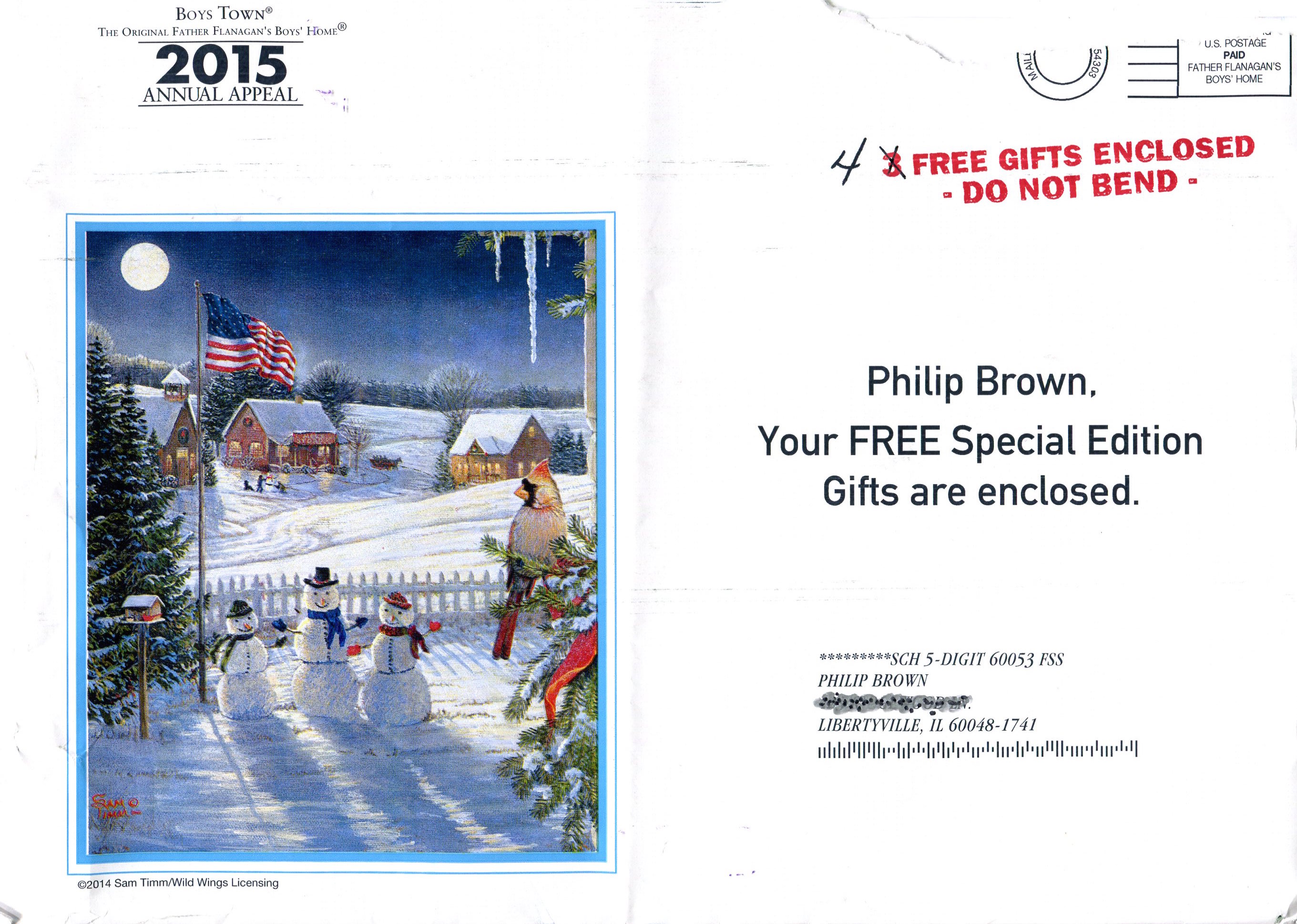
An outer envelope promising lots, and delivering, too.

BoystownBooklet Bird Jan

January.. from the 36-pager booklet, with more birds…growing in numbers.

Just before Christmas we received a 9 x 12 envelope from Boystown announcing their 2015 appeal. The donor acquisition kit weighs about a third of a pound, which is huge. The outer envelope calls out, by name, that FREE Special Edition Gifts are enclosed.

“Free Gifts” is right. They send three calendars: a 24-page hanger for the wall, a 36-page purse calendar booklet, and an 8-1/4 x 10-3/4 calendar card.

Boystown    color labels

The color label sheet. High quality and keepable.

The whole collection is covered in Sam Timm nostalgia art: winter ponds, chimneyed log cabins, old trucks, old boats, old canoes and birds…. enough birds to awaken Alfred Hitchcock one last time.

Boystown    028VGF Calendar

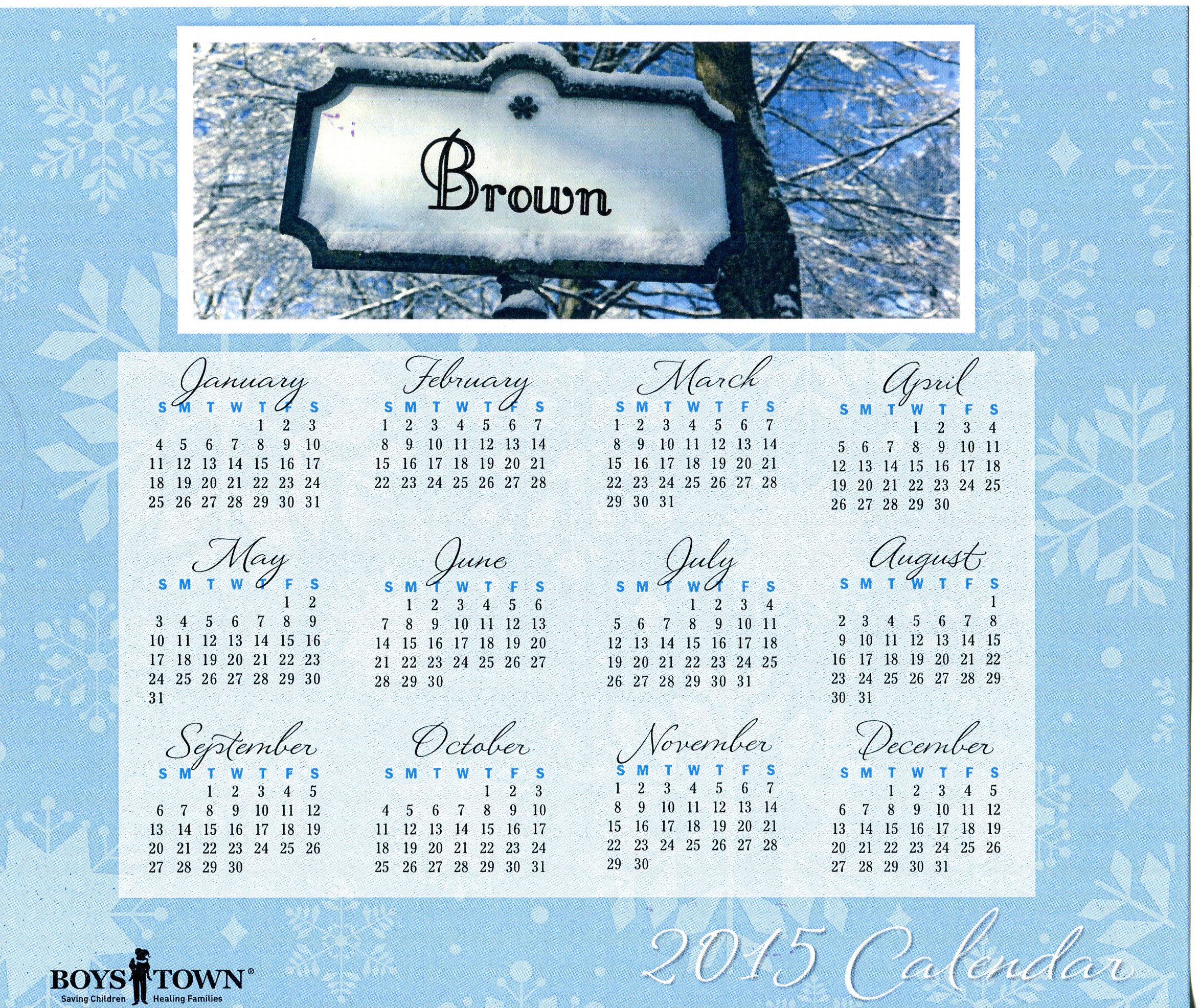
Another calendar, this one with a stylized street sign.

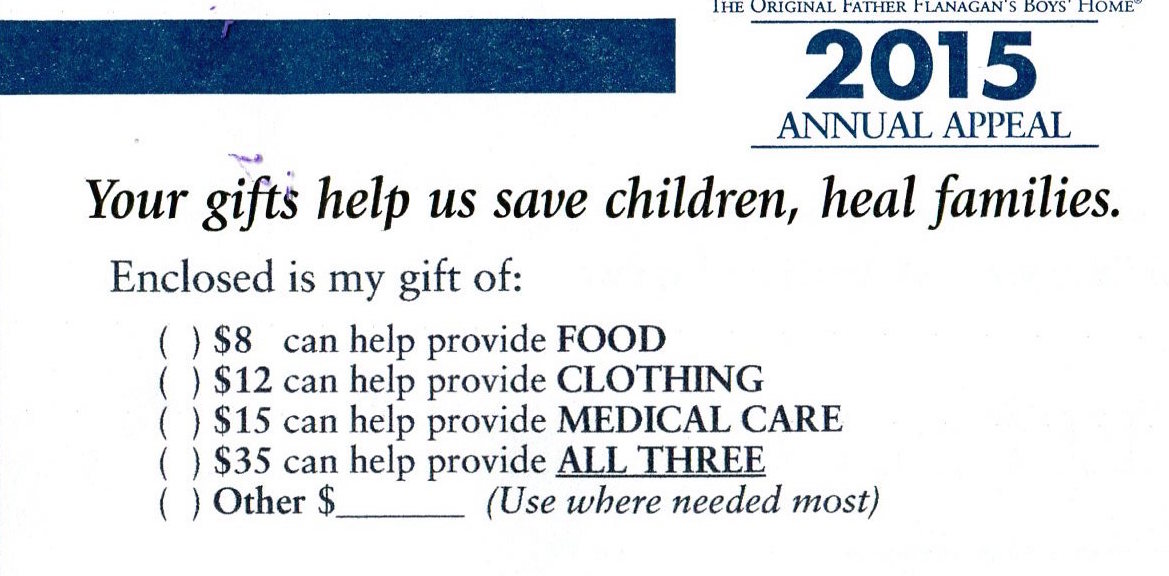
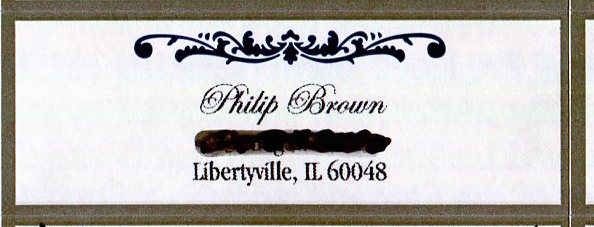
But the overwhelming effect comes from the personalization. Father Flanagan has managed to personalize 8 pieces in this whopper kit: the envelope, the letter, the reply form, the reply envelope, two sets of very nice address labels, a certificate and a calendar card.

Boystown  Certificate

It’s only an acknowledgement, but hey, it’s framable.

Over the top maybe?

Boystown Johnson Box

A Johnson Box, personalized and tinted, captures the gist.

Not really. Remember, good direct mail is designed to be indispensable.   It is extremely difficult to throw out a kit when your name is woven into its making so admirably.   The proof: this is a control package, or very similar to past controls. So it is working.

What’s the math that supports this?

The kit itself probably cost around $1.80. Postage for a 6-ounce Flat at non profit rates is actually a bargain, add another 30-cents. Total cost in the mail, probably $2.25 after adding list and processing.  This is a guess, only, having not spoken directly with Boystown.

Boystown Gift Certificate

Individualized gift certificates, one of three.

Now, the hard part: getting paid. Assume the average gift is $15. To break even, we need a 15.0% response. ($2.25 divided by $15.00 = 15.0%)

And the really hard part: they probably won’t get 15.0% response.   More likely, they might achieve 8-10%.   Let’s say 10%.  So given that, every response came at a cost of $22.50 ($2.25 divided by 10% = $22.50).

Boystown Donor Closeup

A strategic gift choice, Goldilocks-style. Let’s go for $15.00!

Is a new donor worth $22.50?   The answer is, “yes”!

By Father Flanagan’s 2012 financial report, they derived nearly $5 for every dollar spent in fundraising.  A very acceptable payback according to industry standards.  By the numbers above, the new donor will continue to give over time, well in excess of $113.00.

Boystown B&W Close Up revised

A set of stylish B&W labels in case I don’t want to give away the birds.

BoystownBangtail Reply

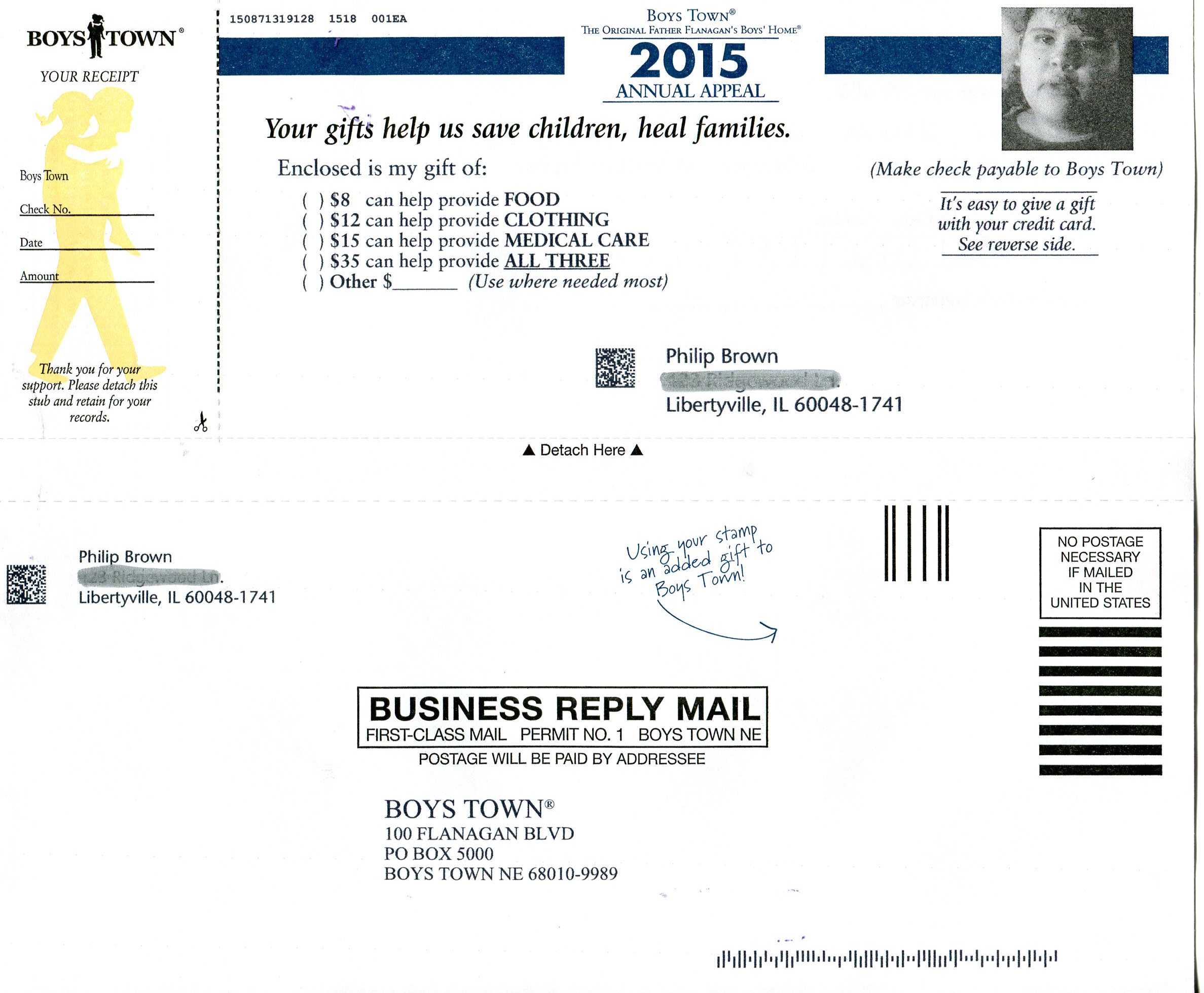
Personalized donor form and reply envelope. Note the QR code for tracking!

Again, this analysis is my perspective only, but a donor will continue to give to a worthy cause, especially one as well branded as Boystown.   And not only will they give today, but some will most assuredly make bequests after passing to keep the institution providing its valuable service.

So personalization plays a big part in winning support, and the savvy marketers at Boystown have done their jobs well in making it pay for their cause.

Thanks for hanging in to read all those numbers!   FYI, Boystown provided nearly $192 million in services in 2012, and in 2013, served 122,000 children and families across America.

Standard
direct mail, Marketing

Pretty Ain’t Pretty Sometimes

Hospital 978

A 2-page high color sell sheet, but no letter!

When you are on the marketing end, you may feel that direct mail, especially fundraisers and business mail, looks pretty vanilla. Maybe even bland.

So the urge is to pretty it up.

Hospital 976

The hospital’s familiar happy logo is disguised here, but this envelope brings no bad news.

That is the case with this fundraising piece for a well known children’s hospital. For its sake, anonymity will prevail. But here is a 7-step rule book on designing fundraising mail.

1. Set the mood for urgent need.

Hospital Sneakers copy

A snappy colorful tease, but is it urgent?

To that end, use color and graphics sparingly, to best create a tone that delivers gravity, not levity.   The envelope for this kit displays a cheery logo (disguised here) for the hospital. Understandably, it wants to convey happiness for its patients.   But that’s not the right strategy for getting financial backing.

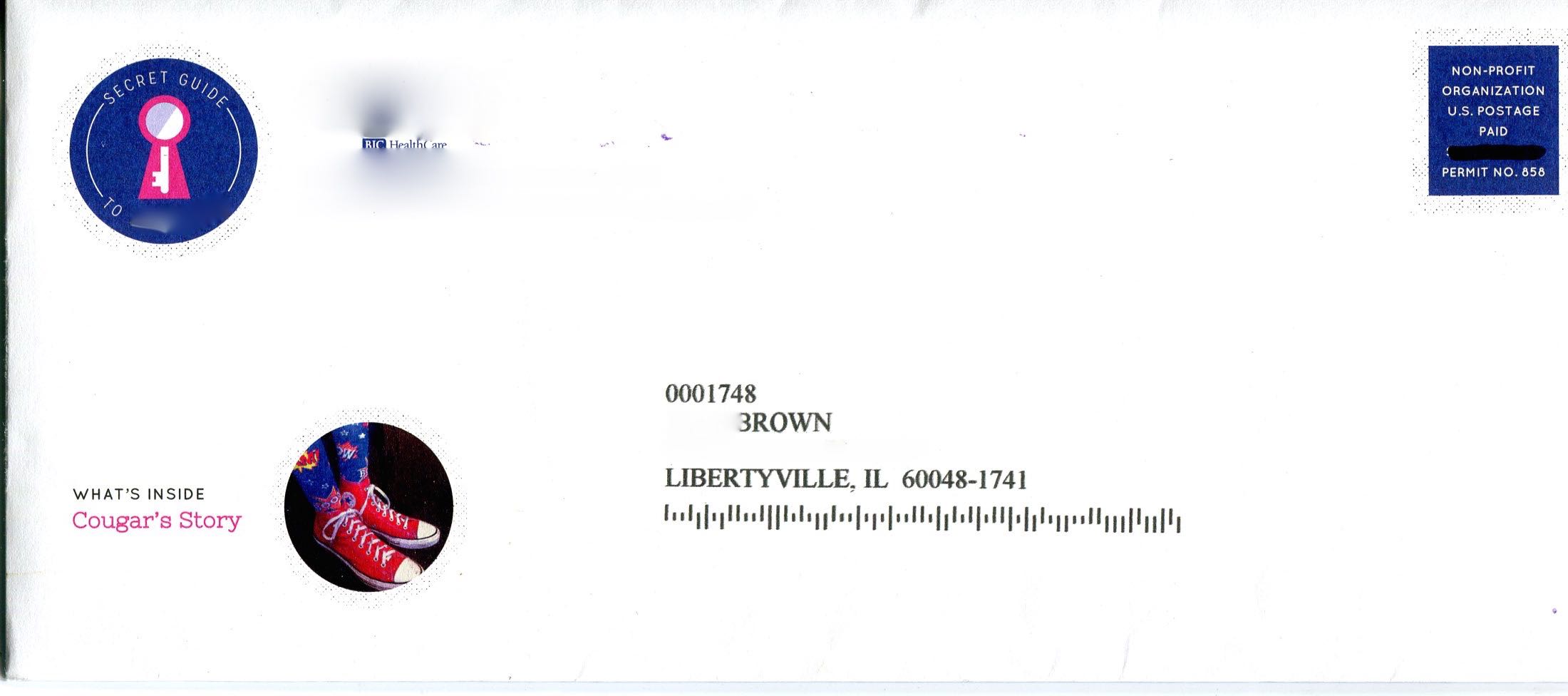
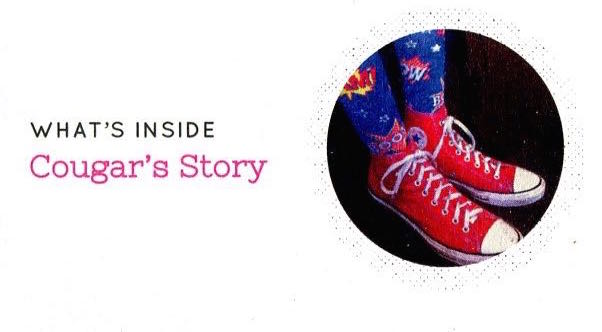
The OE features a spunky new pair of pink sneakers teasing the story of a cured patient, whose story is inside.

The “story inside” teaser is good. But the sneakers remind one of a Saturday morning kids TV show.  Pretty, but not important.

2. Follow up with a personal request.

One of the most recognized personal media in existence is the letter. When we open an envelope, we are looking for it. The letter sets the agenda for the potential donor. This is who we are.  Here’s our challenge, and how you can help.

There is a myth that people no longer read letters, and certainly not long ones.  Not true!  If your story is real, and the request is sincere, the letter will be read.

Hospital Cougar copy

A potentially compelling story is delivered in challenging, small white type against a pink background.

Named, titled and signed, the letter provides basic credentials. A person is “at the other end of the mail box”.

This piece has no letter, but rather hangs its success on a two-page high color sell sheet.

3. Demonstrate and prove the wise use of donations to solve the problem.

Convince the donor that money is needed, and that it won’t be wasted.

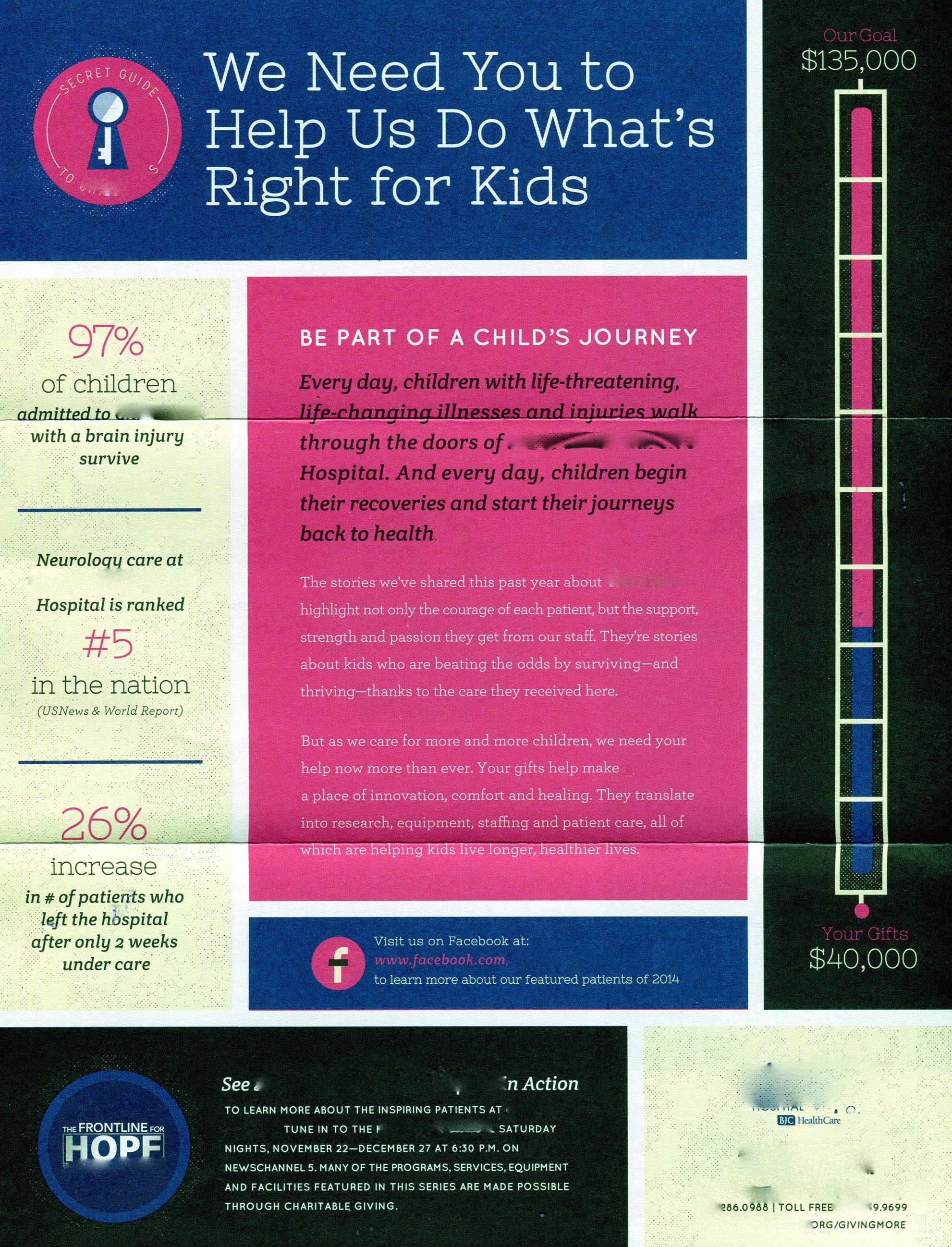
The hospital has a goal of $135,000. What for? It is not apparent that it is short of funds, or solely supported by charitable donations. Not knowing that, why would a donor be moved to give?

Hospital Circles copy

A logical effort to monetize the services provided. But what are the Circles all about?

To its credit, the hospital does explain what your money will buy. It also presents operating statistics, and some official endorsements.

To put an edge on the numbers, show how many cases were turned away or disadvantaged for lack of funds.

4. Be legible and understandable.

Possibly the most difficult task of a senior donor is to read copy that is too small, and reversed out.   In this case, important “ask copy” and narrative is in 8-point type, white on pink. Pink on black. Blue on white.  Ouch!

Hospital Key copy

The significance of the “Secret Guide” is just that: secret.

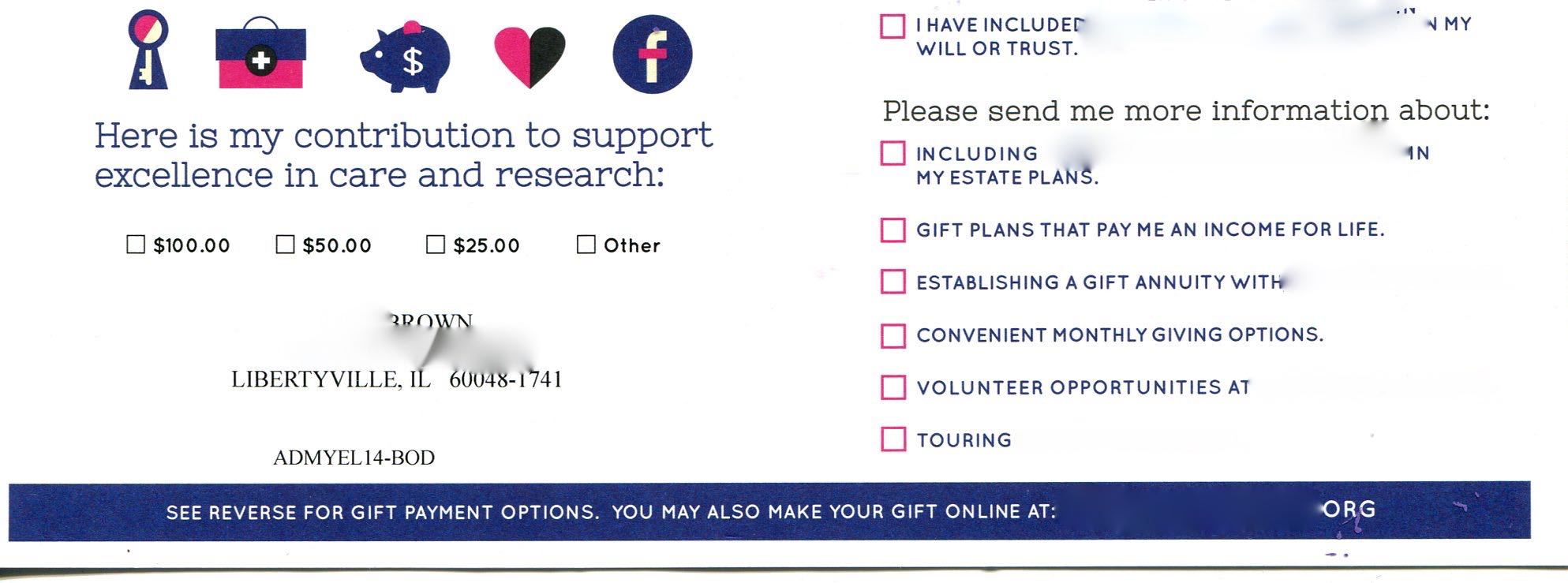
This piece also employs some secret code, uninterpretable by the cold prospect.   The use of their “key” logo is un-explained, and a series of icons on the pledge card do not telegraph any meaning to the uninitiated.

5.   Tie the Ask To A Specific Need.

The story in the piece relates to a child’s full recovery after an accident.  The pledge card, and supporting copy don’t connect to the child’s need, or to the next child with a similar accident.

The list of financial values and associated services in the ad piece refer to Circles of Commitment and generous benefactors, but the recognition value of the Circles is not explained.

6.   Urgency.  

Any mailing’s strategy is aimed to get a response immediately.   Hospital $135,000 copyThis fundraising piece needs  some parameters to define the timely need for a donation.   What will happen if they don’t reach $135,000?   When will time run out?

7.   Indispensability.

Hospital 980

The mystery of the icons: how do they work?


The best direct mail is impossible to throw out.   It just sits there on the kitchen table, or on the dresser until the responder finally acts.   This piece lacks that important nagging factor.

A gift, a freemium, a stamp, a coin, a sample, a personalized card, a photograph, an address label set, are examples of items that  are hard to ignore.

Unless the donor had already decided to contact the hospital, or the donor’s accountant recommended more charitable giving, there’s no reason to hang onto this piece.

Hospital $500

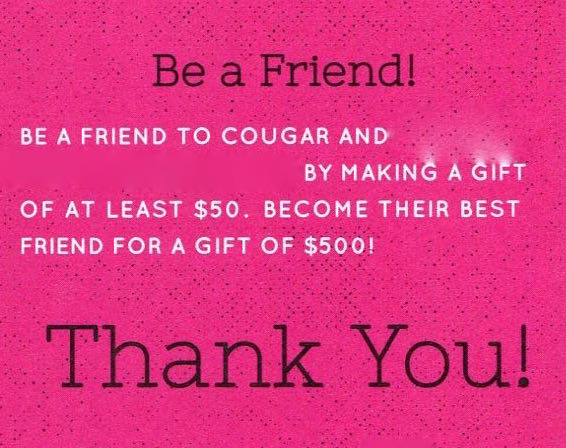
$50 bucks? We haven’t even met!

Direct mail design is challenging because the mailer gets bored with the “same-old, same-old”.  There is a temptation to jazz up the piece just to be different.   After all, you mail out a few thousand, or a few million, and they all look the same!

Just remember: the recipient only gets one piece, and to that person, the piece is well distinguished, just by its mere arrival.

Thanks for reading!  If your fundraising program is serious, make it look that way.  There’s nothing more serious than asking for money.

Standard
direct mail, Economics, Marketing

AAA Goes Flat Out

AAA 2014-12-02 803

The door opener!

Want to know what stops just about anyone when they open their mailbox?

No, not a boxing glove. Instead, it’s a flat.   No, not a flat tire.   A flat-sized mailing piece.

AAA 2014-12-02 800

The 10 x 12 Flat. Size counts in direct mail.

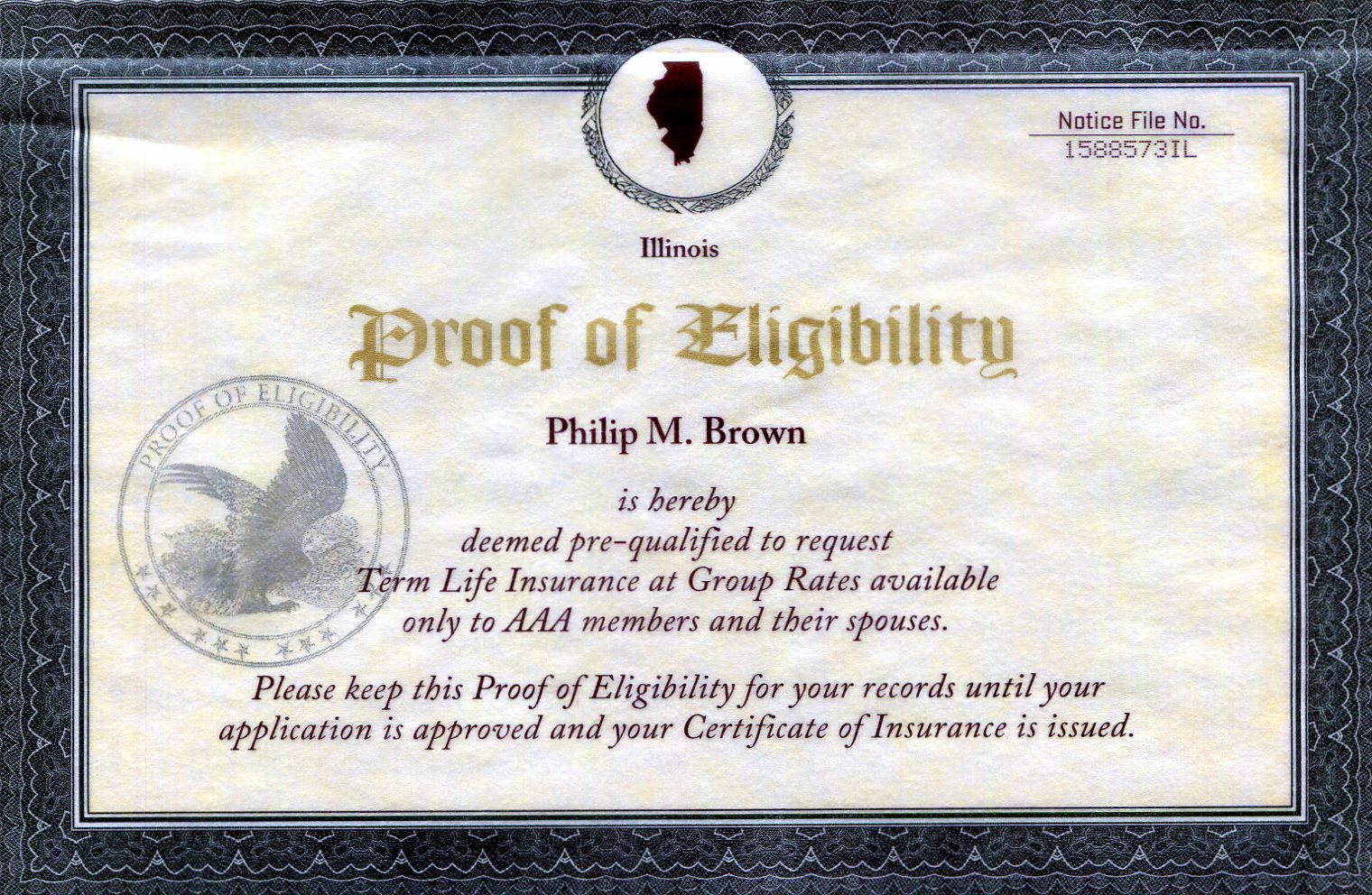
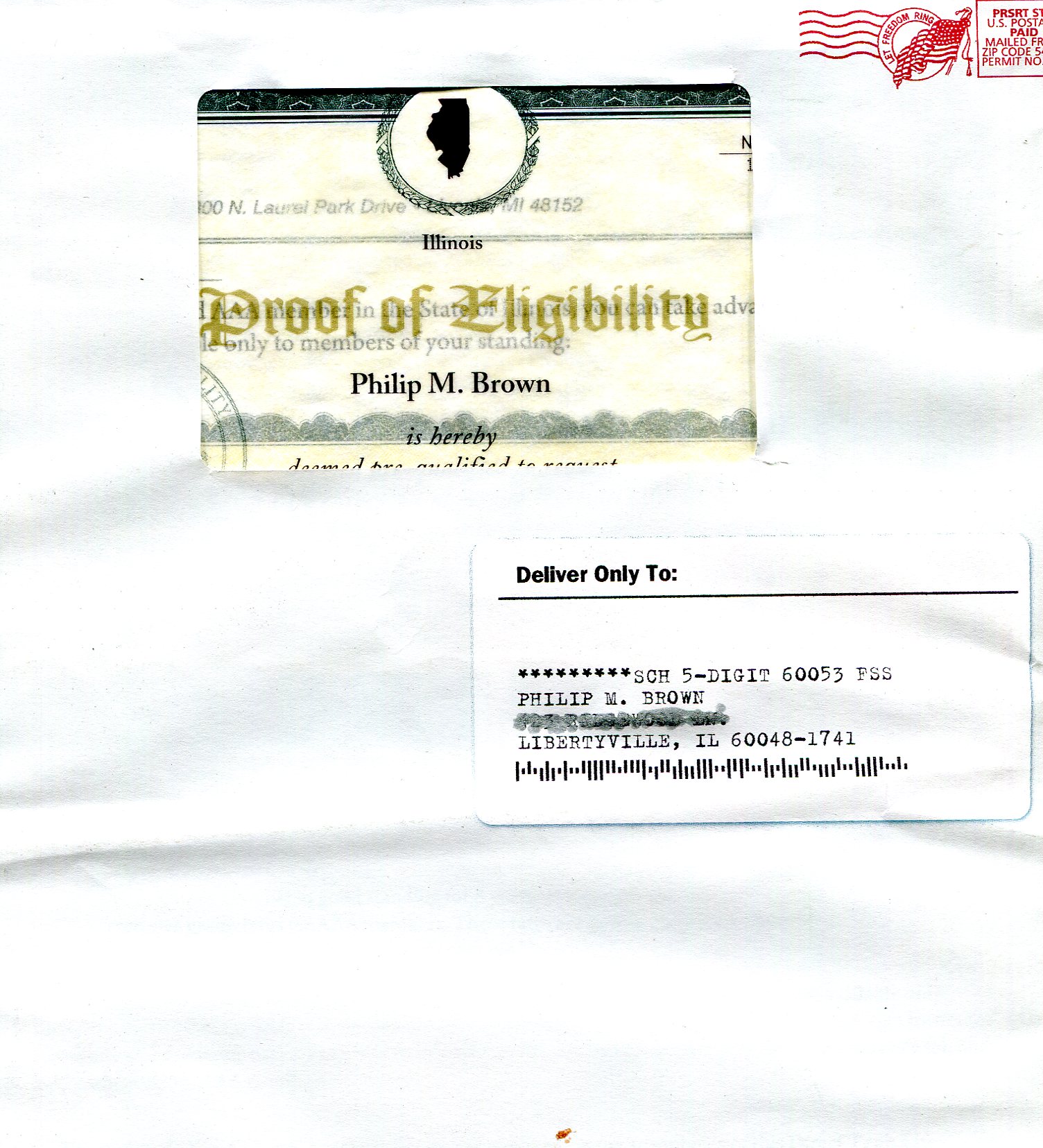
So it is that I opened our mailbox to be confronted by a certificate-sized 10″ x 12″ envelope. Front and center, in portrait orientation, is an open window. As I peak through I see my name, in bold, printed below a 40-point, gothic type proclamation: Proof of Eligibility.  The State of Illinois is symbolically positioned above.

This manifest is shielded behind a thin sheet of parchment. My reaction? Better open this now.

I am not that naiive, I know this is a solicitation. But still, eligible for what?   Nomination? Higher taxes?  Bronzing?

AAA 2014-12-02 Label copy

A beautiful label… applied on a slant, with raised shading, is actually printed, not real.

As it turns out, it is the AAA Life Insurance Company, who has decided to give me a second chance to insure my remaining days.  Or until the age of 80, when all bets are off.

These are the same folks who sent along a policy kit a few months back.    That one was a flat too: a “fulfillment package”.   Presuming I am ready to sign up, it is essentially a welcome kit.   Regrettably, and unknown to AAA, I am disqualified from obtaining coverage due to a shady past.   So I deferred.

AAA 2014-12-02 eagle copy

The official seal of eligibility.

The reason I highlight the new kit is to point out the allure and attraction of the envelope.  “Proof of Eligibility” is vague.   But when it is presented so elegantly, it works.   How many of your incoming direct mail summons use parchment?   40-point Gothic?   Not much I am guessing, since the Sheriff of Nottingham died.

The design strategy of this AAA kit is to get opened.   My bet is that better than 90% of the recipients do open it.   It is irresistible.

From there, the internals have to carry the freight.

The big question you should be asking is why spend the extra postage– probably 15 cents– to send an over-sized envelope?

AAA 2014-12-02 802

The letter under the parchment, complete with filigree.

Do the math.   In a standard #10 envelope, the kit, list and assembly would cost about $250/m.   Postage, another $200/m.   Total, $450/m.

Now lay the papers flat, and place them in a big envelope instead.   Let’s say the production is cost neutral, but adding $150/m flat postage has just increased overall cost by 33%.

The bottom line in direct mail: raise your production cost 33%, you must increase response 33% too.

So if the small envelope garnered a 1% response, the flat needs 1.33% to stay in the game.

From personal experience, I know this is achievable, and judging from AAA’s use of flats before, it’s probably not unusual for them either.

AAA 2014-12-02 Eligible copyBy the way, what was I eligible for?  Discounted premiums as an AAA member.


Thanks for reading!   Never pass up the opportunity to go “big” in a mailing piece.   The cost may frighten you, but usually higher response will cover it.

Standard
direct mail, Marketing

Presidential Letter-Writing: Good, Bad and You Know…

letter-writingA key principle of direct mail strategy is building the personal connection.   Traditional mail order mavens personalize a relationship with a letter from the president, or owner of the business.   When a customer buys, not only are they endorsing the product, but they are also connecting with the owner, who is implicitly guaranteeing satisfaction.

So when you are making the choice to use a letter or not, you are really deciding, “is this going to be personal, or just business?”   Put another way, is this admail, or direct mail?

Within the letter-signing world however, there are good and bad examples.

The best is the personally signed note.   Not economical, but surely convincing.

AAA HuffstetterThe least persuasive is the typeset signature.   Paranoiacally concerned a signature analyst is going to tear it apart.

But there is something far more worrying.

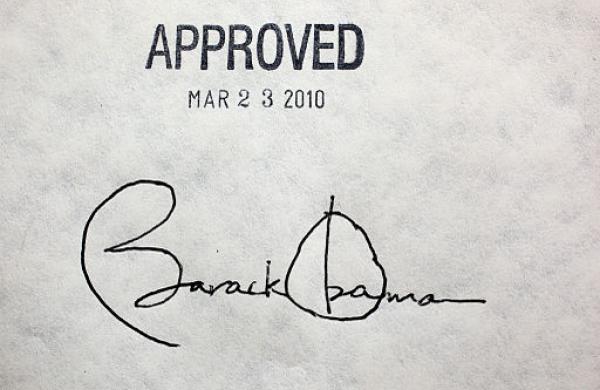
Perusing the news, I saw a photograph of the President’s signature on the Affordable Care Act.   Put aside the law’s contents, what was striking was the shaky signature.

obama signatureAs if our leader had pauses in memory, moments of hesitation, stopping half way through a letter, and then continuing the curve until the next stop.

You may already know this, but in case you have been a life-long libertarian ignoring all laws, and thus this quirky writing habit of CEOs, the jerky writing is attributed to using multiple pens to sign the official document.

In the case of the ACA, there were 22 pens.   See how healthcare costs add up so quickly?

But I digress.   I did a search on this multiple pen phenomenon, and up popped a Time Magazine article with the same signature incident, along with the headline suggesting that our President may have an undiagnosed case of OCD. 

See how a signature creates an image?

Obsessive-compulsive or not, one cannot mail a lot in a full 12-hour day with this type of pen-stutter.

Better, is the thoughtful touch of our third President, Thomas Jefferson.

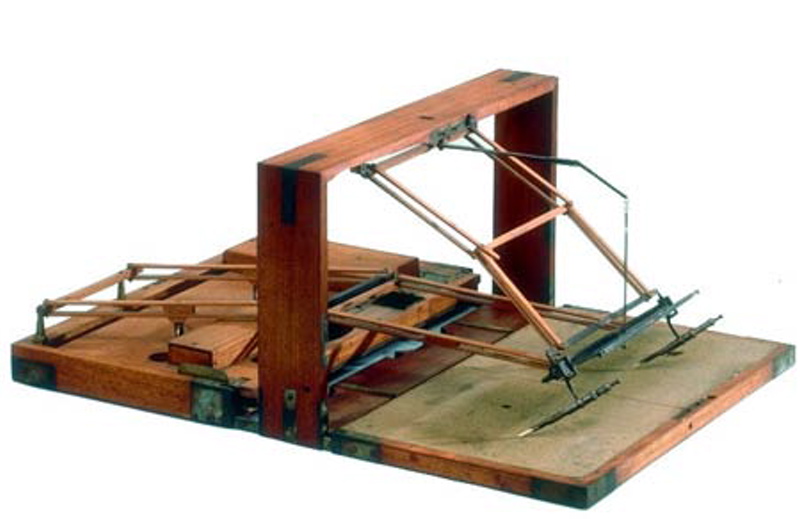
Jefferson MachineRecognizing the power of automation, married seamlessly to manual control, he introduced the polygraph to the Department of State.   This contraption was invented in 1803 by John Isaac Hawkins, of Frankford,  Pennsylvania.

Using the polygraph Jefferson was able to create up to five letters with one sweep of the pen.

Did he know how important direct mail fundraising would become 200 years later?

Standard
direct mail, Marketing, Politics

Fall Seat Sale: The Check’s In the Mail

RNC  558

A dollar a seat… get ’em while they’re hot!

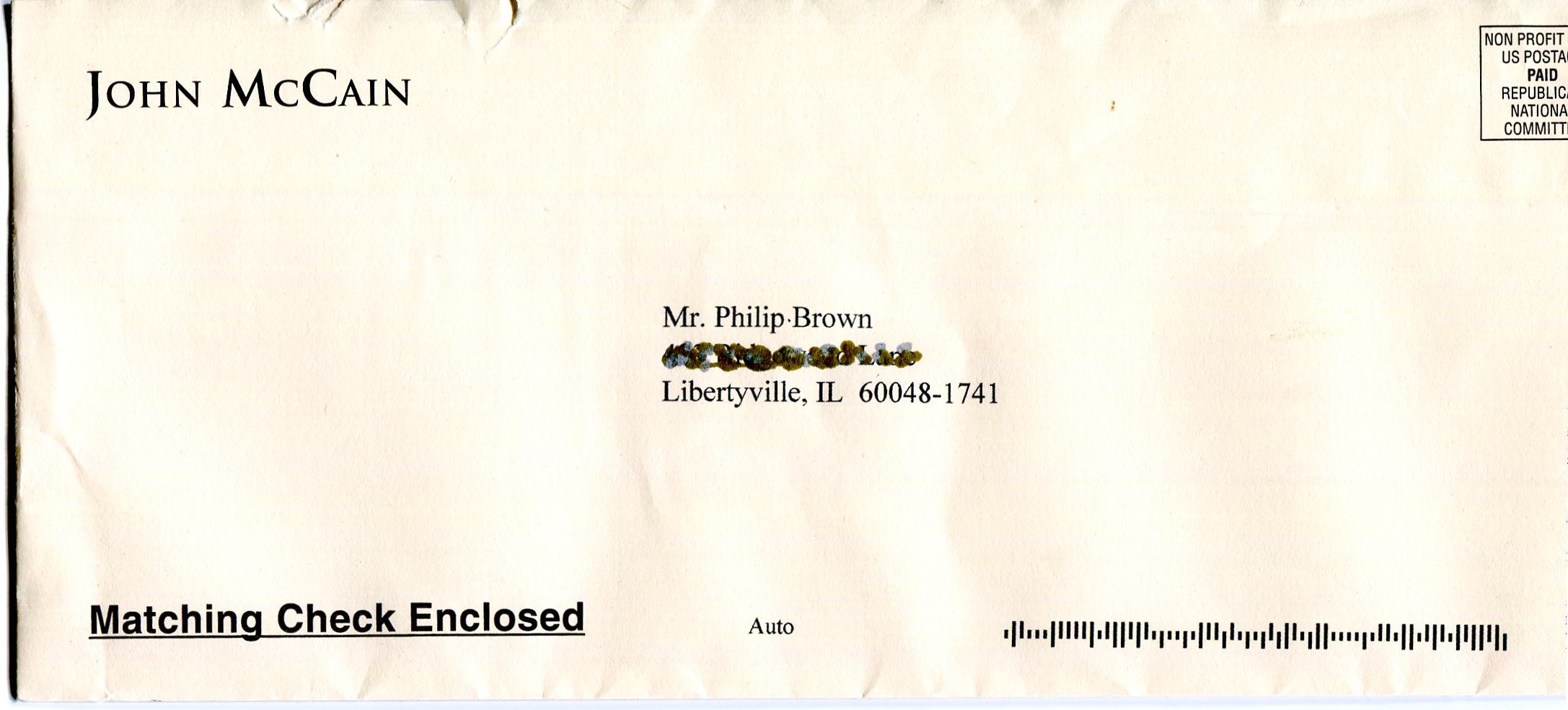
My walk to the mailbox today was rewarded with a letter from John McCain’s desk.

It was especially exciting to get his letter, because he enclosed a personal check!   Usually this works the other way around.

Anyway, I opened his letter to find a check for $36 bucks.  Unfortunately, or fortunately, depending upon your political stripe, it was made out to the Republican National Committee.

This is a very crafty gambit.

RNC  561 copy 2

Is it really the desk writing?  I wonder.

Seldom do we receive checks, and this one, measuring a modest 6″ x 2-3/4″ looks like the real thing.

What I liked about the approach of this fundraiser was the rationale.   The U.S. Senate has 36 seats up for grabs in the mid-term election, and McCain is donating a dollar for each seat.

I know, I know.  It should be more, but hey, have you seen his suits?

Sartorial comments aside, the dollar-a-seat strategy is a door opener for the tight-fisted, like me.   He is asking me to match his donation.

But I am puzzled. The RNC goes on to say it requires only $8,000,000 in the next ten days.  This seems like chicken feed compared to the dollars normally needed to buy an election.   I hope they know what they are doing.

RNC  557

The envelope needs to be opened, just to see the check!

In any event, they are counting on 222,222 folks like me, at $36 each, to respond.   At a 2% response rate, they must be asking over 11 million people.

I will leave the financial logistics to the back room guys.

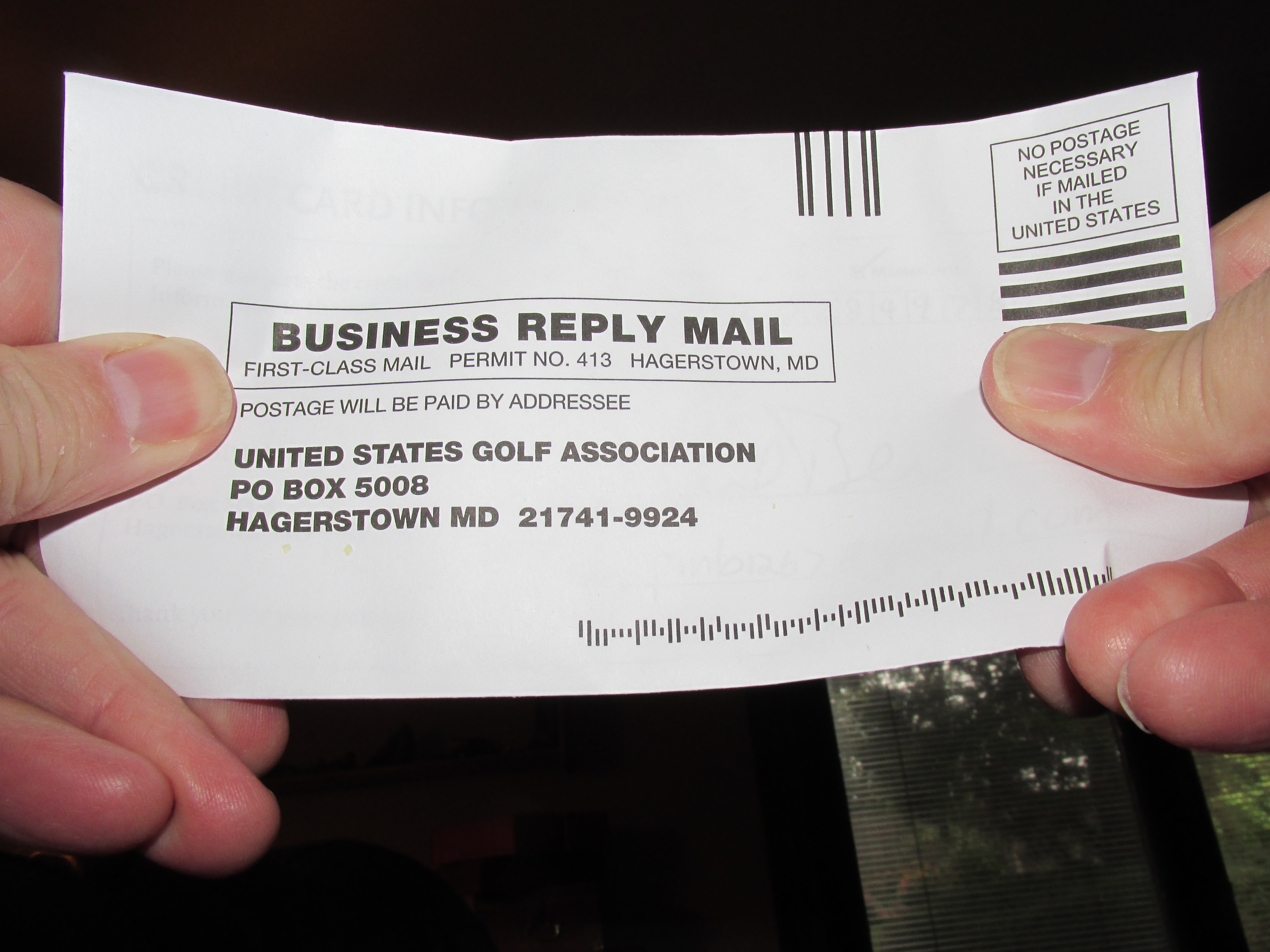
I would point out, however, that after wresting $36 from my cold, thrifty mitts, John could have at least coughed up an additional 49-cents for the stamp on the return envelope.

A stamp! A stamp! The Senate for want of a stamp!

A stamp! A stamp! The Senate for want of a stamp!

You see, the face value of a stamp may seem like a lot to the RNC, but in this case, each one is worth $36 dollars.

Don’t forget to vote!

Standard
direct mail, Marketing, Media, Sports

How the USGA Got My Attention, Fast.

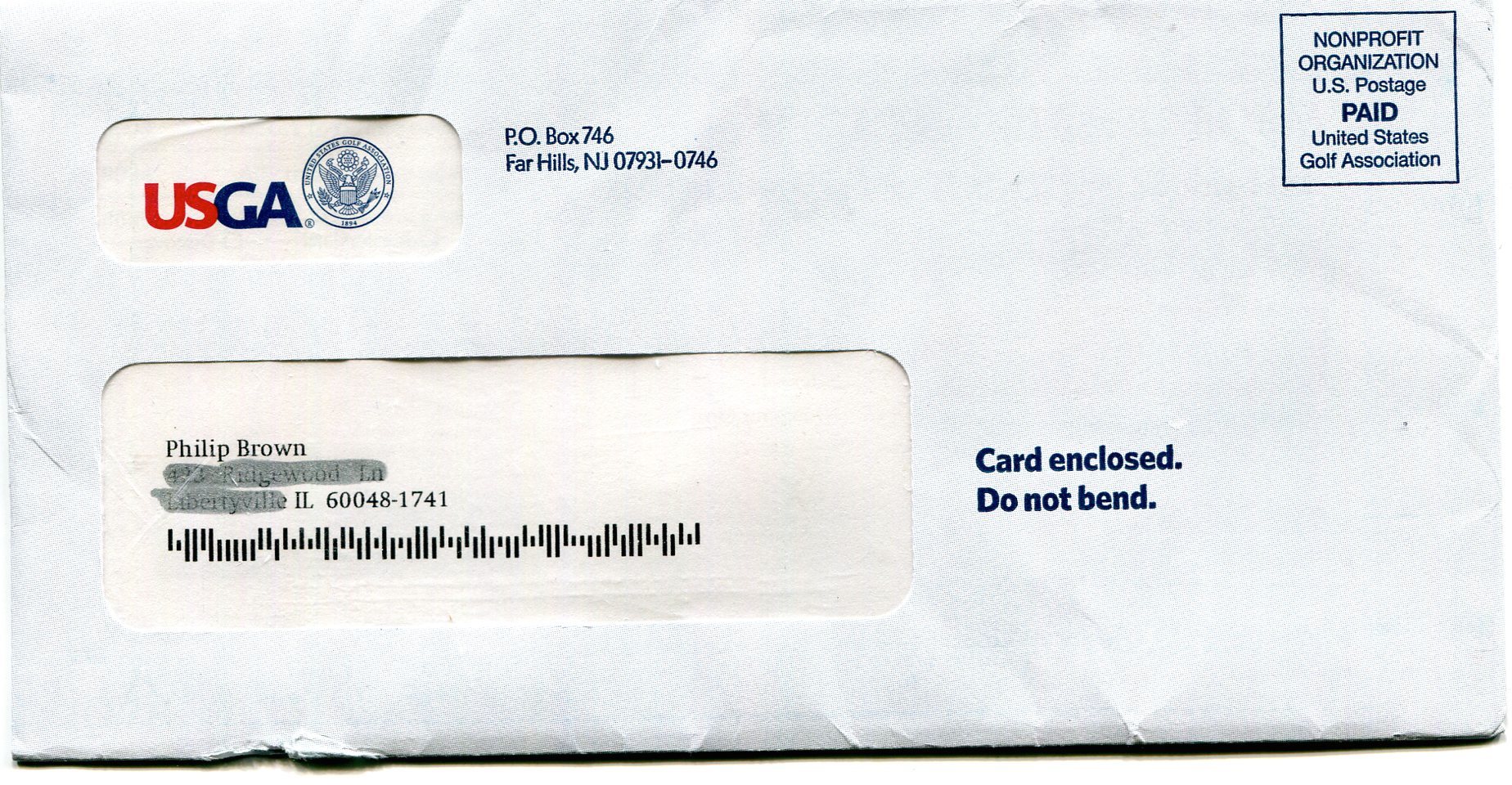
My walk to the mailbox this morning was rewarded by an irresistible offer from the U.S. Golfing Association. A FREE hat!USGA 2014-09-15 505 hat

How can you say no?

Their generosity gives me hope, too. This may be the re-emergence of the direct mail gift premium.

Once there was a time when any subscription offer came with a free gift. A calculator. A tote bag.   We even received a world globe from Macleans Magazine.

IMG_1042

A worldly gift with every subscription.

USGA 2014-09-15 504

The USGA wants me. They actually want me!

This kit begged to be opened. Not because there was a hat, but because the USGA had enclosed a card. For me. An official USGA card for a horrible axe-wielding duffer who scores a rambunctious 108 on a good day.

My handicap is so far off the chart I get a special space to park the golf cart.

USGA 2014-09-15 505 card

I am keeping this close by until my real card arrives, with my hat.

Nevertheless, I am moved by the card. I want it. Opening the kit, I am further thrilled to see that I can join the USGA and get a FREE USGA Open 2015 hat.

USGA 2014-09-15 505 slogan

A great slogan. But they don’t know me well.

At this moment, we have approximately 30 hats on the coat rack, all emblazoned with someone else’s logo. I don’t need another hat. But truly, I want this USGA hat.

USGA 2014-09-15 505

A compact offer, with color, balance, and readable content.

It’s like they recognize me. And how I have toiled to write “single-bogey” on a par 3.

Economics: Does This Kit Pay For Itself?

USGA 2014-09-15 505 benefits

All this stuff comes with the hat. How can you decline?

As thrilled as I am, and I am sure countless thousands of other golfers are thrilled at a Free hat offer, will the USGA lose its shirt with this offer?

No way, and here’s why:

All in, the postage and production for this piece was probably 40-cents. Let’s say they mailed 100,000 pieces. That’s $40,000 out of pocket. Now imagine that 2% of the readers sign up. They each pay $10 to join USGA. That’s 2,000 new members, for $20,000.

But the hat probably cost USGA $10, so the USGA ends up with 2,000 new members, each with a new hat. And a $40,000 bill.

USGA 2014-09-15 507Imagine now that the USGA direct marketing manager goes into the president, and says, “Chief, I just got 2,000 new members. They cost us $20 each!”

He replies, “Awesome– because at least 1,000 of these members will renew next year for $25 each. And 50 of these members will come to the Open and drop about $250 a day sipping coolers in the Club at Chambers Bay between strolls along the course to see the pros.  We pretty much break even.”

Second Thoughts About The Hat

USGA 2014-09-15 505 email

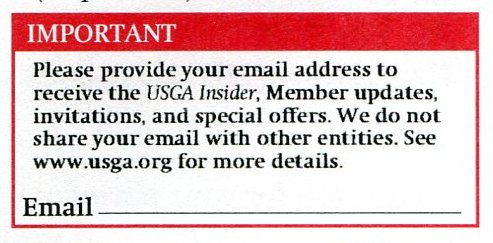
This microscopic email form has just enough room for “@”.

I have mailed my reply, and am quietly excited about my new hat.  And the free golf rules I get, and all the other stuff.  But really, it’s the hat.

IMG_1039

The thrill of mail order is waiting for the merchandise.

And then I start to think, what happens when I wear this hat?   First off, it’s yellow– school bus yellow.   So I will be easily identifiable on any golf course, or in any bar, as the duffer who went for the $10 hat.

Some earnest, scratch golfer will ask, “Are you going to the Open in Chambers Bay?”

“No, not really.”

“So why the hat?”

Or some hopeless hacker like myself will see the hat and ask, “Can you help me with my swing?”

“No. I’ll make your helicopter swing look like Blackhawk Down.”

So the hat is on its way, but I am not exactly sure I can wear it.

USGA PhilAnd that just might be “For the good of the game”.


Thanks for reading.   If you are a direct marketer, perhaps you should test out some gift premiums.   And make sure you put me on your list.

Standard
direct mail, Marketing, Media

Triple-A’s Got You Covered!

AAA 2014-09-06 483

An 11×13 kraft envelope. Pricey, but outstanding in the mailbox.

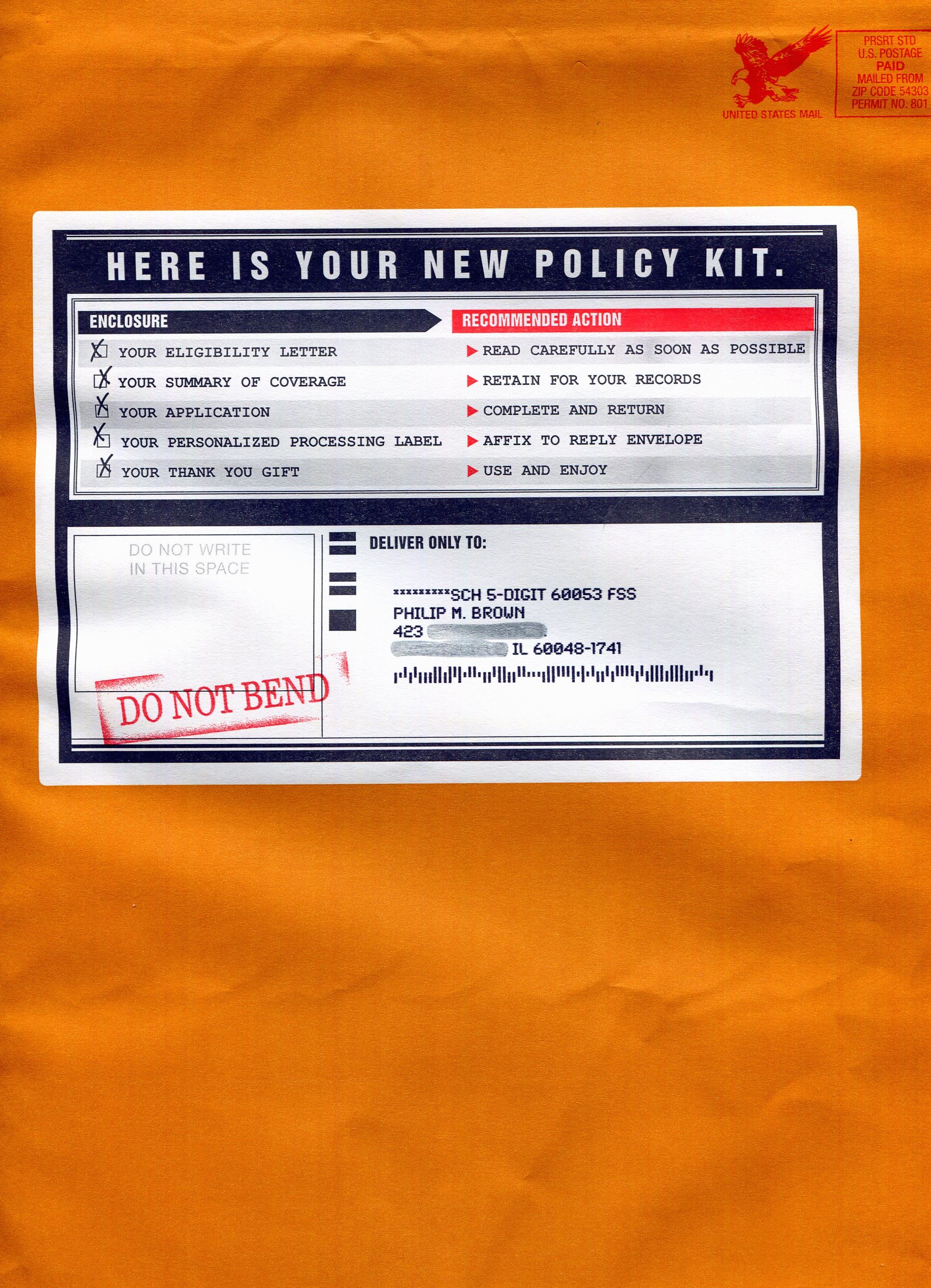
The AAA insurance offer I just received is a classic example of a winning direct mail design, with an important twist: it’s a fulfillment package. By that, I mean that it fulfills my request for a policy.

Only thing is, I didn’t request it.

If you’ve ever been concerned about getting insurance, procrastination is the obstacle. AAA’s direct mail effort overcomes that challenge. Why it works so well is that it presumes I want coverage.  Like Radar knowing Col. Blake needs a pen before he asks for it.

I don’t need coverage. But there are a reliable percentage of people out there who really do want insurance, and this optimistic kit sets the table very nicely. Here’s how:

1. Trust: being a AAA member, I trust and use the company for roadside assistance, and a pretty much guaranteed 10% off any hotel bill.

2. The Envelope: unusual, but not weird. It’s big.   AAA is paying USPS a significant postage premium for this over-sized envelope, but as in life, size counts.   It’s kraft brown paper, portrait orientation, and has a “business forms” look about it with side zipper for opening.

AAA 2014-09-06 483 copy

This label sets the agenda: there’s stuff inside, and it’s “yours”.

3. The oversized label announces “HERE IS YOUR NEW POLICY KIT”.  Yikes.  What’s this?

4. The manifest: the label details five items inside, including a “Summary of Coverage” which one would infer is already in effect. Amongst other things, there is a “Thank You Gift”, again reinforcing the fait accompli.

5. DO NOT BEND: marketers can only say this if there is a  legitimately unfoldable item within… like a sterling silver name plate… no, sorry, not really, but it does raise our hopes.

AAA 2014-09-06 484

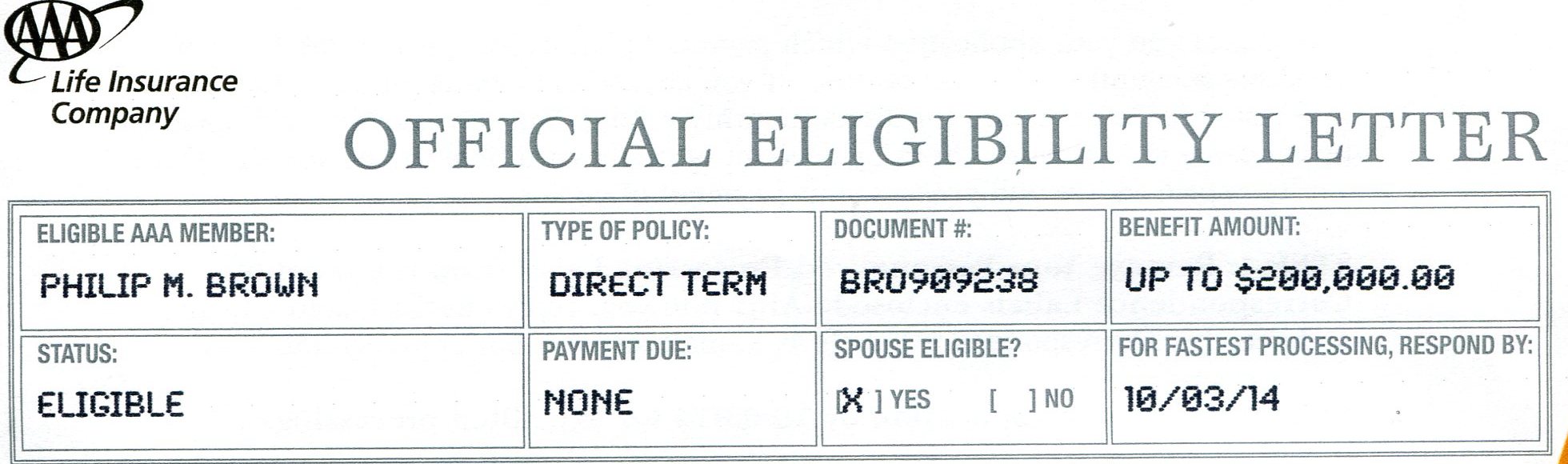
“OFFICIAL ELIGIBILITY” is good enough. The zip strip advises to fold and tear off…as if we needed help.

6. An OFFICIAL ELIGIBILITY LETTER: sounds a little pretentious. I would have dropped “LETTER”. But the title is followed by some computer-generated data dropped into pre-printed boxes.

AAA 2014-09-06 484 copy 2

Evolutionary Throwback: Upper Case Dot Matrix… for the 80’s crowd.

Note the font. Institutional in appearance, it would warm the cockles of any actuary’s heart just to hear the buzz of an 80’s-era dot matrix printer ripping across the page as a cogged wheel advances the continuous form.

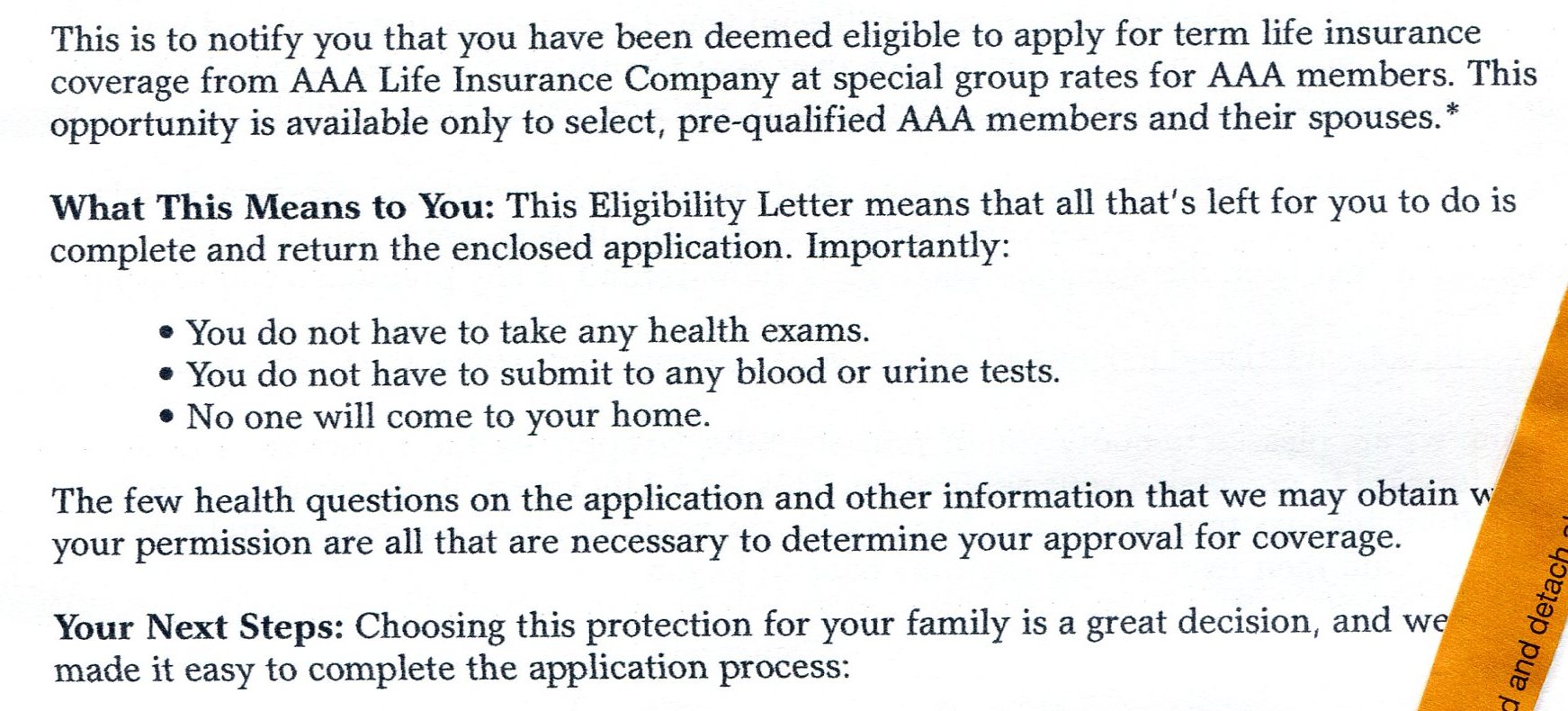
7.   The terse opener: “This is to notify you”

8.   The heads up: “What This Means To You:”

AAA 2014-09-06 484 copy

Commanding, but not demanding copy… and risk is eliminated in three bullets.

9.   Three “No Risk” bullets:  there are two kinds of risk in direct mail.   The obvious one is, “getting ripped off”.

The not-so-obvious risk is the personal hassle that follows saying “yes”.   This letter advises there will be no medical exam, no sending samples, and best of all, no sales person.  So we can put the latex gloves away.

10.   Your Next Steps: from here on, the letter simply instructs the reader how to apply.   There are 5 steps, the last being a deadline date which will be reinforced throughout the kit.

AAA 2014-09-06 485

Penmanship fitting for a President!.

11.   Very important: the letter is signed by a titled officer of AAA Life Insurance.   Unfortunately, I think the writer, Harold W Huffstetter, Jr. suspects that I am a nefarious check forger.   If that is his actual signature, I cringe at the zeal and rabid discipline of his 4th grade teacher who taught him penmanship.

12.   A personalized COVERAGE SELECTION CHART.  (Not shown) There are oodles of legal hurdles that surround direct mail insurance marketing– the prospective insured can’t complain for lack of information.   A close look offers a financial pat on the back for non-smokers, though.

Incidentally, dirt cheap prices start at 18 years of age.   Do Millennials buy insurance?   I doubt it, but it entices the Baby Boomer to look on.

AAA 2014-09-06 486

Application is highlighted and well-spaced.

13.   A color-highlighted application form.  Again, this form probably underwent a martyr’s gauntlet of legal reviews.  I like it because it adds color to an other-wise bland package.   And there’s appropriate spacing for names and addresses.

AAA 2014-09-06 486

This QR code (smudged for confidentiality) pulls up my information.

14.   But note the QR code in the upper right corner.   Could it be that I scan that and immediately apply online?  Nope, and a good thing too.   A distracting jump to a website at this point could kill the sale.

In fact, the QR code is for the data-entry folks at AAA.   When scanned, it identifies me, and all the tracking detail attached to my record.

AAA 2014-09-06 490

Questions are answered. Note the display of contents.

15.   The SUMMARY OF COVERAGE is explicit.  What is attractive on this piece is the table of contents on the front cover.   This is a benefit piece, and again, is described in plain, low energy language.

AAA 2014-09-06 494

Labels. We will never have enough labels, really!

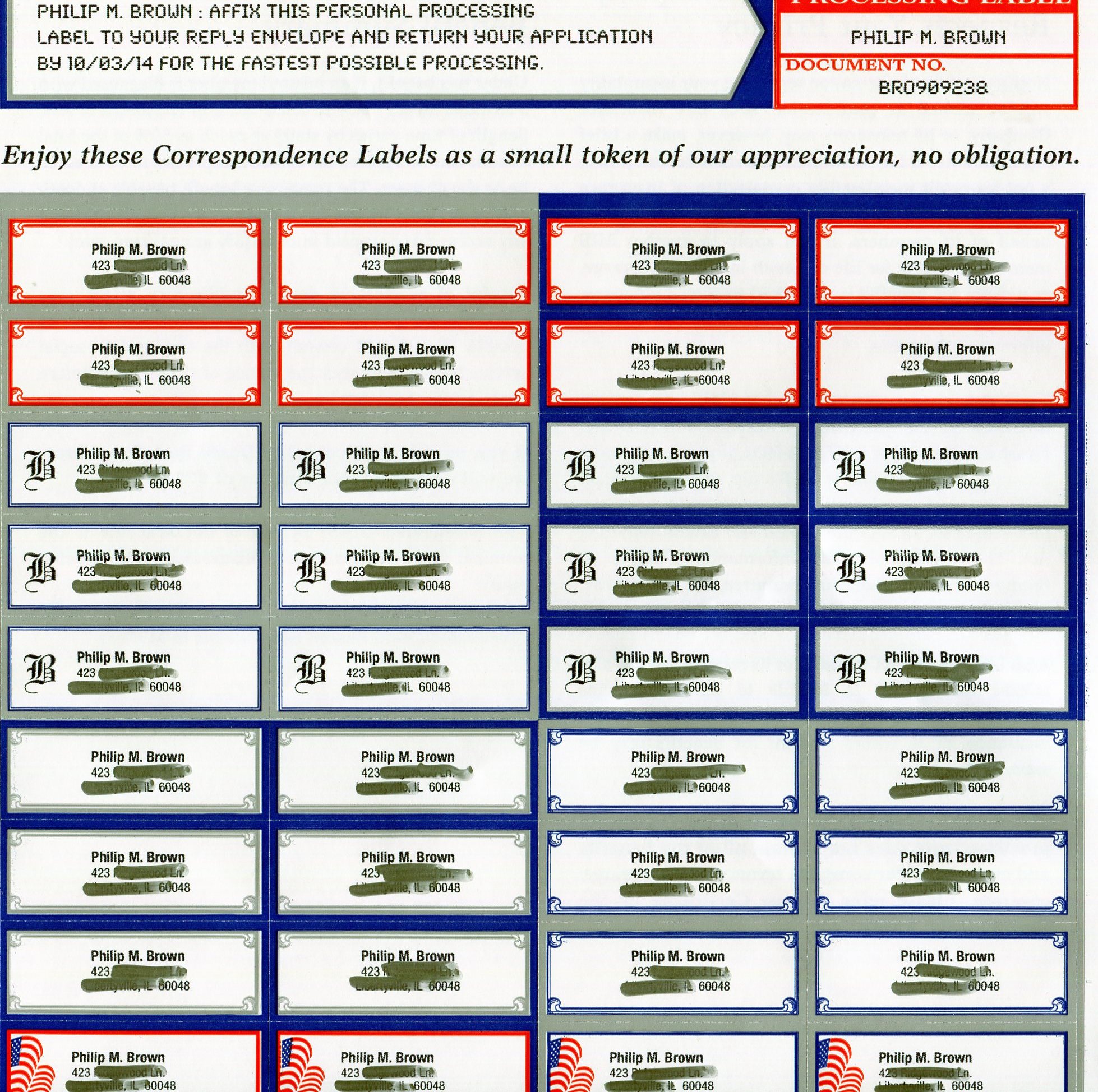
16.    My Thank You Gift.   This is what everyone looks for in the kit.   The unfoldable item.   Here, the gift is a set of address labels.

You know, there is a future for address labels that extends beyond mailing your next bill payment.

Address labels find themselves on everything portable: cell phones, laptops, tablets, phone batteries, cameras, dog collars, staplers, strollers and DVDs.   If it moves and it’s yours, it could use a label.   Warren Buffet may label every freight car of BNSF Rail some day.

AAA 2014-09-06 495

The reply envelope has two perfs. One for tearing, one for folding. Don’t mix them up!

17.   Lastly, a blue reply envelope with motherly reminders to sign and date your application and…AND… to affix your PERSONAL PROCESSING LABEL!

While you may think this is hokey, I bet you a dollar that AAA’s mail box is stuffed with reply envelopes that carry the label, regardless of its seeming irrelevance.   Why?  First, we don’t want to jinx our life karma.  And second, we like to play with sticky things. Honest.

One thing with the reply envelope– I wonder how many get destroyed by confused customers who tear off the wrong perforation.  white_scissors_u2704_icon_256x256A little scissors icon would help.

When reduced to ink on paper, insurance marketing is pretty staid, but consumer friendly.   What it lacks in emotional appeal it makes up in trustworthiness, as this kit demonstrates.   Most important, it didn’t try to sell; it assumed already that I was prepared to apply.

And that’s why it works.


Thanks for taking the time to get to here.   Please pass this along to your direct mail friends.  Thanks!


Standard
direct mail, Economics, Marketing

Just Like Money

<<Spoiler Alert: The incredible reason why retailers flood our pockets with cash every day.>>

Mailbox Money

The mailbox delivers the green– for consumer and marketer alike.

We are having an outrageously good time with store coupons.  As we exit the mall, it takes a 50-pound anchor tied to our belts to stop us from running frantically, eyes over our shoulders, across the parking lot to our get away car.

Why?

Kohl’s, one of America’s most renowned stores, mails us $10 cash coupons with no strings attached.  “Just spend it!”

Hunh? 

"Here's a discount card, no wait, here's TWO discount cards!  Go shop!"

“Here’s a discount card, no wait, here’s TWO discount cards! Go shop!”

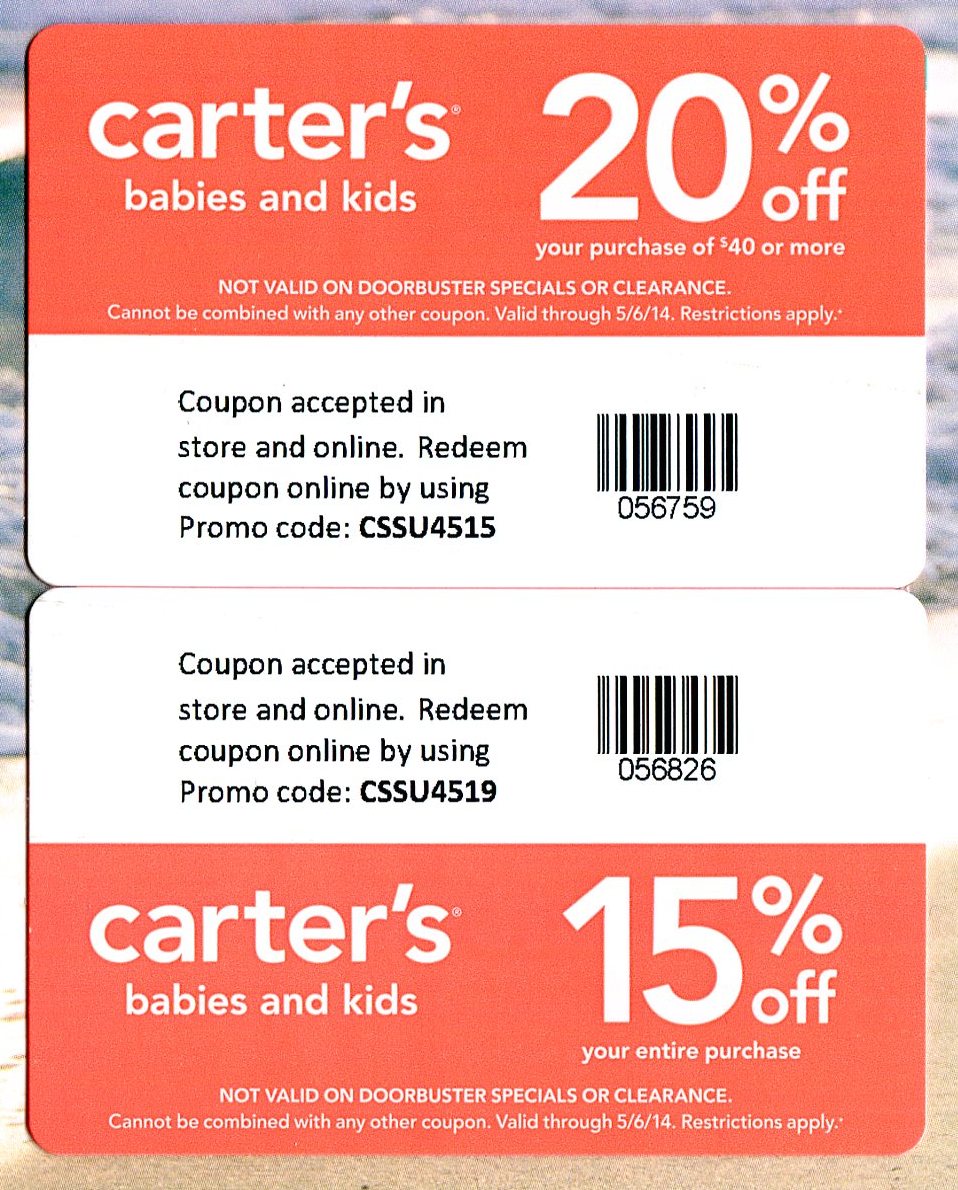
Carter’s throws in a 20% discount for a $40 purchase.  And another– 15% off everything, period.

Bed Bath & Beyond churns out $5 coupons faster than the U.S. Treasury, which is saying something.

Ulta hands us $3.50 just to spend $10.   We have enough conditioner for the entire cast of Muppet Movie 3.

BBBY coupons come so quickly we bale them.

BBBY coupons come so quickly we have to bale them.

For some, coupons are clutter in the mailbox.  For many, they reveal how weak we really are.  Despite our supposed disdain for direct mail, we read each coupon carefully…. and then sneak into the store late Sunday night with a fistful, and a bag over our head.

holeinpocket

‘Just can’t spend the coupon fast enough.

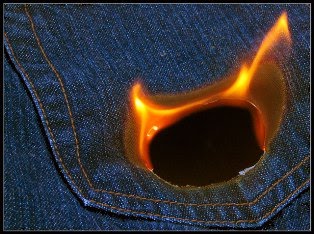
At our house, coupons are incendiary devices, capable of exploding into flames when placed in the pocket.

For instance, I am mailed a $5.00 rebate card from ACE Hardware.   The card sits between the salt and pepper shakers, Tasering me to rise from my chair, go to ACE and buy something, even a bag of sheep manure, just to use the money.

ace manure

Buy something— anything!

My wife is a coupon maven.  She gets the deal, but escapes the accompanying load-up the marketer hoped for.

For instance, that $10 cash gift from Kohl’s?   She tenders it, usually on a $20 item marked down to $10.00.  “Look honey:” she beams, “7 pairs of  underwear, for nothing!”   Totally void of guilt.   Butter would not melt in her mouth.

So how does the retailer really fare with these incredible deals?

Not bad, if you look at the right numbers.

CouponCabin.com does an excellent job of capturing all the publicized deals of a retailer.   It spins them back to any shopper savvy enough to ask for them online.   The company regularly totals results, and in the case of Kohl’s, reports the average shopping cart is $66.43 before $18.04 in coupon savings.  A 22% discount.    That’s a promotional cost, and it comes out of gross profit.

"Take this money, please!"

“Take this money, please!”

January 2014 Kohl’s gross profit margin was 36.49%….. 7 and 11 points better than Target and Walmart respectively.

Kohl’s cost of goods (COGS) was 63.51%.

So are the Kohl’s people nuts, or is this normal business to throw gobs of money out the window?

It boils down to how much Kohl’s will pay to get an extra visitor into the store.

Bottom line: a profit with every sale.

Bottom line: a profit with every sale.

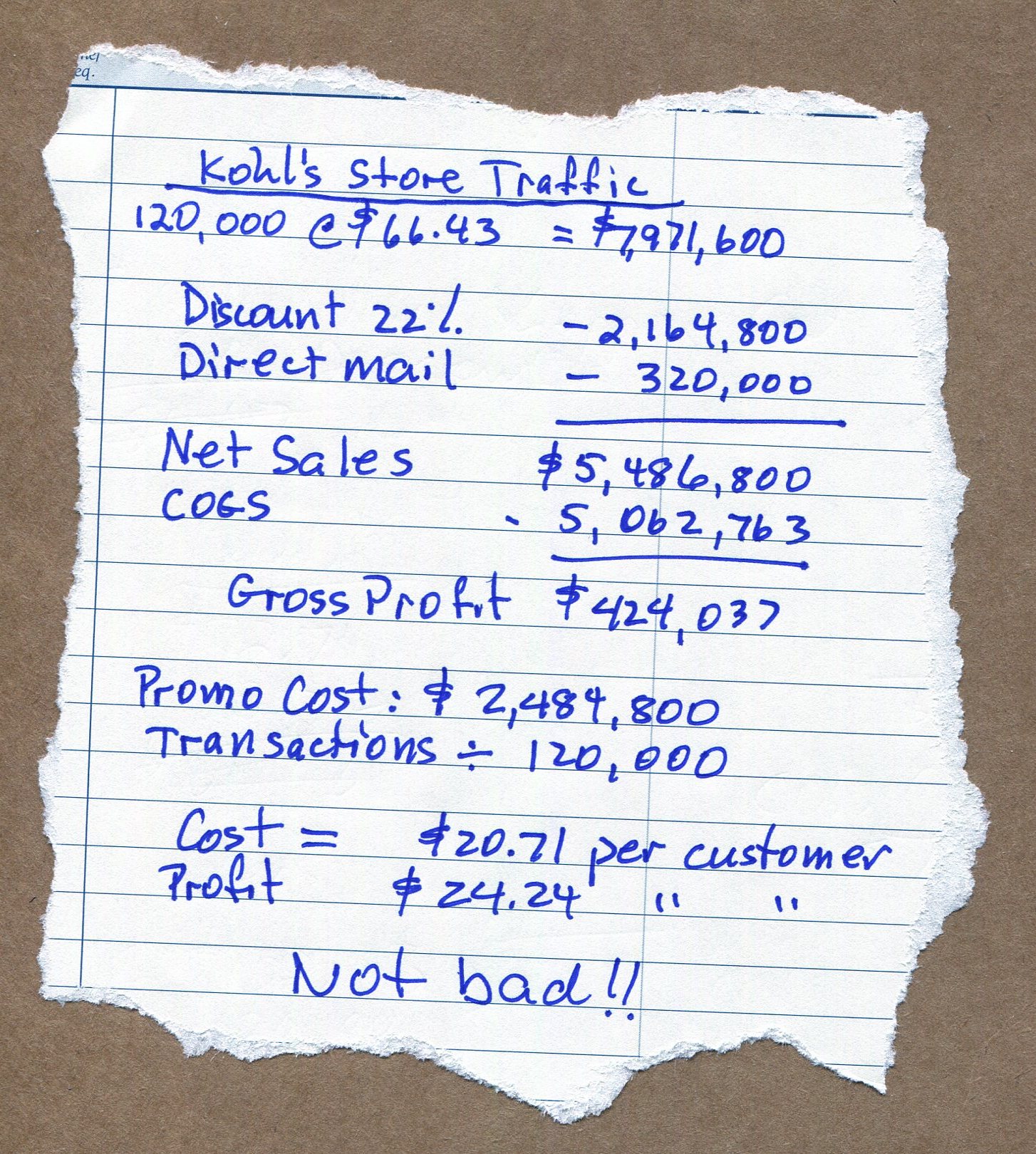
Say they mailed a 1,000,000 coupons, and 15% were redeemed.   150,000 purchases!   But set aside 30,000 purchases for those folks who would have bought the items anyway.   So the mailing generated 120,000 additional transactions, each with a shopping cart of $66.43.  That’s $7,971,600 in extra sales.   But the 22% discount takes away $2,164,800.  And subtract the mailing cost of $320,000.   Kohl’s is left with $5,486,800 cash to pay for the goods sold: $5,062,763 ($7,971,600 x 63.51% COGS).

Bottom line, Kohl’s promotion cost $2,484,800  and delivered $424,037 in extra profit. That is a 17.1% ROI.  Not bad.  You can’t run your whole business that way, but to generate extra sales and margin, still a pretty good day.

And here’s another perspective: the promotion delivered 120,000 extra store visits at a cost of $20.71 each.  And because the gross margin on each cart was $24.24 ($66.43 x 36.49%), Kohl’s did better than break even.

So that is why you find oodles of deals in your mailbox every week.   They work!

Boots

“Buy one, get one free!”

And my bottom line? I am looking for a deal on rubber boots.  To spread the sheep stuff.


If you got this far, I hope you took in all the math.  As with all retailers, these are big, scary numbers.   But well targeted direct mail makes them work.   Please share this article if you liked it!  Thanks.


Standard