direct mail, Marketing, Media, Sports

How the USGA Got My Attention, Fast.

My walk to the mailbox this morning was rewarded by an irresistible offer from the U.S. Golfing Association. A FREE hat!USGA 2014-09-15 505 hat

How can you say no?

Their generosity gives me hope, too. This may be the re-emergence of the direct mail gift premium.

Once there was a time when any subscription offer came with a free gift. A calculator. A tote bag.   We even received a world globe from Macleans Magazine.

IMG_1042

A worldly gift with every subscription.
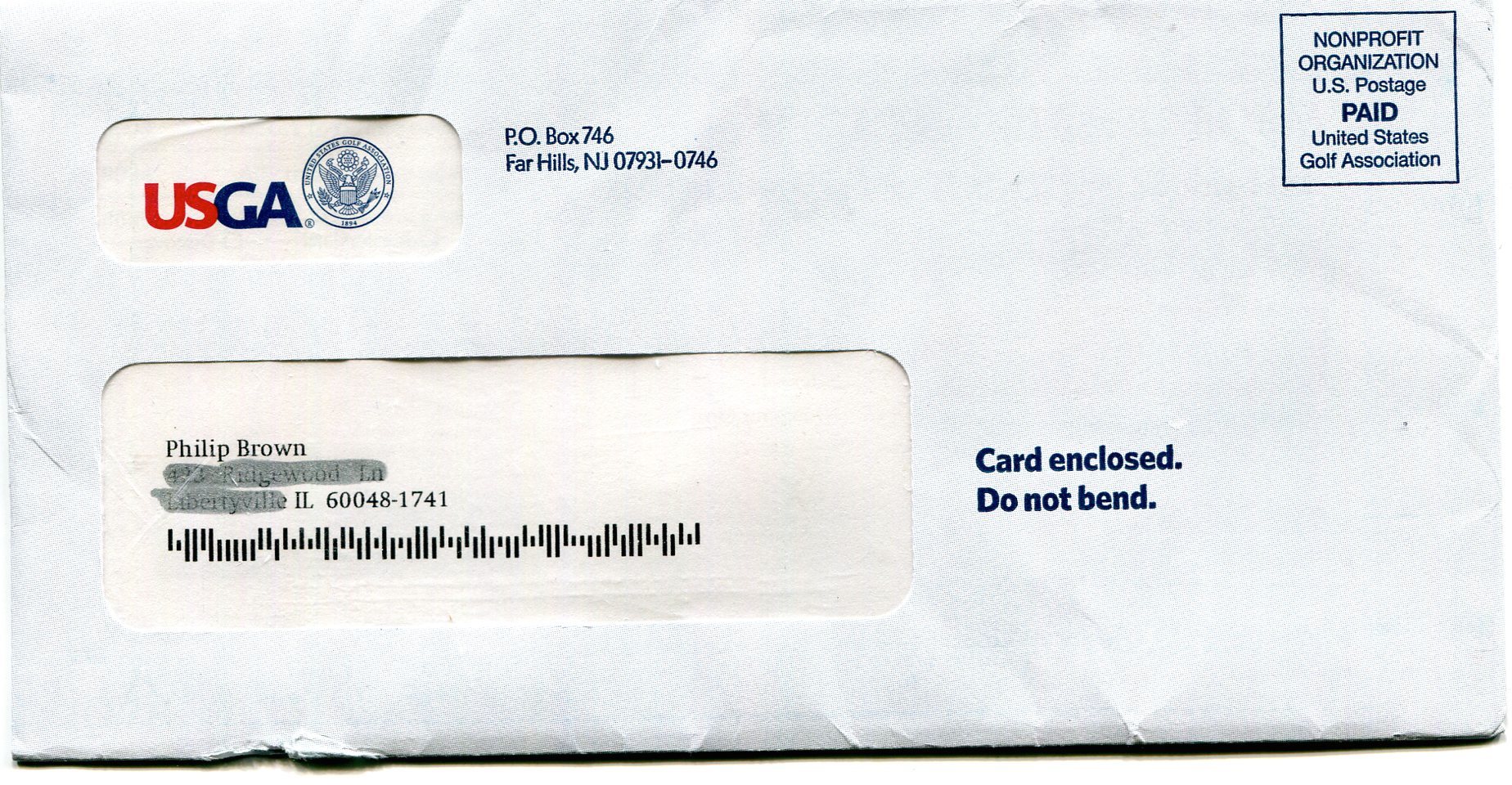
USGA 2014-09-15 504

The USGA wants me. They actually want me!

This kit begged to be opened. Not because there was a hat, but because the USGA had enclosed a card. For me. An official USGA card for a horrible axe-wielding duffer who scores a rambunctious 108 on a good day.

My handicap is so far off the chart I get a special space to park the golf cart.

USGA 2014-09-15 505 card

I am keeping this close by until my real card arrives, with my hat.

Nevertheless, I am moved by the card. I want it. Opening the kit, I am further thrilled to see that I can join the USGA and get a FREE USGA Open 2015 hat.

USGA 2014-09-15 505 slogan

A great slogan. But they don’t know me well.

At this moment, we have approximately 30 hats on the coat rack, all emblazoned with someone else’s logo. I don’t need another hat. But truly, I want this USGA hat.

USGA 2014-09-15 505

A compact offer, with color, balance, and readable content.

It’s like they recognize me. And how I have toiled to write “single-bogey” on a par 3.

Economics: Does This Kit Pay For Itself?

USGA 2014-09-15 505 benefits

All this stuff comes with the hat. How can you decline?

As thrilled as I am, and I am sure countless thousands of other golfers are thrilled at a Free hat offer, will the USGA lose its shirt with this offer?

No way, and here’s why:

All in, the postage and production for this piece was probably 40-cents. Let’s say they mailed 100,000 pieces. That’s $40,000 out of pocket. Now imagine that 2% of the readers sign up. They each pay $10 to join USGA. That’s 2,000 new members, for $20,000.

But the hat probably cost USGA $10, so the USGA ends up with 2,000 new members, each with a new hat. And a $40,000 bill.

USGA 2014-09-15 507Imagine now that the USGA direct marketing manager goes into the president, and says, “Chief, I just got 2,000 new members. They cost us $20 each!”

He replies, “Awesome– because at least 1,000 of these members will renew next year for $25 each. And 50 of these members will come to the Open and drop about $250 a day sipping coolers in the Club at Chambers Bay between strolls along the course to see the pros.  We pretty much break even.”

Second Thoughts About The Hat
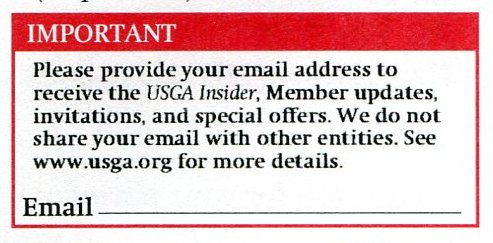
USGA 2014-09-15 505 email

This microscopic email form has just enough room for “@”.

I have mailed my reply, and am quietly excited about my new hat.  And the free golf rules I get, and all the other stuff.  But really, it’s the hat.
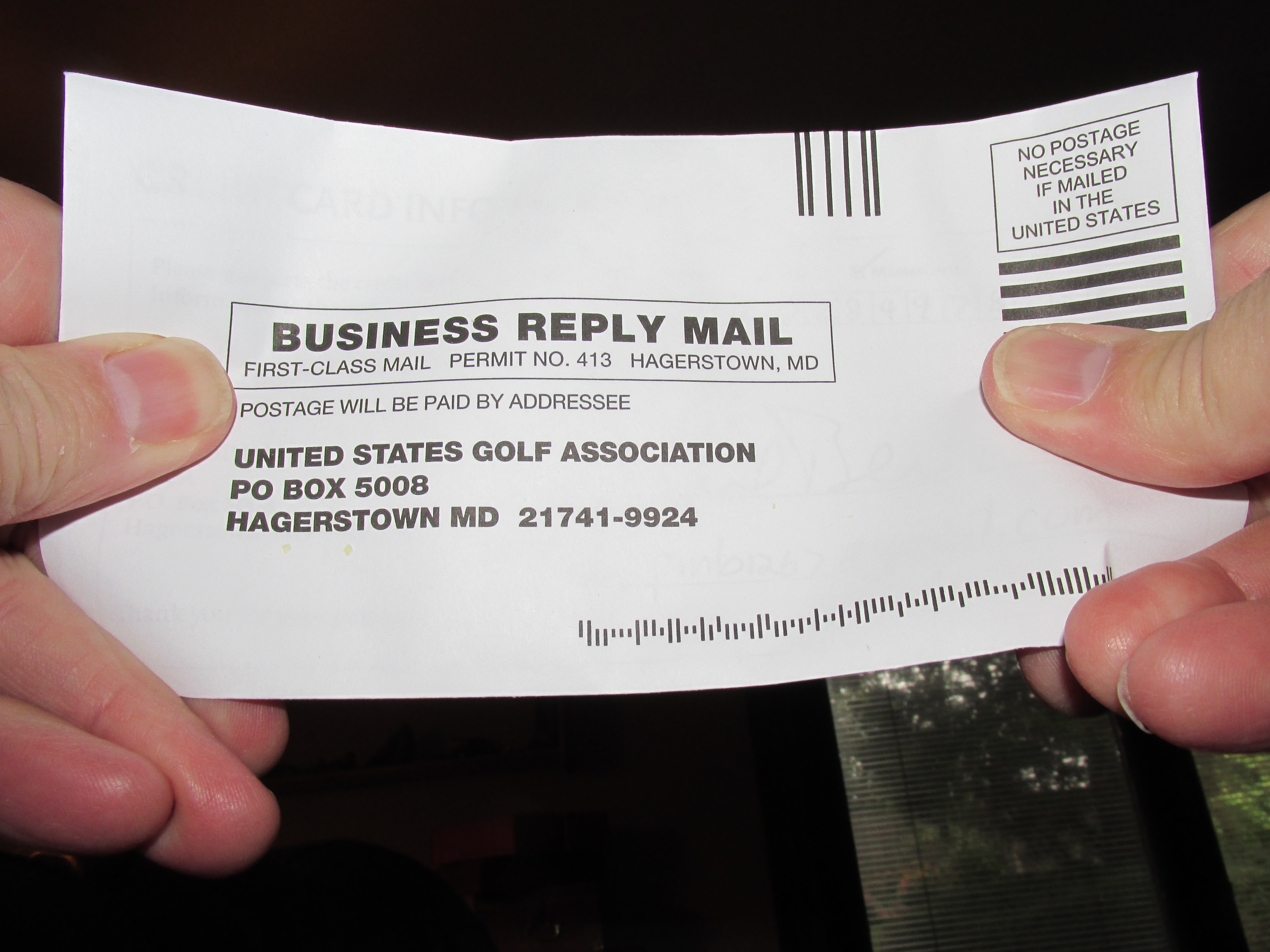
IMG_1039

The thrill of mail order is waiting for the merchandise.

And then I start to think, what happens when I wear this hat?   First off, it’s yellow– school bus yellow.   So I will be easily identifiable on any golf course, or in any bar, as the duffer who went for the $10 hat.

Some earnest, scratch golfer will ask, “Are you going to the Open in Chambers Bay?”

“No, not really.”

“So why the hat?”

Or some hopeless hacker like myself will see the hat and ask, “Can you help me with my swing?”

“No. I’ll make your helicopter swing look like Blackhawk Down.”

So the hat is on its way, but I am not exactly sure I can wear it.

USGA PhilAnd that just might be “For the good of the game”.


Thanks for reading.   If you are a direct marketer, perhaps you should test out some gift premiums.   And make sure you put me on your list.
Standard
direct mail, Marketing, Media

Triple-A’s Got You Covered!

AAA 2014-09-06 483

An 11×13 kraft envelope. Pricey, but outstanding in the mailbox.

The AAA insurance offer I just received is a classic example of a winning direct mail design, with an important twist: it’s a fulfillment package. By that, I mean that it fulfills my request for a policy.

Only thing is, I didn’t request it.

If you’ve ever been concerned about getting insurance, procrastination is the obstacle. AAA’s direct mail effort overcomes that challenge. Why it works so well is that it presumes I want coverage.  Like Radar knowing Col. Blake needs a pen before he asks for it.

I don’t need coverage. But there are a reliable percentage of people out there who really do want insurance, and this optimistic kit sets the table very nicely. Here’s how:

1. Trust: being a AAA member, I trust and use the company for roadside assistance, and a pretty much guaranteed 10% off any hotel bill.

2. The Envelope: unusual, but not weird. It’s big.   AAA is paying USPS a significant postage premium for this over-sized envelope, but as in life, size counts.   It’s kraft brown paper, portrait orientation, and has a “business forms” look about it with side zipper for opening.

AAA 2014-09-06 483 copy

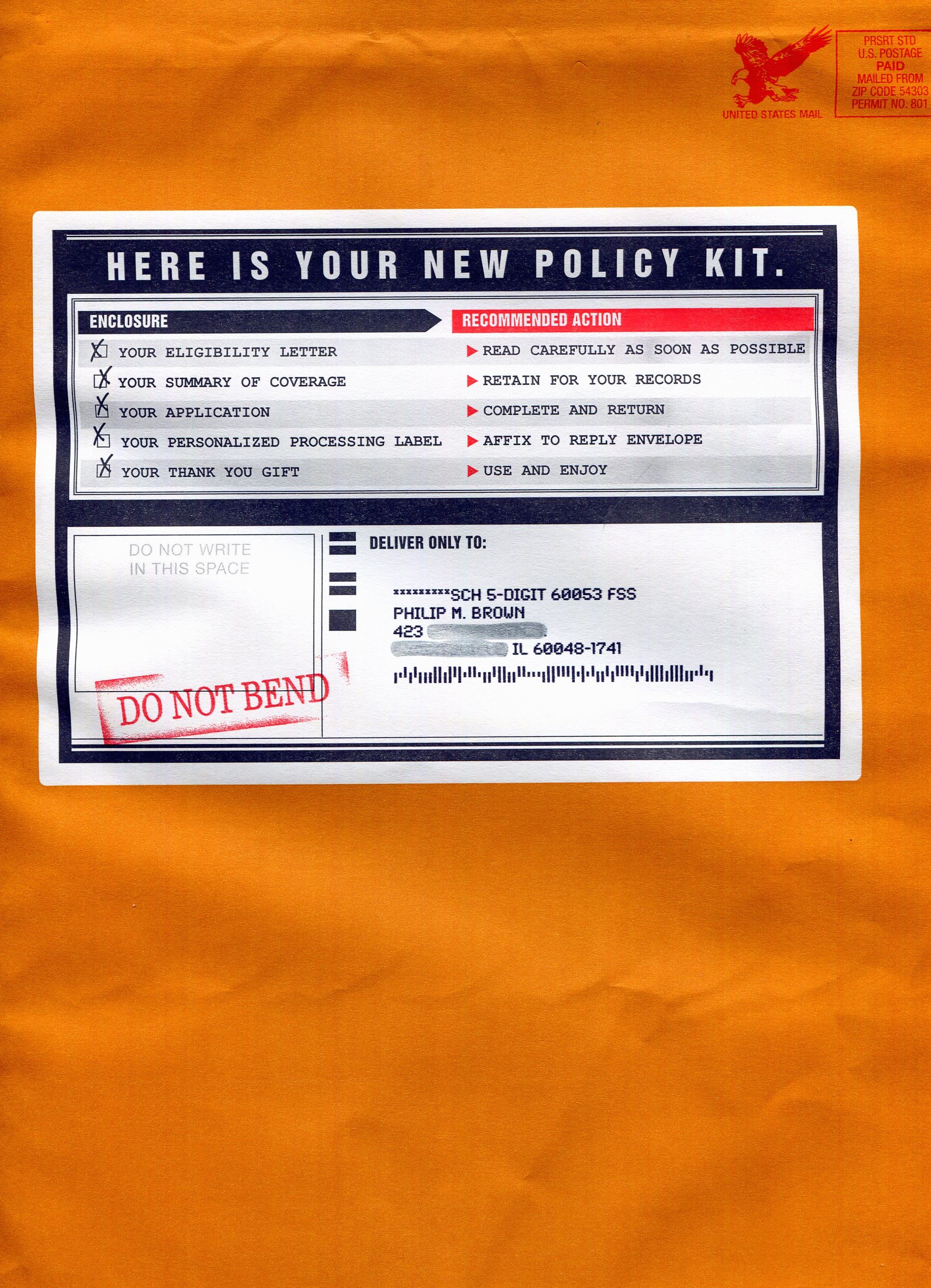
This label sets the agenda: there’s stuff inside, and it’s “yours”.

3. The oversized label announces “HERE IS YOUR NEW POLICY KIT”.  Yikes.  What’s this?

4. The manifest: the label details five items inside, including a “Summary of Coverage” which one would infer is already in effect. Amongst other things, there is a “Thank You Gift”, again reinforcing the fait accompli.

5. DO NOT BEND: marketers can only say this if there is a  legitimately unfoldable item within… like a sterling silver name plate… no, sorry, not really, but it does raise our hopes.

AAA 2014-09-06 484

“OFFICIAL ELIGIBILITY” is good enough. The zip strip advises to fold and tear off…as if we needed help.

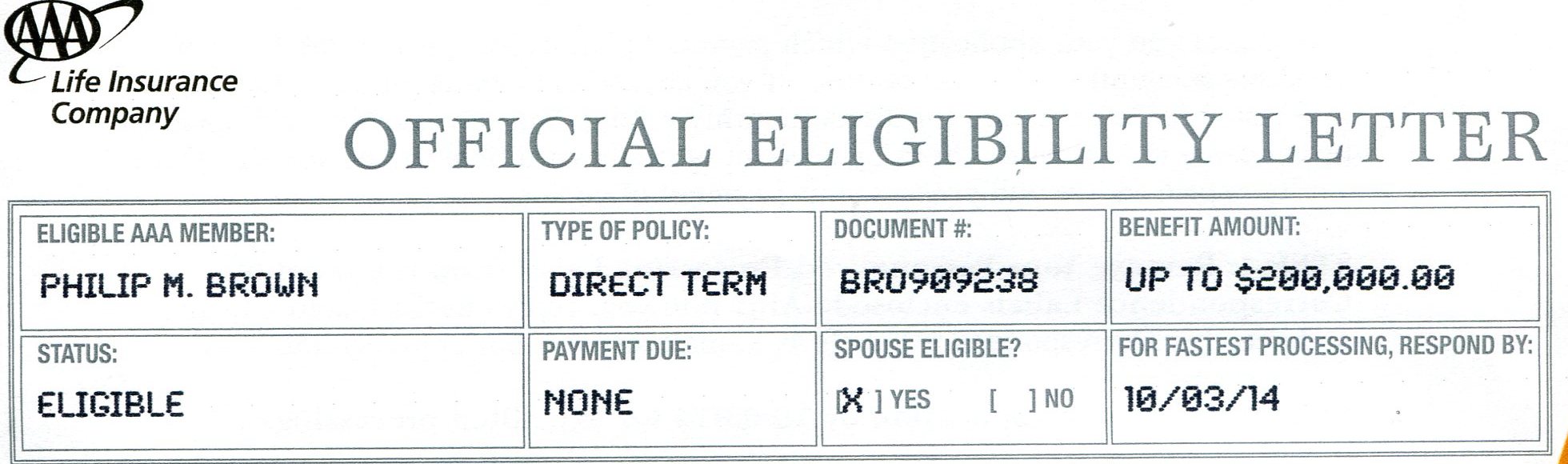
6. An OFFICIAL ELIGIBILITY LETTER: sounds a little pretentious. I would have dropped “LETTER”. But the title is followed by some computer-generated data dropped into pre-printed boxes.

AAA 2014-09-06 484 copy 2

Evolutionary Throwback: Upper Case Dot Matrix… for the 80’s crowd.

Note the font. Institutional in appearance, it would warm the cockles of any actuary’s heart just to hear the buzz of an 80’s-era dot matrix printer ripping across the page as a cogged wheel advances the continuous form.

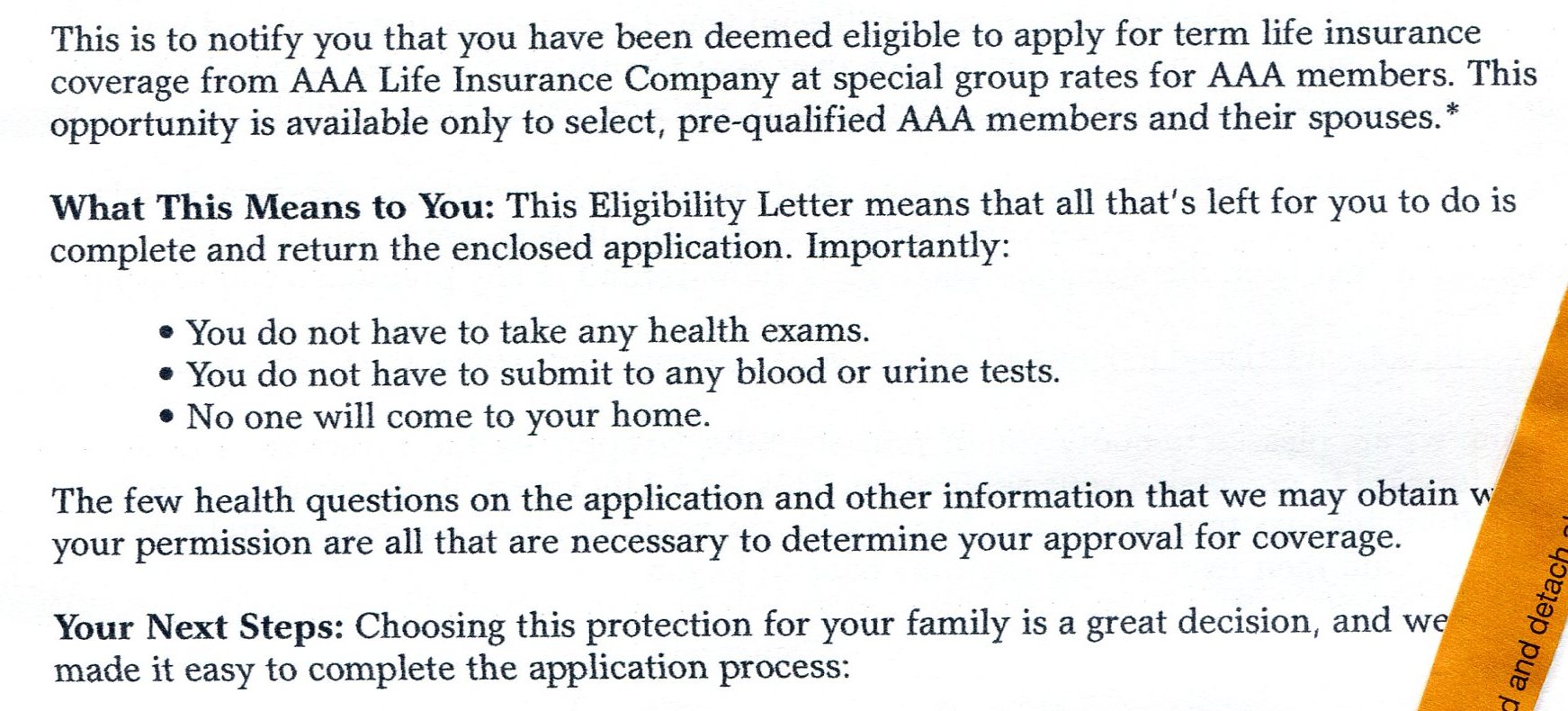
7.   The terse opener: “This is to notify you”

8.   The heads up: “What This Means To You:”

AAA 2014-09-06 484 copy

Commanding, but not demanding copy… and risk is eliminated in three bullets.

9.   Three “No Risk” bullets:  there are two kinds of risk in direct mail.   The obvious one is, “getting ripped off”.

The not-so-obvious risk is the personal hassle that follows saying “yes”.   This letter advises there will be no medical exam, no sending samples, and best of all, no sales person.  So we can put the latex gloves away.

10.   Your Next Steps: from here on, the letter simply instructs the reader how to apply.   There are 5 steps, the last being a deadline date which will be reinforced throughout the kit.

AAA 2014-09-06 485

Penmanship fitting for a President!.

11.   Very important: the letter is signed by a titled officer of AAA Life Insurance.   Unfortunately, I think the writer, Harold W Huffstetter, Jr. suspects that I am a nefarious check forger.   If that is his actual signature, I cringe at the zeal and rabid discipline of his 4th grade teacher who taught him penmanship.

12.   A personalized COVERAGE SELECTION CHART.  (Not shown) There are oodles of legal hurdles that surround direct mail insurance marketing– the prospective insured can’t complain for lack of information.   A close look offers a financial pat on the back for non-smokers, though.

Incidentally, dirt cheap prices start at 18 years of age.   Do Millennials buy insurance?   I doubt it, but it entices the Baby Boomer to look on.

AAA 2014-09-06 486

Application is highlighted and well-spaced.

13.   A color-highlighted application form.  Again, this form probably underwent a martyr’s gauntlet of legal reviews.  I like it because it adds color to an other-wise bland package.   And there’s appropriate spacing for names and addresses.

AAA 2014-09-06 486

This QR code (smudged for confidentiality) pulls up my information.

14.   But note the QR code in the upper right corner.   Could it be that I scan that and immediately apply online?  Nope, and a good thing too.   A distracting jump to a website at this point could kill the sale.

In fact, the QR code is for the data-entry folks at AAA.   When scanned, it identifies me, and all the tracking detail attached to my record.

AAA 2014-09-06 490

Questions are answered. Note the display of contents.

15.   The SUMMARY OF COVERAGE is explicit.  What is attractive on this piece is the table of contents on the front cover.   This is a benefit piece, and again, is described in plain, low energy language.

AAA 2014-09-06 494

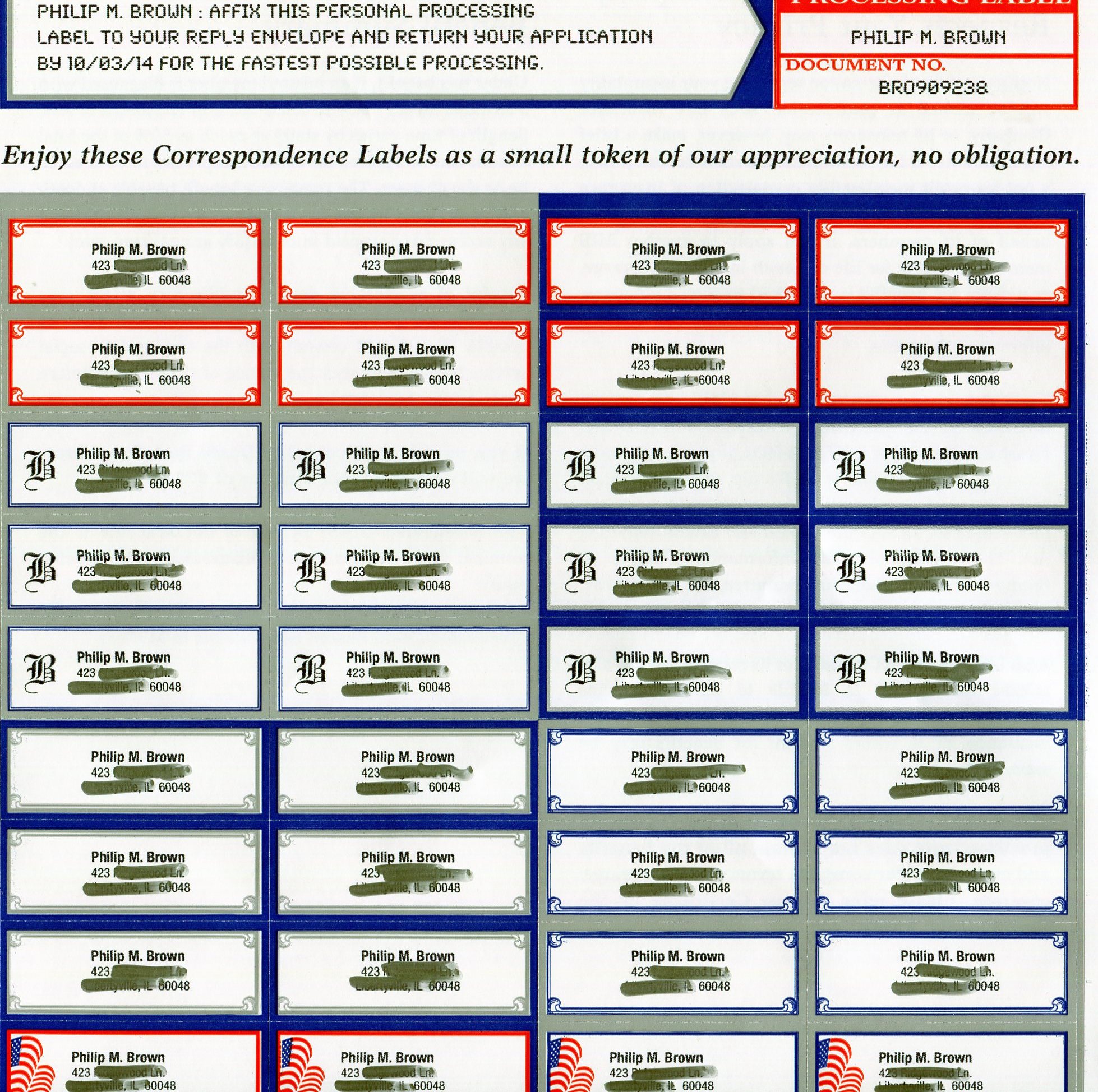
Labels. We will never have enough labels, really!

16.    My Thank You Gift.   This is what everyone looks for in the kit.   The unfoldable item.   Here, the gift is a set of address labels.

You know, there is a future for address labels that extends beyond mailing your next bill payment.

Address labels find themselves on everything portable: cell phones, laptops, tablets, phone batteries, cameras, dog collars, staplers, strollers and DVDs.   If it moves and it’s yours, it could use a label.   Warren Buffet may label every freight car of BNSF Rail some day.

AAA 2014-09-06 495

The reply envelope has two perfs. One for tearing, one for folding. Don’t mix them up!

17.   Lastly, a blue reply envelope with motherly reminders to sign and date your application and…AND… to affix your PERSONAL PROCESSING LABEL!

While you may think this is hokey, I bet you a dollar that AAA’s mail box is stuffed with reply envelopes that carry the label, regardless of its seeming irrelevance.   Why?  First, we don’t want to jinx our life karma.  And second, we like to play with sticky things. Honest.

One thing with the reply envelope– I wonder how many get destroyed by confused customers who tear off the wrong perforation.  white_scissors_u2704_icon_256x256A little scissors icon would help.

When reduced to ink on paper, insurance marketing is pretty staid, but consumer friendly.   What it lacks in emotional appeal it makes up in trustworthiness, as this kit demonstrates.   Most important, it didn’t try to sell; it assumed already that I was prepared to apply.

And that’s why it works.


Thanks for taking the time to get to here.   Please pass this along to your direct mail friends.  Thanks!


Standard
Marketing

Bridget, Goodbye

“Hello, this is Bridget.   This is an urgent call about your credit card account….”

Perhaps you’ve had the experience at least once in your life of blowing somebody off, sending them packing, ever so gently, but resolutely, with a well-rehearsed sayonara.

The Library of Congress has a whole wing devoted to archiving songs and scenes written about the countless techniques and art of saying goodbye.    Bogie melts the runway around Ingrid Bergman in Casablanca.   Arnold blasts away the T1000 in Terminator 2. Simon & Garfunkel raise the ante with “50 Ways To Leave Your Lover”.  The group Train meets that bet with a creative assembly of exits in “50 Ways To Say Goodbye”.

I am happy to reveal #51–  “Press 3”.

This is the specific and business-like instruction I received from Bridget, who has been throwing herself at me for an interminable period.

On the phone, poor girl– she was only trying to alert me about my credit card, urgently, mind you, that there was no emergency, but that I should speak with her immediately about my interest rates.  She did warn that it was my last chance to get in contact.   I could do that by Pressing “1”.

Through years of comprehensive training as a sales professional, I have always practiced the rule after a closing statement, “the first person to speak, loses.”    So, I clammed up.

regretAnd then Bridget caved: “To no longer receive these calls, press 3.”

Bam!

Just like that, I pounded the 3 button on our receiver, possibly pushing it so far up the line it would pop in Bridget’s ear somewhere in a basement call center in Atlanta.

In my mind’s eye, I saw her wince, blown out of her chair, frantically tearing off the headphone and ear piece.    Supervisors run over to pick her up, gaping at the smoking embers of telecommunications technology as it burns a hole in the carpet.

In the conning tower at the back of the darkened telemarketing center, controllers stare at their screens as the disconnect hits.   Lights dim only for an instant before the backup generators kick in.    Everyone is calm on the mezzanine level.   Down below, hundreds of units continue their work in the dimly lit, air-conditioned office cavern, oblivious.

Controller:   (Bbrzztchzt)  “Ray?  Unit 56 got a 3, Ray.   Can you fix it?”

Ray:  “Got it, C.   Looking it over now.  We’ll be up in a jif.”

Controller:  (Bbrrxwxschh)  “Tell me what you find.   We have a pool running up here.”

Ray:   “C, looks like 56 needs a trip to the shop.  It’s got a fingerprint etched right into its diagnostic display.”

Controller:   (Bbrrtyffszt)  “Hah!  ‘Like I figured.   That totals 235 today, my magic number.  It’s pay-up time everybody!”

Ray:   “C, you want I should shut this booth down?”

Controller:  (Bbrssttadx)   “No way.  Let’s double down, Ray.  Plug in 37, and boot her up.”

Ray:   “Got it.  I am powering it up now.”

The vast room’s gentle murmur resumes among the darkened honeycombs as Ray extinguishes his flashlight and follows the maze of hallways back to the control tower.

Unit 37 digs in for the night.

“Hello, this is Carmen.  This is an urgent call about your credit card account….”

Standard
direct mail, Economics, Marketing

Just Like Money

<<Spoiler Alert: The incredible reason why retailers flood our pockets with cash every day.>>

Mailbox Money

The mailbox delivers the green– for consumer and marketer alike.

We are having an outrageously good time with store coupons.  As we exit the mall, it takes a 50-pound anchor tied to our belts to stop us from running frantically, eyes over our shoulders, across the parking lot to our get away car.

Why?

Kohl’s, one of America’s most renowned stores, mails us $10 cash coupons with no strings attached.  “Just spend it!”

Hunh? 

"Here's a discount card, no wait, here's TWO discount cards!  Go shop!"

“Here’s a discount card, no wait, here’s TWO discount cards! Go shop!”

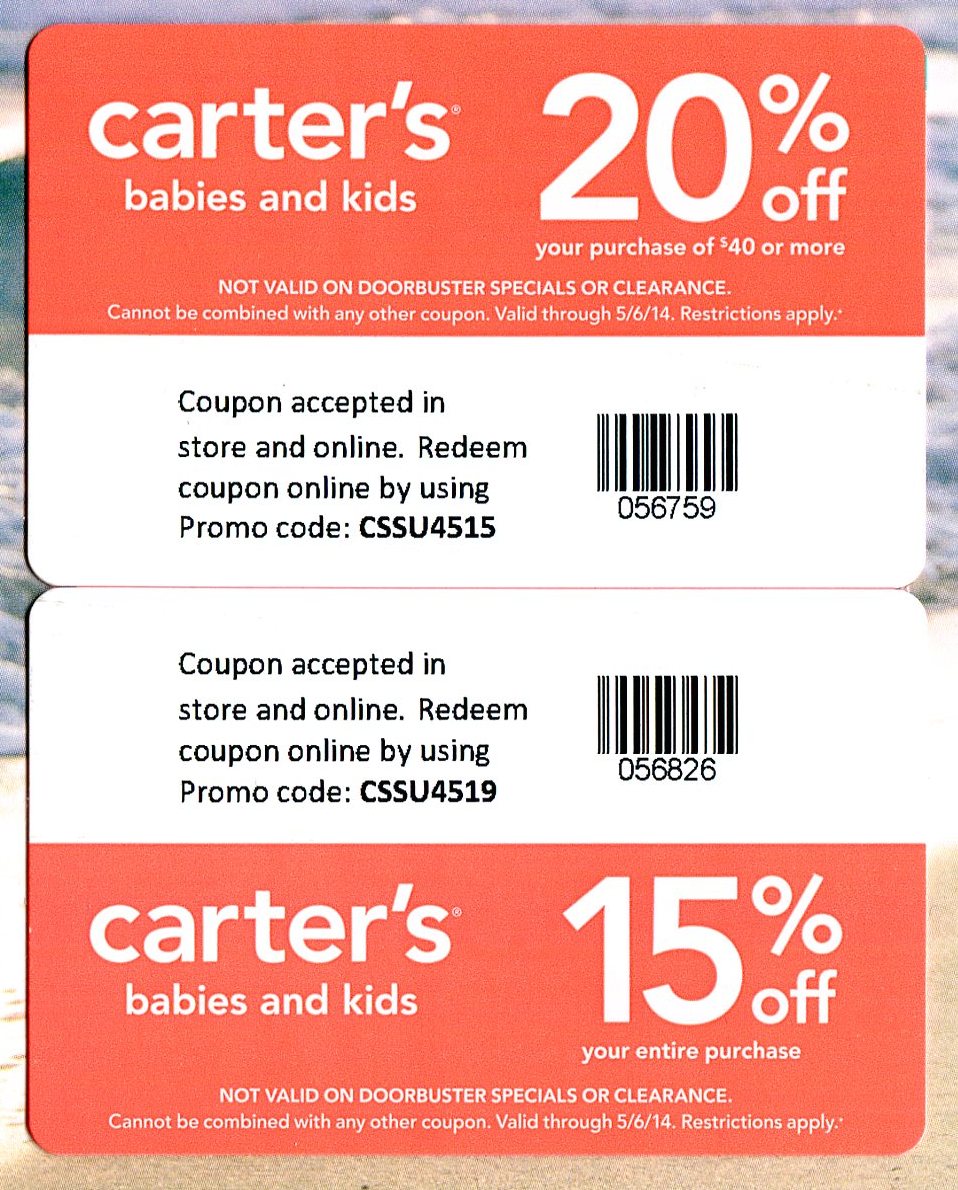
Carter’s throws in a 20% discount for a $40 purchase.  And another– 15% off everything, period.

Bed Bath & Beyond churns out $5 coupons faster than the U.S. Treasury, which is saying something.

Ulta hands us $3.50 just to spend $10.   We have enough conditioner for the entire cast of Muppet Movie 3.

BBBY coupons come so quickly we bale them.

BBBY coupons come so quickly we have to bale them.

For some, coupons are clutter in the mailbox.  For many, they reveal how weak we really are.  Despite our supposed disdain for direct mail, we read each coupon carefully…. and then sneak into the store late Sunday night with a fistful, and a bag over our head.

holeinpocket

‘Just can’t spend the coupon fast enough.

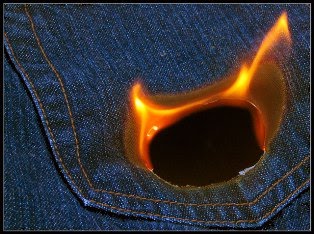
At our house, coupons are incendiary devices, capable of exploding into flames when placed in the pocket.

For instance, I am mailed a $5.00 rebate card from ACE Hardware.   The card sits between the salt and pepper shakers, Tasering me to rise from my chair, go to ACE and buy something, even a bag of sheep manure, just to use the money.

ace manure

Buy something— anything!

My wife is a coupon maven.  She gets the deal, but escapes the accompanying load-up the marketer hoped for.

For instance, that $10 cash gift from Kohl’s?   She tenders it, usually on a $20 item marked down to $10.00.  “Look honey:” she beams, “7 pairs of  underwear, for nothing!”   Totally void of guilt.   Butter would not melt in her mouth.

So how does the retailer really fare with these incredible deals?

Not bad, if you look at the right numbers.

CouponCabin.com does an excellent job of capturing all the publicized deals of a retailer.   It spins them back to any shopper savvy enough to ask for them online.   The company regularly totals results, and in the case of Kohl’s, reports the average shopping cart is $66.43 before $18.04 in coupon savings.  A 22% discount.    That’s a promotional cost, and it comes out of gross profit.

"Take this money, please!"

“Take this money, please!”

January 2014 Kohl’s gross profit margin was 36.49%….. 7 and 11 points better than Target and Walmart respectively.

Kohl’s cost of goods (COGS) was 63.51%.

So are the Kohl’s people nuts, or is this normal business to throw gobs of money out the window?

It boils down to how much Kohl’s will pay to get an extra visitor into the store.

Bottom line: a profit with every sale.

Bottom line: a profit with every sale.

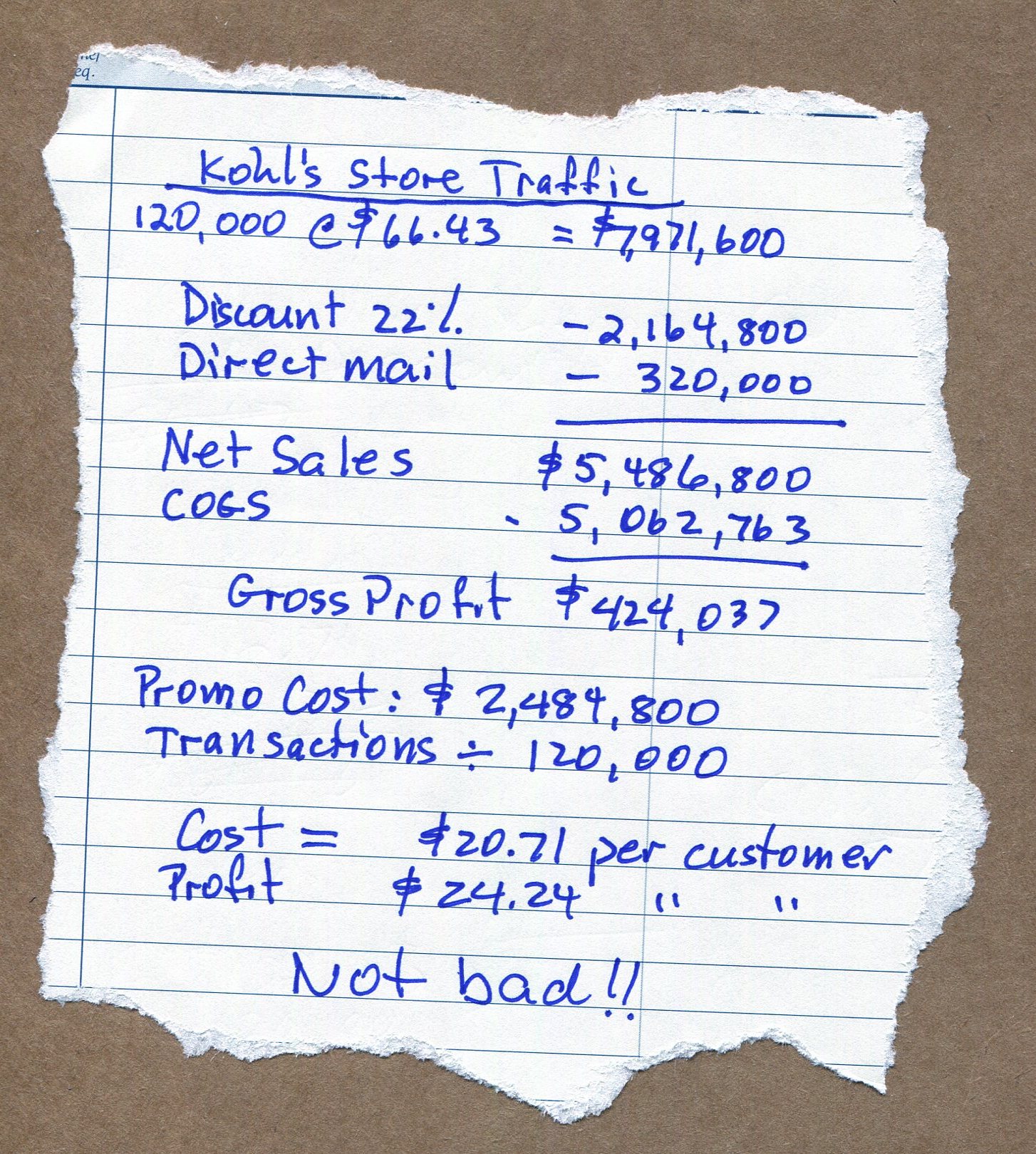
Say they mailed a 1,000,000 coupons, and 15% were redeemed.   150,000 purchases!   But set aside 30,000 purchases for those folks who would have bought the items anyway.   So the mailing generated 120,000 additional transactions, each with a shopping cart of $66.43.  That’s $7,971,600 in extra sales.   But the 22% discount takes away $2,164,800.  And subtract the mailing cost of $320,000.   Kohl’s is left with $5,486,800 cash to pay for the goods sold: $5,062,763 ($7,971,600 x 63.51% COGS).

Bottom line, Kohl’s promotion cost $2,484,800  and delivered $424,037 in extra profit. That is a 17.1% ROI.  Not bad.  You can’t run your whole business that way, but to generate extra sales and margin, still a pretty good day.

And here’s another perspective: the promotion delivered 120,000 extra store visits at a cost of $20.71 each.  And because the gross margin on each cart was $24.24 ($66.43 x 36.49%), Kohl’s did better than break even.

So that is why you find oodles of deals in your mailbox every week.   They work!

Boots

“Buy one, get one free!”

And my bottom line? I am looking for a deal on rubber boots.  To spread the sheep stuff.


If you got this far, I hope you took in all the math.  As with all retailers, these are big, scary numbers.   But well targeted direct mail makes them work.   Please share this article if you liked it!  Thanks.


Standard
direct mail, Marketing

Mayo Clinic: Right On The Money

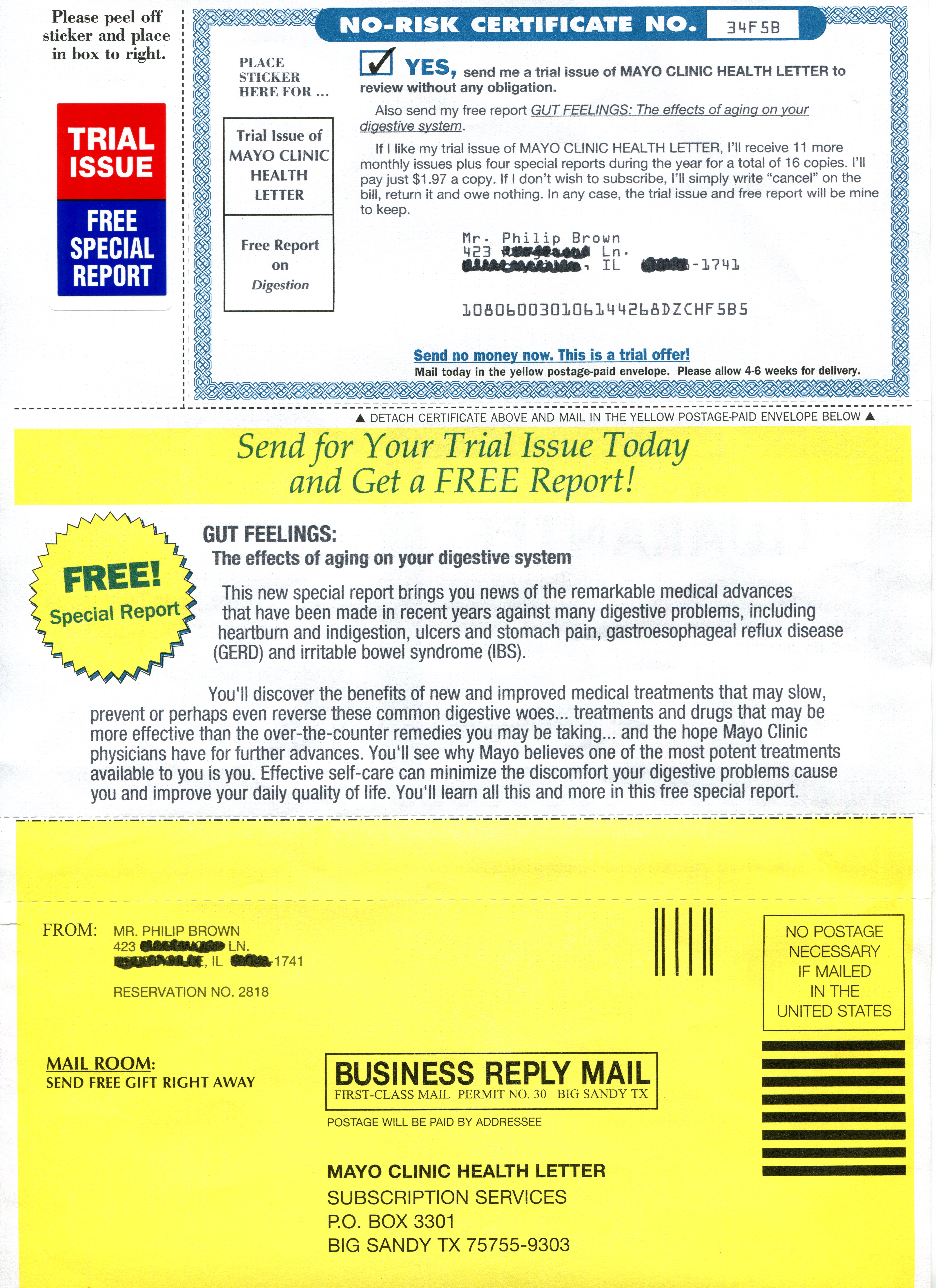
Smart, effective direct mail design comes from experience, and some times a lot of guts.    The Mayo Clinic Health Letter subscription kit is a classic example.   This masterpiece came to my mail box last month, and while the design may shake you, the numbers will knock you out.   Here’s why:

A Whopping Big Envelope

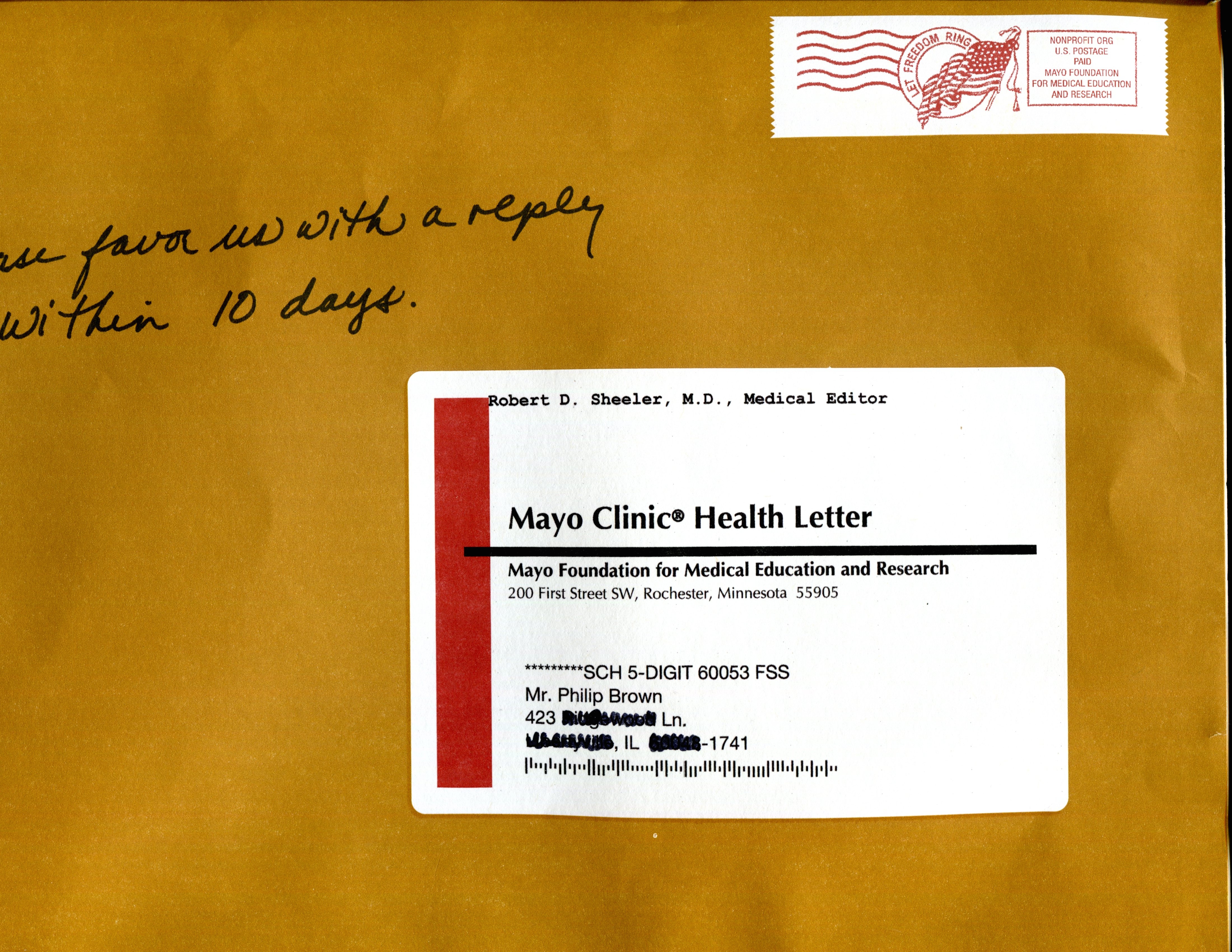
This one measures 10 x 14 inches.  Really??  Yes.   Why send a little #9 package when

Mayo OE

The envelope becomes the carrier for all the other letters delivered that day.

you can bury the mail carrier with a doormat?   To reinforce the mailing’s impact, the paper stock is nearly cardboard–you could chip a tooth on it–and it’s printed to look like kraft paper.

Creating the kraft look is just the beginning though. The address label is not real, but it is varnished to look like it, and as a special touch, this mass-produced kit has a postage meter label, except–that’s printed too.  The overall presentation says to the reader: “you need to open this now”.

My immediate reaction is:

1.   The Mayo accountants are taking blood pressure tests on both arms in the cafeteria, jabbing at their adding machines, looking for answers.

2.   USPS Postmaster Donahoe is toting up his winnings on this over-sized Flat mail piece.

Long On Words

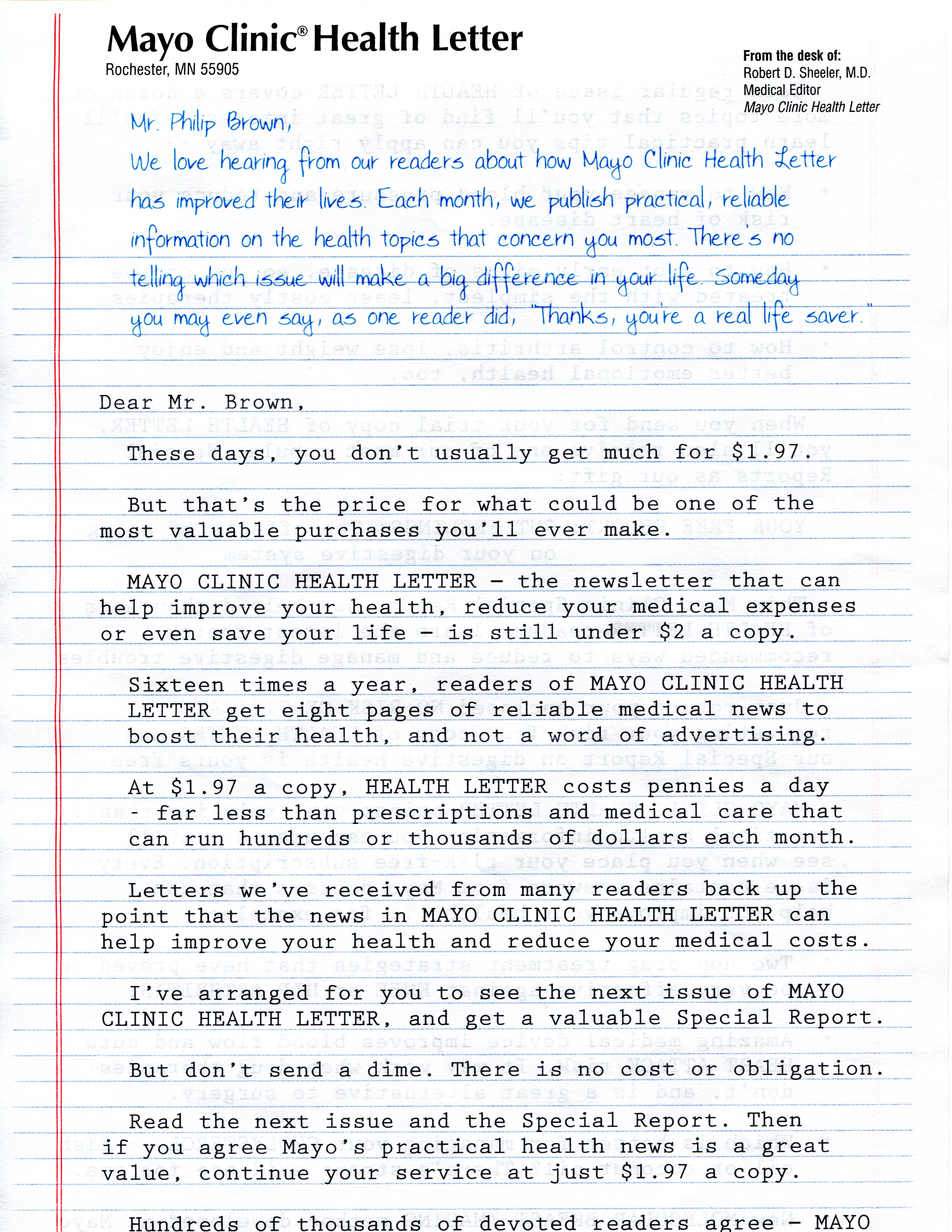
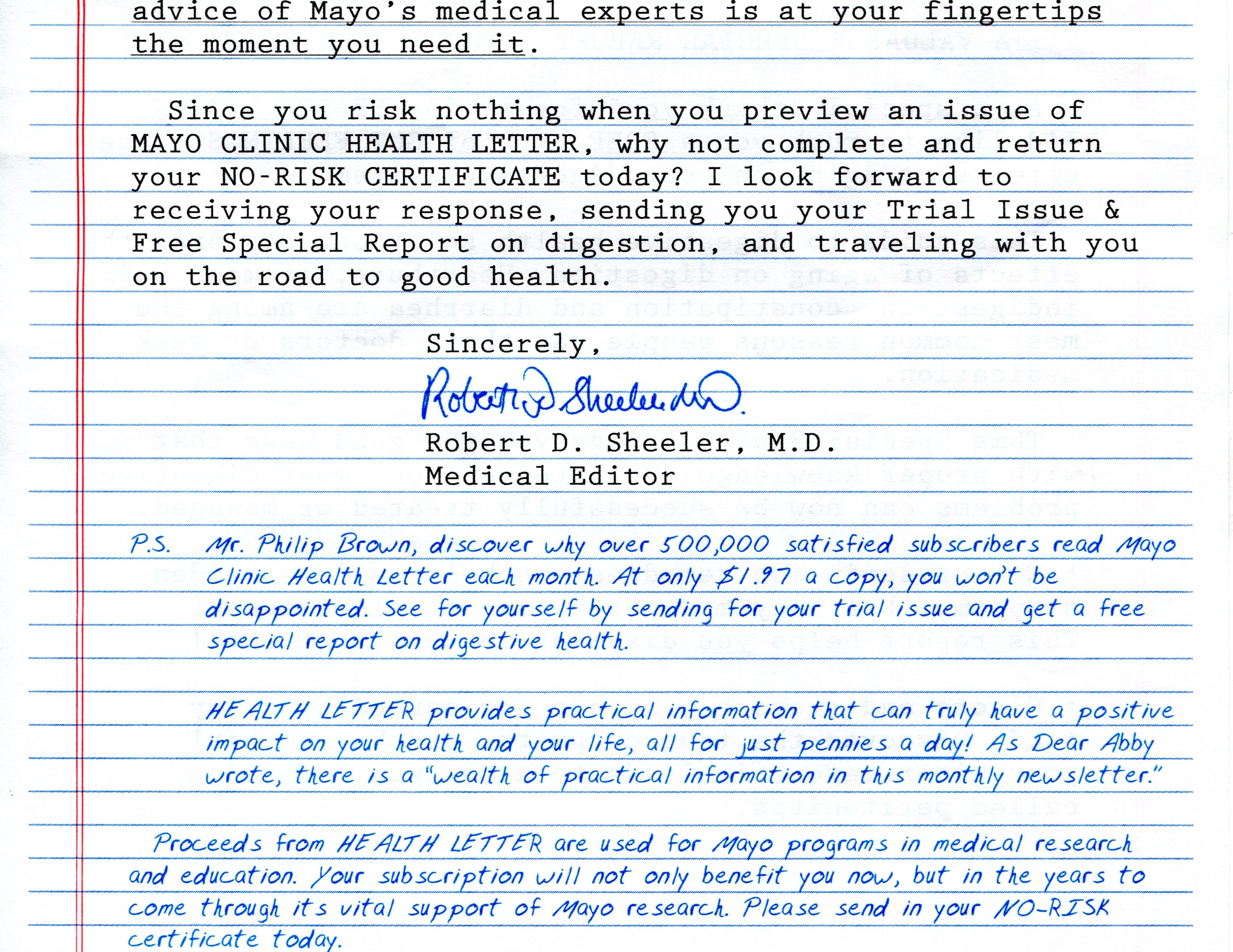
The extravagance continues inside.   I ripped open the zipper on the envelope to pull out the letter. 8 pages!   That’s four, 8-1/2 by 12-inch

The letter: a lifetime of Tweets.

The letter: a lifetime of Tweets.

sheets, printed front and back.  For you attention-deficient followers, that’s about 198 Tweets.   The CFO is banging out numbers to see how much waste was incurred by using 16-point type instead of 10-point.    Not to mention typing the letter on lined pages!

Nobody reads letters.  Well just about nobody.  Right?

Canary Yellow Reply Envelope

Subtlety doesn’t work in direct mail, even for Mayo.   We can’t just hide stuff in white reply envelopes when we can tell the world we probably have an urgent itch in a better-left-unmentionable place.   So there it is– a large bangtail order form I send back in this shout-it-out yellow BRE.

Yellow BREs never get mislaid.

Yellow BREs never get mislaid. And they get action, too.


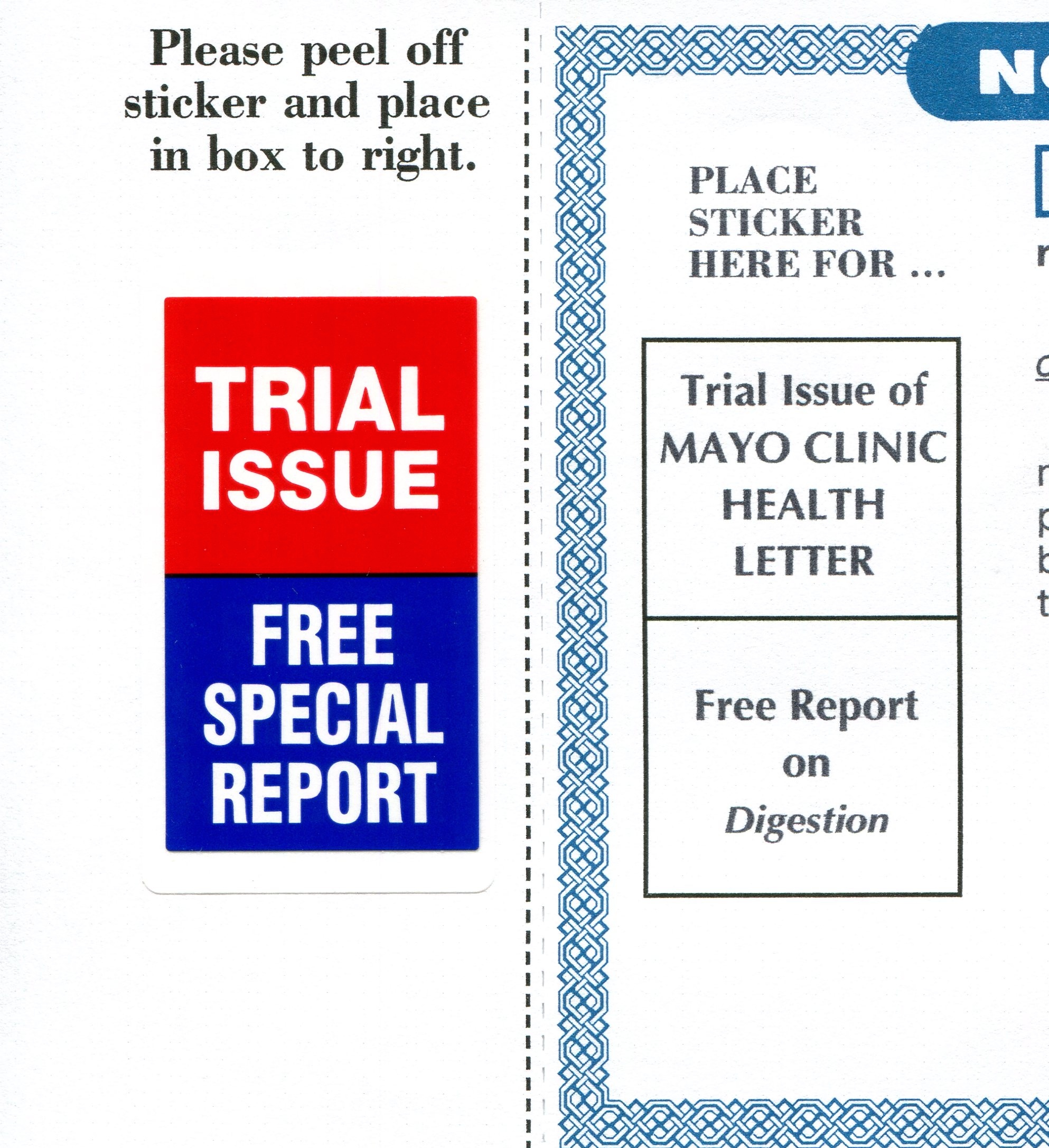
Stickers-just to keep it tactile.

Stickers-just to keep it tactile.

Stickers!

The ad agency downtown would never place a sticky label in a mail piece.   How corny.   Yet Mayo does this prominently and proudly, knowing that we can’t resist the temptation.  Does anyone really need to peel a “trial issue” label and stick it on the order form?   Of course we do.  There’s a sense of decisiveness and approval connected to the action, just like updating your car plate ever year.

It’s All About Me

What is irritatingly attractive is Mayo’s continual pandering to my ego.   They have hijacked my name.  Of course, they have it on the envelope, but it’s also on the letter.   And at the top of the letter is a handwritten note addressed to me.   Wow!

The P.S.--after 8 pages, there's still more to say!

The P.S.–even after 8 pages, there’s still more to say!

Again on page 8, up to which, yes, I read, there’s a P.S.  Also written to me.

As expected, the order form has my name, but they slapped it on the flaming yellow BRE just for good measure.

The Story Continues

To dispel any last doubts about the Mayo brothers, they have also included a brochure on the Mayo Clinic just in case I had been hiding in a duck blind too long.   Plus a Post-It note stuck onto the letter quoting readers who bragged about how the newsletter fixed their swollen joints, their riled digestion and unbending digits.

The family story fills in the cracks.

The family story fills in the cracks.

It’s About Making The Numbers

Any cognoscente in the advertising world would roll their eyes at this piece and grab another canapé off the awards dinner banquet table.   Mayo is not going to win a trophy any time soon.

That is because they are too busy depositing checks at the bank.    This package works because it takes enormous advantage of our curiosity.   If you are in the right demographic, you can’t ignore it.

Here are the numbers as I see them.  I have not confirmed with Mayo, but then again, they didn’t ask me either.

It's going to run into money!

It’s going to run into money!

List and production costs have to be at least $350/m. Postage for this Flat, $200/m.   This could be a 55-cent package, all-in.   By the way, while you thought the accountants might have been turning into jelly at that number, it is more likely they are quietly smiling while they top up the USPS Caps account.

Now, response rates.   1% is pretty much the norm, but this gargantuan kit, which includes a gift, could pull a 2% response, which again, I have not confirmed with Mayo.   At 2%, a 55-cent kit delivers a $27.50 acquisition cost. ($0.55/2% = $27.50).  Large, but actually about half of what any credit card sub would cost.   In any event, they wouldn’t do it if it didn’t work.

The Final Number

Medicine aside, Mayo still needs to return a positive cash flow, a.k.a. profit.   An annual subscription to this newsletter is basically $32.00.  Assuming a contribution of $8.00 per sub, Mayo needs to keep the average reader for 3-1/2 years to pay back the $27.50 acquisition cost.

But maybe not.  Because while these 50-year to 80-year-olds, approximately 500,000 of them, are perusing their newsletter, they are also biting on additional offers for Mayo’s entire library of publications. Enough to fill all the waiting rooms in Fort Myers, Miami and Scottsdale for years.

Even if the Mayo Clinic Health Letter program only breaks even, it is the gateway to a flood of peripheral revenues.

Mastering a standout program like the Mayo Clinic Health Letter didn’t happen over night.   These savvy marketers have tested into the present format.   In fact, it could be a test too.

But the numbers are still rewarding, if formidable.  And that’s where the guts come in.


Thanks for reading along on this.  Please let me know you liked it.  And share, too!


Standard
direct mail, Marketing, Media

Tempting The Fates: 21 Ways To Miss A Mail Date

Just taking the time to share a thought or two while rushing to the airport.   My apologies to all my faithful readers who wonder why they have to scan this post.   But I was a direct mail guy, and the tangled webs of direct mail production may well be a metaphor for life in general.

Calendar-date-circledFor mailers, timelines are tight, the post office has rules, and nobody sees your see emergency as their emergency.   The laws of physics trump all wishes to the contrary. This catechism of faux pas are all reminders of actual events.


How To Miss The Mail Date And Likely Disappear Into A Black Hole

1.   Start late.   The corollary: take up the wacky idea by your boss to be in the mail by Easter.

2.   Assume that three weeks is 21 days.   It is actually 15.

3.   Skip the research: the offer is so powerful only a knucklehead could goof it up.

4.   Pull in the Creative folks with a “team-building” challenge: just give them the offer and let them work out the rest.

5.   Demand copy, comps and layout before you settle on the budget.

6.   Demonstrate your economic intuition: estimate the numbers, response, cost, sales.  Don’t be scared by the unknowns; you are a visionary risk taker.   Guess!

7.    Lean on your list provider.   Maintain project secrecy.   Ask for competitor ideas.

8.    Once Creative gives you format design, get your Printer to price it.   Ask for competitor ideas.

designs-envelope-clean

9.    New Printer specs!  Get Creative to revamp copy.   Be firm with the deadline.  No dilly dallying, this is a mega opportunity.

10.   Flex your muscles. Go out to bid on print anyway.  Don’t tip your hand to the competition. Quantities should be secret.  Vague drop date.

11.    Don’t bug your lettershop with production schedule questions.

12.   A Power day for you!   Bless the newly found low-bid printer with their first order.   Advise impending drop date.  Quantities may go up.   Or down.

messy-desk

13.   Delay approving final art.   Experience has taught you that something could change later!

14.   You are a team player.  After rushing  final art approval, pass to Legal to keep them in the loop. (Noseyparkers!)

15.   Marketing brainstorm: boss adds a new version for a paper test.  No problem!

16.   Hold off approving printer’s proofs until Legal edits are changed on press.

17.    Advise the lettershop: a split run over two weeks.   Re-run list for goofy, inflexible postal demands.

18.    Ask your list house for more names.   Your boss wants to add his parents to the seed list.  No problem!

19.    Play hardball: hold off postage deposits with the USPS.

20.   Get proactive: advise your inbound phone center of the impending promotion.   Set up a separate meeting with the website folks.

21.    Share your wisdom with the new trainee: test the phone number.    When a “telephone dating service” answers, ask if you may borrow their number while your promotion runs.

I am sure that none of these instances have ever occurred in your career.  Lucky you!

I have to go now as there is an unaccountably stupid, long, glacially slow line-up in airport security today.

Be sociable! Share!

Standard
Marketing

Waste Not, Want Not

"It took its leave when somebody sneezed."

“It took its leave when somebody sneezed.”

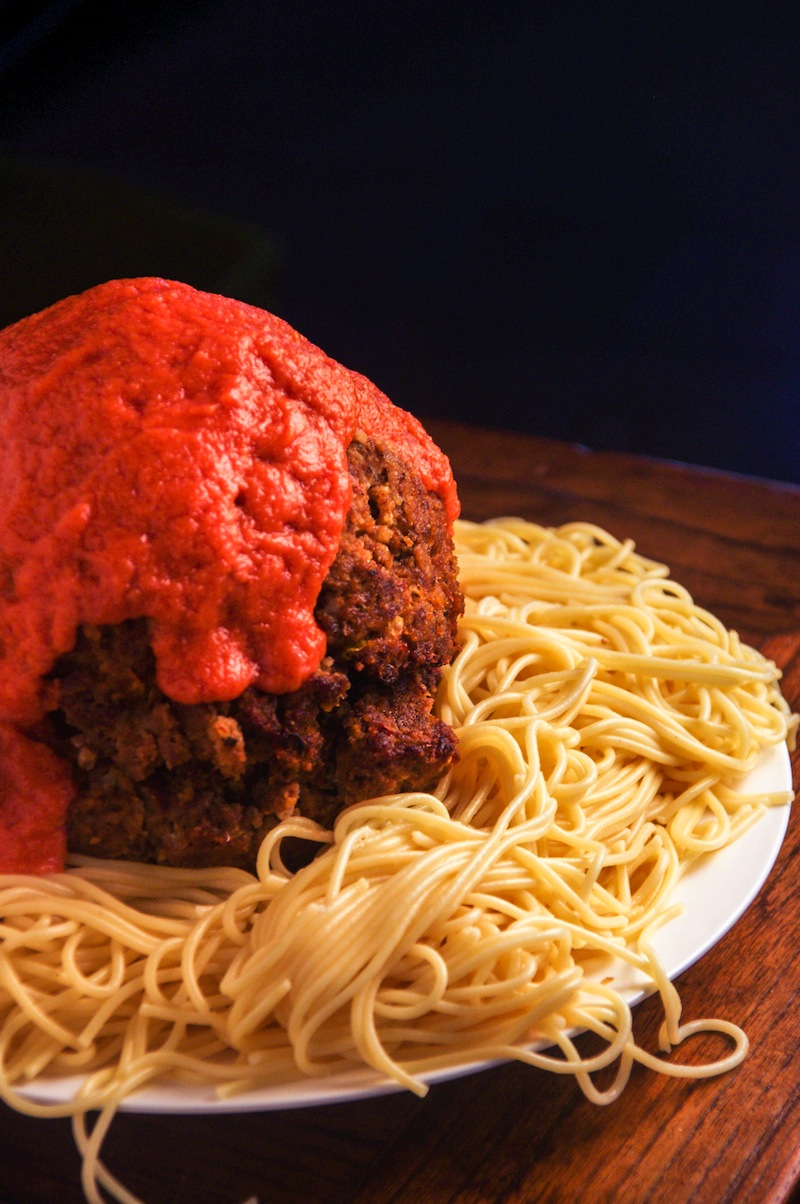
Did you find a few more fries hiding under your car seat lately?   What happened to that cheese sandwich you left on top of the DVR?    And that meatball you last saw on your plate: where did it roll to?   It made a break for it, and don’t be surprised.

The USDA just released their stomach-churning report on “Post-Harvest Food Losses in the United States – 2010”.   Apparently in that year we managed to misplace or otherwise not eat 133 billion pounds of food.    That’s nearly 67 million tons if you have trouble figuring.   Judging by the collective girth of America, I say kudos for us pushing back from the table early.

Minimalism: maybe the French had it right after all.

Minimalism: maybe the French had it right after all.

What is amazing is that in a nation overwhelmed by baby boomers, now retired and capable of eating full time, we just aren’t saving more food for later.   A random audit of any refrigerator should show freezer-burned remains of chicken pot pie served three weeks ago, buried tightly beside the bag of frozen peas which is regularly exhumed to chill granddad’s sore knee.

But it’s not.   Apparently we are throwing the stuff out.  The same report claims that 21% of our landfill is food.   Rather than cleaning our plates, we are scraping them, right into the garbage.

Multiplying and out of control.

Multiplying like Lego and out of control.

This concerning statistic explains the rising glut of empty food containers growing like giant, pale Lego –in the dark– under America’s kitchen  sinks.    Once we would have blamed this outgrowth on Tupperware– party central for the kitchen mavens.    Not any more.   Hold off on the pickle lifter.   Skip the deviled egg tray.    No one is saving leftovers any more.

This is a radical change from a civilization which used to save everything.   Archeologists have found 4,000-year-old bowls of noodles in China.   Carbon dating advises “best before” the Xia Dynasty.  

You can't throw out a good noodle.

You can’t throw out a good noodle.

In the arctic we are thawing out cartons of mastodon knuckles put away for a rainy day, but nowadays, nobody cares, because despite the microwave, we aren’t eating yesterday’s dinner anymore.

So we have a pair of statistics marching in lock step together.   Food waste up; empty containers up.  What to do?

Do NOT throw this out!

Do NOT throw this out!

A little more figuring leads to the sorry fact that every day, every person in America wastes a little over one pound of food.   With buns and condiments, that’s like throwing four Quarter Pounders into the bin!    Meanwhile, the USDA report points out that 49 million Americans live in “food-insecure” environments.  That is, there isn’t enough food, or not enough money to buy the food that is necessary to meet daily nutritional requirements.

Would it not be great if we could just set aside an extra plate with every meal we prepare, and pack its fare into one of those empty containers?   Pop these into the freezer, and once a week, drop them off at our grocery store for pick up by the local food bank!

Of course, you need to find the right top for the container.

Thanks for reading my rambling on our food conundrum.   FYI, Tupperware (TUP) is extremely successful today. In the past 5 years its stock is up 450% vs. the S&P’s 150%.    If you like this post, say so below, and be sociable: share it too.  Thanks!

PS: here’s the report.

The Estimated Amount, Value, and Calories of Postharvest Food Losses at the Retail and Consumer Levels in the United States,”

Standard
Marketing

Don’t Play With Your Food

It is so good to be at the top of the food chain.    I know, there are grizzly bears out there who would have us for lunch, but generally, we rule, I think.

But our supremacy causes some nutty behaviors.    I am thinking specifically of our advertising.

"I have this recurring nightmare..."

“I have this recurring dream…”

Let’s say we are promoting internet grocery shopping.      Concept:  a plump, naked guy scampering across the road, jogging down the sidewalk to the store.

Nope.   Too edgy for the after-school viewing. Let’s get a plump, naked chicken.   Oh yeah, take his head off, too.   That’s okay to show during the six o’clock news hour.

"This is the BEST picnic ever!"

“This is the BEST picnic ever!”

Or perhaps we are promoting an antacid to settle our stomach.   Concept:  a plump, naked, slow-roasted, headless man, playing doubles volleyball in the backyard.

Nope.   That’s a message endorsing tanning.  Surgeon General won’t like it. Let’s go chicken instead.   “Hey Marsha, see if you can get Roddy from the internet shopping commercial to audition…”

And logic-defying creative like this:   there’s a buffalo farm near us advertising its meat products.  And who’s making the pitch on the billboard?  A proud cartoon buffalo beaming down on us as we drive by, gazing at the bison in the pasture.

Chicken chef: fowl treachery!

Chicken chef: fowl treachery!

Been to a BBQ restaurant lately?   Notice the smiling pigs and cows on the napkins?    How about lovable Mrs. Leghorn offering up her fresh-laid children for breakfast?   No wonder PETA gets antsy.

It’s not all twisted though.

I point to our favorite duck -sorry, not you Donald– no, not you Daffy– but the celebrated pitchman who has won our hearts and minds for supplemental insurance coverage.   He shows how hard work, and a friend in the advertising business can get you somewhere.

"I took voice modulation too."

“I took voice modulation too.”

Could it be that this fellow started in insurance as an actuary?   And somebody in marketing called him up to the seventh floor for a talk?

"I was an extra on the Muppets.  But I was going nowhere."

“I was an extra on the Muppets. But I was going nowhere.”

And there’s the British import gecko.   May have been a driving instructor for the U.N. Consular Service until he realized his job had no meaning.   Went for a casting call for a pest control ad and ended up selling auto insurance.  They loved his accent.

Their futures are secure.  Unless the Food Network takes a shine to them.   Or Comedy Central.

Next thing you know– Concept: A duck, gecko and a rooster walk into a bar…


There’s a good punch line for this set up.   I hope you can supply it!   Thanks for reading, and please “like” or “share” below.  Thanks!

Standard
Marketing

Runny Numbers

DCIM100MEDIAI think we were all a bit startled by the recent alarm over the Velveeta shortage.   The fundamentals of human existence are oxygen, water, sunlight and Velveeta.   So the breathless announcement made at the peak of the football season provokes even the modest cheese nibbler to wonder: who got paid to leak that tidbit?   Line-ups at the Piggly Wiggly are around the corner.

crowds

Kraft executives estimate there are 40 million U.S. households which buy a Velveeta product every year.   They point proudly to this market as the Velveeta Nation.   Yet somehow, some way, they misjudged demand after owning Velveeta since 1927?

Fortunately, I have a solution in hand for the empty pantry, dear reader.   Government scientists can now fill the Velveeta gap without squeezing any additional cows.

algae-biofuel-pnlRecall, just last week, I alerted you to the stunning news that crude oil could be made quickly from sea algae.   How difficult can it be to divert some of the ersatz crude, rich in vitamins mind you, to be fracked into Velveeta?   Yes!  Science rules!

Quesa Supremo.   The Super Bowl can go on.

Putting out press releases like the Velveeta scare feeds consumer skepticism.   But the whopper of all time is being laid on us right now under the guise of an identity theft alert.    As you know, the nation’s retailer, Target, regretfully announced just before Christmas that their credit and debit card transactions had been hacked.  40,000,000 customers were vulnerable.

credit cards

I.T. is on the carpet.   The accountants are rifling through reports.   But up in the marketing department however, the story is being celebrated in the hallways.   “Forty million customers!   Hah!  Take that Costco!   How ’bout them apples, Walmart!!   Eat your heart out K-Mart!  See ya in the funny papers Kohls!”   It is a marketer’s dream to be the biggest and best, and Target has staked the claim.

40,000,000 customers is the envy of any retail chain.   But why stop there?calculating_costs

“Oh-oh!  OH-OH!!   Sorry, we got that wrong.   It’s actually 70 million customer accounts.   We have even more customers than we first said.    Call Associated Press!  Advise Congress!   Tell the networks!  Get this on the wire: it was 40 million cards, plus 70 million customer files… that’s 110 million  customers!!”   And sure enough, the media obliges with more breathless announcements and the new number.

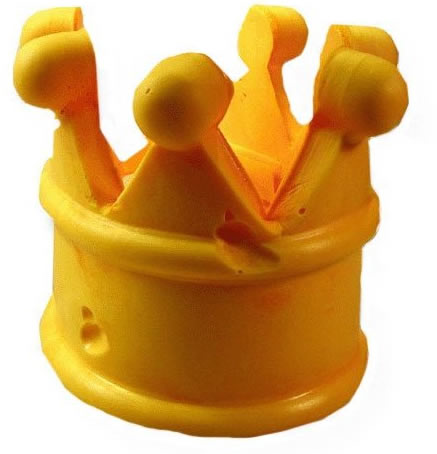
You know, the U.S. Census Bureau tells us that there are 317 million residents here in the country.   Deduct 76 million children, and there are 241,000,000 American shoppers available to Target.    The retailer tallied 46% of them as customers.  Wow!   Continental domination achieved. cheese crown

The IRS counts itself lucky to have 69 million paying customers.   I wonder how many like cheese?

Standard
direct mail, Marketing

Are You For Real?

SantaLetterText-776x1024“You have to write letters to get them,” said my 5th grade teacher as she drilled us on formatting.    What a drag.    At the uncomfortable age of 10 we had no one to write, let alone anything to say.

So it’s ironic that over half a century later I exit from a successful business which is all about writing good letters.

In direct mail, the letter is the backbone of building a personal relationship.  Avid consumers are enchanted by letters from their favorite gardener, doctor, hunter, dress maker, shopper, financier, teacher, traveller and coin buff  frothing over the latest gadget, find, or technique.

It’s no wonder direct mail grew astronomically through the back half of last century and into this one.    We were guaranteed to receive a letter at least once or twice a week with important news from somebody we knew, and who knew us, from far away, like Terre Haute, Fort Wayne, Franklin Center, Troy, West Babylon or Battle Creek.

But the bloom pales, if it doesn’t fall right off the rose if we discover that the writer doesn’t exist.    I was stunned when I learned that Readers Digest’s Carolyn Davis was just a beautification project — a makeover from “CD” for the Credit Department.
Betty Crocker in the Witness Protection Program

Betty Crocker in the Witness Protection Program

Carolyn was just my first commercial heartbreak.    I only recently learned that Betty Crocker, the lady who guided my mother through countless birthday cakes and blueberry muffins is a complete phony.   Never existed.    Isn’t even an anagram for an NSA operative named Cory Berckett… clandestinely stealing philo recipes while posing as a dishwasher.

Martha Logan modeled on Beth Bailey McLean

Martha Logan modeled on Beth Bailey McLean

The charade continues.   Martha Logan, who managed the Swift meat kitchen for a generation never existed, though at least she was a pen name for the real Beth Bailey McLean.

Ms. McLean was born in Superior Wisconsin in 1892 and knew her bacon.   But Swift’s ad agency apparently wasn’t satisfied with her creds.  They invented their own version of Martha Logan to broadcast from the Swift radio studios on Chicago’s WLS.

The Radio Martha Logan

The Radio Martha Logan

This new Martha had a photo portrait, and was reared and educated in Illinois, homeland of a long tradition of phonies.

Still, there’s one more fictional character, Beatrice Cooke.

Beatrice Cooke, queen of cream.

Beatrice Cooke, queen of cream.

She was the majordomo for Beatrice Foods, formerly the Beatrice Creamery Company, founded in 1894 in no, don’t say it, Beatrice, Nebraska.  That’s right, there never was a whiff of a Beatrice in that company unless she was lactating in a stable outside.   Adding the final insult, Beatrice moved to Iowa in 1905.

Which brings me to a quandary today.   On impulse, I made a donation to Wikipedia.   Totally guilt-ridden, I felt better after giving them a measly $10.    In response, I received a Thank You letter from Sue Gardner, executive director of Wikimedia Foundation.

Well, this wasn’t a Thank You letter.   It was a THANK YOU letter.  555 words, 14 paragraphs, 49 lines and 3337 keystrokes.   I winced in embarrassment.   Imagine dropping a few pennies into the Salvation Army bucket, and the bell ringer chases you down the crowded street crying thanks, before tackling you around the knees and blubbering all over your $900 cashmere wool coat.

scroogeMs. Gardner saw my paltry $10 funding the sum total of all world knowledge sought by countless individuals, and she began to describe the dire circumstances of each of them.

She concluded: “On behalf of the Wikimedia Foundation and the half-a-billion other Wikipedia readers around the world: thank you.”   

This was a “loaves and fishes” moment.   I did not guess my $10 would go that far.

Truly though, her letter did its job.   I have to return to Wikipedia, and I will no doubt double down on my charity.

But now I wonder– is she really there?

https://donate.wikimedia.org

Standard